

Public Administration: Understanding Management, Politics, and Law in the Public Sector 8th Edition Solution Manual
- Political Science
- 220 pages
- Shared May 2025
Public Administration: Understanding Management, Politics, and Law in the Public Sector 8th Edition Solution Manual is your guide to textbook mastery, offering detailed solutions to every chapter's exercises.
Preview 16 of 220 pages
See the first 16 pages exactly as they appear in the document.
Page 1 Read page 1 as text
1 Student: ___________________________________________________________________________ 1. Politics is salient to public administration because A. most public employees are hired on a partisan basis B. all administrative functions are highly political C. public administrators are involved in the public policy cycle D. all of the above 2. Which of the following is not a central value of the managerial approach? A. accountability B. economy C. effectiveness D. providing for political representation in public administration 3. According to the chapter, the political approach considers individuals as A. members of groups B. ill - informed C. interchangeable with one another D. all of the above 4. A good or service that individuals cannot be excluded from and that is not exhausted as more individuals use it is known as A. public interest B. public good C. public choice D. none of the above
Page 2 Page 3 Read page 3 as text
5. Unlike private firms, governments cannot readily A. go bankrupt B. dissolve C. seek lower labor costs in other geographic areas D. all of the above 6. Contemporary federalism in the United States is best characterized by A. a strict separation of federal from state functions B. subordination of the federal government to the states C. dependence of the state governments on the federal government for the administration of state programs D. dependence of the federal government on the states for implementation of federal programs 7. According to the chapter, which of the following is least valued by the political approach to public administration? A. representativeness B. responsiveness C. clear lines of administrative jurisdiction D. interest groups 8. The cognitive approach of the legal perspective is best described as A. theoretical B. social scientific C. inductive D. none of the above 9. According to the chapter, the legal approach treats individual intentions as A. subjective assessments B. objective facts C. always irrelevant D. always relevant
Page 4 Read page 4 as text
10. The judiciary's power to dispense with the harsh application of the law and adjust remedies to specific groups and individuals is known as A. adjudication B. equal protection C. due process D. equity 11. The U.S. Constitution A. comprehensively provides for federal and state public administration B. comprehensively provides for federal administration C. contains no provisions for public administration D. none of the above 12. According to the chapter, the best approach to public administration is A. managerial B. political C. legal D. none of the above is best 13. Which approach frowns upon using social classifications for the sake of analyzing and predicting individual behavior? A. traditional management B. New Public Management C. political D. legal 14. Osborne and Gaebler's idea that government should "steer, not row" is referring to their support of A. incremental decision making B. privatization C. deregulation D. benchmarking
Page 5 Read page 5 as text
15. Benchmarking A. encourages experimentation B. promotes results - oriented public administration C. permits greater flexibility D. all of the above 16. "Sunshine" provisions are most closely associated with which approach? A. traditional management B. New Public Management C. political D. legal 17. "Muddling through" refers to an incremental style of A. budgeting B. decision making C. organizing D. regulating 18. The public values of representation and transparency A. are equally relevant to the public and private sectors B. have differing relevance to the public and private sectors C. do not bear on the practice of public administration D. none of the above 19. According to the text, the New Public Management (NPM) approach is the best way to organize A. social welfare programs B. homeland security C. all of public administration D. none of the above
Page 6 Read page 6 as text
20. Which of the following could not be described as public or quasi - public good? A. small businesses B. a lighthouse C. homeland security D. public education 21. Which of the following is not associated with the traditional managerial approach to public administration? A. Max Weber B. Paul Appleby C. Woodrow Wilson D. Frederick Taylor 22. Public administration resembles private management in that A. it is profit - seeking B. it regulates the public at large C. it provides services D. none of the above 23. The public sector may favor contracting - out because A. private employees are generally more able than public employees B. contracting - out helps the public sector take better advantage of markets C. contracting - out always reduces costs D. all of the above 24. The legal approach to public administration is derived from A. administrative law B. judicialization of public administration C. constitutional law D. all of the above
Page 7 Read page 7 as text
25. Which of the following is not generally considered a feature of bureaucratic organizations? A. specialization B. impersonality C. hierarchy D. adjudication 26. Which of the following are considered advantages of collaborative government? A. government being able to benefit from the activities of private entities in reaching shared objectives B. promoting cost effectiveness by coordinating public administrative efforts with those of corporations and nonprofits C. taking advantage of private organizations' specialization, expertise, capacity, flexibility D. all of the above 27. The Separation of Powers doctrine was intended by the framers of the Constitution to promote efficiency in governmental operations. True False 28. The governmental obligation to promote the public interest distinguishes public administration from private management. True False 29. All public administrative organizations are bureaucratically structured. True False 30. The civil service reform movement of the nineteenth century tried to bring politics back into public administration. True False 31. Judicialization is the tendency for administrative processes increasingly to resemble courtroom procedures. True False
Page 8 Read page 8 as text
32. Rule of law embodies the central values of procedural due process, substantive rights, and efficiency. True False 33. Frank Goodnow developed the principles of scientific management. True False 34. Politics and administration are easily separable in modern governments. True False 35. The constitutional separation of powers facilitates administrative coordination. True False 36. The managerial and political approaches to public administration are sometimes in conflict with the legal approach. True False 37. For the most part, the Constitution does not regulate relationships between private parties. True False 38. The New Public Management approach maintains that government will be more responsive and efficient if it is compelled to react to market like forces. True False 39. The Ethics in Government Act of 1978 established "Sunshine" provisions. True False 40. Public administrators are not agents of the sovereign people and generally are not considered to hold the "public trust." True False 41. The incremental approach to budgeting is associated with the political approach to public administration. True False
Page 9 Read page 9 as text
42. Collaborative governance could potentially lead to the government losing the ability to provide a service itself. True False
Page 10 Read page 10 as text
1 Key 1. Politics is salient to public administration because A. most public employees are hired on a partisan basis B. all administrative functions are highly political C. public administrators are involved in the public policy cycle D. all of the above Accessibility: Keyboard Navigation David - Chapter 01 #1 2. Which of the following is not a central value of the managerial approach? A. accountability B. economy C. effectiveness D. providing for political representation in public administration Accessibility: Keyboard Navigation David - Chapter 01 #2 3. According to the chapter, the political approach considers individuals as A. members of groups B. ill - informed C. interchangeable with one another D. all of the above Accessibility: Keyboard Navigation David - Chapter 01 #3 4. A good or service that individuals cannot be excluded from and that is not exhausted as more individuals use it is known as A. public interest B. public good C. public choice D. none of the above Accessibility: Keyboard Navigation
Page 11 Read page 11 as text
David - Chapter 01 #4 5. Unlike private firms, governments cannot readily A. go bankrupt B. dissolve C. seek lower labor costs in other geographic areas D. all of the above Accessibility: Keyboard Navigation David - Chapter 01 #5 6. Contemporary federalism in the United States is best characterized by A. a strict separation of federal from state functions B. subordination of the federal government to the states C. dependence of the state governments on the federal government for the administration of state programs D. dependence of the federal government on the states for implementation of federal programs Accessibility: Keyboard Navigation David - Chapter 01 #6 7. According to the chapter, which of the following is least valued by the political approach to public administration? A. representativeness B. responsiveness C. clear lines of administrative jurisdiction D. interest groups Accessibility: Keyboard Navigation David - Chapter 01 #7 8. The cognitive approach of the legal perspective is best described as A. theoretical B. social scientific C. inductive D. none of the above Accessibility: Keyboard Navigation David - Chapter 01 #8
Page 12 Read page 12 as text
9. According to the chapter, the legal approach treats individual intentions as A. subjective assessments B. objective facts C. always irrelevant D. always relevant Accessibility: Keyboard Navigation David - Chapter 01 #9 10. The judiciary's power to dispense with the harsh application of the law and adjust remedies to specific groups and individuals is known as A. adjudication B. equal protection C. due process D. equity Accessibility: Keyboard Navigation David - Chapter 01 #10 11. The U.S. Constitution A. comprehensively provides for federal and state public administration B. comprehensively provides for federal administration C. contains no provisions for public administration D. none of the above Accessibility: Keyboard Navigation David - Chapter 01 #11 12. According to the chapter, the best approach to public administration is A. managerial B. political C. legal D. none of the above is best Accessibility: Keyboard Navigation David - Chapter 01 #12
Page 13 Read page 13 as text
13. Which approach frowns upon using social classifications for the sake of analyzing and predicting individual behavior? A. traditional management B. New Public Management C. political D. legal Accessibility: Keyboard Navigation David - Chapter 01 #13 14. Osborne and Gaebler's idea that government should "steer, not row" is referring to their support of A. incremental decision making B. privatization C. deregulation D. benchmarking Accessibility: Keyboard Navigation David - Chapter 01 #14 15. Benchmarking A. encourages experimentation B. promotes results - oriented public administration C. permits greater flexibility D. all of the above Accessibility: Keyboard Navigation David - Chapter 01 #15 16. "Sunshine" provisions are most closely associated with which approach? A. traditional management B. New Public Management C. political D. legal Accessibility: Keyboard Navigation David - Chapter 01 #16
Page 14 Read page 14 as text
17. "Muddling through" refers to an incremental style of A. budgeting B. decision making C. organizing D. regulating Accessibility: Keyboard Navigation David - Chapter 01 #17 18. The public values of representation and transparency A. are equally relevant to the public and private sectors B. have differing relevance to the public and private sectors C. do not bear on the practice of public administration D. none of the above Accessibility: Keyboard Navigation David - Chapter 01 #18 19. According to the text, the New Public Management (NPM) approach is the best way to organize A. social welfare programs B. homeland security C. all of public administration D. none of the above Accessibility: Keyboard Navigation David - Chapter 01 #19 20. Which of the following could not be described as public or quasi - public good? A. small businesses B. a lighthouse C. homeland security D. public education Accessibility: Keyboard Navigation David - Chapter 01 #20
Page 15 Read page 15 as text
21. Which of the following is not associated with the traditional managerial approach to public administration? A. Max Weber B. Paul Appleby C. Woodrow Wilson D. Frederick Taylor Accessibility: Keyboard Navigation David - Chapter 01 #21 22. Public administration resembles private management in that A. it is profit - seeking B. it regulates the public at large C. it provides services D. none of the above Accessibility: Keyboard Navigation David - Chapter 01 #22 23. The public sector may favor contracting - out because A. private employees are generally more able than public employees B. contracting - out helps the public sector take better advantage of markets C. contracting - out always reduces costs D. all of the above Accessibility: Keyboard Navigation David - Chapter 01 #23 24. The legal approach to public administration is derived from A. administrative law B. judicialization of public administration C. constitutional law D. all of the above Accessibility: Keyboard Navigation David - Chapter 01 #24
Page 16 Read page 16 as text
25. Which of the following is not generally considered a feature of bureaucratic organizations? A. specialization B. impersonality C. hierarchy D. adjudication Accessibility: Keyboard Navigation David - Chapter 01 #25 26. Which of the following are considered advantages of collaborative government? A. government being able to benefit from the activities of private entities in reaching shared objectives B. promoting cost effectiveness by coordinating public administrative efforts with those of corporations and nonprofits C. taking advantage of private organizations' specialization, expertise, capacity, flexibility D. all of the above Accessibility: Keyboard Navigation David - Chapter 01 #26 27. The Separation of Powers doctrine was intended by the framers of the Constitution to promote efficiency in governmental operations. FALSE Accessibility: Keyboard Navigation David - Chapter 01 #27 28. The governmental obligation to promote the public interest distinguishes public administration from private management. TRUE Accessibility: Keyboard Navigation David - Chapter 01 #28 29. All public administrative organizations are bureaucratically structured. FALSE Accessibility: Keyboard Navigation David - Chapter 01 #29
204 more pages in the full document
Unlock it once and it stays in your library, ready to chat with or turn into flashcards.
Unlock the full documentMore Political Science study materials
See all Exam Guides
California Politics: A Primer, 4th Edition Test Bank
Political Science
118 pages147downloadsFeb 2025 Exam Guides
Test Bank for Political Science: An Introduction, 14th Edition
Political Science
389 pages136downloadsFeb 2025 Exam Guides
Test Bank for Revel for Political Science: An Introduction , 14th Edition
Political Science
389 pages132downloadsFeb 2025 Exam Guides
Test Bank for Understanding Public Policy, 15th Edition
Political Science
233 pages47downloadsFeb 2025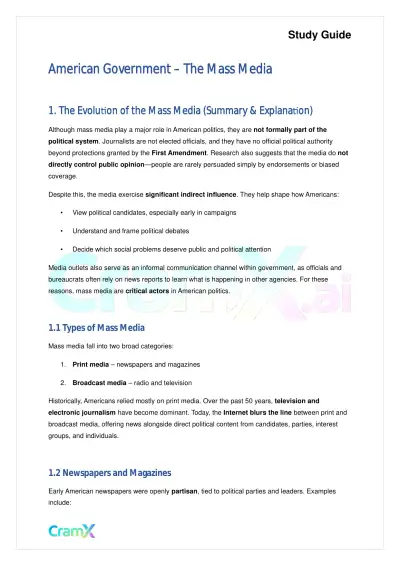 Quick Guides
American Government - The Mass Media
Political Science
11 pagesMar 2026 Solved Assignments
International Insecurity and the Use of Force in Darfur
Political Science
9 pagesMay 2025 Solved Assignments
Pieces of Legislation: Key Legislation Shaping the Union-Management Relationship
Political Science
8 pagesMay 2025 Solved Assignments
PAD-510 Position Paper Strayer University
Political Science
8 pagesMay 2025
Study this document with CramX
Once it is in your library, every tool can work from it.