

Revision Notes for Politics in America, 11th edition
- Political Science
- 816 pages
- Shared May 2025
Need to review lecture content? Revision Notes for Politics in America, 11th edition makes it easy with clear, concise notes summarizing each lecture.
Preview 16 of 816 pages
See the first 16 pages exactly as they appear in the document.
Page 1 Read page 1 as text
Instructor Resource Manual for Politics in America , 2016 Presidential Election Eleventh Edition Ronald Keith Gaddie Thomas R. Dye CLASS NOTES
Page 2 Page 3 Read page 3 as text
i Table of Contents How to Use This Instructor’s Manual vii Sample Syllabus i x Part I. Chapter Resources Chapter 1 Politics: Who Gets What, When, and How ................................ ........... 1 Chapter Overview 1 Lecture Suggestions 1 Class Activities 14 Research Activities 1 8 Participation Activities 2 1 Revel Features 22 Suggested Readings 2 6 Chapter 2 Political Culture: Ideas in Conflict ................................ ...................... 31 Chapter Overview 31 Lecture Suggestions 32 Class Activities 47 Research Activities 5 1 Participation Activities 5 4 Revel Features 5 4 Suggested Readings 59 Chapter 3 The Constitution: Limiting Governmental Power ............................. 6 3 Chapter Overview 6 3 Lecture Suggestions 6 3 Class Activities 9 2 Research Activities 9 8
Page 4 Read page 4 as text
ii Participation Activities 10 1 Revel Features 10 2 Suggested Readings 1 06 Chapter 4 Federalism: Dividing Governmental Power ................................ ..... 1 1 1 Chapter Overview 1 1 1 Lecture Suggestions 1 1 1 Class Activities 136 Research Activities 1 39 Participation Activities 1 4 1 Revel Features 14 2 Suggested Readings 1 47 Chapter 5 Opinion and Participation: Thinking and Acting in Politics ........... 1 5 1 Chapter Overview 1 5 1 Lecture Suggestions 1 5 1 Class Activities 1 69 Research Activities 1 74 Participation Activities 1 76 Revel Features 177 Suggested Readings 1 82 Chapter 6 Media , Politics, and Communication : Setting the Political Agenda? 1 86 Chapter Overview 1 86 Lecture Suggestions 1 87 Class Activities 211 Research Activities 214 Participation Activities 216 Revel Features 217 Suggested Readings 221 Chapter 7 Political Parties: Organizing Politics ................................ ................ 2 26
Page 5 Read page 5 as text
iii Chapter Overview 2 26 Lecture Suggestions 2 26 Class Activities 248 Research Activities 2 51 Participation Activities 2 53 Revel Features 254 Suggested Readings 2 59 Chapter 8 Campaigns and Elections ................................ ................................ . 2 6 3 Chapter Overview 2 6 3 Lecture Suggestions 2 6 3 Class Activities 2 8 4 Research Activities 2 87 Participation Activities 2 89 Revel Features 290 Suggested Readings 295 Chapter 9 Interest Groups: Getting Their Share and More ............................... 300 Chapter Overview 300 Lecture Suggestions 30 1 Class Activities 3 21 Research Activities 3 24 Participation Activities 3 27 Revel Features 327 Suggested Readings 3 32 Chapter 10 Congress: Politics on Capitol Hill ................................ ..................... 3 36 Chapter Overview 3 36 Lecture Suggestions 3 36 Class Activities 3 63 Research Activities 3 68 Participation Activities 3 71
Page 6 Read page 6 as text
iv Revel Features 372 Suggested Readings 3 76 Chapter 11 The President: White House Politics ................................ ................ 3 80 Chapter Overview 3 80 Lecture Suggestions 3 80 Class Activities 400 Research Activities 406 Participation Activities 409 Revel Features 410 Suggested Readings 414 Chapter 12 The Bureaucracy: Bureaucratic Politics ................................ ........... 419 Chapter Overview 419 Lecture Suggestions 419 Class Activities 4 38 Research Activities 4 41 Participation Activities 4 45 Revel Features 446 Suggested Readings 4 50 Chapter 13 Courts: Judicial Politics ................................ ................................ ..... 4 54 Chapter Overview 4 54 Lecture Suggestions 4 54 Class Activities 4 78 Research Activities 4 8 1 Participation Activities 4 84 Revel Features 486 Suggested Readings 4 90 Chapter 14 Politics and Personal Liberty ................................ ............................ 494 Chapter Overview 494
Page 7 Read page 7 as text
v Lecture Suggestions 494 Class Activities 518 Research Activities 521 Participation Activities 525 Revel Features 526 Suggested Readings 53 0 Chapter 15 Politics and Civil Rights ................................ ................................ .... 5 35 Chapter Overview 5 35 Lecture Suggestions 5 35 Class Activities 5 62 Research Activities 5 65 Participation Activities 5 68 Revel Features 569 Suggested Readings 5 75 Chapter 16 Politics and the Economy ................................ ................................ . 5 80 Chapter Overview 5 80 Lecture Suggestions 5 80 Class Activities 597 Research Activities 600 Participation Activities 602 Revel Features 603 Suggested Readings 607 Chapter 17 Politics and Social Welfare ................................ ................................ 612 Chapter Overview 612 Lecture Suggestions 612 Class Activities 631 Research Activities 634 Participation Activities 6 37 Revel Features 638
Page 8 Read page 8 as text
vi Suggested Readings 6 43 Chapter 18 Politics and National Security ................................ .......................... 6 47 Chapter Overview 6 47 Lecture Suggestions 6 47 Class Activities 6 72 Research Activities 6 75 Participation Activities 6 78 Revel Features 679 Suggested Readings 6 83 Part II. Teaching Essays Essay 1 Implementing Deliberative Civic Education: Persuasion and Skill Building by J. Cherie Strachan ................................ ................................ ...................... 688 Essay 2 From Chalkboard to Chat Room: Making the Transition to Online Instruction to American Government by Bradley Dyke ................................ .............. 700 Essay 3 Using Technology to Engage in Large Classroom Settings by Sh erri L. Mora and Tom Miles ................................ ................................ .............................. 712 Essay 4 Group Projects: Collaborative L earning in Introductory American Government Classes by Eric Cox ................................ ........................... 724 Essay 5 From Civic Engagement to Informed Advocacy by Michelle Lorenzini ................................ ................................ ................. 741 Essay 6 Interactive Lesson Plans for American Government: A Political Science Instructor’s Challenge by Deann e Repetto ................................ ................ 758 Essay 7 Making the “A Word” Work for You: Assessment in American Government by Victoria A. Farrar - Myers ................................ ................................ ........... 7 73
Page 9 Read page 9 as text
vii How to Use This Instructor’s Manual Overview This instructor’s manual provides a comprehensive roadmap for teaching classroom, online, or hybrid courses. Designed for new and experienced instructors, the Instructor’s Manual includes a sample syllabus, lecture suggestions, class activities, research a ctivities, participation activities, Revel Features, suggested readings, and essays on teaching American Government. Resources Sample Syllabus. Each instructor’s manual includes a syllabus that provides suggested assignments from American Government . This syllabus can be modified easily to fit your individual and institutional requirements. Lecture Suggestions. This manual includes lecture suggestions arranged according to the order of each chapter and its learning objectives. These suggestions hel p instructors create lectures that cover the main concepts of each chapter. Class Activities . Each chapter includes ideas for group exercises and class discussions instructors; these are designed to encourage critical analysis of the key concepts covered in the lecture suggestions. Research Activities. Every chapter includes research activities that focus on honing student’s research skills. These activities include position papers, bibliographies, book reviews, data research and analysis papers, media analysis papers, and response papers. Participation Activities . Each chapter includes participation activities that focus on promoting political engagement and encouraging student reflection on their participation in the political process. Revel Featur es. Each chapter contains modules including videos, social explorers, applications, journal prompts, shared writing prompts, simulations, and quizzes related to specific learning objectives. Suggested Readings . Each c hapter concludes with a list of sugge sted readings. These readings include books, journals, articles, and websites that would be helpful for instructors to consult in
Page 10 Read page 10 as text
viii preparation of their syllabus or for students doing additional research. Each suggested reading is annotated with an explanati on of the significance and usefulness of the reading. Teaching Essays . A collection of essays on teaching American government authored by seasoned American government instructors is included with this instructor’s manual. These essays deal with common in structor concerns, such as how to teach online courses, how to assign and evaluate group projects, and how to create interactive lessons. Using the Instructor’s Manual with Other Pearson Resources PowerPoint Presentation with Learning Catalytics . These PowerPoints provide a full lecture outline and script with all the photos and figures from the book. Use the PowerPoint presentation in conjunction with this manual’s lecture suggestions and class activities. To download the PowerPoint presentatio n, go to www.pearsonhighered.com . After signing up for an instructor account on the website, log in and search by the book ISBN, book title, or author last name. Under the resources tab for the book, download the PowerPoint presentation by chapter. Test Bank. After you have taught students to master concepts of American Government, test their understanding and knowledge by assigning questions from the test bank. Test bank questions test knowledge, understanding, application, and analysis, so that you can evaluate your students at every level. This test bank is available in Word, MyTest, Blackboard, WebCT, and Respondus.
Page 11 Read page 11 as text
ix SAMPLE SYLLABUS POLITICS IN AMERICA Course Overview The goal of this course is to familiarize students with the structures, functions, and processes of American government. We will explore the philosophical and historical roots of American politics, the three branches of government, and various political i nstitutions like the media and political parties. By the end of the course, you should be able to do the following: Explain how government impacts your daily life. Recognize and evaluate the basic debates and issues in government and political history in the United States. Explain and critically assess the formal and informal political institutions, and their respective roles, in American politics. Identify and describe the key functions of the three branches of government. Assess the causes and consequen ces of different forms of political participation, and outline the ways in which individuals and groups can affect political outcomes in the United States. Required Texts. Thomas R. Dye and Ronald Keith Gaddie. Politics in America, 2012 Election Edition. (New York: Pearson). Course Calendar Week 1. Politics and Political Culture Learning Objectives: 1.2: Compare and contrast governmental politics with politics in other societal organizations. 1.6: Compare and contrast representational government and di rect government. 1.7: Show how elitism and pluralism reach different conclusions about who governs in America. 1.8: Evaluate the implications of the elitist and pluralist views for the realization of American democratic ideals. 2.1: Define the concept of political culture. 2.4: Characterize the trends affecting the current distribution of wealth and income and analyze the relationships among social mobility, inequality, and class conflict. 2.8: Differentiate various political ideolog ies that depart from conservatism and liberalism. Text: Dye, et al., Chapters 1 and 2 Week 2. The Constitution and Federalism
Page 12 Read page 12 as text
x Learning Objectives: 3.3: Outline the principles on which the Founders were in agreement and characterize their areas of conflict. 3.5: Explain how the Constitution structured the new government. 3.6: Analyze the separation of powers and the checks and balances established by the Constitution. 3.8: Assess the protections provided by the Bill of Rights and determine the vario us means through which the Constitution may be changed. 4.1: Distinguish the federal form of government from confederal and unitary forms and evaluate the arguments in favor of federalism. 4. 4 : Trace the evolution of American federalism , and describe how t he use of federalism leads to theories of political behavior . 4.6: Explain how federal grants impact the distribution of power between the federal and state governments , and assess the impact of coercive federalism on state - national relations . Text: Dye, et al., Chapters 3 and 4 Week 3. Public Opinion and Political Participation Learning Objectives: 5.2: Explain how the agents of socialization influence the development of political opinions. 5.3: Determine the role of ideology in shaping opinion and describe the relationship between gender, race, and opinion 5.4: Assess how and to what extent public opinion influences public policy making. 5.5: Identify the various ways in which a citizen may participate in politics , and trace the expansion of the rig ht to vote . 5. 6 : Analyze the political and demographic factors that influence voter turnout and asses the consequences of nonvoting. 5. 7 : Characterize protest as a form of political participation. Text: Dye, et al., Chapter 5 Week 4. The Mass Media Learning Objectives: 6.1: Identify functions and components of the media. 6.3: Describe the business of the media , and assess how the politics of the media are shaped by their economic interests, environment, and ideological leanings. . 6.5: Analyze the rol e of the media in shaping campaigns and elections. 6.6: Distinguish between freedom of the press and fairness of the press. 6. 7 : Assess the effects that the media have on public opinion and political behavior. Text:
Page 13 Read page 13 as text
xi Dye, et al., Chapter 6 Week 5. Political Parties Learning Objectives: 7.1: Show how the relationship between organization and political power explains political parties and interest groups. 7.2: Differentiate the three political arenas in which the parties battle. 7. 4 : Trace changes in political parties over the course of American history. 7. 5 : Outline the functions and perceptions of the two major American political parties, explain how they are financed, and assess their changing role in the electoral process. 7.7: E valuate the role of third parties within the U.S. electoral system. 7.8: Determine why the American two - party system has persisted. Text: Dye, et al., Chapter 7 Week 6. Campaigns and Elections Learning Objectives: 8.1: Evaluate the role of elections in American democracy. 8.2: Characterize the various factors that motivate people to pursue a political career. 8.3: Explain the advantages of incumbency. 8. 5 : Identify the main components of campaign strategies. 8. 6 : Analyze the role of money in campaigns, i dentify the major sources of funding, assess the motivations of contributors, and evaluate efforts to regulate campaign finances. 8. 7 : Outline candidates’ strategies for primary races and the general election 8. 8 : Assess influences on voters’ choices. Text: Dye, et al., Chapter 8 Week 7. Interest Groups Learning Objectives: 9.1: Explain the origins, functions, strengths, and weaknesses of the interest - group system in America. 9.2: Characterize the interests represented by organized interest groups lobbying in Washington. 9.3: Explain how interest - group leaders create and build organizations. 9.4: Describe the overall environment of lobbying in Washington, and identify the main activities of lobbyists. 9.5: Outline the development, role, and structur e of political action committees.
Page 14 Read page 14 as text
xii 9.6: Assess the relationships between interest groups and bureaucratic agencies, and identify ways in which interest groups seek to influence the federal court system. 9.7: Evaluate different positions on the consequences of interest groups for American democracy. Text: Dye, et al., Chapter 9 Week 8. The Congress Learning Objectives: 10.1: Explain the sources of Congress’s power. 10.2: Explain the processes of congressional apportionment and redistricting, and assess how representative Congress is of the general population. 10.3: Describe congressional elections and organization, and characterize the working life of a member of Congress . 10.4 : Evaluate the successes and failures of the two parties in Congress. 10.5: Characterize the legislative work of committees and assess the repercussions of committees for distribution of power in Congress. 10.6: Outline the process for a bill that ha s reached the floor and identify obstacles to passage. 10.7: Assess the influences on congressional decision making. Text: Dye, et al., Chapter 10 Week 9. The Executive Branch: The Presidency and the Bureaucracy Learning Objectives: 11.1: Identify the p owers and responsibilities of the president. 11.3: Assess the sources of the president’s political power and analyze how presidents’ personality and policy positions affect their approval ratings. 11.8: Characterize the roles and responsibilities of the vi ce president. 12.1: Assess the nature, sources, and extent of bureaucratic power. 12.2: Describe the types of agencies in the federal bureaucracy and the extent and purposes of the bureaucracy. 12.3: Trace changes over time in the size and composition of t he bureaucracy and assess the repercussions for democracy. 12.8: Summarize the constraints that Congress can place on the bureaucracy. Text: Dye, et al., Chapters 11 and 12
Page 15 Read page 15 as text
xiii Week 10. The Courts Learning Objectives: 13.1: Assess the basis for and use of judicial power. 13.2: Compare and contrast the philosophies of judicial activism and judicial restraint. 13.4: Characterize the “special rules” of judicial decision making. 13.5: Assess the role of politics in the judicial selection process. 13.7: Assess t he role of politics and ideology in Supreme Court decision making. 13.8: Evaluate checks on Supreme Court power. Text: Dye, et al., Chapter 13 Week 11. Civil Liberties and Civil Rights Learning Objectives: 14.1: Outline the Founders' views on individual liberty and trace the expansion of the Bill of Rights. 14.8: Identify the constitutional rights of criminal defendants and assess the consequences of their implementation. 15.1: Assess the role that politics played over the centuries in America’s quest fo r equality, and analyze how the Constitution was interpreted to first justify and then attack slavery and segregation. 15.2: Differentiate the various meanings of equal protection of the laws. 15.3: Outline major civil rights legislation. 15.8: Determine h ow the 14th Amendment has been interpreted regarding gender equality and describe the policy issues arising from sex. Text: Dye, et al., Chapters 14 and 15 Week 12. Public Policy Learning Objectives: 16.1: Compare politics and economics as decision - making systems. 17.3: Outline major social welfare programs in the United States. 17. 6 : Analyze the role of politics in welfare reform. 17. 7 : Compare the United States and other nations on health care expenditures and measures of health care, and describe the nation’s major health care programs. 18.1: Describe the ways in which nations have attempted to bring order to international politics. 18. 6 : Describe the nature of terrorism and the U.S. response to terrorism. Text:
Page 16 Read page 16 as text
xiv Dye, et al., Chapters 16 - 18 Welcome to Revel Welcome to the Revel edition of Politics in America, by Ronald Keith Gaddie and Thomas R. Dye. The Revel edition offers the same narrative content as the print textbook but with a major advantage: integrated media interactives and assessments allowing students to engage with the material through hands - on applications. This immersive educational technology boosts student engagement, which leads to better understanding of concepts and improved performance throughout the course. All chapters begin on an introductory screen with a current events bulletin and learning objectives. The chapter - specific learning objectives outline the pedagogical goals of the chapter.
800 more pages in the full document
Unlock it once and it stays in your library, ready to chat with or turn into flashcards.
Unlock the full documentMore Political Science study materials
See all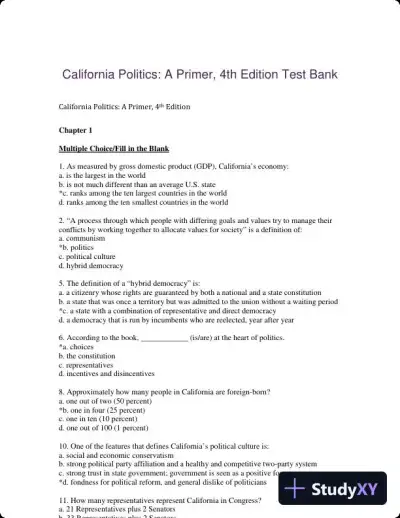 Exam Guides
California Politics: A Primer, 4th Edition Test Bank
Political Science
118 pages147downloadsFeb 2025 Exam Guides
Test Bank for Political Science: An Introduction, 14th Edition
Political Science
389 pages136downloadsFeb 2025 Exam Guides
Test Bank for Revel for Political Science: An Introduction , 14th Edition
Political Science
389 pages132downloadsFeb 2025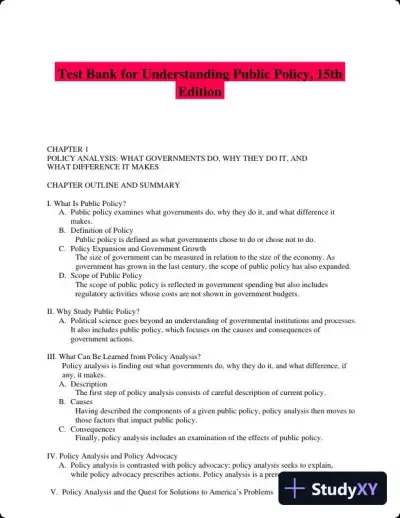 Exam Guides
Test Bank for Understanding Public Policy, 15th Edition
Political Science
233 pages47downloadsFeb 2025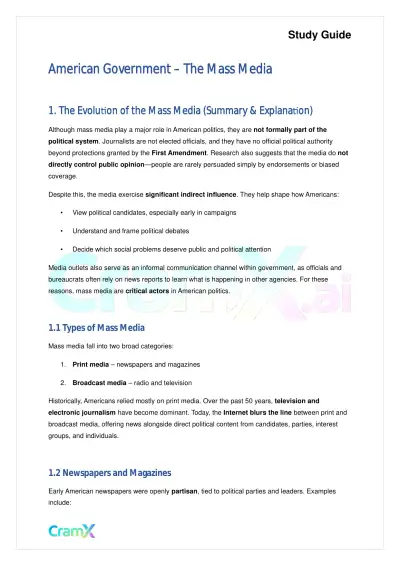 Quick Guides
American Government - The Mass Media
Political Science
11 pagesMar 2026 Solved Assignments
International Insecurity and the Use of Force in Darfur
Political Science
9 pagesMay 2025 Solved Assignments
Pieces of Legislation: Key Legislation Shaping the Union-Management Relationship
Political Science
8 pagesMay 2025 Solved Assignments
PAD-510 Position Paper Strayer University
Political Science
8 pagesMay 2025
Study this document with CramX
Once it is in your library, every tool can work from it.