

The Role of Non-State Actors in Shaping Foreign Policy: Analyzing Their Influence on Terrorism, Trade, and International Relations
- Political Science
- 3 pages
- Shared May 2025
This document examines the impact of non-state actors on foreign policy, terrorism, and international trade.
Preview 2 of 3 pages
See the first 2 pages exactly as they appear in the document.
Page 1 Read page 1 as text
The Role of Non - State Actors in Shaping Foreign Policy: Analyzing Their Influence on Terrorism, Trade, and International Relations "Non - State Roles" Please respond to the following: From the second e - Activity, examine the overall roles of the Non - State participants within a current event that requires a foreign policy on terrorism to be developed. Provide a rationale for your response. Since the closing of the 19th century the middle class has emerged into the largest class in our society. With the four previously discussed policies, or ideals in place, the middle class would improve and become stronger, which it has. Otherwise, without protection of U.S. foreign policy, our nation’s economy and power would deflate, sinking the middle class to becoming a poor working class. Fortunately, our nation’s leaders sought to protect and uphold foreign policy throughout the decades, and as a result turned our society into one built on the foundations of the middle class. Emphasizing diligence in work and in savings, daily life lived on a strong moral basis, and education as the key to economic success, which has emerged into the cornerstone of the U.S. and its people throughout the twentieth century. President Obama has committed himself and his Administration from the beginning of his presidency to a foreign policy that ensures the safety of the American people. But he also refuses the false division between our values and our security; the United States can be true to our values and ideals while also protecting the American people. We will use all elements of American power to achieve objectives, and consult closely with the Congress so that our policies may have the broad and bipartisan support that makes them most effective. Finally, while there are instances and individuals who can be met only by force, the United States will be prepared to listen to and talk with our adversaries in order to advance our interests. Refocusing on the Threat from al Qaeda in Afghanistan and Pakistan Following an intensive 60 - day interagency review, on March 27, 2009, the President announced a new strategy with a clear and focused goal: to disrupt, dismantle, and defeat al Qaeda in Pakistan and Afghanistan, and to prevent their return to either country in the future. The strategy is comprehensive and flexible and will need to be fully resourced. In addition to the new troops the President has chosen to deploy, the strategy calls for significantly more resources to the civilian effort and frequent evaluations of our progress. Responsibly Ending the War in Iraq On February 27, 2009, President Obama announced a plan to responsibly end the war in Iraq. By August 31, 2010, our combat mission in Iraq will end and Iraqi Security Forces will have full responsibility for major combat missions. After August 31, 2010, the mission of United States forces in Iraq will fundamentally change. Our forces will have three tasks: train, equip, and advise the Iraqi Security Forces; conduct targeted counterterrorism operations; and provide force protection for military and civilian personnel. The President intends to keep our commitment under the Status of Forces Agreement to remove all of our troops from Iraq by the end of 2011.
Page 2
1 more page in the full document
Unlock it once and it stays in your library, ready to chat with or turn into flashcards.
Unlock the full documentMore Political Science study materials
See all Exam Guides
California Politics: A Primer, 4th Edition Test Bank
Political Science
118 pages147downloadsFeb 2025 Exam Guides
Test Bank for Political Science: An Introduction, 14th Edition
Political Science
389 pages136downloadsFeb 2025 Exam Guides
Test Bank for Revel for Political Science: An Introduction , 14th Edition
Political Science
389 pages132downloadsFeb 2025 Exam Guides
Test Bank for Understanding Public Policy, 15th Edition
Political Science
233 pages47downloadsFeb 2025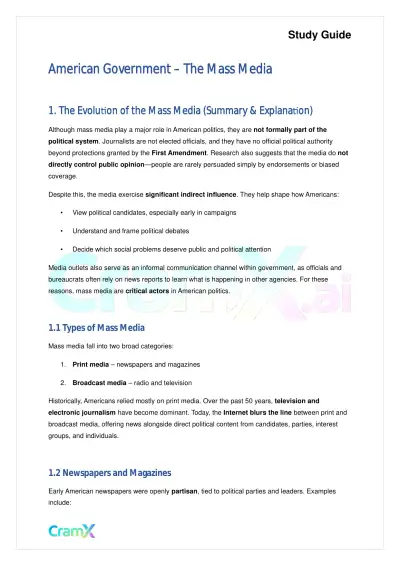 Quick Guides
American Government - The Mass Media
Political Science
11 pagesMar 2026 Solved Assignments
International Insecurity and the Use of Force in Darfur
Political Science
9 pagesMay 2025 Solved Assignments
Pieces of Legislation: Key Legislation Shaping the Union-Management Relationship
Political Science
8 pagesMay 2025 Solved Assignments
PAD-510 Position Paper Strayer University
Political Science
8 pagesMay 2025
Study this document with CramX
Once it is in your library, every tool can work from it.