

Developmental Psychology - Conception, Pregnancy, Birth
- Psychology
- Texas A&M University
- 17 pages
- Shared March 2026
Preview 6 of 17 pages
See the first 6 pages exactly as they appear in the document.
Page 1 Read page 1 as text
Study Guide Developmental Psychology – Conception, Pregnancy, Birth 1. Prenatal Care Prenatal development is the process that begins at conception and continues until birth. This period includes many important stages, each with specific changes that help a fertilized egg grow into a healthy baby. Let’s walk through these stages step by ste p in a clear and simple way. 1.1 Conception: How Pregnancy Begins Ovulation and the Egg Around day 14 of a 28 - day menstrual cycle , ovulation usually occurs. During ovulation: • One ovary releases an egg (ovum) . • Fingerlike structures called fimbriae guide the egg into a nearby fallopian tube . • If the egg is not fertilized , it dissolves within about 48 hours . 1.2 How Sperm Reach the Egg After ejaculation: • Sperm can reach the fallopian tube closest to the ovary in about 90 minutes .
Page 2 Read page 2 as text
Study Guide • Sperm move using a whipping motion called flagellation , powered by energy - producing structures called mitochondria . • Out of about 300 million sperm , only around 2,000 reach the correct fallopian tube. • Only about 50 sperm get close to the egg. • One sperm successfully penetrates and fertilizes the egg. Other sperm help by releasing an enzyme called hyaluronidase , which softens the egg’s protective layer, the zona pellucida . Once one sperm enters, the egg’s membrane thickens to block all others. 1.3 Fertilization and Chromosomes Fertilization is complete when the nucleus of the sperm fuses with the nucleus of the egg. At this moment: • The sex of the baby is determined . • Chromosomes carry genes, which are the body’s biological instructions. • The egg always provides an X chromosome . • The sperm provides either an X or a Y chromosome . This means: • XX = female • XY = male The X chromosome carries essential genetic information, while the Y chromosome mainly triggers male development. 1.4 Multiple Pregnancies A multiple pregnancy can happen in two ways: • Identical twins or triplets form when one fertilized egg splits into two or more embryos. • Fraternal twins form when two separate eggs are fertilized by two different sperm.
Page 3 Read page 3 as text
Study Guide 1.5 Early Cell Division Within 24 – 36 hours , the fertilized egg (now called a zygote ) begins dividing rapidly: • 1 cell becomes 2 • 2 become 4 • 4 become 8, and so on All of this happens as the zygote travels down the fallopian tube toward the uterus. 1.6 Implantation: Attaching to the Uterus About one week after conception , the zygote becomes a blastocyst , a hollow ball of about 100 cells . • The blastocyst floats in the uterus for about 3 days . • It then attaches to the endometrium , the inner lining of the uterus. • Outer cells called trophoblasts release enzymes that help the blastocyst embed itself securely. This process is called implantation . 1.7 From Zygote to Embryo to Fetus • After implantation and for the first 8 weeks , the developing organism is called an embryo . • From the end of week 8 until birth, it is called a fetus . During implantation: • Cell division speeds up. • Early organs and tissues begin to form. • A groove called the neural groove appears and later develops into the brain and nervous system. • The trophoblasts help form the placenta, umbilical cord, and amniotic sac .
Page 4 Read page 4 as text
Study Guide 1.8 The First Trimester (Weeks 1 – 12) The Placenta and Hormones The placenta is a disk - shaped organ that: • Connects to the fetus through the umbilical cord • Supplies oxygen, nutrients, and antibodies • Removes waste from the fetus Early in pregnancy, the placenta releases human chorionic gonadotropin (HCG) . • HCG prevents menstruation by maintaining the corpus luteum . • Pregnancy tests detect HCG in blood or urine. • Home pregnancy tests may give false negatives, making laboratory tests more reliable . 1.9 Umbilical Cord and Blood Exchange By week 5 , the umbilical cord forms. • It contains one vein and two arteries . • Blood exchange happens through chorionic villi , tiny projections in the placenta. • The mother’s and fetus’s blood never mix , but substances like oxygen, nutrients, viruses, and drugs can pass between them. 1.10 Hormones and Physical Changes After the first trimester, the placenta produces: • Progesterone and estrogen , which: o Enlarge reproductive organs o Relax ligaments o Develop the uterine lining and breasts o Prevent uterine contractions • Placental lactogen , which prepares the breasts for milk production
Page 5 Read page 5 as text
Study Guide 1.11 Amniotic Sac and Fluid The embryo is surrounded by: • The amnion (inner membrane) • The chorion (outer membrane) Together, they form the amniotic sac , filled with amniotic fluid . This fluid: • Cushions the fetus • Protects against shock • Maintains a constant temperature 1.12 Confirming Pregnancy Pregnancy can be confirmed by: • An HCG - based test • Ballottement , where a doctor feels for the fetus during a pelvic exam • Hearing the uterine souffle , a rushing sound made by blood flow, using a stethoscope 1.13 Growth and Development in the First Trimester Development follows a cephalocaudal pattern , meaning growth starts at the head and moves downward. This is why the fetus’s head is much larger than the rest of its body early on. Three cell layers form: • Ectoderm → skin, nervous system, sensory organs • Mesoderm → muscles, bones, circulatory and reproductive systems • Endoderm → digestive, respiratory, and glandular systems
Page 6 Read page 6 as text
Study Guide By: • Week 7 : Digestive and respiratory systems begin limited function • Week 8 : Embryo is about 1¼ inches long and weighs 1/30 of an ounce • Week 10 : Arms, legs, hands, feet, and toes are visible • Week 12 : Fetus looks human, weighs about 1 ounce, is 3 – 4 inches long, and has visible sex organs 1.14 The Second Trimester (Weeks 13 – 26) • Begins at week 13 • By week 14 , the mother can feel fetal movement • By weeks 17 – 18 , doctors can hear the heartbeat • Between weeks 20 – 26 , the fetus may weigh up to 2 pounds • The fetus can open its eyes, sleep, wake, and move its limbs 1.15 The Third Trimester (Week 27 to Birth) • Begins around week 27 • The fetus develops a layer of fat , giving it a baby - like appearance • The fetus usually turns head - down in preparation for birth • If it does not, a breech presentation occurs (feet - first or hips - first) By: • Month 8 : The fetus weighs about 5 pounds • After that, it gains about ½ pound per week • Skin becomes less red and smoother • A waxy coating covers the skin to protect it during delivery
11 more pages in the full document
Unlock it once and it stays in your library, ready to chat with or turn into flashcards.
Unlock the full documentMore Psychology study materials
See all Quick Guides
Developmental Psychology - Physical, Cognitive Development Age 2–6
Psychology
7 pagesMar 2026 Quick Guides
Developmental Psychology - Physical, Cognitive Development Age 12+
Psychology
8 pagesMar 2026 Quick Guides
Developmental Psychology - Psychosocial Development Age 12–19
Psychology
7 pagesMar 2026 Quick Guides
Developmental Psychology - Physical, Cognitive Development 17–45
Psychology
7 pagesMar 2026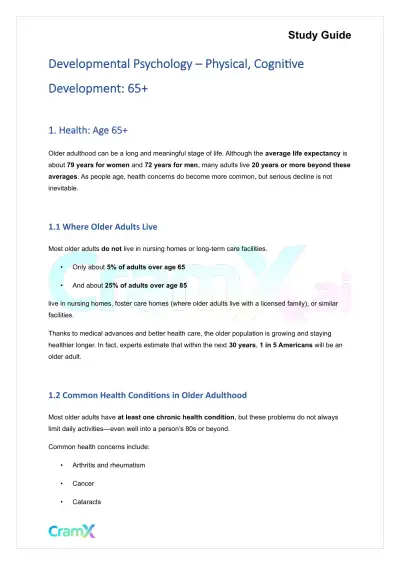 Quick Guides
Developmental Psychology - Physical, Cognitive Development 65+
Psychology
10 pagesMar 2026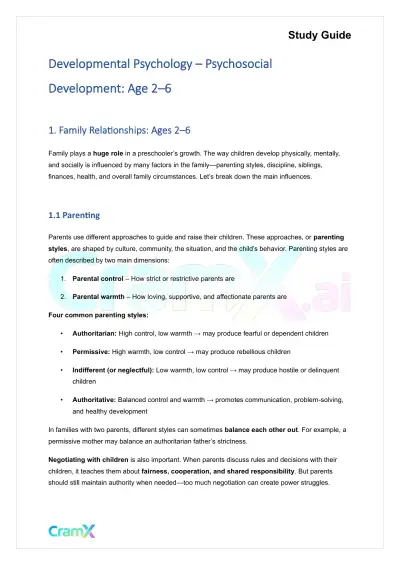 Quick Guides
Developmental Psychology - Psychosocial Development Age 2–6
Psychology
8 pagesMar 2026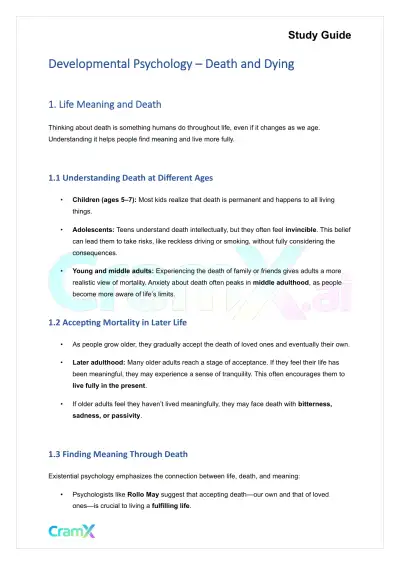 Quick Guides
Developmental Psychology - Death and Dying
Psychology
8 pagesMar 2026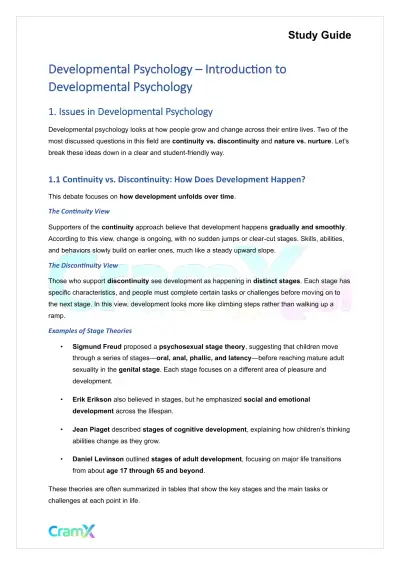 Quick Guides
Developmental Psychology - Introduction to Developmental Psychology.docx
Psychology
10 pagesMar 2026
Study this document with CramX
Once it is in your library, every tool can work from it.