

Developmental Psychology - Introduction to Developmental Psychology.docx
- Psychology
- Texas A&M University
- 10 pages
- Shared March 2026
Preview 3 of 10 pages
See the first 3 pages exactly as they appear in the document.
Page 1 Read page 1 as text
Study Guide Developmental Psychology – Introduction to Developmental Psychology 1. Issues in Developmental Psychology Developmental psychology looks at how people grow and change across their entire lives. Two of the most discussed questions in this field are continuity vs. discontinuity and nature vs. nurture . Let’s break these ideas down in a clear and student - friendly way. 1.1 Continuity vs. Discontinuity: How Does Development Happen? This debate focuses on how development unfolds over time . The Continuity View Supporters of the continuity approach believe that development happens gradually and smoothly . According to this view, change is ongoing, with no sudden jumps or clear - cut stages. Skills, abilities, and behaviors slowly build on earlier ones, much like a steady upward slope. The Discontinuity View Those who support discontinuity see development as happening in distinct stages . Each stage has specific characteristics, and people must complete certain tasks or challenges before moving on to the next stage. In this view, development looks more like climbing steps rather than walking up a ramp. Examples of Stage Theories • Sigmund Freud proposed a psychosexual stage theory , suggesting that children move through a series of stages — oral, anal, phallic, and latency — before reaching mature adult sexuality in the genital stage . Each stage focuses on a different area of pleasure and development. • Erik Erikson also believed in stages, but he emphasized social and emotional development across the lifespan. • Jean Piaget described stages of cognitive development , explaining how children’s thinking abilities change as they grow. • Daniel Levinson outlined stages of adult development , focusing on major life transitions from about age 17 through 65 and beyond . These theories are often summarized in tables that show the key stages and the main tasks or challenges at each point in life.
Page 2 Read page 2 as text
Study Guide 1.2 Nature vs. Nurture: Where Do Our Traits Come From? The nature vs. nurture debate asks another big question: Are we shaped more by biology (nature) or by experience and environment (nurture) ? • Nature includes genetics and biological factors we are born with. • Nurture includes our surroundings, upbringing, education, culture, and life experiences. Most modern psychologists agree that both nature and nurture work together . Development is not caused by just one or the other — it is the result of their interaction over time. 1.3 Putting It All Together In developmental psychology, there is no single “right” answer to these debates. Some aspects of development appear smooth and continuous , while others clearly happen in stages . Likewise, both biological factors and environmental influences play important roles in shaping who we become. Understanding these debates helps psychologists better explain human growth — from infancy through adulthood and into old age.
Page 3 Read page 3 as text
Study Guide
7 more pages in the full document
Unlock it once and it stays in your library, ready to chat with or turn into flashcards.
Unlock the full documentMore Psychology study materials
See all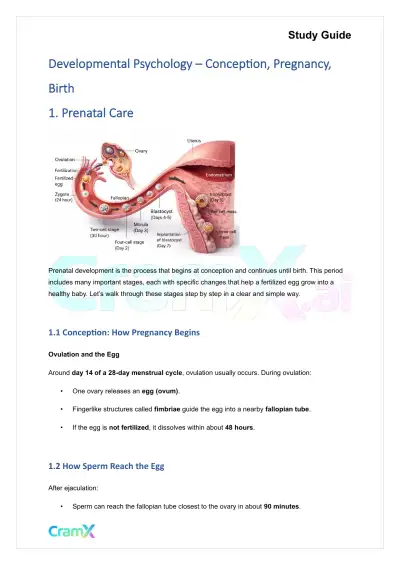 Quick Guides
Developmental Psychology - Conception, Pregnancy, Birth
Psychology
17 pagesMar 2026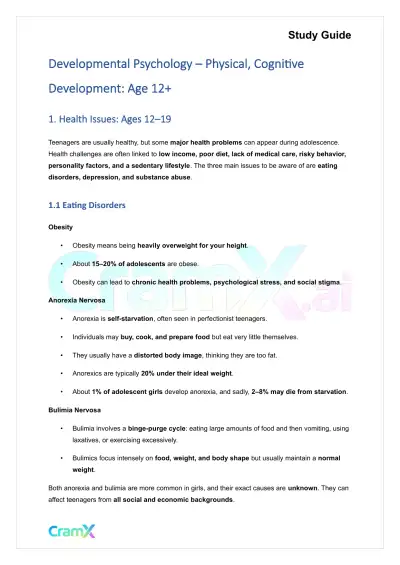 Quick Guides
Developmental Psychology - Physical, Cognitive Development Age 12+
Psychology
8 pagesMar 2026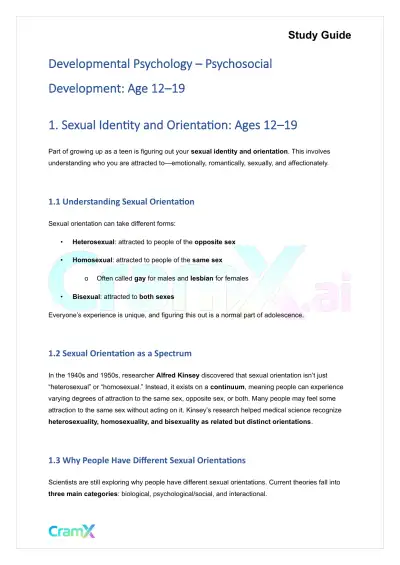 Quick Guides
Developmental Psychology - Psychosocial Development Age 12–19
Psychology
7 pagesMar 2026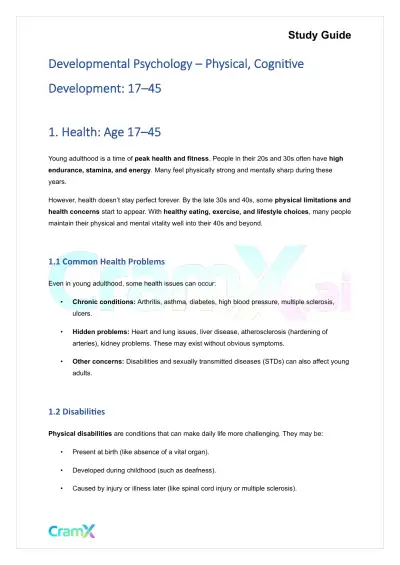 Quick Guides
Developmental Psychology - Physical, Cognitive Development 17–45
Psychology
7 pagesMar 2026 Quick Guides
Developmental Psychology - Physical, Cognitive Development 65+
Psychology
10 pagesMar 2026 Quick Guides
Developmental Psychology - Psychosocial Development Age 2–6
Psychology
8 pagesMar 2026 Quick Guides
Developmental Psychology - Death and Dying
Psychology
8 pagesMar 2026 Quick Guides
Developmental Psychology - Physical, Cognitive Development Age 2–6
Psychology
7 pagesMar 2026
Study this document with CramX
Once it is in your library, every tool can work from it.