

PSYC 110 Psychology Fundamentals: Key Concepts and Applications
- Psychology
- Franklin University
- 7 pages
- Shared May 2025
This introductory course in psychology covers key concepts and their real-world applications in human behavior.
Preview 3 of 7 pages
See the first 3 pages exactly as they appear in the document.
Page 1 Read page 1 as text
PSYC 110 Psychology Fundamentals: Key Concepts and Applications DeVr y PSYC 110 Midterm Exam Question 1.1. (TCOs 1, 2) Participants in research early in psychology’s history might have been asked to view a chair and describe its color, shape, texture, and other aspects of their conscious experience. These individuals would have been using a method called (Points : 2) hypnosis objective introspection. psychosurgery. psychoanalysis. Question 2.2. (TCO 4) As part of a psychology experiment, Brett decides to measure a person’s “anxiety” by noting the number of blinks a person makes in a 20 - minute social interaction with a stranger. Brett appears to have offered a(n) _____ of anxiety. (Points : 2) variable operational definition theory hypothesis Question 3.3. (TCOs 2, 3) Marta was in an automobile accident and suffered an injury to her brain, resulting in the paralysis of her left arm. What part of Marta’s brain was injured?(Points : 2) Auditory association area Motor cortex Association areas Somatosensory cortex Question 4.4. (TCOs 2, 3) A group of axons bundled together coated in myelin that travels together through the body is called a (Points : 2) synaptic vesicle nerve neurilemma myelinated pathway.
Page 2 Page 3 Read page 3 as text
Question 5.5. (TCOs 2, 3) _____ synapses make it more likely that a neuron will send its message to other neurons, whereas _____ synapses make it less likely that a neuron will send its message. (Points : 2 ) Excitatory; inhibitory Inhibitory; excitatory Augmentation; depletion Depletion; augmentation Question 6.6. (TCO 4) Which of the following phenomena is a function of the distribution of the rods and cones in the retina? (Points : 2 ) The moon looks much larger near the horizon than it looks when it is higher in the sky. The light from distant stars moving rapidly away from us is shifted toward the red end of the spectrum. Stars can be seen only with difficulty during the daytime A dim star viewed at night may disappear when you look directly at it, but reappear when you look to one side of it. Question 7.7. ( TCO 4) What are the five primary tastes? (Points : 2 ) Hot, sour, spicy, sweet, origami Salty, sour, spicy, sweet, tart Bitter, salty, sour, sweet, umami Peppery, salty, sour, sweet, acidic Question 8.8. (TCO 4) Dizziness, nausea, and disorientation may result if the information from the eyes conflicts a little too much with that from the vestibular organs, according to the _____ of motion sickness. (Points : 2 sensory conflict theory motor conflict theory vestibular conflict theory semicircular canal conflict theory Question 9.9. (TCO 5) Judith is startled when her 6 - year - old daughter, Laura, sleepwalks into the family room. It is most likely that Laura is experiencing the _____ stage of the sleep cycle. (Points : 2 ) REM
4 more pages in the full document
Unlock it once and it stays in your library, ready to chat with or turn into flashcards.
Unlock the full documentMore Psychology study materials
See all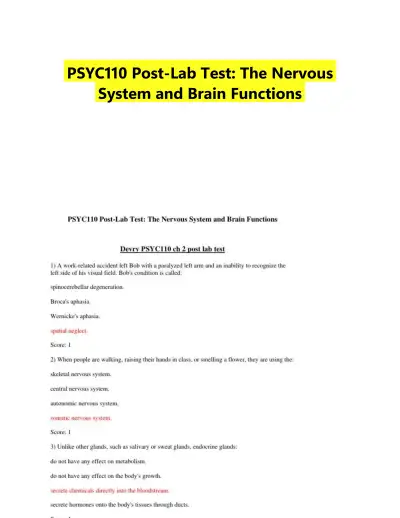 Solved Assignments
PSYC110 Post-Lab Test: The Nervous System and Brain Functions
Psychology
10 pagesMay 2025 Exam Guides
Test Bank for Fundamentals of Corporate Finance, 4th Edition
Psychology
917 pages173downloadsFeb 2025 Textbook Guides
Solution Manual for International Economics, 13th Edition
Psychology
242 pages156downloadsFeb 2025 Exam Guides
Test Bank For Fundamentals of Abnormal Psychology, 7th Edition
Psychology
665 pages149downloadsFeb 2025 Class Notes
Lecture Notes for Abnormal Child and Adolescent Psychology, 8th Edition
Psychology
124 pages146downloadsFeb 2025 Class Notes
Lecture Notes For Abnormal Psychology, 18th Edition
Psychology
413 pages146downloadsFeb 2025 Exam Guides
Test Bank For Understanding Dying, Death, and Bereavement, 7th Edition
Psychology
140 pages141downloadsFeb 2025 Exam Guides
Test Bank For Psychology in Modules, 10th Edition
Psychology
1393 pages139downloadsFeb 2025
Study this document with CramX
Once it is in your library, every tool can work from it.