

Psychology - Psychology Treatments
- Psychology
- Texas A&M University
- 12 pages
- Shared March 2026
Preview 4 of 12 pages
See the first 4 pages exactly as they appear in the document.
Page 1 Read page 1 as text
Study Guide Psychology – Psychology: Treatments 1. Psychotherapies Psychotherapy refers to different methods used to help people understand, manage, and overcome emotional, behavioral, and mental health problems. There is no single type of therapy that works for everyone. Instead, psychologists use different approaches depending on th e person and the problem. Below are the major types of psychotherapies, explained simply. 1.1 Psychodynamic Therapies Psychodynamic therapies are based on ideas from Freud’s psychoanalytic theory. These therapies usually take a long time and focus on gaining insight , or deep understanding, into unconscious thoughts and conflicts. Key Techniques • Free association : Clients say whatever comes to mind without censoring themselves. This helps uncover unconscious thoughts. • Dream analysis : Clients describe their dreams, which therapists interpret to find hidden conflicts or desires. Therapists look for repeated patterns in thoughts and behaviors and explain how these patterns relate to the client’s problems. Important Concepts • Resistance : When clients avoid sharing thoughts or feelings because they are uncomfortable. • Transference : When clients transfer feelings they have toward important people (like parents) onto the therapist. • Working through : The process of helping clients understand and resolve their conflicts by dealing with resistance and transference.
Page 2 Read page 2 as text
Study Guide 1.2 Humanistic Therapies Humanistic therapies focus on the present rather than the past and on conscious thoughts instead of unconscious ones. The goal is personal growth, self - acceptance, and fulfillment . Person - Centered Therapy Developed by Carl Rogers , this therapy creates a warm and supportive environment where clients feel fully accepted. Key ideas include: • Unconditional positive regard : Accepting clients without judgment • Empathy : Understanding the client’s feelings from their point of view • Encouraging self - growth and higher self - esteem Rogers believed many people suffer because they grow up with conditions of worth , meaning they feel accepted only if they meet others’ expectations. Gestalt Therapy Developed by Fritz Perls , Gestalt therapy helps clients become more aware of their feelings and actions in the present moment. Therapists may use: • Questioning • Role - playing • Confrontation Clients are encouraged to take responsibility for their choices and behaviors. Existential Therapy Existential therapy focuses on life’s big questions, such as: • Meaning • Choice • Responsibility • Death
Page 3 Read page 3 as text
Study Guide It emphasizes free will — the idea that people can make choices that shape their lives. The goal is to help clients find meaning and live responsibly. After surviving a Nazi concentration camp, Viktor Frankl developed logotherapy , a form of existential therapy. He believed people survive hardship by holding onto a sense of meaning ( logos ). Therapy helps clients identify what truly matters in their lives. 1.3 Behavior Therapies Behavior therapies focus on changing observable behaviors using learning principles. These therapies do not explore unconscious conflicts. Instead, they assume maladaptive behaviors are learned and can be unlearned . Core Idea If a behavior was learned through conditioning, it can be changed using the same learning processes. Common Techniques • Systematic desensitization : Clients learn to relax while gradually imagining feared situations. This method is especially effective for phobias. • Implosive therapy : Clients imagine their worst fears in a safe setting until anxiety decreases. • Flooding : Clients face their feared situation directly, often with therapist support. • Biofeedback : Clients receive feedback about body functions (like heart rate) and learn to control them. • Aversive conditioning : Undesirable behaviors are paired with unpleasant stimuli to reduce the behavior. • Modeling : Clients learn by watching others perform desired behaviors. • Token economy : Often used in institutions, clients earn tokens for positive behaviors, which can be exchanged for rewards. 1.4 Cognitive Therapies Cognitive therapies focus on changing unhealthy thought patterns that cause emotional and behavioral problems.
Page 4 Read page 4 as text
Study Guide Cognitive Therapy for Depression Developed by Aaron Beck , this therapy suggests depression is caused by distorted thinking, such as: • Selective perception : Focusing only on negative events • Overgeneralization : Letting one failure define everything • All - or - none thinking : Seeing things as completely good or bad Clients learn to recognize and replace these thoughts with more realistic ones. Rational - Emotive Therapy (RET) Developed by Albert Ellis , RET is based on the idea that irrational beliefs cause emotional problems. For example, believing “I must be perfect at everything” can lead to anxiety and depression. Therapy helps clients: • Challenge irrational beliefs • Reduce emotional distress • Develop better problem - solving skills 1.5 Feminist Therapy Feminist therapy focuses on how social inequality and discrimination contribute to psychological problems. Key beliefs include: • Rejecting gender - role stereotypes • Opposing discrimination based on gender, age, ethnicity, or sexual orientation • Recognizing how society affects mental health Therapists also examine their own biases and how these influence therapy.
8 more pages in the full document
Unlock it once and it stays in your library, ready to chat with or turn into flashcards.
Unlock the full documentMore Psychology study materials
See all Quick Guides
Psychology - Psychology Measurement and Statistics
Psychology
11 pagesMar 2026 Quick Guides
Psychology - Psychology Perception
Psychology
15 pagesMar 2026 Quick Guides
Psychology - Psychology Personality
Psychology
17 pagesMar 2026 Quick Guides
Psychology - Psychology Consciousness
Psychology
16 pagesMar 2026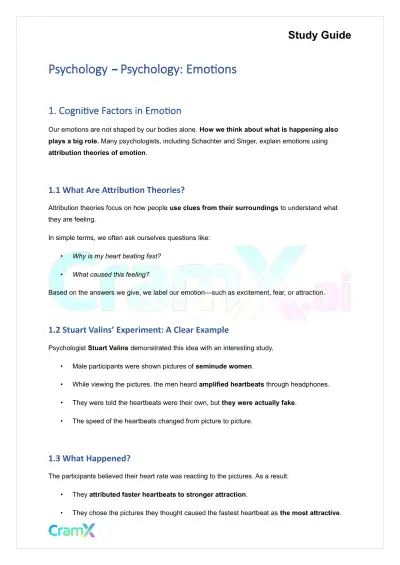 Quick Guides
Psychology - Psychology Emotions
Psychology
17 pagesMar 2026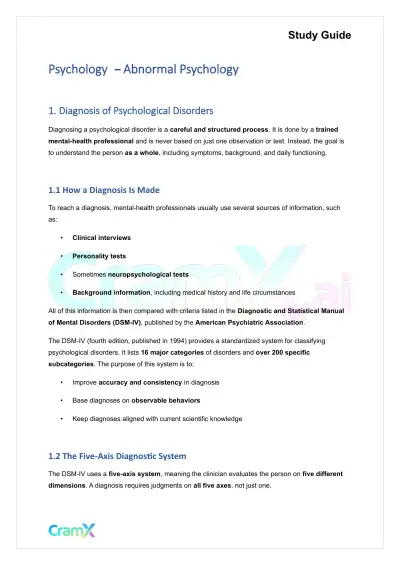 Quick Guides
Psychology - Abnormal Psychology
Psychology
14 pagesMar 2026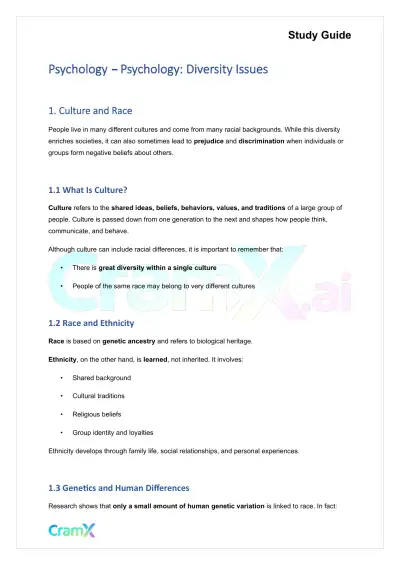 Quick Guides
Psychology - Psychology Diversity Issues
Psychology
7 pagesMar 2026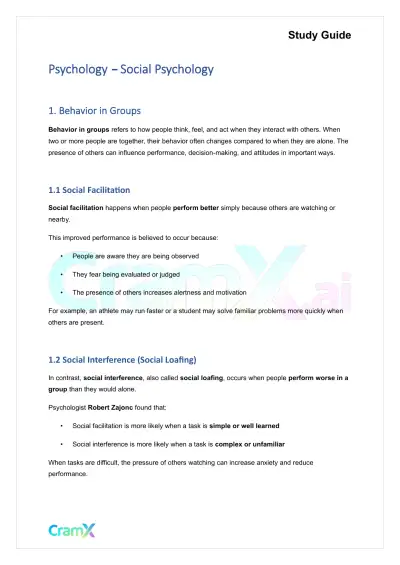 Quick Guides
Psychology - Social Psychology
Psychology
15 pagesMar 2026
Study this document with CramX
Once it is in your library, every tool can work from it.