

Psychology - Psychology Motivation
- Psychology
- Texas A&M University
- 23 pages
- Shared March 2026
Preview 7 of 23 pages
See the first 7 pages exactly as they appear in the document.
Page 1 Read page 1 as text
Study Guide Psychology – Psychology: Motivation 1. Sexual Motivation 1.1 Regulation of Sexual Responses Sexual motivation, like hunger and thirst, is influenced by biological processes in the brain and body . Certain areas of the brain — especially parts of the hypothalamus (such as the medial preoptic area and the ventromedial hypothalamus, VMH) — play a key role in regulating sexual motivation and behavior. Other brain regions, including the limbic system , are also involved. Sexual behavior is strongly affected by sex hormones : • Testosterone is the primary hormone involved in males • Estrogens are the primary hormones involved in females These hormones are produced by the gonads (testes and ovaries). Hormone production in the gonads is controlled by hormones released from the pituitary gland . Sexual behavior is complex and can be influenced by many factors, especially during development. These factors may include: • exposure to sex hormones • use of drugs that affect hormone production • brain development and functioning 1.2 The Sexual Response Cycle Researchers William Masters and Virginia Johnson described the sexual response cycle , which occurs in both males and females. It consists of four phases . 1. Excitement • Initial sexual arousal • Genital areas become stimulated
Page 2 Read page 2 as text
Study Guide 2. Plateau • Sexual excitement continues and intensifies • Breathing rate, pulse, and blood pressure increase 3. Orgasm • Rapid muscle contractions in the genital area • In males, semen is released • Both males and females experience intense pleasure 4. Resolution • The body gradually returns to an unaroused state • Sexual arousal decreases 1.3 Sexual Dysfunction Some individuals experience problems during one or more stages of the sexual response cycle. These difficulties are known as sexual dysfunctions and are often addressed by psychologists and other health professionals. Examples include: • Premature ejaculation in males • Impotence (difficulty becoming physically aroused) in males • Inability to experience orgasm in females • Low sexual desire in females Such difficulties can have biological, psychological, or social causes. Sexual Orientation Sexual orientation refers to the direction of a person’s sexual or romantic attraction. • Heterosexual : attraction to the opposite gender • Homosexual : attraction to the same gender (gay males and lesbian females) • Bisexual : attraction to both genders
Page 3 Read page 3 as text
Study Guide Differences in sexual orientation exist in all cultures . Most psychologists today agree that: • sexual orientation is not a choice • it is not something people can deliberately change • individuals are born with their orientation A 1996 survey reported that: • 3.5% of men • 2.1% of women reported having had a homosexual experience in the previous 12 months. Importantly: • sexual orientation is not linked to mental illness • it is not associated with sexual crimes , such as child molestation Homosexuality was officially removed as a mental disorder by the American Psychiatric Association in 1973 . Key Points to Remember • Sexual motivation is regulated by the brain and hormones • The hypothalamus and limbic system play major roles • The sexual response cycle has four stages • Sexual dysfunctions can affect any stage of the cycle • Sexual orientation is a natural variation of human behavior
Page 4 Read page 4 as text
Study Guide 2. Electrical Stimulation of the Brain (ESB) 2.1 Discovery of Brain Reward Areas In 1954 , psychologists James Olds and Peter Milner made an important discovery while studying rats. They found that when an electrode was implanted in certain areas of a rat’s brain , the rat would repeatedly press a bar to receive a small burst of electrical stimulation. This behavior occurred even without food or water rewards. This led researchers to believe they had discovered a brain reward system . 2.2 Electrical Stimulation as a Reinforcer Electrical stimulation of the brain (ESB) acted as a powerful reinforcer . • Rats pressed the bar continuously for 15 to 20 hours • They continued until they became completely exhausted • During this time, rats: o ignored food and water o neglected other natural behaviors o mother rats even ignored their pups This showed that the electrical stimulation was extremely motivating , sometimes more motivating than basic survival needs. 2.3 Positive and Negative Brain Stimulation It was already known that: • stimulating certain brain areas could trigger behaviors such as eating, drinking, sexual behavior, or aggression • damaging (lesioning) those areas could reduce or eliminate these behaviors
Page 5 Read page 5 as text
Study Guide Later research showed that: • positive ESB sites caused animals to seek stimulation • negative ESB sites caused animals to avoid stimulation Many of these sites were found to be concentrated in the limbic system , a group of brain structures involved in motivation and emotion. Turning Off Stimulation In 1955 , psychologist José Delgado demonstrated another important finding. • Rats learned to press a bar to turn off electrical stimulation to the hippocampus • The hippocampus is not involved in pain transmission • This showed that animals could also learn behaviors to stop unpleasant brain stimulation Electrical Stimulation in Humans Some humans have had electrodes implanted in their brains to help reduce symptoms of Parkinson’s disease . These individuals reported that the stimulation felt: • mildly pleasurable • satisfying • calming This suggests that similar reward - related brain systems exist in humans. Neurotransmitters and Modern Research Research has shown that ESB causes the release of neurotransmitters such as: • dopamine • norepinephrine Because of this, ESB helped scientists better understand the brain’s reward and motivation systems .
Page 6 Read page 6 as text
Study Guide However, modern research focuses more on: • using drugs to regulate neurotransmitter levels • rather than directly stimulating the brain with electrodes Key Points to Remember • ESB can strongly reinforce behavior • Rats will work intensely for rewarding brain stimulation • Reward and avoidance sites are often found in the limbic system • ESB affects dopamine and norepinephrine release • Modern treatment prefers drug - based methods over ESB 3. Behavioral Perspective 3.1 Understanding Motivation from a Behavioral View The behavioral perspective explains motivation by focusing on: • drives (both learned and unlearned) • incentives (external rewards) According to this approach, behavior is motivated either by internal needs that push us or by external rewards that pull us . Drive Theory What Is Drive Theory? Drive theory explains motivation in terms of biological needs and the body’s attempt to maintain homeostasis , or a stable internal condition . All living organisms have basic physiological needs, such as:
Page 7 Read page 7 as text
Study Guide • food • water • sleep When these needs are met, the body stays in balance. Primary (Unlearned) Drives When homeostasis is disrupted, the body experiences tension or arousal , called a primary (unlearned) drive . Examples: • hunger • thirst • fatigue If the body lacks food, a hunger drive develops. Eating food reduces this drive and helps restore balance. This process is called drive reduction . Drives motivate behavior because organisms are pushed to reduce discomfort and return to homeostasis. Learning theorist Clark Hull developed mathematical formulas to explain how drive strength and learning work together to influence behavior. Secondary (Learned) Drives Not all drives are biological. Some drives are learned , or secondary drives . A common example is fear (or anxiety) , which can be learned through: • classical conditioning • operant conditioning Neal Miller’s Experiment Psychologist Neal Miller demonstrated learned drives in an operant conditioning experiment.
16 more pages in the full document
Unlock it once and it stays in your library, ready to chat with or turn into flashcards.
Unlock the full documentMore Psychology study materials
See all Quick Guides
Psychology - Psychology Measurement and Statistics
Psychology
11 pagesMar 2026 Quick Guides
Psychology - Psychology Perception
Psychology
15 pagesMar 2026 Quick Guides
Psychology - Psychology Personality
Psychology
17 pagesMar 2026 Quick Guides
Psychology - Psychology Treatments
Psychology
12 pagesMar 2026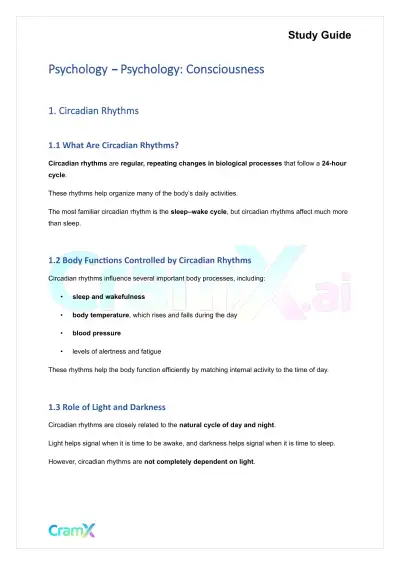 Quick Guides
Psychology - Psychology Consciousness
Psychology
16 pagesMar 2026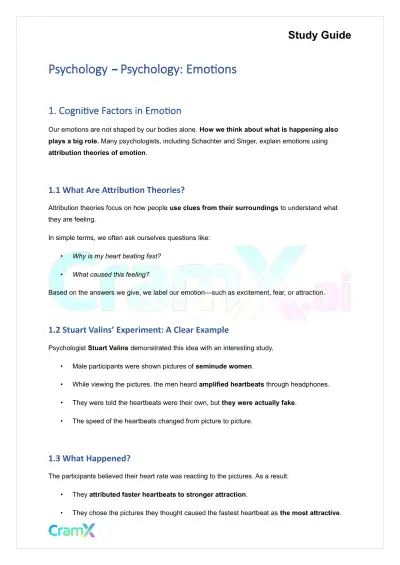 Quick Guides
Psychology - Psychology Emotions
Psychology
17 pagesMar 2026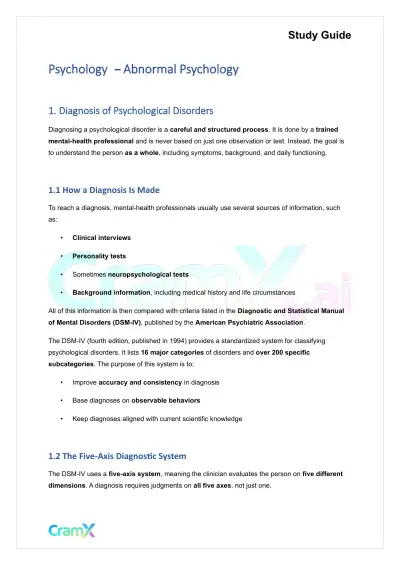 Quick Guides
Psychology - Abnormal Psychology
Psychology
14 pagesMar 2026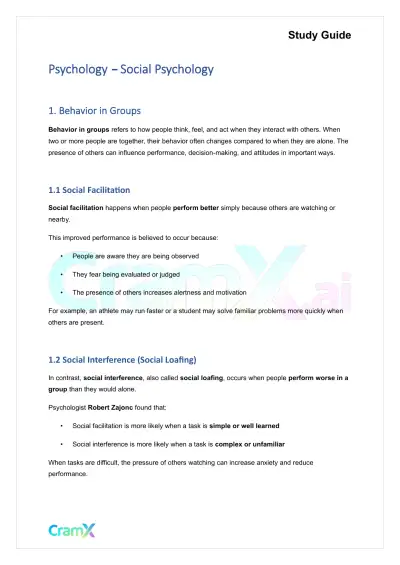 Quick Guides
Psychology - Social Psychology
Psychology
15 pagesMar 2026
Study this document with CramX
Once it is in your library, every tool can work from it.