

Psychology - Psychology Biological Bases of Behavior
- Psychology
- Texas A&M University
- 29 pages
- Shared March 2026
Preview 9 of 29 pages
See the first 9 pages exactly as they appear in the document.
Page 1 Read page 1 as text
Study Guide Psychology – Psychology : Biological Bases of Behavior 1. Neural Transmission 1.1 What Does a Neuron Do? The main job of a neuron is to send information through the nervous system. This process is called neural transmission . A neuron sends information when it becomes activated , or fires , by producing an electrical signal. Neurons can be stimulated in different ways. For example, they may respond to pressure, heat, light , or chemical signals from other neurons. The kind of stimulus needed depends on the type of neuron. 1.2 Inside and Outside the Neuron The inside of a neuron is separated from the outside by a cell membrane . This membrane is polarized , meaning there is a difference in electrical charge across it. The charges come from tiny particles called ions .
Page 2 Read page 2 as text
Study Guide When stimulation is strong enough to reach a critical level called the neural threshold , the electrical balance of the membrane changes. This change is known as depolarization , and it allows the neuron to fire. 1.3 Potentials: Electrical States of a Neuron The word potential means a difference in electrical charge. Neurons have two main types of electrical potential: 1. Resting Potential Resting potential is the electrical charge of a neuron when it is not active. • An inactive neuron is like a small battery. • It has a negative charge of about – 70 millivolts . • This state is maintained until the neuron is stimulated. 2. Action Potential An action potential happens when stimulation is strong enough to reach the neural threshold. • The neuron fires by changing the permeability of its membrane. • Electrical charge shifts from negative to positive . • This electrical wave travels along the entire length of the axon. • Afterward, the neuron returns to its resting potential and is ready to fire again. 1.4 The All - or - None Principle Neurons follow the all - or - none principle . • If stimulation does not reach the threshold, the neuron will not fire . • If the threshold is reached or exceeded , the neuron fires completely . • The strength of the stimulus does not change the size of the action potential. This means the action potential always stays the same size and does not weaken as it travels down the axon.
Page 3 Read page 3 as text
Study Guide 1.5 The Refractory Period After firing, a neuron needs a short recovery time called the refractory period . Absolute Refractory Period • The neuron cannot fire again , no matter how strong the stimulus. • This period is very brief. Relative Refractory Period • The neuron can fire again , but only if the stimulus is stronger than usual . • Once recovery is complete, the neuron can fire normally again. 1.6 Synaptic Transmission: How Neurons Communicate Neurons do not touch each other directly. They communicate at a junction called a synapse . • The sending neuron is the presynaptic neuron . • The receiving neuron is the postsynaptic neuron . • The tiny gap between them is the synaptic cleft . When an action potential reaches the end of the presynaptic neuron, it triggers the release of neurotransmitters . 1.7 Neurotransmitters and the Synapse Neurotransmitters are chemical messengers. • They are stored in vesicles inside terminal buttons at the end of the axon. • When released, they cross the synaptic cleft. • Most bind to receptors on the postsynaptic neuron. • Any extra neurotransmitters are taken back by the presynaptic neuron through reuptake .
Page 4 Read page 4 as text
Study Guide 1.8 Postsynaptic Potentials (PSPs) When neurotransmitters bind to receptors, they create a postsynaptic potential (PSP) . PSPs change how likely the postsynaptic neuron is to fire. Two Types of PSPs • Excitatory PSPs (EPSPs): increase the chance the neuron will fire • Inhibitory PSPs (IPSPs): decrease the chance the neuron will fire Whether a neuron fires depends on the balance between EPSPs and IPSPs . 1.9 Neurotransmitters and Their Functions Acetylcholine (ACh) • Found throughout the nervous system • The only neurotransmitter between motor neurons and voluntary muscles • Loss of ACh - producing cells is linked to Alzheimer’s disease 1.10 Biogenic Amines This group includes: • Norepinephrine – low levels linked to some forms of depression • Dopamine – low levels linked to Parkinson’s disease • Serotonin – levels increase with LSD use 1.11 GABA (Gamma - Aminobutyric Acid) • Produces only inhibitory effects • Many tranquilizers work by increasing GABA’s action
Page 5 Read page 5 as text
Study Guide 1.12 Glycine • An inhibitory neurotransmitter • Found in the spinal cord, lower brainstem, and retina Endorphins • Act as neuromodulators • Reduce pain and produce pleasure • Similar in effect to opiates like morphine • Responsible for the “runner’s high” Substance P • Involved in pain pathways • Helps transmit pain signals in the nervous system 2. The Nervous System The nervous system is the body’s main communication network. It helps us think, move, feel, and react to what is happening both inside and outside our body. As shown in Figure 1 , the nervous system has two major parts : • The Central Nervous System (CNS) • The Peripheral Nervous System (PNS)
Page 6 Read page 6 as text
Study Guide Central Nervous System (CNS) The central nervous system includes: • The brain • The spinal cord These two organs are the control centers of the body. Protection of the CNS Because the brain and spinal cord are very delicate, they are well protected: • The brain is enclosed within the skull • The spinal cord lies inside the spinal column • Both are surrounded by a special fluid called cerebrospinal fluid (CSF) Meninges: Protective Coverings The brain and spinal cord are also covered by three protective layers called meninges : 1. Dura mater – the tough outer layer 2. Arachnoid layer – the middle layer 3. Pia mater – the thin inner layer, closely attached to the brain and spinal cord
Page 7 Read page 7 as text
Study Guide Between the arachnoid layer and the pia mater is a space known as the subarachnoid space . This space is filled with cerebrospinal fluid , which cushions the CNS and protects it from injury. 2.1 Peripheral Nervous System (PNS) The peripheral nervous system includes all the nerves that lie outside the brain and spinal cord . These nerves connect the CNS to the rest of the body. The PNS is divided into two main systems : 1. Somatic Nervous System • Controls voluntary actions • Helps us move skeletal muscles • Allows conscious activities like walking, writing, and speaking 2. Autonomic Nervous System • Controls involuntary actions • Works automatically without conscious effort • Regulates organs like the heart, glands, and smooth muscles The autonomic nervous system has two subdivisions : a) Sympathetic Nervous System • Prepares the body for “fight or flight” • Activated during stress or emergencies • Increases heart rate and prepares muscles for action b) Parasympathetic Nervous System • Promotes “rest and digestion” • Helps the body relax and conserve energy • Slows heart rate and supports digestion
Page 8 Read page 8 as text
Study Guide 🔁 How It All Works Together • The CNS processes information and makes decisions • The PNS carries messages to and from the CNS • The somatic system controls voluntary movements • The autonomic system manages involuntary body functions 3. Central Nervous System (CNS) 3.1 What Is the Central Nervous System? The central nervous system (CNS) is made up of two main parts: • the brain • the spinal cord Early in development, the CNS begins as a hollow tube with three connected chambers . As development continues: • these chambers become the ventricles of the brain • the surrounding tissue develops into the three major divisions of the brain
Page 9 Read page 9 as text
Study Guide 3.2 The Three Major Parts of the Brain The brain is divided into three main regions: 1. Forebrain – the most recently evolved and largest part 2. Midbrain – forms the upper part of the brain stem 3. Hindbrain – contains most of the brain stem Each part plays a different role in controlling behavior and body functions.
20 more pages in the full document
Unlock it once and it stays in your library, ready to chat with or turn into flashcards.
Unlock the full documentMore Psychology study materials
See all Quick Guides
Psychology - Psychology Measurement and Statistics
Psychology
11 pagesMar 2026 Quick Guides
Psychology - Psychology Perception
Psychology
15 pagesMar 2026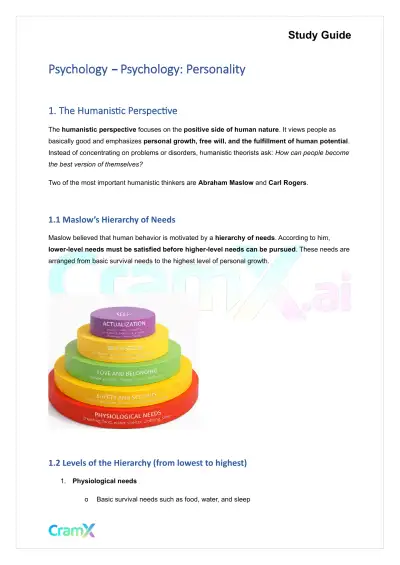 Quick Guides
Psychology - Psychology Personality
Psychology
17 pagesMar 2026 Quick Guides
Psychology - Psychology Treatments
Psychology
12 pagesMar 2026 Quick Guides
Psychology - Psychology Consciousness
Psychology
16 pagesMar 2026 Quick Guides
Psychology - Psychology Emotions
Psychology
17 pagesMar 2026 Quick Guides
Psychology - Abnormal Psychology
Psychology
14 pagesMar 2026 Quick Guides
Psychology - Social Psychology
Psychology
15 pagesMar 2026
Study this document with CramX
Once it is in your library, every tool can work from it.