

Psychology - Psychology Consciousness
- Psychology
- Texas A&M University
- 16 pages
- Shared March 2026
Preview 5 of 16 pages
See the first 5 pages exactly as they appear in the document.
Page 1 Read page 1 as text
Study Guide Psychology – Psychology: Consciousness 1. Circadian Rhythms 1.1 What Are Circadian Rhythms? Circadian rhythms are regular, repeating changes in biological processes that follow a 24 - hour cycle . These rhythms help organize many of the body’s daily activities. The most familiar circadian rhythm is the sleep – wake cycle , but circadian rhythms affect much more than sleep. 1.2 Body Functions Controlled by Circadian Rhythms Circadian rhythms influence several important body processes, including: • sleep and wakefulness • body temperature , which rises and falls during the day • blood pressure • levels of alertness and fatigue These rhythms help the body function efficiently by matching internal activity to the time of day. 1.3 Role of Light and Darkness Circadian rhythms are closely related to the natural cycle of day and night . Light helps signal when it is time to be awake, and darkness helps signal when it is time to sleep. However, circadian rhythms are not completely dependent on light .
Page 2 Read page 2 as text
Study Guide 1.4 Circadian Rhythms Without Normal Light Research shows that even when people are placed in unusual environments — such as places with constant light or darkness , like Antarctica — circadian rhythms continue. • In these conditions, the cycle shifts slightly • Rhythms often follow a 25 - hour cycle instead of 24 hours • This shows that circadian rhythms are controlled by an internal biological clock 1.5 Circadian Rhythms in Other Animals Circadian rhythms are found in many animal species , not just humans. However, there are important differences between species . Examples: • Horses, cattle, and cats sleep much more than humans • Each species has rhythms adapted to its survival needs 1.6 Importance for Psychology Circadian rhythms are especially important to psychologists because they influence: • alertness • attention • reaction time • levels of consciousness Changes in circadian rhythms can affect how well people respond to environmental stimulation , such as studying, working, or driving. Key Points to Remember • Circadian rhythms follow a roughly 24 - hour cycle • They regulate sleep, temperature, and blood pressure • Rhythms continue even without normal light cues • Humans and animals both have circadian rhythms • These rhythms affect alertness and consciousness
Page 3 Read page 3 as text
Study Guide 2. Procedures for Changing Consciousness 2.1 Changing Levels of Consciousness A person’s level of consciousness can be changed in different ways. These changes may occur through internal processes (methods that come from within the individual) or external processes (factors such as drugs or chemicals from the environment). 2.2 Internal Processes Internal methods change consciousness without using drugs . These techniques often promote relaxation and increased mental focus. 2.3 Hypnosis Hypnosis is a procedure in which a hypnotist guides a person into a deeply relaxed and highly suggestible state . • The person remains conscious • Attention becomes narrowly focused • The individual may respond more strongly to suggestions 2.4 Meditation Meditation involves deliberately narrowing attention . • The person focuses on breathing, a sound, or a thought • This produces feelings of calmness and relaxation • Meditation can reduce stress and increase self - awareness 2.5 Biofeedback Biofeedback is a technique related to meditation.
Page 4 Read page 4 as text
Study Guide • Bodily processes such as heart rate, skin temperature, or brain waves are measured • The individual learns to control these processes • Biofeedback is often used to promote relaxation and reduce stress 2.6 External Processes External factors — especially chemical substances (drugs) — can also change levels of consciousness. Environmental conditions, such as poor ventilation, can sometimes increase or alter the effects of these chemicals. Drugs are used both: • medically , to treat illness or pain • recreationally , to change mood or awareness 2.7 Drugs Used in Medicine and Daily Life General Anesthetics General anesthetics are used during major surgery to produce total unconsciousness . • Examples include halothane and nitrous oxide 2.8 Analgesics (Painkillers) Analgesic drugs reduce pain. • Examples include morphine , other opiates, and aspirin • Morphine and opiates can also: o change mood o be addictive Addiction involves: • physical or psychological dependence • discomfort when the drug is not available • tolerance , meaning higher doses are needed to get the same effect
Page 5 Read page 5 as text
Study Guide 2.9 Tranquilizers (Anti - Anxiety Drugs) Tranquilizers reduce anxiety and promote calmness. • They are among the most commonly prescribed mood - altering drugs • A major group includes benzodiazepines , such as Valium (diazepam) 2.10 Depressants Depressants slow down the central nervous system and produce relaxation. • Examples include barbiturates and alcohol • Alcohol is widely used in beer, wine, and liquor • Both alcohol and barbiturates can be addictive 2.11 Stimulants Stimulants increase activity in the central nervous system. Common stimulants include: • cocaine • amphetamine • nicotine • caffeine 2.12 Cocaine and Amphetamines • Both block the reuptake of neurotransmitters • They produce feelings of euphoria and alertness • Cocaine can be used medically as a local anesthetic • Recreational use can lead to addiction
11 more pages in the full document
Unlock it once and it stays in your library, ready to chat with or turn into flashcards.
Unlock the full documentMore Psychology study materials
See all Quick Guides
Psychology - Psychology Measurement and Statistics
Psychology
11 pagesMar 2026 Quick Guides
Psychology - Psychology Perception
Psychology
15 pagesMar 2026 Quick Guides
Psychology - Psychology Personality
Psychology
17 pagesMar 2026 Quick Guides
Psychology - Psychology Treatments
Psychology
12 pagesMar 2026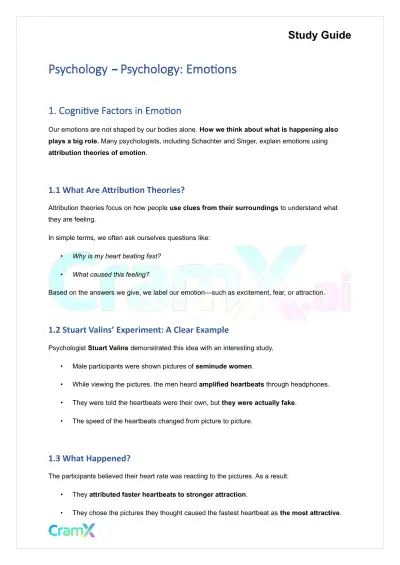 Quick Guides
Psychology - Psychology Emotions
Psychology
17 pagesMar 2026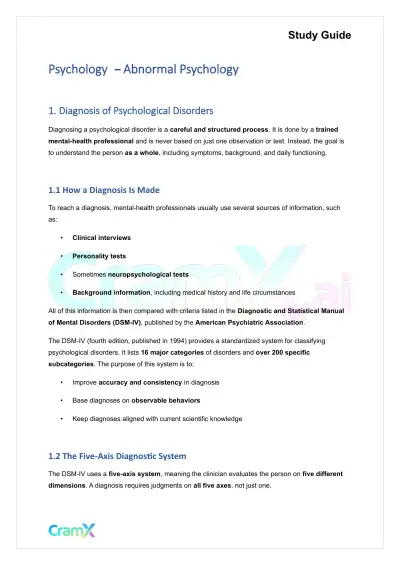 Quick Guides
Psychology - Abnormal Psychology
Psychology
14 pagesMar 2026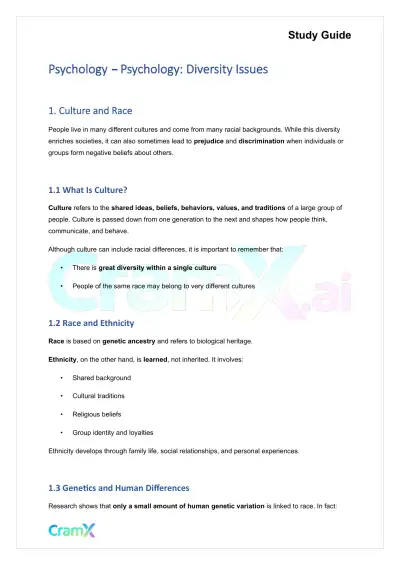 Quick Guides
Psychology - Psychology Diversity Issues
Psychology
7 pagesMar 2026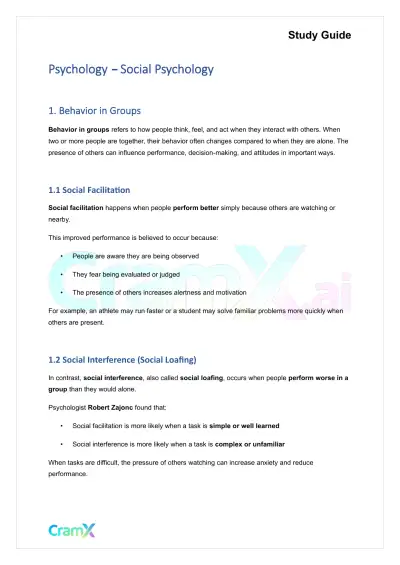 Quick Guides
Psychology - Social Psychology
Psychology
15 pagesMar 2026
Study this document with CramX
Once it is in your library, every tool can work from it.