

Psychology - Psychology Intelligence
- Psychology
- Texas A&M University
- 10 pages
- Shared March 2026
Preview 3 of 10 pages
See the first 3 pages exactly as they appear in the document.
Page 1 Read page 1 as text
Study Guide Psychology – Psychology : Intelligence 1. Intelligence Tests Intelligence is often described as a person’s overall mental ability , including how well they think, reason, and solve problems. Some of the most widely used intelligence tests were developed by David Wechsler . He defined intelligence as: “The global capacity to act purposefully, to think rationally, and to deal effectively with the environment.” Most psychologists agree with this general definition. However, they do not fully agree on: • How intelligence should be operationally defined (clearly defined in measurable terms) • The best way to measure intelligence accurately 1.1 How Intelligence Tests Are Constructed To be useful and trustworthy, intelligence tests must meet three important standards: 1. Standardization 2. Reliability 3. Validity Standardization Standardization means that: • The test is given and scored in the same way for everyone • Results can be compared fairly across individuals Test scores are interpreted by comparing them to scores from a standardization sample — a large, representative group of people who took the test under similar conditions. This comparison helps determine whether a score is above average, average, or below average.
Page 2 Read page 2 as text
Study Guide Reliability Reliability refers to the consistency of test results. A reliable test produces similar results under consistent conditions. There are several ways to measure reliability: Test – Retest Reliability • Compares scores from the same test taken at two different times Alternate - Form Reliability • Compares scores from different versions of the same test Split - Half Reliability • Compares scores from two halves of the same test , such as odd - numbered versus even - numbered questions If the scores are similar, the test is considered reliable. Validity Validity refers to whether a test actually measures what it claims to measure . A test can be reliable without being valid, but it cannot be valid unless it is reliable. Different types of validity include: Content Validity • Measures how well the test covers a representative sample of the behavior or knowledge being tested Predictive Validity • Indicates how well a test can predict future performance , such as academic or job success Face Validity • Refers to whether the test appears appropriate based on how the questions look • This is the weakest form of validity Construct Validity • Examines how well a test measures an abstract concept , such as intelligence
Page 3 Read page 3 as text
Study Guide Concurrent Validity • Shows how closely a test’s results match those of another established test measuring the same ability Key Takeaway Intelligence tests aim to measure general mental ability, but defining and measuring intelligence is complex. For a test to be useful, it must be standardized, reliable, and valid. Understanding these principles helps explain why some tests are more trustw orthy than others. 2. Measures of Intelligence Psychologists have been interested in measuring intelligence for a long time. Early researchers wanted to understand how people differ in mental abilities and how these differences can be measured fairly. 2.1 Early Work on Intelligence Testing One of the first scientists to study intelligence was Sir Francis Galton . In the late 1800s, Galton believed intelligence was closely related to sensory abilities , such as: • Visual and hearing sharpness • Reaction time Although modern psychology no longer defines intelligence this way, Galton’s work helped start the scientific study of individual differences . 2.2 The Binet – Simon Intelligence Scale The first practical intelligence test was created by Alfred Binet and Theodore Simon . Key Ideas • The test was designed for children • It measured mental age , or how a child performs compared to others of the same age • Mental age was compared to chronological age This comparison produced a mental quotient , which helped estimate a child’s learning potential.
7 more pages in the full document
Unlock it once and it stays in your library, ready to chat with or turn into flashcards.
Unlock the full documentMore Psychology study materials
See all Quick Guides
Psychology - Psychology Measurement and Statistics
Psychology
11 pagesMar 2026 Quick Guides
Psychology - Psychology Perception
Psychology
15 pagesMar 2026 Quick Guides
Psychology - Psychology Personality
Psychology
17 pagesMar 2026 Quick Guides
Psychology - Psychology Treatments
Psychology
12 pagesMar 2026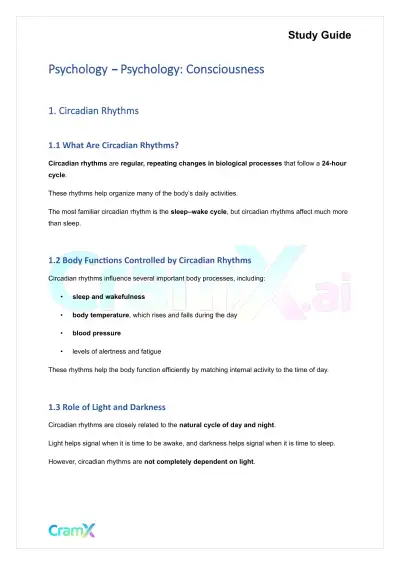 Quick Guides
Psychology - Psychology Consciousness
Psychology
16 pagesMar 2026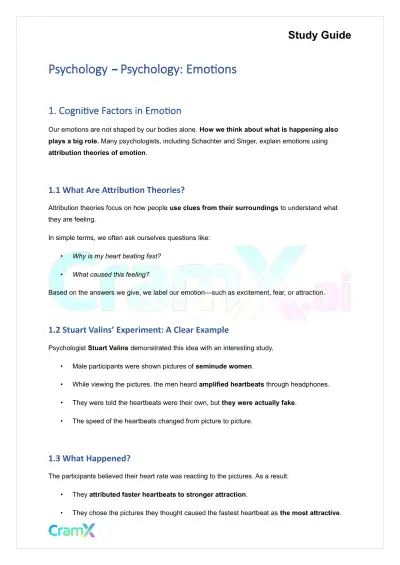 Quick Guides
Psychology - Psychology Emotions
Psychology
17 pagesMar 2026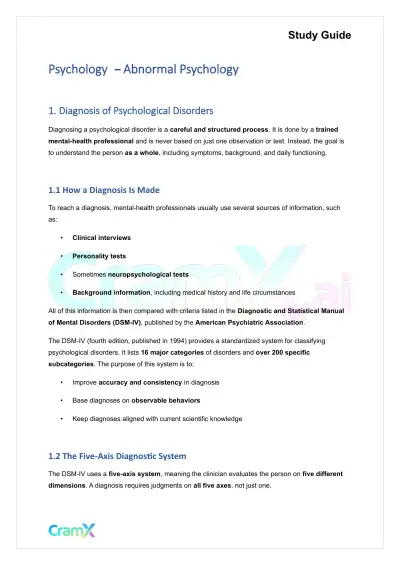 Quick Guides
Psychology - Abnormal Psychology
Psychology
14 pagesMar 2026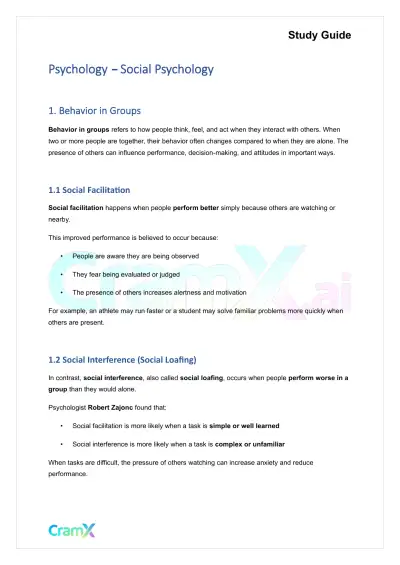 Quick Guides
Psychology - Social Psychology
Psychology
15 pagesMar 2026
Study this document with CramX
Once it is in your library, every tool can work from it.