

French I - Possession
- World Languages
- Texas A&M University
- 8 pages
- Shared March 2026
Preview 3 of 8 pages
See the first 3 pages exactly as they appear in the document.
Page 1 Read page 1 as text
Study Guide French I – Possession 1. Possession Using de 1. Using de to Show Possession or Relationship In French, the preposition de means “of” and is used to show possession or relationship between nouns. This is similar to using ’s in English. Examples: • les parents de Roger Roger’s parents / the parents of Roger • la voiture de Marie Marie’s car 2. Repeating de with Multiple Nouns If a sentence includes two or more nouns , de must be repeated before each noun . Example: • Ce sont les parents de Roger et de Luc. They are Roger and Luke’s parents. Here, de appears before both names. 3. Using d’ Before a Vowel When de comes before a word that starts with a vowel , it becomes d’ . Example: • la maison d’Anne Anne’s house
Page 2 Read page 2 as text
Study Guide 4. Contractions with Definite Articles When de is used with certain definite articles , contractions occur. Combination Result Meaning de + le du of the (masculine singular) de + les des of the (plural) Examples: • Ce sont les parents du garçon. They are the parents of the boy. • Ce sont les parents des garçons. They are the parents of the boys. 5. Key Pattern for Possession French usually expresses possession using the pattern: noun + de + owner Examples: • le livre de Paul – Paul’s book • la maison de mon ami – my friend’s house • les parents du garçon – the boy’s parents Key Takeaway To express possession in French: • Use de meaning “of” . • Repeat de before each noun if there are multiple owners. • Use d’ before a vowel. • Contract de + le → du and de + les → des .
Page 3 Read page 3 as text
Study Guide 2. Possession Using être à 1. Meaning of être à The expression être à means “to belong to.” It is commonly used in French to show ownership of an object or thing . The verb être (to be) must be conjugated to match the subject of the sentence. Basic structure: subject + être + à + owner Example: • Ce livre est à Marie. This book belongs to Marie. 2. Agreement with the Subject Because être is conjugated, its form changes depending on whether the subject is singular or plural . Examples: • Ce stylo est à Paul. This pen belongs to Paul. • Ces CDs sont à Mathieu. These CDs belong to Mathieu. 3. Using Multiple Owners If there are two or more owners , the preposition à must be repeated before each name . Example: • Ces CDs sont à Mathieu et à Bernard. These CDs belong to Mathieu and Bernard.
5 more pages in the full document
Unlock it once and it stays in your library, ready to chat with or turn into flashcards.
Unlock the full documentMore World Languages study materials
See all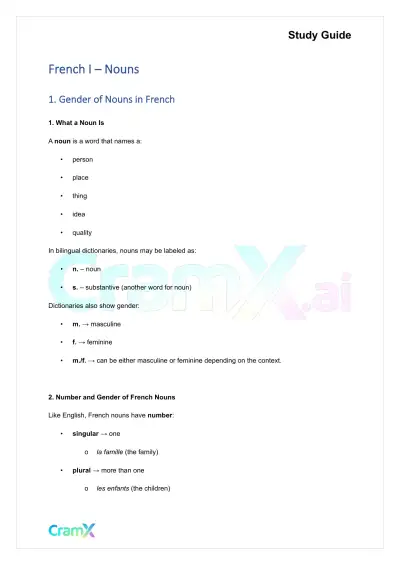 Quick Guides
French I - Nouns
World Languages
16 pagesMar 2026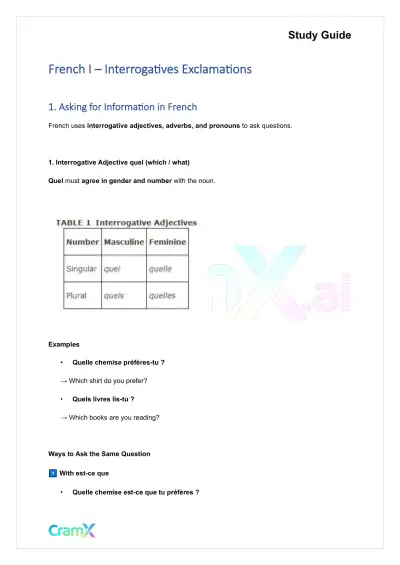 Quick Guides
French I - Interrogatives Exclamations
World Languages
12 pagesMar 2026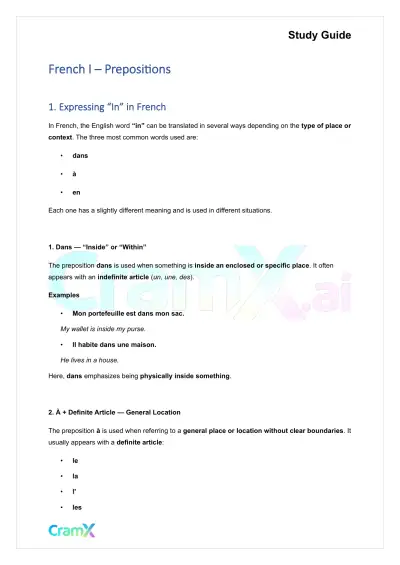 Quick Guides
French I - Prepositions
World Languages
24 pagesMar 2026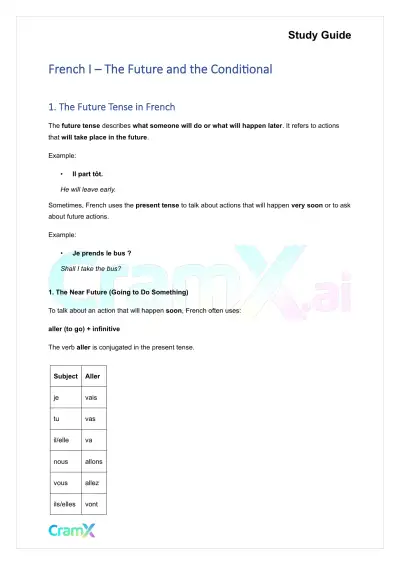 Quick Guides
French I - The Future and the Conditional
World Languages
13 pagesMar 2026 Quick Guides
French I - Present Tense of Verbs
World Languages
25 pagesMar 2026 Quick Guides
French I - Pronouns
World Languages
22 pagesMar 2026 Quick Guides
French I - Pronunciation
World Languages
26 pagesMar 2026 Quick Guides
French I - Verb Charts
World Languages
20 pagesMar 2026
Study this document with CramX
Once it is in your library, every tool can work from it.