

French I - Pronouns
- World Languages
- Texas A&M University
- 22 pages
- Shared March 2026
Preview 7 of 22 pages
See the first 7 pages exactly as they appear in the document.
Page 1 Read page 1 as text
Study Guide French I – Pronouns 1. Independent (Stress) Pronouns 1. What Independent (Stress) Pronouns Are Independent pronouns (also called stress pronouns ) can stand alone or follow a verb or preposition . They are used to: • emphasize a person • highlight or replace a noun or pronoun • answer questions • follow prepositions 2. French Independent Pronouns
Page 2 Read page 2 as text
Study Guide 3. Emphasizing the Subject Stress pronouns can be used at the beginning of a sentence to emphasize the subject. Example: • Moi, je suis vraiment indépendant. Me, I'm really independent. This highlights the speaker. 4. When There Is No Verb Independent pronouns can stand alone as answers. Example: • Qui veut partir ? Who wants to leave? • Moi. Me. 5. After Prepositions Independent pronouns are used after prepositions (such as à, chez, pour, avec). Example: • Allons chez elle. Let's go to her house. 6. After C'est They are also used after c'est . Example: • C'est moi qui pars. I'm the one leaving.
Page 3 Read page 3 as text
Study Guide 7. Used After Certain Verbs Some expressions require à + stress pronoun . Examples: • avoir affaire à – to deal with • être à – to belong to • faire attention à – to pay attention to • penser à – to think about • se fier à – to trust • s'intéresser à – to be interested in Example: • Ceci est à moi. This belongs to me. 8. In Compound Subjects Stress pronouns are used when two subjects are combined . Examples: • Lui et moi allons au restaurant. He and I are going to the restaurant. • Sylvie et toi dînez chez Marie. Sylvia and you are dining at Marie's. 9. Agreement in Compound Subjects When moi is part of a compound subject, French usually summarizes the subject as nous (we) . Example: • Lui et moi allons au restaurant.
Page 4 Read page 4 as text
Study Guide When toi is used in a compound subject, the sentence is treated like vous (you plural) . Example: • Sylvie et toi dînez chez Marie. Even though nous or vous may not appear in the sentence, the verb agrees with them . 10. Using - même(s) for Emphasis The word même can be added to stress pronouns to emphasize “self” or “by oneself.” Example: • Je suis allé au concert moi - même. I went to the concert myself. Key Takeaway Independent (stress) pronouns: • emphasize a person • stand alone or follow prepositions • are used in answers, compound subjects, and after c'est • can be strengthened with - même(s) for emphasis. 2. Relative Pronouns in French 1. What Relative Pronouns Do A relative pronoun connects a main clause with a dependent clause . It refers back to a noun or pronoun already mentioned, called the antecedent . Relative pronouns are similar to English words like: • who • which • that
Page 5 Read page 5 as text
Study Guide Example: • C'est la femme qui a gagné. She is the woman who won. Here, la femme is the antecedent , and qui introduces the clause describing her. 2. Using qui (Subject) Qui means who, which, or that and acts as the subject of the relative clause. Because it is the subject, a verb follows it . Structure: antecedent + qui + verb Example: • C'est la femme qui a gagné. She is the woman who won. The verb must agree with the antecedent : • C'est moi qui choisis les bons cafés. I am the one who chooses the good cafés. 3. Using que (Direct Object) Que means whom, which, or that and acts as the direct object in the relative clause. Structure: antecedent + que + subject + verb Example: • C'est l'homme que j'adore. He is the man that I love. Note: Even if “that” is omitted in English, que must always appear in French .
Page 6 Read page 6 as text
Study Guide 4. Using qui After a Preposition (for People) When the relative pronoun refers to a person and follows a preposition , French uses qui . Example: • Anne est la femme avec qui je travaille. Anne is the woman with whom I work. 5. Using lequel (for Things) Lequel and its forms mean which and are used mainly for things after prepositions. They must agree with the antecedent in gender and number . Forms of lequel Example: • Voilà la piscine dans laquelle je nage. There is the pool in which I swim. 6. Contractions with à and de When lequel follows the prepositions à or de , contractions occur. With à
Page 7 Read page 7 as text
Study Guide Example: • Ce sont les hommes auxquels elle pense. Those are the men she is thinking about. With de Form Meaning duquel of which de laquelle of which desquels of which (plural) desquelles of which (plural feminine) Example: • C'est la classe de laquelle je parlais. That's the class I was talking about.
15 more pages in the full document
Unlock it once and it stays in your library, ready to chat with or turn into flashcards.
Unlock the full documentMore World Languages study materials
See all Quick Guides
French I - Nouns
World Languages
16 pagesMar 2026 Quick Guides
French I - Possession
World Languages
8 pagesMar 2026 Quick Guides
French I - Interrogatives Exclamations
World Languages
12 pagesMar 2026 Quick Guides
French I - Prepositions
World Languages
24 pagesMar 2026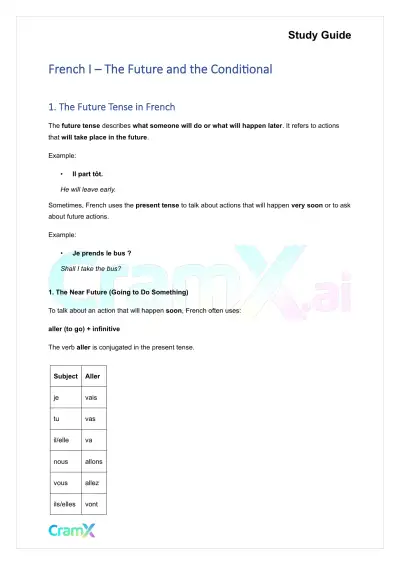 Quick Guides
French I - The Future and the Conditional
World Languages
13 pagesMar 2026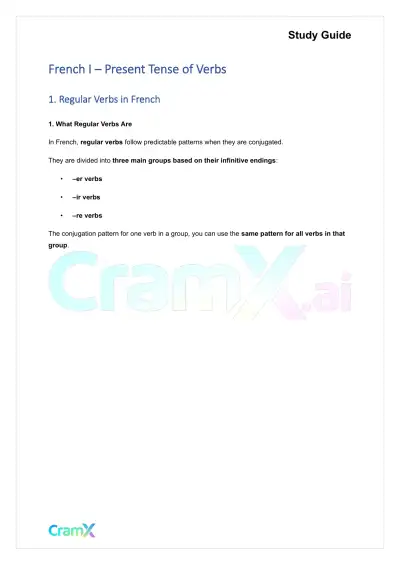 Quick Guides
French I - Present Tense of Verbs
World Languages
25 pagesMar 2026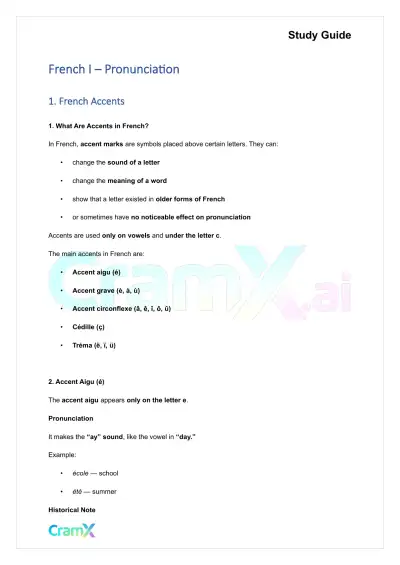 Quick Guides
French I - Pronunciation
World Languages
26 pagesMar 2026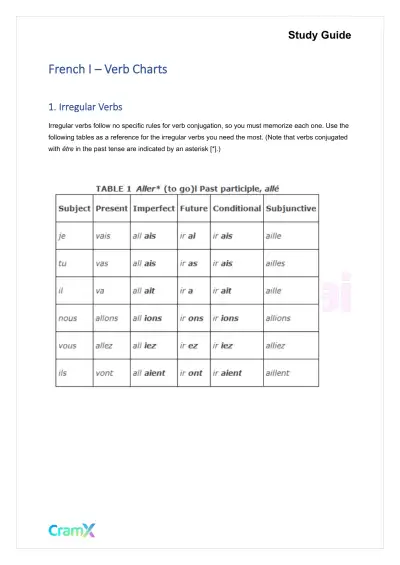 Quick Guides
French I - Verb Charts
World Languages
20 pagesMar 2026
Study this document with CramX
Once it is in your library, every tool can work from it.