

French I - The Future and the Conditional
- World Languages
- Texas A&M University
- 13 pages
- Shared March 2026
Preview 4 of 13 pages
See the first 4 pages exactly as they appear in the document.
Page 1 Read page 1 as text
Study Guide French I – The Future and the Conditional 1. The Future Tense in French The future tense describes what someone will do or what will happen later . It refers to actions that will take place in the future . Example: • Il part tôt. He will leave early. Sometimes, French uses the present tense to talk about actions that will happen very soon or to ask about future actions. Example: • Je prends le bus ? Shall I take the bus? 1. The Near Future (Going to Do Something) To talk about an action that will happen soon , French often uses: aller (to go) + infinitive The verb aller is conjugated in the present tense. Subject Aller je vais tu vas il/elle va nous allons vous allez ils/elles vont
Page 2 Read page 2 as text
Study Guide Examples • Il va aller loin. He is going to go far. • Ils vont jouer. They are going to play. This structure is called the near future (futur proche) . 2. When to Use the Future Tense The future tense is used to: A. Express what will happen Example: • Je réussirai. I will succeed. B. After certain time expressions Use the future tense after words like: • quand — when • lorsque — when • dès que — as soon as • aussitôt que — as soon as Example: • Quand nous aurons beaucoup d’argent, nous irons en France. When we have a lot of money, we will go to France. 3. Future Tense of Regular Verbs The future tense is formed by adding endings to the infinitive of the verb .
Page 3 Read page 3 as text
Study Guide These endings are similar to the present tense of avoir . Subject Ending je - ai tu - as il/elle - a nous - ons vous - ez ils/elles - ont
Page 4 Read page 4 as text
Study Guide Examples Verb je tu il laver laverai laveras lavera punir punirai puniras punira vendre vendrai vendras vendra Examples: • Nous laverons la voiture. We will wash the car. • Ils vendront la maison. They will sell the house. 4. Special Rules for Regular Verbs A. – re verbs drop the final e Example: • vendre → vendrons we will sell B. The final e in the infinitive is not pronounced. 5. Spelling Changes in the Future Some verbs change slightly before adding the endings. A. Verbs ending in – yer Often change y → i
9 more pages in the full document
Unlock it once and it stays in your library, ready to chat with or turn into flashcards.
Unlock the full documentMore World Languages study materials
See all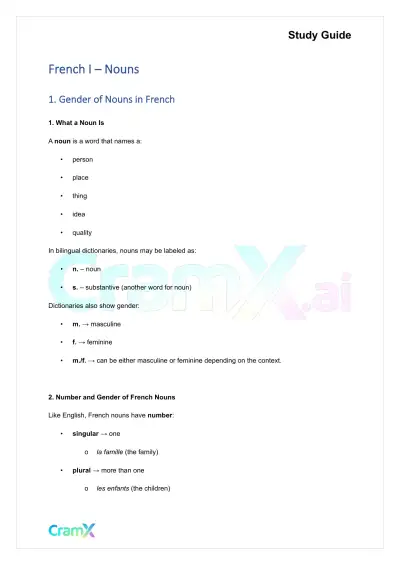 Quick Guides
French I - Nouns
World Languages
16 pagesMar 2026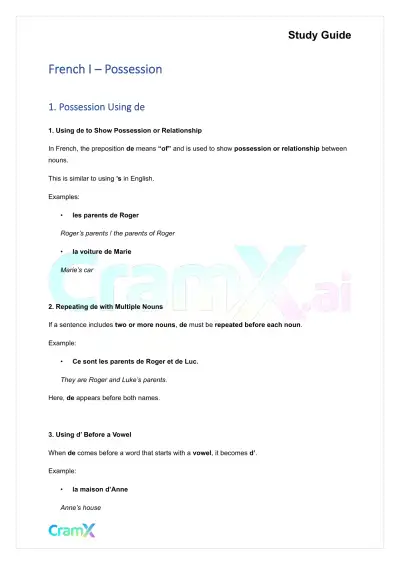 Quick Guides
French I - Possession
World Languages
8 pagesMar 2026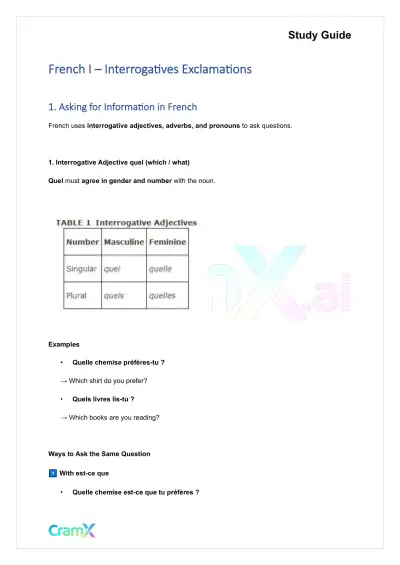 Quick Guides
French I - Interrogatives Exclamations
World Languages
12 pagesMar 2026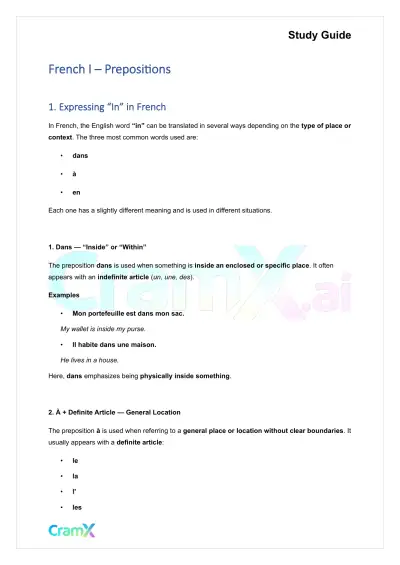 Quick Guides
French I - Prepositions
World Languages
24 pagesMar 2026 Quick Guides
French I - Present Tense of Verbs
World Languages
25 pagesMar 2026 Quick Guides
French I - Pronouns
World Languages
22 pagesMar 2026 Quick Guides
French I - Pronunciation
World Languages
26 pagesMar 2026 Quick Guides
French I - Verb Charts
World Languages
20 pagesMar 2026
Study this document with CramX
Once it is in your library, every tool can work from it.