

French I - Present Tense of Verbs
- World Languages
- Texas A&M University
- 25 pages
- Shared March 2026
Preview 8 of 25 pages
See the first 8 pages exactly as they appear in the document.
Page 1 Read page 1 as text
Study Guide French I – Present Tense of Verbs 1. Regular Verbs in French 1. What Regular Verbs Are In French, regular verbs follow predictable patterns when they are conjugated. They are divided into three main groups based on their infinitive endings : • – er verbs • – ir verbs • – re verbs T he conjugation pattern for one verb in a group, you can use the same pattern for all verbs in that group .
Page 2 Read page 2 as text
Study Guide 2. How to Form the Present Tense To conjugate regular verbs in the present tense , follow these steps: 1. Remove the infinitive ending ( - er, - ir, or - re) 2. Add the correct ending depending on the subject pronoun. Example verb parts:
Page 3 Read page 3 as text
Study Guide Verb Infinitive Stem parler parler parl - finir finir fin - vendre vendre vend - 3. Present Tense Endings for – ER Verbs Example: parler (to speak) Subject Ending Example je - e parle tu - es parles il/elle - e parle nous - ons parlons vous - ez parlez ils/elles - ent parlent 4. Present Tense Endings for – IR Verbs Example: finir (to finish) Subject Ending Example je - is finis tu - is finis
Page 4 Read page 4 as text
Study Guide il/elle - it finit nous - issons finissons vous - issez finissez ils/elles - issent finissent 5. Present Tense Endings for – RE Verbs Example: vendre (to sell) Subject Ending Example je - s vends tu - s vends il/elle — vend nous - ons vendons vous - ez vendez ils/elles - ent vendent Notice: The third person singular (il/elle) has no ending . 6. Special Exceptions in – RE Verbs Three verbs ending in - rompre behave slightly differently. Examples: • rompre – to break • corrompre – to corrupt • interrompre – to interrupt
Page 5 Read page 5 as text
Study Guide In the third person singular , they end with - t : • il rompt • il corrompt • il interrompt 7. Meaning of the Present Tense in French The French present tense can express several meanings in English: French English Meaning Je parle I speak Je parle I do speak Je parle I am speaking Unlike English, French usually does not use “do” or “am” as helpers unless they appear independently. Key Takeaway French regular verbs belong to three groups : • – er verbs • – ir verbs • – re verbs To conjugate them in the present tense : 1. Remove the infinitive ending . 2. Add the correct subject ending .
Page 6 Read page 6 as text
Study Guide 2. Regular Verbs with Spelling Changes (Shoe Verbs) 1. What Spelling - Change Verbs Are Some French verbs are mostly regular but have small spelling changes in certain forms . These verbs are often called “shoe verbs.” They are called this because the forms that change look like the shape of a shoe when you mark them on a conjugation chart. 2. What “Shoe” Means in Conjugation The spelling changes usually occur in these forms : • je • tu • il / elle / on • ils / elles These forms make the shape of a shoe in a conjugation table. The forms that usually do NOT change are: • nous • vous These often keep the same spelling as the infinitive stem .
Page 7 Read page 7 as text
Study Guide 3. Why Spelling Changes Happen The spelling changes usually happen to keep the correct pronunciation of the verb. For example: • to keep a soft sound • to maintain the original vowel sound The change is usually small (like adding a letter or changing a vowel). 4. Typical Pattern of Shoe Verbs Subject Change? je changes tu changes il / elle / on changes
Page 8 Read page 8 as text
Study Guide nous usually no change vous usually no change ils / elles changes This is why the pattern looks like a shoe shape . 5. Important Idea to Remember Even though these verbs have spelling changes: • they still follow regular conjugation endings • only the stem spelling changes Example pattern: stem change + regular ending Key Takeaway • Shoe verbs are verbs with spelling changes in certain forms . • The changes usually occur in je, tu, il/elle/on, ils/elles . • Nous and vous usually stay regular. • The changes help maintain correct pronunciation . 3. Irregular Verbs in French Irregular verbs are verbs that do not follow the normal conjugation rules of - er, - ir, or - re verb families. Because their forms change unpredictably, they must be memorized . These verbs are very common in everyday French. Most Common Irregular Verbs 1. aller (to go)
17 more pages in the full document
Unlock it once and it stays in your library, ready to chat with or turn into flashcards.
Unlock the full documentMore World Languages study materials
See all Quick Guides
French I - Nouns
World Languages
16 pagesMar 2026 Quick Guides
French I - Possession
World Languages
8 pagesMar 2026 Quick Guides
French I - Interrogatives Exclamations
World Languages
12 pagesMar 2026 Quick Guides
French I - Prepositions
World Languages
24 pagesMar 2026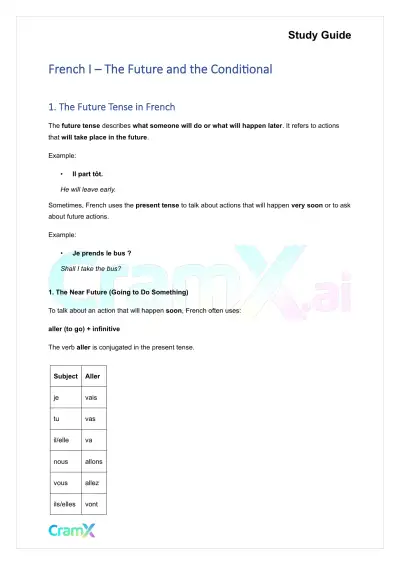 Quick Guides
French I - The Future and the Conditional
World Languages
13 pagesMar 2026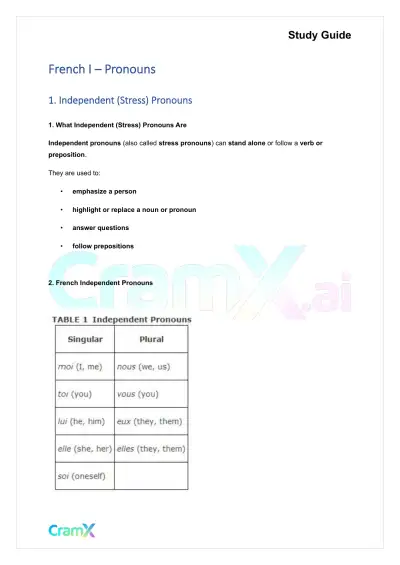 Quick Guides
French I - Pronouns
World Languages
22 pagesMar 2026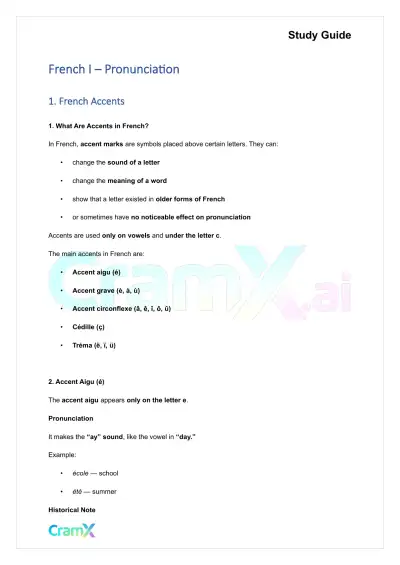 Quick Guides
French I - Pronunciation
World Languages
26 pagesMar 2026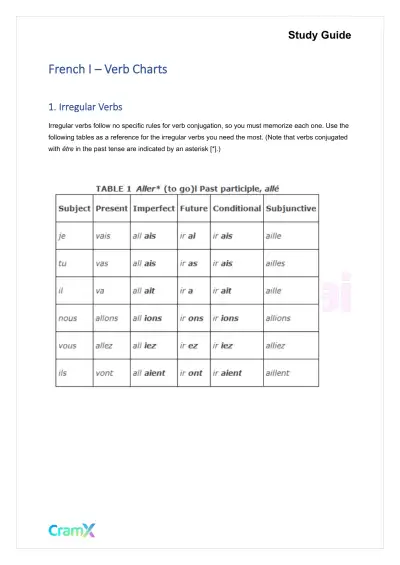 Quick Guides
French I - Verb Charts
World Languages
20 pagesMar 2026
Study this document with CramX
Once it is in your library, every tool can work from it.