

Spanish I - Irregular Verbs in the Present Tense
- World Languages
- Texas A&M University
- 43 pages
- Shared March 2026
Preview 10 of 43 pages
See the first 10 pages exactly as they appear in the document.
Page 1 Read page 1 as text
Study Guide Spanish I – Irregular Verbs in the Present Tense 1. Quiz: Stem - Changing Verbs in the Present Tense 1. Question Ella closes la ventana. Answer Choices • cierra • niega • empieza Correct Answer cierra Why This Is Correct The verb cerrar means “to close.” In the present tense, ella cierra translates directly to “she closes.” • niega = denies • empieza = begins So, cierra is the correct choice because it matches the meaning of the sentence exactly. 2. Question ¿Qué piensa (Ud.) del presidente?
Page 2 Read page 2 as text
Study Guide Answer Choices • piensan • piensas • piensa Correct Answer piensa Why This Is Correct In Spanish, “Ud.” (usted) uses third - person singular verb forms , even though it means “you.” The verb pensar in the present tense, third - person singular, is piensa . • Ud. piensa = You (formal) think • Tú piensas = You (informal) think • Ellos piensan = They think So, the correct sentence is: ¿Qué piensa Ud. del presidente? 3. Question Nosotros understand el dilema. Answer Choices • entendemos • entienden • entiendo Correct Answer entendemos
Page 3 Read page 3 as text
Study Guide Why This Is Correct The subject “Nosotros” means “we.” In Spanish, the verb entender (to understand) is conjugated as entendemos for nosotros in the present tense. • entiendo = I understand (yo) • entienden = they understand (ellos/ellas/ustedes) • entendemos = we understand (nosotros) So, the correct sentence is: Nosotros entendemos el dilema. 4. Question Mi hijo no ___ nunca. Answer Choices • miente • mientas • mienten Correct Answer miente Why This Is Correct The subject “Mi hijo” is third person singular , so the correct present - tense conjugation of mentir is miente . • miente = he lies • mientas = tú form (or used in the subjunctive) • mienten = they lie Since the sentence is a simple present - tense statement , miente is the correct choice.
Page 4 Read page 4 as text
Study Guide 5. Question El no can hablar árabe. Answer Choices • prueba • puede • vuela Correct Answer puede Why This Is Correct The correct verb is puede , which is the third - person singular form of poder (to be able to / can). The sentence means: He cannot speak Arabic. • puede = can / is able to → correct • prueba = tries/tests → incorrect meaning • vuela = flies → incorrect meaning Correct sentence: Él no puede hablar árabe. 6. Question El bebé no sleep toda la noche. Answer Choices • juega • duerme • viene
Page 5 Read page 5 as text
Study Guide Correct Answer duerme Why This Is Correct The sentence needs the correct Spanish verb for “sleep.” The verb dormir (to sleep) conjugated for él/ella/usted is duerme . So the correct sentence is: El bebé no duerme toda la noche. (The baby does not sleep all night.) The other options do not fit the meaning: • juega = plays • viene = comes 7 . Question En la fiesta las chicas ___ mucho. Answer Choices • ríen • siguen • miden Correct Answer ríen Why This Is Correct The verb reír means to laugh . In this sentence, “las chicas” is third person plural, so the correct present - tense conjugation is ríen .
Page 6 Read page 6 as text
Study Guide • ríen = they laugh • siguen = they follow • miden = they measure So the complete and correct sentence is: En la fiesta las chicas ríen mucho. 2. Confusing Verbs: Determining Which Verb to Use 2.1 Ser vs. Estar — Both Mean “To Be,” But Not the Same In English, we use “to be” for many situations. In Spanish, there are two different verbs : • Ser • Estar Both mean “to be,” but they describe different types of situations . Ser: For More Permanent or Defining Traits Ser is used for things that are long - lasting, defining, or essential . To make this easier, we use an acronym: C - NOTE (Reasons for Using Ser)
Page 7 Read page 7 as text
Study Guide Use ser for: • C – Characteristics • Physical or personality traits • Ellos son altos y delgados. • (They are tall and thin.) • N – Nationality / Origin • Where someone is from • Lolita es Colombiana. • (Lolita is Colombian.) • O – Occupation • Jobs or professions • Su padre es abogado. • (His father is a lawyer.) • T – Time • Telling time or dates • Son las cinco y media. • (It’s five thirty.) • E – Event location • Where an event takes place • La fiesta es en mi casa. • (The party is at my house.) Important Note: The “E” stands for Event location , which is an exception to the location rule you’ll see with estar . 2.2 Estar: For Temporary Conditions and Situations Estar is usually used for temporary states , feelings, or locations.
Page 8 Read page 8 as text
Study Guide To remember this, use the acronym: TLF (Reasons for Using Estar) Use estar for: • T – Temporary conditions • States that can change • La comida está caliente. • (The food is hot.) • L – Location (not events) • Where something or someone is located • El parque está aquí. • (The park is here.) • F – Feelings, emotions, and health • How someone feels • Estoy nerviosa durante un examen. • (I am nervous during a test.) Reminder: Even though locations don’t always feel temporary, buildings and places still use estar . Only events use ser for location.
Page 9 Read page 9 as text
Study Guide 2.3 Conocer vs. Saber — Both Mean “To Know” In English, we use “to know” for many ideas. In Spanish, there are two different verbs , and each has a specific use. Conocer: To Be Acquainted With Use conocer when you mean: • Knowing a person • Being familiar with a place • Being acquainted with something When conocer is followed by a person, it uses the preposition a . Examples: • Yo conozco a Manuel. • I know (am acquainted with) Manuel. • Conoces bien la ciudad de Guatemala. • You are familiar with Guatemala City. Saber: To Know a Fact or How to Do Something Use saber when talking about: • Facts or information • Knowing how to do something Saber is often followed by an infinitive (verb ending in - ar, - er, or - ir). In Spanish, you do not say the word “how” — it is understood. In the preterite tense , saber means “found out.” Examples: • Sabes construir una casa muy bien. • You know how to build a house very well. • Yo sé la dirección. • I know the address.
Page 10 Read page 10 as text
Study Guide • No vamos a la piscina porque no sabemos nadar. • We don’t go to the pool because we don’t know how to swim. 2.4 Llevar, Tomar, and Sacar — Different Ways to Say “To Take” The English verb “to take” can mean many things. Spanish uses different verbs depending on what is being taken . Llevar: To Take or Carry From One Place to Another Use llevar when you mean transporting a person or an object . If a person is taken somewhere, llevar uses the preposition a . Examples: • Marla lleva a su sobrina a la playa. • Marla takes her niece to the beach. • Juan y Andrés llevan los refrescos a la fiesta. • Juan and Andrés take the drinks to the party. • Llevas a un amigo a la fiesta. • You are taking a friend to the party. Tomar: To Take Transportation or Consume Something Use tomar when you: • Take a means of transportation • Take something by mouth (food, drinks, medicine) Examples: • Él nunca toma un taxi. • He never takes a taxi. • Es importante tomar vitaminas. • It’s important to take vitamins. • Toman muchas bebidas frías durante el verano.
33 more pages in the full document
Unlock it once and it stays in your library, ready to chat with or turn into flashcards.
Unlock the full documentMore World Languages study materials
See all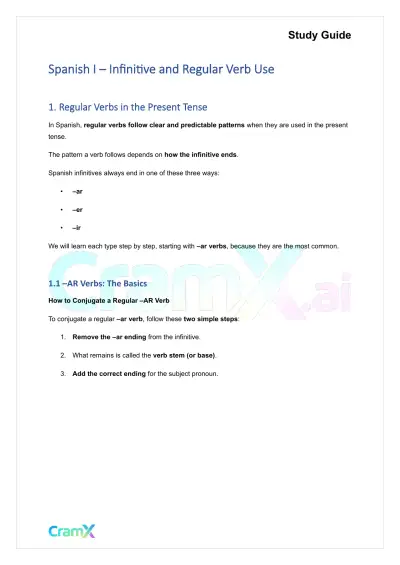 Quick Guides
Spanish I - Infinitive and Regular Verb Use
World Languages
38 pagesMar 2026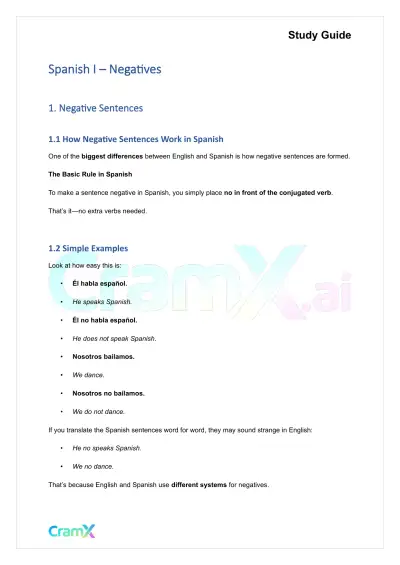 Quick Guides
Spanish I - Negatives
World Languages
19 pagesMar 2026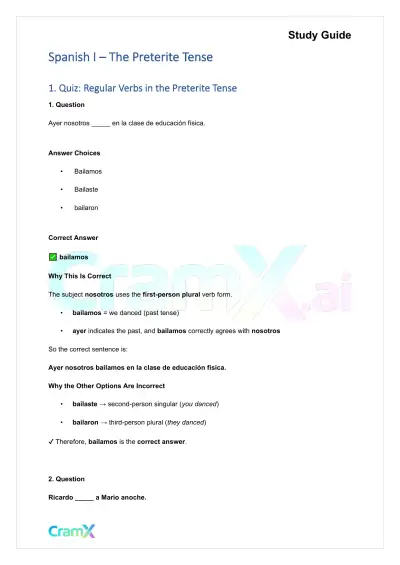 Quick Guides
Spanish I - The Preterite Tense
World Languages
52 pagesMar 2026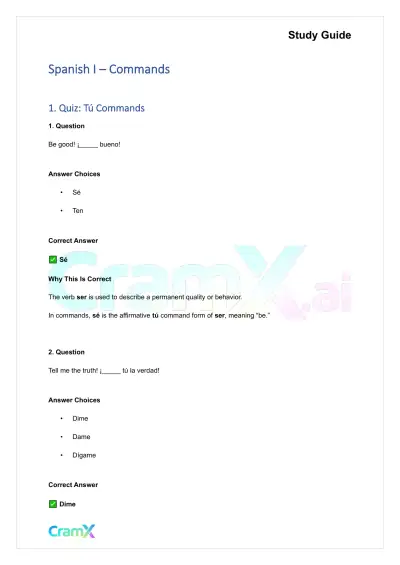 Quick Guides
Spanish I - Commands
World Languages
29 pagesMar 2026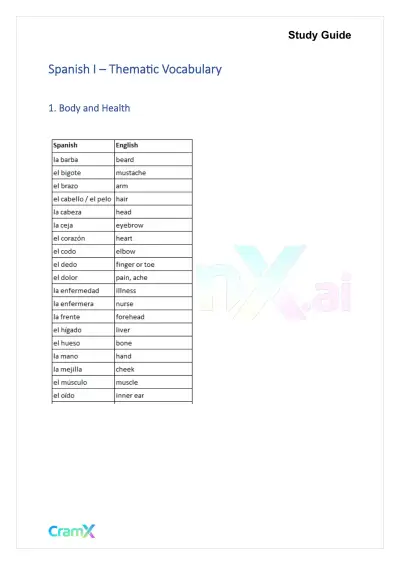 Quick Guides
Spanish I - Thematic Vocabulary
World Languages
27 pagesMar 2026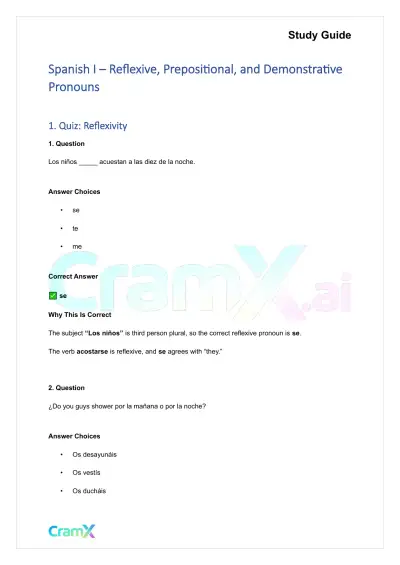 Quick Guides
Spanish I - Reflexive, Prepositional, and Demonstrative Pronouns
World Languages
20 pagesMar 2026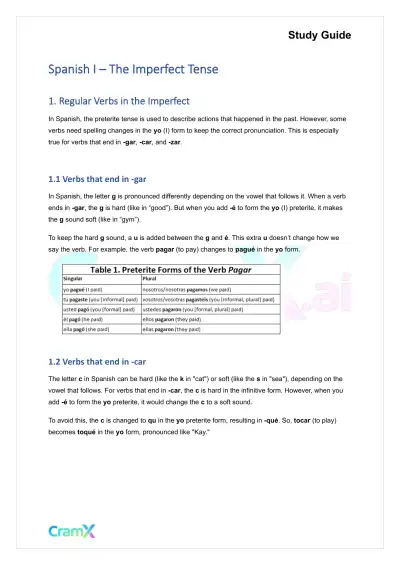 Quick Guides
Spanish I - The Imperfect Tense
World Languages
34 pagesMar 2026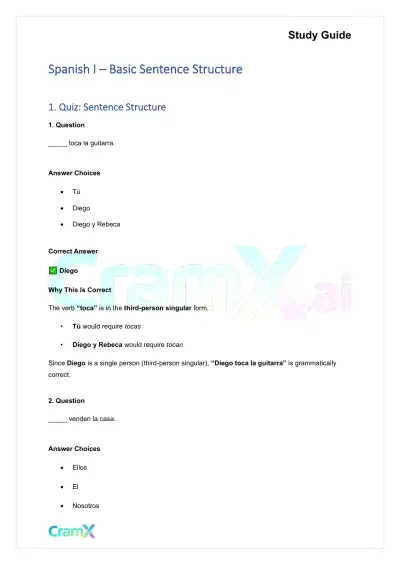 Quick Guides
Spanish I - Basic Sentence Structure
World Languages
14 pagesMar 2026
Study this document with CramX
Once it is in your library, every tool can work from it.