

Spanish I - Basic Sentence Structure
- World Languages
- Texas A&M University
- 14 pages
- Shared March 2026
Preview 5 of 14 pages
See the first 5 pages exactly as they appear in the document.
Page 1 Read page 1 as text
Study Guide Spanish I – Basic Sentence Structure 1. Quiz: Sentence Structure 1. Question _____ toca la guitarra. Answer Choices • Tú • Diego • Diego y Rebeca Correct Answer Diego Why This Is Correct The verb “toca” is in the third - person singular form. • Tú would require tocas • Diego y Rebeca would require tocan Since Diego is a single person (third - person singular), “Diego toca la guitarra” is grammatically correct. 2. Question _____ venden la casa. Answer Choices • Ellos • El • Nosotros
Page 2 Read page 2 as text
Study Guide Correct Answer Ellos Why This Is Correct The verb venden is in the third person plural form. Ellos matches this conjugation correctly. • Ellos venden la casa. ✔ • El vende la casa. ✘ (singular) • Nosotros vendemos la casa. ✘ (different verb ending) Therefore, Ellos is the correct choice. 3. Question _____ bebimos los refrescos. Answer Choices • Tú • Ellas • Nosotros Correct Answer Nosotros Why This Is Correct The verb “bebimos” is in the first - person plural (nosotros) form of the preterite tense. This form is used when “we” performed the action in the past. • Yo bebí → I drank • Tú bebiste → You drank
Page 3 Read page 3 as text
Study Guide • Nosotros bebimos → We drank Example Sentence: Nosotros bebimos los refrescos. 2. Conjunctions 2.1 What Are Conjunctions? One of the easiest ways to make your sentences more interesting is by using conjunctions . Conjunctions are small words that join ideas together . They can connect: • words • phrases • complete sentences In English, the most common conjunctions are and , but , and or . English Examples Here are some examples of how conjunctions work in English: • Jill and Brad are my neighbors. • Brad or Jill mows the lawn once a week. • Brad mows in the morning, but Jill prefers the evening. Each conjunction has a specific job: • and adds information • or gives a choice • but shows contrast 2.2 Spanish Conjunctions Spanish uses very similar conjunctions. The most basic Spanish conjunctions are:
Page 4 Read page 4 as text
Study Guide These conjunctions are used almost the same way as in English , which makes them easier to learn. 2.3 Subject – Verb Agreement with Conjunctions When conjunctions join subjects, they affect how the verb is used. Using y (and) When y joins two subjects, the subject becomes plural , so the verb must also be plural . • Estela y Coleta bailan tango. • (Estela and Coleta dance the tango.) • Notice that bailan is a plural verb form. Using o (or) When o joins two subjects, the subject is treated as singular , so the verb stays singular . • Miguelita o Marisol baila el flamenco hoy. • (Miguelita or Marisol dances the flamenco today.) • Notice that baila is a singular verb form. 2.4 Using pero (but) There is one important rule to remember about pero : pero can only be used to join complete sentences , not just nouns. • Juan baila pero Marco canta. • (Juan dances but Marco sings.)
Page 5 Read page 5 as text
Study Guide 2.5 Special Changes in Spanish Conjunctions Spanish conjunctions sometimes change their form to make pronunciation easier. o → u The conjunction o changes to u when it comes before a word that starts with o - or ho - . y → e The conjunction y changes to e when it comes before a word that starts with i - or hi - . These changes help Spanish sound smoother and avoid repeating similar sounds. Summary • Conjunctions connect ideas in a sentence • Spanish conjunctions y, pero, o work like and, but, or • y → plural verb • o → singular verb • pero joins only full sentences • y becomes e before i / hi • o becomes u before o / ho
9 more pages in the full document
Unlock it once and it stays in your library, ready to chat with or turn into flashcards.
Unlock the full documentMore World Languages study materials
See all Quick Guides
Spanish I - Negatives
World Languages
19 pagesMar 2026 Quick Guides
Spanish I - The Preterite Tense
World Languages
52 pagesMar 2026 Quick Guides
Spanish I - Irregular Verbs in the Present Tense
World Languages
43 pagesMar 2026 Quick Guides
Spanish I - Commands
World Languages
29 pagesMar 2026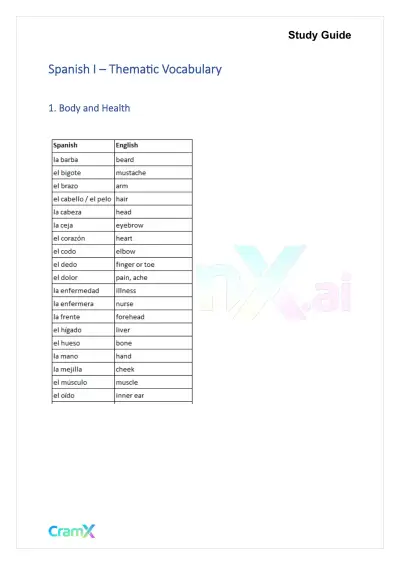 Quick Guides
Spanish I - Thematic Vocabulary
World Languages
27 pagesMar 2026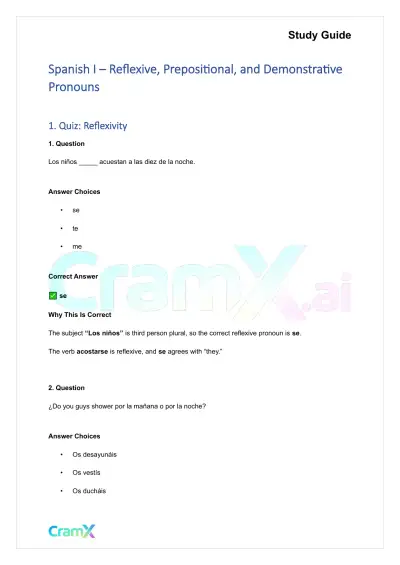 Quick Guides
Spanish I - Reflexive, Prepositional, and Demonstrative Pronouns
World Languages
20 pagesMar 2026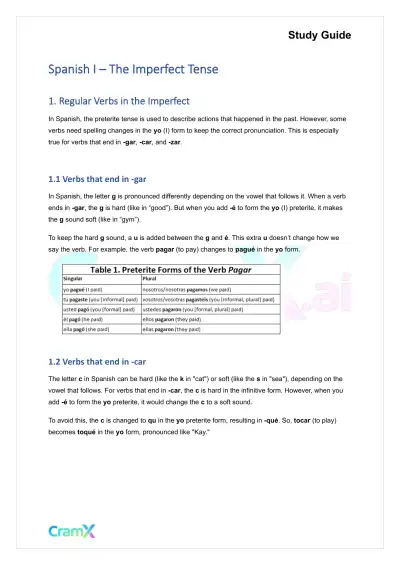 Quick Guides
Spanish I - The Imperfect Tense
World Languages
34 pagesMar 2026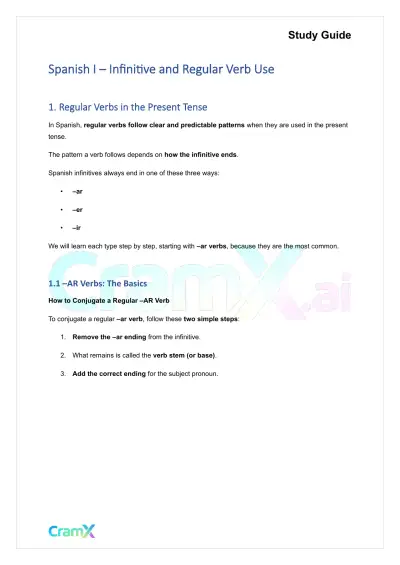 Quick Guides
Spanish I - Infinitive and Regular Verb Use
World Languages
38 pagesMar 2026
Study this document with CramX
Once it is in your library, every tool can work from it.