

Spanish I - Infinitive and Regular Verb Use
- World Languages
- Texas A&M University
- 38 pages
- Shared March 2026
Preview 10 of 38 pages
See the first 10 pages exactly as they appear in the document.
Page 1 Read page 1 as text
Study Guide Spanish I – Infinitive and Regular Verb Use 1. Regular Verbs in the Present Tense In Spanish, regular verbs follow clear and predictable patterns when they are used in the present tense. The pattern a verb follows depends on how the infinitive ends . Spanish infinitives always end in one of these three ways: • – ar • – er • – ir We will learn each type step by step, starting with – ar verbs , because they are the most common. 1.1 – AR Verbs: The Basics How to Conjugate a Regular – AR Verb To conjugate a regular – ar verb , follow these two simple steps : 1. Remove the – ar ending from the infinitive. 2. What remains is called the verb stem (or base) . 3. Add the correct ending for the subject pronoun.
Page 2 Read page 2 as text
Study Guide Example: The Verb Hablar (to speak) Let’s use hablar as an example. • Infinitive: hablar • Remove – ar • Stem: habl – Now, add the correct ending: • yo + o → hablo • tú + as → hablas • él/ella/usted + a → habla This same process works for all regular – ar verbs .
Page 3 Read page 3 as text
Study Guide 1.2 – ER Verbs: The Second Group Verbs that end in – er are the second most common type of regular verb. The process is the same as with – ar verbs: 1. Remove the – er ending. 2. Add the correct – er endings . The only difference is that – er verbs use different endings . Example: The Verb Comer (to eat) Let’s apply the steps to comer . • Infinitive: comer • Remove – er • Stem: com – Now add the endings: • yo como • tú comes • nosotros comemos • ellos comen
Page 4 Read page 4 as text
Study Guide 1.3 – IR Verbs: The Third Group The last group of regular verbs ends in – ir . Good news! – ir verbs are almost the same as – er verbs. There are only two differences : • The nosotros/nosotras ending • The vosotros/vosotras ending All other forms use the same endings as – er verbs . Example: The Verb Escribir (to write) Now let’s look at escribir , a regular – ir verb . • Infinitive: escribir • Remove – ir • Stem: escrib –
Page 5 Read page 5 as text
Study Guide Then add the endings: • yo escribo • tú escribes • nosotros escribimos • ellos escriben This pattern works for all regular – ir verbs . Summary • – ar, – er, and – ir verbs are conjugated differently • The steps never change : • remove the ending • add the correct one • – er and – ir verbs are very similar • Only nosotros and vosotros are different in – ir verbs 2. Quiz: Regular Verbs in the Present Tense 1. Question You (familiar, singular) run. = Answer Choices • Corre • Corres • Corriendo
Page 6 Read page 6 as text
Study Guide Correct Answer Corres Why This Is Correct In Spanish, the verb correr (to run) is conjugated based on the subject. “You (familiar, singular)” corresponds to tú , which uses the - es ending for regular - er verbs in the present tense. For example: • Yo corro → I run • Tú corres → You run (familiar, singular) • Él/Ella corre → He/She runs Corre is for él/ella/usted Corriendo is a gerund meaning running , not a conjugated verb 2 . Question They write. = Answer Choices • Escribís • Escriben • Estamos escribiendo Correct Answer Escriben
Page 7 Read page 7 as text
Study Guide Why This Is Correct “They write” is third person plural in English. In Spanish, the third person plural (ellos/ellas/ustedes) form of escribir in the present tense is escriben . Why the others are incorrect: • Escribís → second person plural ( vosotros ), mainly used in Spain • Estamos escribiendo → first person plural and present continuous (“we are writing”), not simple present Example: • They write letters every day. → Ellos escriben cartas todos los días. 3 . Question Julia y yo sing bien . Answer Choices • cantan • cantamos • cantáis Correct Answer cantamos Why This Is Correct “ Julia y yo ” is a first - person plural subject (equivalent to nosotros ). In the present tense, the verb cantar is conjugated as cantamos for nosotros . • cantan → they sing (ellos/ellas) • cantáis → you all sing (vosotros, used in Spain) • cantamos → we sing (nosotros) So the correct sentence is: Julia y yo cantamos bien.
Page 8 Read page 8 as text
Study Guide 4 . Question Mario y yo eat quesadillas. Answer Choices • comemos • comiendo • están comiendo Correct Answer comemos Why This Is Correct “Mario y yo” is a nosotros (we) subject. The correct present tense conjugation of comer for nosotros is comemos . • comiendo = “eating” (gerund, not a complete verb) • están comiendo = “they are eating” (incorrect subject) So the correct sentence is: Mario y yo comemos quesadillas. 5 . Question We live en Nueva York. Answer Choices • Vivimos • Vivamos • Viven
Page 9 Read page 9 as text
Study Guide Correct Answer Vivimos Why This Is Correct “ We live ” refers to the first person plural (nosotros) in the present tense . The correct present - tense conjugation of vivir for nosotros is vivimos . • Vivimos = we live • Vivamos = we may live (subjunctive, used for wishes/commands) • Viven = they live So, Vivimos correctly completes the sentence: We live en Nueva York. 6 . Question I read muchas novelas. Answer Choices • Leo • Lee • Puedo leer Correct Answer Leo Why This Is Correct “ Leo ” is the first - person singular present tense form of leer , which correctly matches the subject “I” (yo) . • Leo = I read • Lee = he/she reads
Page 10 Read page 10 as text
Study Guide • Puedo leer = I can read So, the correct sentence is: Yo leo muchas novelas. 7. Question He swims todos los días. Answer Choices • Nado • Nada • Nadando Correct Answer Nada Why This Is Correct The subject “He” (Él) requires the third - person singular form of the verb nadar in the present tense. • Nada = he/she swims • Nado = I swim • Nadando = swimming (gerund, not a conjugated verb) So, “He swims todos los días” → “Él nada todos los días.” 8 . Question Tú y Luciano travel juntos. Answer Choices • viajas • viajáis • viaja
28 more pages in the full document
Unlock it once and it stays in your library, ready to chat with or turn into flashcards.
Unlock the full documentMore World Languages study materials
See all Quick Guides
Spanish I - Negatives
World Languages
19 pagesMar 2026 Quick Guides
Spanish I - The Preterite Tense
World Languages
52 pagesMar 2026 Quick Guides
Spanish I - Irregular Verbs in the Present Tense
World Languages
43 pagesMar 2026 Quick Guides
Spanish I - Commands
World Languages
29 pagesMar 2026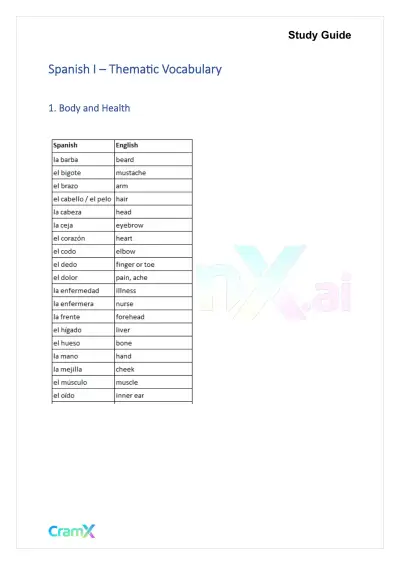 Quick Guides
Spanish I - Thematic Vocabulary
World Languages
27 pagesMar 2026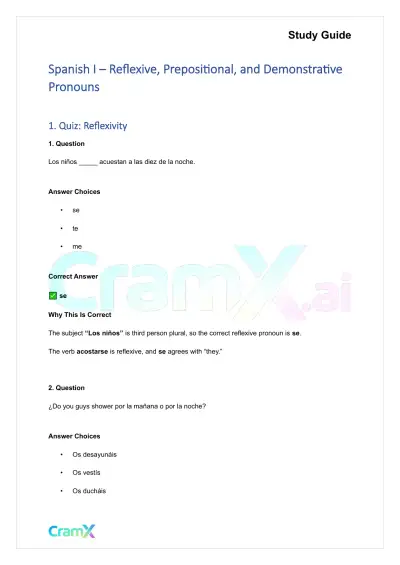 Quick Guides
Spanish I - Reflexive, Prepositional, and Demonstrative Pronouns
World Languages
20 pagesMar 2026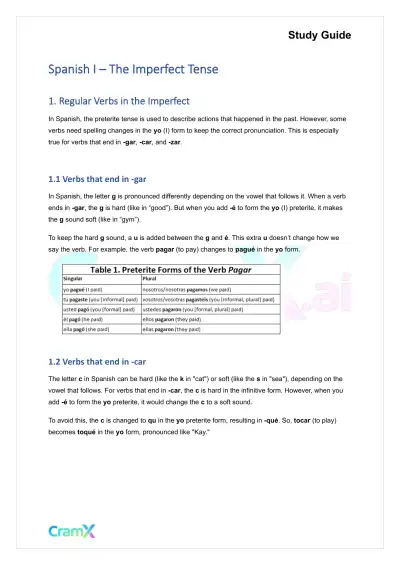 Quick Guides
Spanish I - The Imperfect Tense
World Languages
34 pagesMar 2026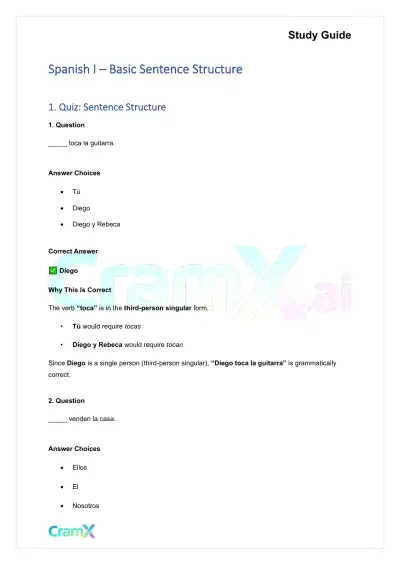 Quick Guides
Spanish I - Basic Sentence Structure
World Languages
14 pagesMar 2026
Study this document with CramX
Once it is in your library, every tool can work from it.