

Spanish I - Reflexive, Prepositional, and Demonstrative Pronouns
- World Languages
- Texas A&M University
- 20 pages
- Shared March 2026
Preview 6 of 20 pages
See the first 6 pages exactly as they appear in the document.
Page 1 Read page 1 as text
Study Guide Spanish I – Reflexive, Prepositional, and Demonstrative Pronouns 1. Quiz: Reflexivity 1. Question Los niños _____ acuestan a las diez de la noche. Answer Choices • se • te • me Correct Answer se Why This Is Correct The subject “Los niños” is third person plural, so the correct reflexive pronoun is se . The verb acostarse is reflexive, and se agrees with “they.” 2. Question ¿Do you guys shower por la mañana o por la noche? Answer Choices • Os desayunáis • Os vestís • Os ducháis
Page 2 Read page 2 as text
Study Guide Correct Answer Os ducháis Why This Is Correct The question is asking about showering . The reflexive verb ducharse means “to shower,” and os is used for you all (vosotros) . 3. Question Mi esposo y yo go to bed temprano. Answer Choices • nos acostamos • nos despertamos • nos bañamos Correct Answer nos acostamos Why This Is Correct “Mi esposo y yo” = we , so the correct reflexive pronoun is nos . Acostarse means “to go to bed,” which matches the sentence. 4. Question En la fiesta de año nuevo I enjoyed myself mucho. Answer Choices • me divertí • me fui • me despedí
Page 3 Read page 3 as text
Study Guide Correct Answer me divertí Why This Is Correct Divertirse means “to enjoy oneself.” The verb is in the past tense ( pretérito ) and matches “I enjoyed myself.” 5. Question Los profesores left después de trabajar. Answer Choices • se quedaron • se marcharon • se cayeron Correct Answer se marcharon Why This Is Correct Marcharse means “to leave.” The subject is plural ( los profesores ), so se marcharon is the correct form. 6. Question I wash la cara antes de que cepille los dientes. Answer Choices • Me limpio • Me ducho • Me lavo • Me baño
Page 4 Read page 4 as text
Study Guide Correct Answer Me lavo Why This Is Correct Lavarse is used for washing specific body parts, like la cara . Me lavo correctly expresses “I wash myself (my face).” 7. Question I fell asleep a la medianoche y I woke up a las seis de la mañana. Answer Choices • Me dormí, me levanté • Me desayuné, me vestí • Me fui, me desperté • Me dormí, me desperté Correct Answer Me dormí, me desperté Why This Is Correct Dormirse means “to fall asleep,” and despertarse means “to wake up.” Both verbs are in the past tense and correctly describe the actions in the sentence.
Page 5 Read page 5 as text
Study Guide 2. Prepositional Pronouns 2.1 What Are Prepositional Pronouns? Sometimes, a pronoun comes after a preposition like para (for), por (for/because of), con (with), or de (of/from). In these cases, Spanish uses prepositional pronouns . A prepositional pronoun replaces a noun that is the object of a preposition . (Refer to Table 1 above while reading this section.) Most prepositional pronouns look exactly the same as subject pronouns . However, there are two important exceptions : • yo → mí (has an accent mark) • tú → ti (no accent mark) Important to remember: • mí has an accent • ti does not have an accent All other forms stay the same as subject pronouns. 2.2 Why Do These Pronouns Sound Different? In English, pronouns after prepositions sound like object pronouns ( me, him, her ). In Spanish, they usually look like subject pronouns , even though they act like object pronouns.
Page 6 Read page 6 as text
Study Guide Example: • I sing for him • → Yo canto para él Here, él means him , not he , because it comes after the preposition para . Examples in Sentences Read these examples carefully and notice how the pronouns come after prepositions : • Mi hermana trabaja por mí porque estoy enferma. • My sister works for me because I’m sick. • Yo no compré esta comida para ti. • I didn’t buy this meal for you. • Ese libro romántico es el mejor para ella. • That romantic book is the best for her. • Queremos viajar con él porque él conoce bien la ciudad. • We want to travel with him because he knows the city well. • Ella no nos invita a nosotros porque no somos buenos amigos. • She doesn’t invite us because we are not good friends. • Catalina no baila con ellos cuando ponen música lenta. • Catalina doesn’t dance with them when they play slow music. These examples show how prepositional pronouns are used naturally in everyday Spanish. 2.3 Special Case: con + mí / ti When the preposition con ( with ) is followed by mí or ti , they combine into one word . conmigo = with me • con + mí → conmigo • The accent mark disappears when - go is added.
14 more pages in the full document
Unlock it once and it stays in your library, ready to chat with or turn into flashcards.
Unlock the full documentMore World Languages study materials
See all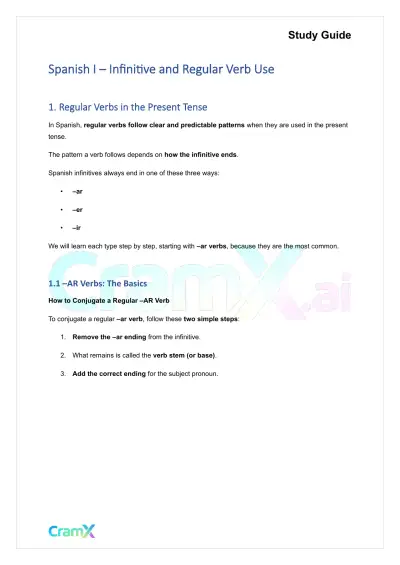 Quick Guides
Spanish I - Infinitive and Regular Verb Use
World Languages
38 pagesMar 2026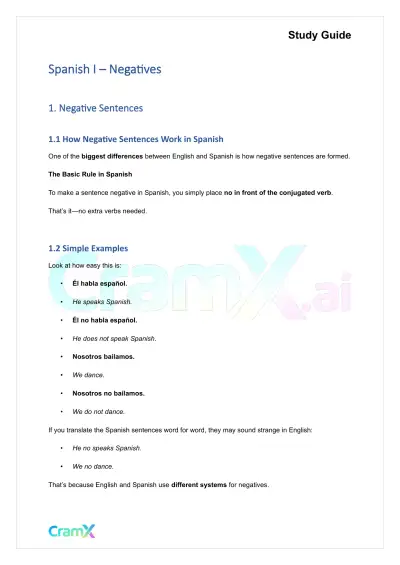 Quick Guides
Spanish I - Negatives
World Languages
19 pagesMar 2026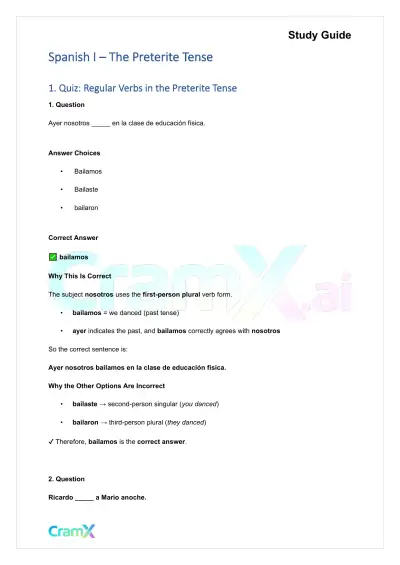 Quick Guides
Spanish I - The Preterite Tense
World Languages
52 pagesMar 2026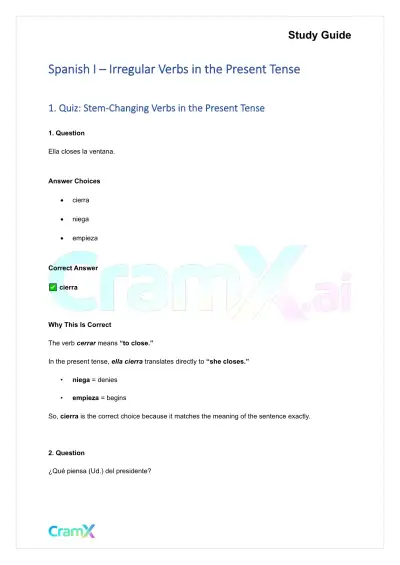 Quick Guides
Spanish I - Irregular Verbs in the Present Tense
World Languages
43 pagesMar 2026 Quick Guides
Spanish I - Commands
World Languages
29 pagesMar 2026 Quick Guides
Spanish I - Thematic Vocabulary
World Languages
27 pagesMar 2026 Quick Guides
Spanish I - The Imperfect Tense
World Languages
34 pagesMar 2026 Quick Guides
Spanish I - Basic Sentence Structure
World Languages
14 pagesMar 2026
Study this document with CramX
Once it is in your library, every tool can work from it.