

Spanish I - The Imperfect Tense
- World Languages
- Texas A&M University
- 34 pages
- Shared March 2026
Preview 10 of 34 pages
See the first 10 pages exactly as they appear in the document.
Page 1 Read page 1 as text
Study Guide Spanish I – The Imperfect Tense 1. Regular Verbs in the Imperfect In Spanish, the preterite tense is used to describe actions that happened in the past. However, some verbs need spelling changes in the yo (I) form to keep the correct pronunciation. This is especially true for verbs that end in - gar , - car , and - zar . 1.1 Verbs that end in - gar In Spanish, the letter g is pronounced differently depending on the vowel that follows it. When a verb ends in - gar , the g is hard (like in “good”). But when you add - é to form the yo (I) preterite, it makes the g sound soft (like in “gym”). To keep the hard g sound, a u is added between the g and é . This extra u doesn’t change how we say the verb. For example, the verb pagar (to pay) changes to pagué in the yo form. 1.2 Verbs that end in - car The letter c in Spanish can be hard (like the k in "cat") or soft (like the s in "sea"), depending on the vowel that follows. For verbs that end in - car , the c is hard in the infinitive form. However, when you add - é to form the yo preterite, it would change the c to a soft sound. To avoid this, the c is changed to qu in the yo preterite form, resulting in - qué . So, tocar (to play) becomes toqué in the yo form, pronounced like "Kay."
Page 2 Read page 2 as text
Study Guide 1.3 Verbs that end in - zar When a verb ends in - zar , the z changes to a c in the yo preterite form. This is because in Spanish, when z is followed by an e , it is pronounced as c . For example, cruzar (to cross) changes to crucé in the yo form.
Page 3 Read page 3 as text
Study Guide
Page 4 Read page 4 as text
Study Guide 1.4 I to Y Spelling Change When a verb stem ends in a vowel and is followed by certain endings, a spelling change happens in the preterite tense. Specifically, if there are three vowels in a row and the middle vowel is i , the i changes to y . This change happens in the third - person forms ( él, ella, usted, ellos, ellas, ustedes ), and an accent is added to other i vowels. For example, caer (to fall) changes to cayó for the él/ella/usted form. 1.5 Other Common Verbs with I to Y Changes Other verbs that end in - er or - ir also follow this I to Y rule, like leer (to read) or oír (to hear). These verbs change their i to y in the third person forms.
Page 5 Read page 5 as text
Study Guide • This image shows other common verbs like creer (to believe), leer (to read), and oír (to hear) that follow the I to Y rule. 1.6 Verbs that end in - uir Verbs ending in - uir (like construir – to build) also follow similar rules in the preterite . These verbs change their endings in the third - person forms, much like caer .
Page 6 Read page 6 as text
Study Guide Conclusion Remember these spelling changes only apply to certain verbs in the yo form of the preterite tense and follow consistent patterns. By practicing these changes, you’ll be able to use these verbs correctly and confidently! 2. The Three Imperfect Irregulars In the imperfect tense, most Spanish verbs follow regular patterns. However, three very common verbs do not follow the usual rules at all : • ser (to be) • ir (to go) • ver (to see) Because these verbs are so important, it’s best to memorize their imperfect forms . Let’s look at each one step by step. 2.1 Ser (to be) – Imperfect Tense The verb ser is completely irregular in the imperfect tense. This means you do not use regular endings and you do not remove an infinitive ending . Instead, you must learn all of its forms as they are. This table shows all singular and plural forms of ser in the imperfect tense, such as era , éramos , and eran . These forms are used to describe what someone was or used to be in the past. 2.2 Ir (to go) – Imperfect Tense Just like ser , the verb ir is also completely irregular in the imperfect tense. None of its forms follow the regular verb patterns.
Page 7 Read page 7 as text
Study Guide This table shows the full conjugation of ir , including forms like iba , íbamos , and iban . These forms are used to talk about where someone was going or used to go in the past. 2.3 Ver (to see) – Imperfect Tense The verb ver is a little different. It is considered irregular, but not for the same reason as ser and ir . At first glance, ver looks regular because it uses the standard imperfect endings for – er verbs . However, what makes ver irregular is how its stem is formed . 2.4 Why Ver Is Still Irregular With most regular – er verbs, you remove the entire – er ending before adding imperfect endings. Example: • comer → comía But with ver , you remove only the final – r , not the entire ending. This leaves the stem ve – , which is then used with regular imperfect endings. That’s why the conjugation looks like: • veía, veías, veía, veíamos, veían Also, notice that all forms of ver have accent marks . This is because all regular imperfect endings for – er and – ir verbs include written accents , and ver follows that same pattern.
Page 8 Read page 8 as text
Study Guide Summary • Ser and ir are completely irregular in the imperfect tense and must be memorized. • Ver uses regular imperfect endings , but its stem is irregular. • All three verbs are very common, so learning them well will make Spanish much easier. 3. Quiz: The Three Imperfect Irregulars 1. Question ¿_____ usted al parque los domingos? Answer Choices • Ibas • Iba • Iban Correct Answer Iba Why This Is Correct The sentence is talking about a habitual action in the past (“on Sundays”), so the imperfect tense is needed. • “Usted” is a singular subject. • The correct imperfect form of ir for usted is iba . Why the others are incorrect: • Ibas → used with tú , not usted • Iban → used with ellos/ustedes (plural)
Page 9 Read page 9 as text
Study Guide Example: • Usted iba al parque los domingos. 2 . Question Yo _____ la tele durante la noche. Answer Choices • veías • veían • veía Correct Answer veía Why This Is Correct The subject “Yo” (I) requires the first person singular form of the verb ver in the imperfect tense . • veía = I was watching / I used to watch • veías = you (tú) were watching • veían = they were watching The imperfect tense is used to describe ongoing or habitual actions in the past , such as watching TV at night. Correct sentence: Yo veía la tele durante la noche. 3 . Question De niño ellos _____ muy simpáticos.
Page 10 Read page 10 as text
Study Guide Answer Choices • era • eran • eras Correct Answer eran Why This Is Correct The subject “ellos” is plural , so the verb ser must also be in the plural imperfect tense . “Eran” is the correct imperfect form of ser used to describe what people were like in the past . • Era → singular (he/she/it) • Eras → singular informal you (tú) • Eran → plural ( ellos/ellas ) ✔ So, the correct sentence is: De niño ellos eran muy simpáticos. 4 . Question ¿_____ vosotros las películas para niños? Answer Choices • Veíais • Veían • Veíamos Correct Answer Veíais
24 more pages in the full document
Unlock it once and it stays in your library, ready to chat with or turn into flashcards.
Unlock the full documentMore World Languages study materials
See all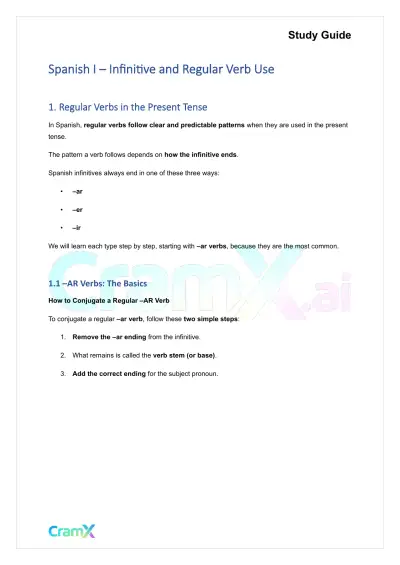 Quick Guides
Spanish I - Infinitive and Regular Verb Use
World Languages
38 pagesMar 2026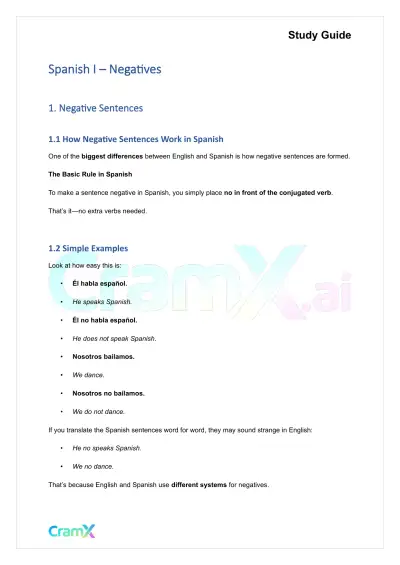 Quick Guides
Spanish I - Negatives
World Languages
19 pagesMar 2026 Quick Guides
Spanish I - The Preterite Tense
World Languages
52 pagesMar 2026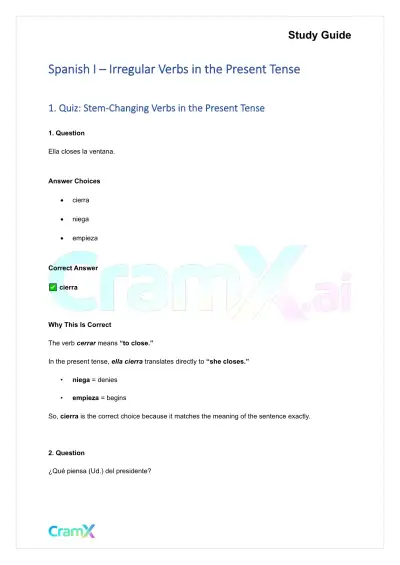 Quick Guides
Spanish I - Irregular Verbs in the Present Tense
World Languages
43 pagesMar 2026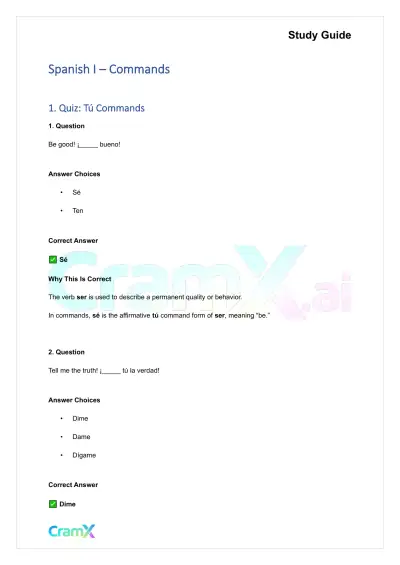 Quick Guides
Spanish I - Commands
World Languages
29 pagesMar 2026 Quick Guides
Spanish I - Thematic Vocabulary
World Languages
27 pagesMar 2026 Quick Guides
Spanish I - Reflexive, Prepositional, and Demonstrative Pronouns
World Languages
20 pagesMar 2026 Quick Guides
Spanish I - Basic Sentence Structure
World Languages
14 pagesMar 2026
Study this document with CramX
Once it is in your library, every tool can work from it.