

Spanish I - Narration in the Past
- World Languages
- Texas A&M University
- 25 pages
- Shared March 2026
Preview 8 of 25 pages
See the first 8 pages exactly as they appear in the document.
Page 1 Read page 1 as text
Study Guide Spanish I – Narration in the Past 1. Quiz: Verbs That Change Meaning in the Preterite 1. Question Yo got un carro magnífico cuando cumplí 16 años. Answer Choices • Tuve • tenía Correct Answer tenía Why This Is Correct In this sentence, "tenía" is the correct choice because it is the imperfect tense, which describes an action or state that was ongoing or habitual in the past. The phrase "cuando cumplí 16 años" implies that the speaker had the car over a period of time ar ound their 16th birthday, so the imperfect tense is appropriate. "Tuve" would be incorrect because it is the preterite tense, used for actions that are viewed as completed or specific in time, which doesn’t fit the context of an ongoing state. 2. Question Pilar met a su nueva profesora ayer. Answer Choices • conoció • conocía
Page 2 Read page 2 as text
Study Guide Correct Answer conoció Why This Is Correct The verb "conoció" is in the preterite tense, which is used to describe actions that were completed in the past. Since the sentence indicates that Pilar met her new teacher yesterday, this is a one - time event, which calls for the preterite tense. On the other hand, "conocía" is in the imperfec t tense, which would describe actions that were habitual or ongoing in the past. 3. Question Por fin los muchachos ___ comprar un boleto para el concierto. Answer Choices • pudieron • podían Correct Answer pudieron Why This Is Correct The correct answer is "pudieron," as it is the preterite tense of the verb "poder," used to express an action completed in the past. In this case, the sentence indicates that the boys succeeded in buying the ticket, which is a completed action. "Podían" is the imperfect tense, which would suggest an ongoing or habitual action in the past, not a completed one. 4. Question Nosotros knew que la película empezó tarde.
Page 3 Read page 3 as text
Study Guide Answer Choices • supimos • sabíamos Correct Answer sabíamos Why This Is Correct The verb "sabíamos" is the correct choice because it is the imperfect form of "saber," which expresses ongoing or habitual actions in the past. "Sabíamos" means "we knew" in a general sense, implying that the knowledge was ongoing or not confined to a sing le event. On the other hand, "supimos" (the preterite form) would indicate that the action of knowing was completed at a specific point in the past. 5. Question Graciela refused to train with the volleyball team. Answer Choices • no quiso • no quería Correct Answer no quiso Why This Is Correct The correct answer is "no quiso," as the verb "quiso" (the preterite form of "querer ") indicates a specific action that was refused or declined at a particular point in the past. "No quería" would be used to express an ongoing or habitual refusal in the past, but in this case, the action is a specific instance.
Page 4 Read page 4 as text
Study Guide 6. Question Tú wanted ir con tus amigos, ¿verdad? Answer Choices • quisiste • querías Correct Answer querías Why This Is Correct The correct choice is "querías " because it uses the imperfect tense, which expresses an ongoing or habitual action in the past. In this case, you're asking about a situation that was likely continuous or habitual, like a desire to do something with friends. "Quisiste" (preterite tense) would be used for a completed action, which doesn’t fit the context here. For example: • Querías ir (you wanted to go) implies you were in a state of wanting, possibly for an extended period. • Quisiste ir (you wanted to go) implies a specific, completed instance of wanting. 7. Question Pedro knew muy bien a esa actriz. Answer Choices • conoció • conocía Correct Answer conocía
Page 5 Read page 5 as text
Study Guide Why This Is Correct The verb "conocía" is the imperfect tense of "conocer ," which is used to describe actions that were ongoing or habitual in the past, or to give background information. In this case, it suggests that Pedro had an ongoing familiarity with the actress in the past. For example: Pedro conocía muy bien a esa actriz, meaning he knew her well over a period of time. 8 . Question Yo found out quién ganó la carrera. Answer Choices • supe • sabía Correct Answer supe Why This Is Correct "Supe" is the correct form because it refers to a specific moment in the past when the speaker learned the information (preterite tense). "Sabía" would be used in a more general, habitual context or to describe background knowledge in the past, but here, the action of finding out is a one - time event. 2. Preterite - Imperfect Formulas In Spanish, the preterite and imperfect tenses are often used together in the same sentence. While this might seem tricky at first, there are easy sentence structures (or formulas) you can learn to make it simpler. To connect two verbs in the past tense, you’ll need two important words: mientras (while) and cuando (when). It's important to remember that cuando doesn’t have an accent mark unless it’s used as a question word.
Page 6 Read page 6 as text
Study Guide 2.1 Both Verbs in the Imperfect Tense When mientras is used to show two ongoing actions happening together, both verbs will be in the imperfect tense. This means that neither action interrupts the other, and both are happening at the same time. • Formula: Imperfect + mientras + Imperfect • Example: Ellos secaban los platos mientras yo los lavaba. • (They were drying the dishes while I was washing them.) 2.2 One Verb in the Preterite and the Other in the Imperfect When mientras connects an action in progress with an action that interrupts it, the verb in the preterite interrupts the ongoing action in the imperfect. • Formula: Preterite + mientras + Imperfect • Example: Samuel llamó mientras tú estudiabas. • (Samuel called while you were studying.) Notice that you can flip the sentence order and it still makes sense. Whether mientras comes in the middle or the beginning, the verb in the imperfect will show the ongoing action, and the verb in the preterite will show the interrupting action. • Formula: Mientras + Imperfect, Preterite • Example: Mientras tú estudiabas, Samuel llamó. • (While you were studying, Samuel called.) 2.3 Joining Verbs with "Cuando" (When) Cuando is another word that helps link actions in the past. It usually comes with the preterite tense because it points to a specific moment when something happened. In many cases, one verb is in the imperfect (showing an ongoing action) and the other is in the preterite (showing something that interrupts or happens at a specific time). One Verb in the Imperfect and One in the Preterite When cuando connects an ongoing action with a moment in time (the preterite), the verb after cuando will be in the preterite.
Page 7 Read page 7 as text
Study Guide • Formula: Imperfect + cuando + Preterite • Example: Alicia trabajaba cuando yo entré en la oficina. • (Alicia was working when I entered the office.) Just like with mientras , the order of the sentence can be switched, but cuando will always be followed by a verb in the preterite. • Formula: Cuando + Preterite, Imperfect • Example: Cuando yo entré en la oficina, Alicia trabajaba. • (When I entered the office, Alicia was working.) When cuando is at the beginning, a comma will separate it from the imperfect verb that follows. 2.4 Two Verbs in the Preterite In some cases, cuando is used to connect two actions that happened at the same time or one action that caused the other. Both verbs will be in the preterite tense. • Formula: Preterite + cuando + Preterite • Example: Carlos me llamó cuando él llegó. • (Carlos called me when he arrived.) • Yo grité cuando vi al fantasma. • (I screamed when I saw the ghost.) You can also flip the order of these sentences, just remember to put a comma between the two verbs. • Formula: Cuando + Preterite, Preterite • Example: Cuando él llegó, Carlos me llamó. • (When he arrived, Carlos called me.) • Cuando vi al fantasma, yo grité. • (When I saw the ghost, I screamed.)
Page 8 Read page 8 as text
Study Guide Summary • Mientras is used to connect two actions happening at the same time. If both verbs describe ongoing actions, use the imperfect tense for both. If one action interrupts another, the interrupting action is in the preterite. • Cuando is mostly followed by the preterite to point to a specific moment. If it's connecting an ongoing action and an interrupting action, the imperfect comes first. But when two completed actions are happening at the same time, both verbs are in the preterite. 3. Quiz: Preterite - Imperfect Formulas 1. Question Mientras yo _____ en el parque, la lluvia empezó. Answer Choices • corrí • corría Correct Answer corría Why This Is Correct In this sentence, the verb "corría " is correct because the action is described in the imperfect tense, which is used to describe actions that were ongoing in the past or habitual actions. The context of the sentence suggests that the action of running in the park was happening when the rain started, which is why the imperfect tense (corría) is used. 2. Question Beatriz estudiaba su vocabulario mientras su hermana _____ su tarea.
17 more pages in the full document
Unlock it once and it stays in your library, ready to chat with or turn into flashcards.
Unlock the full documentMore World Languages study materials
See all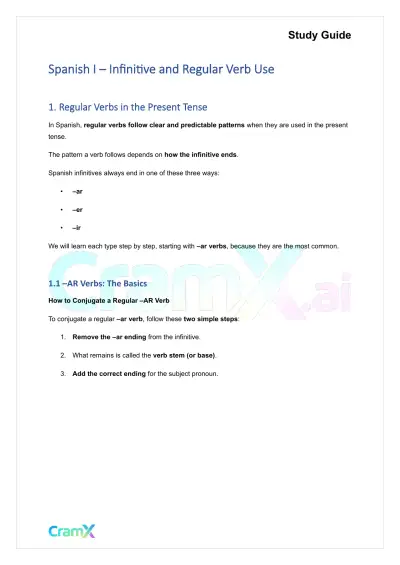 Quick Guides
Spanish I - Infinitive and Regular Verb Use
World Languages
38 pagesMar 2026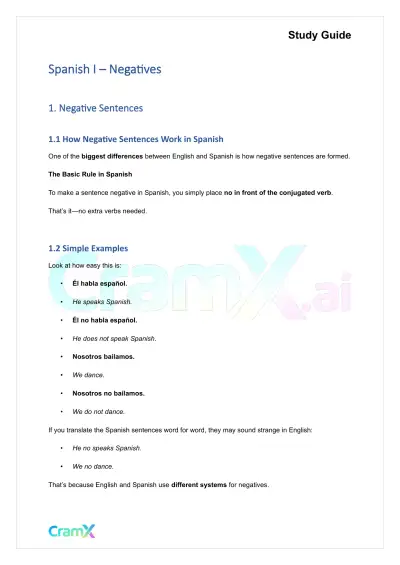 Quick Guides
Spanish I - Negatives
World Languages
19 pagesMar 2026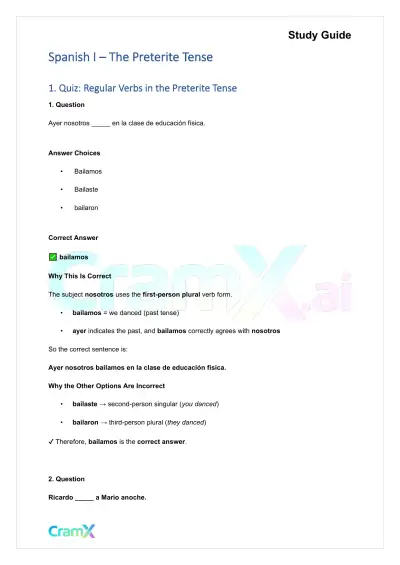 Quick Guides
Spanish I - The Preterite Tense
World Languages
52 pagesMar 2026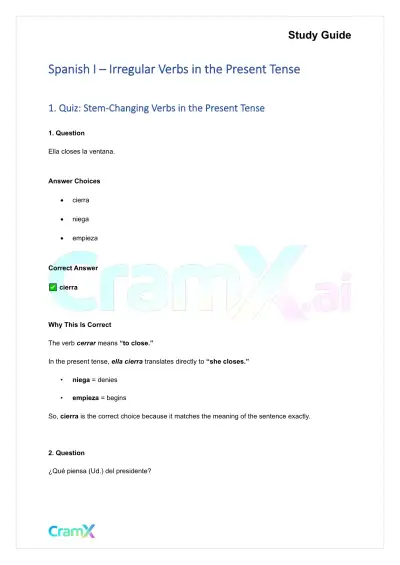 Quick Guides
Spanish I - Irregular Verbs in the Present Tense
World Languages
43 pagesMar 2026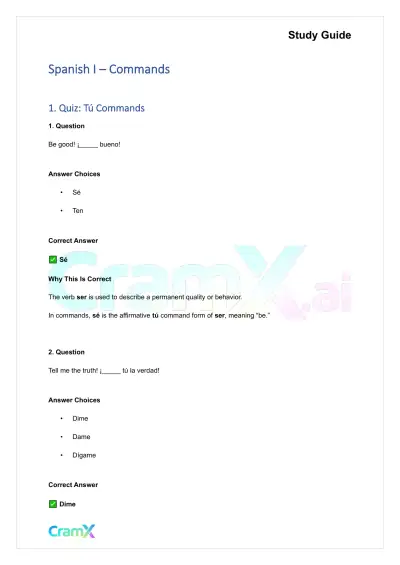 Quick Guides
Spanish I - Commands
World Languages
29 pagesMar 2026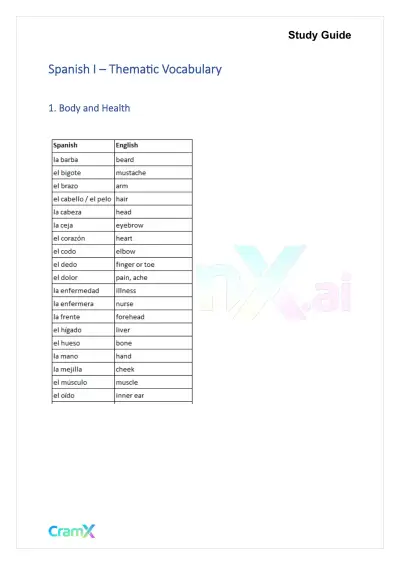 Quick Guides
Spanish I - Thematic Vocabulary
World Languages
27 pagesMar 2026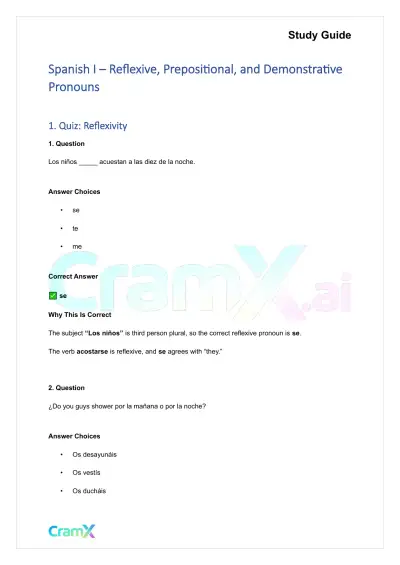 Quick Guides
Spanish I - Reflexive, Prepositional, and Demonstrative Pronouns
World Languages
20 pagesMar 2026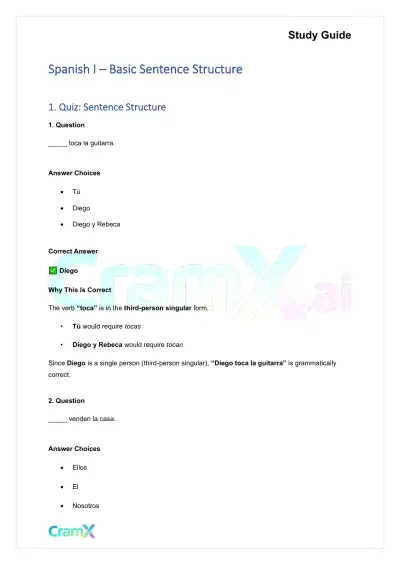 Quick Guides
Spanish I - Basic Sentence Structure
World Languages
14 pagesMar 2026
Study this document with CramX
Once it is in your library, every tool can work from it.