

Spanish I - Prepositions
- World Languages
- Texas A&M University
- 56 pages
- Shared March 2026
Preview 10 of 56 pages
See the first 10 pages exactly as they appear in the document.
Page 1 Read page 1 as text
Study Guide Spanish I – Prepositions 1. Quiz: Simple Prepositions 1. Question ¿Quiénes asistieron _____ la fiesta? Answer Choices • de • a • para Correct Answer a Why This Is Correct The correct preposition in this context is "a," which is used when talking about attending or going to an event or place. In this case, "asistir a" means "to attend" or "to be present at," so the phrase would translate as "Who attended the party?" • "De" is typically used to express origin or possession, and "para" is used to indicate purpose or destination, neither of which would fit this context. 2. Question _____ mí me encantan las películas románticas. Answer Choices • De • Con • A
Page 2 Read page 2 as text
Study Guide Correct Answer A Why This Is Correct The correct preposition to use in this sentence is "A," which means "to" or "for" in this context. The verb "encantar" is often used with "a" when referring to what someone likes or loves. For example: A mí me encantan las películas románticas means "I love romantic movies." Using "de" or "con" would not fit grammatically in this case. 3. Question Amo mucho _____ mis padres. Answer Choices • con • de • a Correct Answer a Why This Is Correct The preposition "a" is used in Spanish to indicate the direct object, particularly with people. The correct construction here is "Amo mucho a mis padres," which translates to "I love my parents very much." 4. Question Elena sale _____ California y va a Nueva York para estudiar en la universidad.
Page 3 Read page 3 as text
Study Guide Answer Choices • contra • de • en Correct Answer de Why This Is Correct In Spanish, "de" is used to indicate origin or departure from a place. In this case, "Elena sale de California" means "Elena leaves from California." The other options don't fit the context: • "contra" means "against," which is not appropriate here. • "en" means "in," which would change the meaning of the sentence. 5. Question Mis primos vienen a visitarme _____ noviembre. Answer Choices • con • de • en Correct Answer en Why This Is Correct In Spanish, the preposition "en " is used to indicate a specific point in time, such as months, seasons, and years. Therefore, "en noviembre" means "in November."
Page 4 Read page 4 as text
Study Guide For example: Mis primos vienen a visitarme en noviembre. (My cousins are coming to visit me in November.) 6. Question En la peregrinación a Santiago de Compostela, todos llegaron _____ pie. Answer Choices • por • a • delante de Correct Answer a Why This Is Correct In Spanish, the correct preposition to use with "pie" in this context is "a." "Llegaron a pie" translates to "they arrived on foot." • "Por" would indicate a reason or motive, not the mode of transportation. • "Delante de" means "in front of," which doesn't fit the context here. 7. Question Poco _____ poco voy aprendiendo el español. Answer Choices • a • para • por
Page 5 Read page 5 as text
Study Guide Correct Answer por Why This Is Correct The phrase "poco a poco" is a common expression in Spanish, meaning "little by little." The correct preposition to complete the sentence is "por," as it is part of the expression. For example: "Poco a poco voy aprendiendo el español" translates to "Little by little, I am learning Spanish." 8. Question Yo le compré a mi hermano un iPod nuevo _____ su cumpleaños. Answer Choices • a • para • de Correct Answer para Why This Is Correct In Spanish, we use the preposition "para" to indicate the purpose or recipient of an action. In this case, "para su cumpleaños" translates to "for his birthday," indicating the purpose of the gift. On the other hand, "de" is typically used for possession or origin, which does not fit the context of this sentence. 9. Question El equipo de fútbol va _____ jugar mañana _____ la noche.
Page 6 Read page 6 as text
Study Guide Answer Choices • que • en • por Correct Answer en (for the first blank), por (for the second blank) Why This Is Correct • "En" is used to indicate a place or time. In this case, "en" is used to mean "at" or "in" in reference to time ("en la noche" = "at night"). • "Por" is often used to express the idea of "during" in time - related contexts. So, "por la noche" translates to "during the night". Example: • El equipo de fútbol va a jugar mañana en la noche. ("The soccer team is going to play tomorrow in the night.") 10. Question La primera clase empieza _____ las ocho menos cuarto. Answer Choices • ante • a • para Correct Answer a
Page 7 Read page 7 as text
Study Guide Why This Is Correct In Spanish, the preposition "a" is used when referring to specific times of the day. For example, "a las ocho" means "at eight o'clock," and it is the correct way to express time in this context. So, the sentence would be: "La primera clase empieza a las ocho menos cuarto." 2. Para and Por 2.1 Understanding "Para" and "Por" The Spanish prepositions para and por can be tricky for English speakers because they have several meanings. But don't worry! We’ll break them down in simple terms to help you understand when to use each one. 2.2 What is "Para"? We use para in various situations, and an easy way to remember them is the acronym PRODDS . Let’s go through each one: 1. Purpose 2. Use para to talk about the reason or purpose for doing something. It’s like saying "in order to" or "for" in English. o Trabajamos para ganar dinero. o We work to earn money. o Viajo para entender otras culturas. o I travel in order to understand other cultures. o Coma las legumbres para la salud. o Eat vegetables for health. You’ll notice that para is followed by the infinitive form of the verb (the base form like "ganar" or "entender").
Page 8 Read page 8 as text
Study Guide 3. Recipient 4. Para shows to whom or for whom something is done. It tells you the recipient. o Yo traje la comida para mi abuela. o I brought the food for my grandmother. But, por is used when talking about the recipient of an emotion, like love or admiration. o Siento mucho amor por mi abuela. o I feel much love for my grandmother. 5. Opinion 6. When expressing an opinion, we use para . o Para mí, los derechos humanos son importantes. o In my opinion, human rights are important. 7. Destination 8. Use para to talk about the destination of something, whether it's a physical place or a metaphorical one. o Las toallas son para el baño. o The towels are for the bathroom. o Salimos para las islas del Caribe mañana. o We leave for the Caribbean Islands tomorrow. 9. Deadline 10. Para is used to indicate a deadline or due date. o El proyecto es para el veinte de mayo. o The project is due by May 20th. o Es necesario terminar el programa para las dos. o It’s necessary to finish the program by two o’clock. 11. Standard 12. Use para when comparing something to what is considered normal or standard.
Page 9 Read page 9 as text
Study Guide o Su hijo sabe mucho para su edad. o His son knows a lot for his age. o Para ser extranjera, ella habla inglés bien. o For being a foreigner, she speaks English well. 2.3 What is "Por"? Now let’s look at por . We can remember its uses with the acronym DEEMMMS . Here’s what each letter stands for: 1. Duration 2. Use por to talk about how long something lasts. o Vivimos en Puerto Rico por dos años. o We lived in Puerto Rico for two years. 3. Emotions 4. Por is used when talking about emotions directed towards someone. o Su amor no es por mí. o His/her love is not for me. 5. Exchange 6. When something is exchanged for something else (like money for a product), use por . o Talia pagó veinte dólares por los zapatos. o Talia paid twenty dollars for the shoes. o Te doy las gracias por tu ayuda. o I thank you for your help. 7. Motivation 8. Por expresses the reason or motivation behind something, similar to saying "because of" or "due to." o Tengo muchas muestras de champú por el viaje de negocios.
Page 10 Read page 10 as text
Study Guide o I have many shampoo samples due to the business trip. o Ellos van a la tienda por la leche. o They go to the store for milk. 9. Means 10. When talking about how something is done (like by phone or by car), we use por . o Viajamos por avión. o We travel by plane. o Hablamos por teléfono. o We talk on the phone. 11. Movement 12. Use por when talking about movement through an area, like "through," "by," or "along." o Viajamos por los pueblos blancos de la Costa del Sol. o We traveled through the whitewashed villages of the Costa del Sol. o Caminamos por las orillas del río. o We walked along the riverbank.
46 more pages in the full document
Unlock it once and it stays in your library, ready to chat with or turn into flashcards.
Unlock the full documentMore World Languages study materials
See all Quick Guides
Spanish I - Infinitive and Regular Verb Use
World Languages
38 pagesMar 2026 Quick Guides
Spanish I - Negatives
World Languages
19 pagesMar 2026 Quick Guides
Spanish I - The Preterite Tense
World Languages
52 pagesMar 2026 Quick Guides
Spanish I - Irregular Verbs in the Present Tense
World Languages
43 pagesMar 2026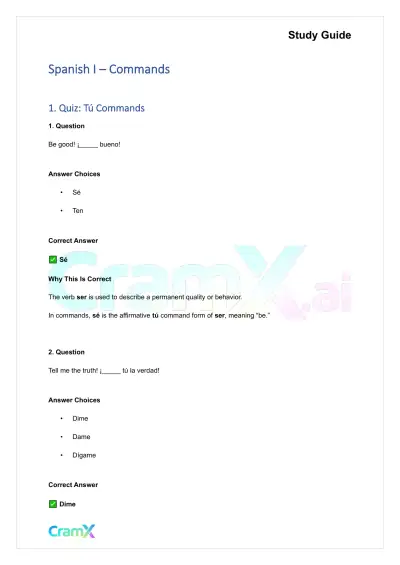 Quick Guides
Spanish I - Commands
World Languages
29 pagesMar 2026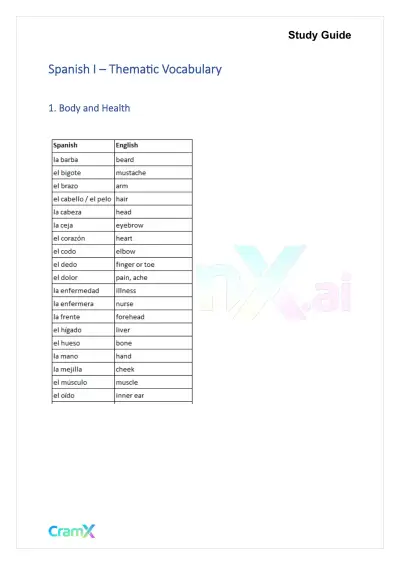 Quick Guides
Spanish I - Thematic Vocabulary
World Languages
27 pagesMar 2026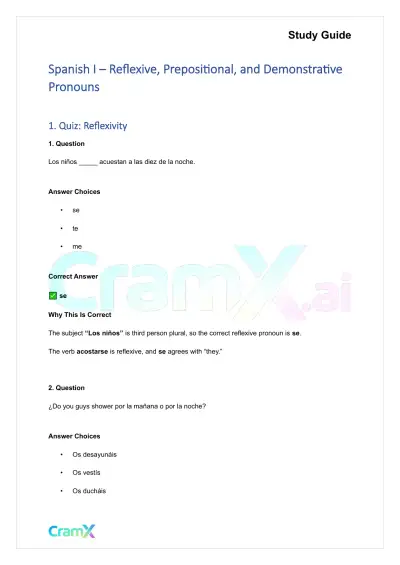 Quick Guides
Spanish I - Reflexive, Prepositional, and Demonstrative Pronouns
World Languages
20 pagesMar 2026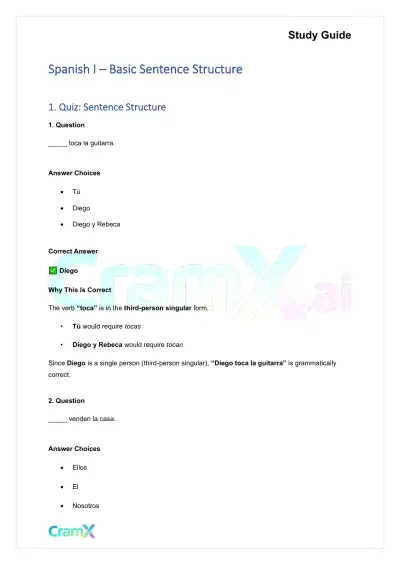 Quick Guides
Spanish I - Basic Sentence Structure
World Languages
14 pagesMar 2026
Study this document with CramX
Once it is in your library, every tool can work from it.