

Spanish I - Spelling and Pronunciation
- World Languages
- Texas A&M University
- 24 pages
- Shared March 2026
Preview 8 of 24 pages
See the first 8 pages exactly as they appear in the document.
Page 1 Read page 1 as text
Study Guide Spanish I – Spelling and Pronunciation 1. Quiz: Vowels 1. Question In Spanish, the letter “i” in the word “imagina” has which vowel sound? Answer Choices • easy • ivory Correct Answer easy Why This Is Correct In Spanish, vowels have consistent, pure sounds . The letter “i” is always pronounced like the long “ee” sound in easy , never like the short “i” sound in ivory . For example: • imagina → ee - mah - HEE - nah • vino (wine) → VEE - no • sí (yes) → see This consistency is one reason Spanish pronunciation is much more predictable than English. 2. Question In Spanish, the letter “a” is always pronounced like the “a” in which English word?
Page 2 Read page 2 as text
Study Guide Answer Choices • father • cake • back Correct Answer father Why This Is Correct In Spanish, the vowel “a” has a consistent sound, similar to the short, open “a” in the English word “father.” It is never pronounced like the long “a” in cake or the short, flat “a” in back . For example: • amigo → sounds like ah - mee - go • casa → sounds like kah - sah This consistency is one of the reasons Spanish pronunciation is easier to predict than English. 3. Question In Spanish, the vowel “o” is always pronounced like the “o” in which English word? Answer Choices • oven • over • obvious Correct Answer over
Page 3 Read page 3 as text
Study Guide Why This Is Correct In Spanish, the vowel “o” is always pronounced as a pure, short “o” sound , similar to the “o” at the beginning of the English word over (without exaggerating the glide). It does not change its sound based on position, unlike in English. • oven has an “uh” sound ( ʌ ) • obvious has an “ah” sound ( ɑ) • over best matches the Spanish “o” sound Example: • hola → ho - la (same “o” sound as in over ) 4. Question In Spanish, the vowel “i” is always pronounced like the “i” in which English word? Answer Choices • pizza • item • little Correct Answer pizza Why This Is Correct In Spanish, the vowel “i” is always pronounced as a long “ee” sound, similar to the “i” in pizza (pee - tsa). The other options are incorrect because: • item uses a short “ih” sound • little uses a relaxed “ih” or schwa sound
Page 4 Read page 4 as text
Study Guide Spanish vowels are consistent, and “i” never changes its pronunciation. 5. Question In Spanish, the vowel “e” is always pronounced like the “e” in which English word? Answer Choices • easy • essay • eye Correct Answer easy Why This Is Correct In Spanish, the vowel “e” is always pronounced with a short “eh” sound, similar to the “e” in the English word easy (especially the first vowel sound). It does not change based on spelling or stress, unlike English vowels. For example: • mesa → meh - sa • elefante → eh - leh - fan - teh This consistent pronunciation makes Spanish vowels easier to learn than English vowels. 6. Question In Spanish, the vowel “u” is always pronounced like the “u” in which English word? Answer Choices • ukelele • umbrella • union
Page 5 Read page 5 as text
Study Guide Correct Answer ukelele Why This Is Correct In Spanish, the vowel “u” is always pronounced with a long “oo” sound (like food or boot ), never with the “uh” or “yoo” sounds common in English. • ukelele → the “u” sound matches the Spanish “u” (oo sound) • umbrella → the “u” sounds like “uh” • union → the “u” sounds like “yoo” Example: • uno → oo - no • luna → loo - na This consistent pronunciation is one of the easiest parts of Spanish vowels to master 2. Stress and Accentuation Understanding stress and accent marks is a big step toward speaking and writing Spanish correctly. The good news is that the rules are simple and predictable. Once you learn them, they make pronunciation much easier. Let’s break everything down step by step. 2.1 Word Stress: The Two Basic Rules Every Spanish word has one stressed syllable. In many cases, you don’t even need a written accent mark because Spanish follows two clear stress rules: 1. Words ending in most consonants If a word ends in any consonant except n or s , the stress naturally falls on the last syllable .
Page 6 Read page 6 as text
Study Guide 2. Words ending in vowels, n, or s If a word ends in a vowel , n , or s , the stress naturally falls on the next - to - last syllable . These two rules explain how most Spanish words are pronounced. 2.2 Accent Marks: The Basic Facts Accent marks are not random. They follow clear rules too. There are three important things to remember: • There is only one kind of accent mark in Spanish. • A word can have only one accent mark . • An accent mark can appear only on a vowel , never on a consonant. 2.3 Why Accent Marks Are Used Accent marks exist for specific reasons. Let’s look at each one. 1. To Show Unusual Stress The main purpose of an accent mark is to show that a word does not follow the normal stress rules. For example, many Spanish words are similar to English words that end in - tion , such as nation , liberation , and condition . In Spanish, these become nación , liberación , and condición . Here’s the important part: • These words end in n , so normally the stress would fall on the next - to - last syllable. • However, these words are stressed on the last syllable , just like in English. Because the stress breaks the usual rule, an accent mark is placed on the final vowel (ó) to show where the stress belongs. 2. To Break a Diphthong into Two Syllables Your earlier lesson on strong and weak vowels matters here. • A diphthong forms when: o one strong vowel and one weak vowel, or
Page 7 Read page 7 as text
Study Guide o two weak vowels o are pronounced together as one syllable . That’s why iglesia does not have an accent mark. The i acts like a consonant (similar to y ), and ia forms one syllable. Since the word ends in a vowel, the stress naturally falls on the next - to - last syllable. However, sometimes Spanish uses an accent mark to force both vowels to be pronounced separately . This breaks the diphthong into two syllables , and the stress goes on the accented vowel. 3. To Tell Two Words Apart Sometimes, accent marks have nothing to do with pronunciation at all. Instead, they are used to distinguish between two words that look the same but have different meanings . For example: • si = if • sí = yes When speaking, you can usually tell the meaning from the context. In writing, the accent mark makes the meaning clear. 2.4 Why These Rules Matter Learning stress and accent rules helps you in two important ways: • Spelling : You’ll know when a word needs an accent mark. • Pronunciation : When you see an accent mark, you’ll immediately know which syllable to stress. Over time, these rules will start to feel natural — and your Spanish will sound clearer and more confident because of it.
Page 8 Read page 8 as text
Study Guide 3. Quiz: Stress and Accentuation 1. Question The Spanish word “gracias” has how many syllables? Answer Choices • 2 • 3 Correct Answer 2 Why This Is Correct In Spanish, “gracias” is divided into gra - cias , which makes two syllables . • The “cia” forms a diphthong (a weak vowel i with a strong vowel a ), so it stays in the same syllable. • Spanish syllable rules focus on vowel combinations, not just the number of letters. So, gra - cias → 2 syllables 2. Question The Spanish word “panadería” has how many syllables? Answer Choices • 4 • 5 Correct Answer 5
16 more pages in the full document
Unlock it once and it stays in your library, ready to chat with or turn into flashcards.
Unlock the full documentMore World Languages study materials
See all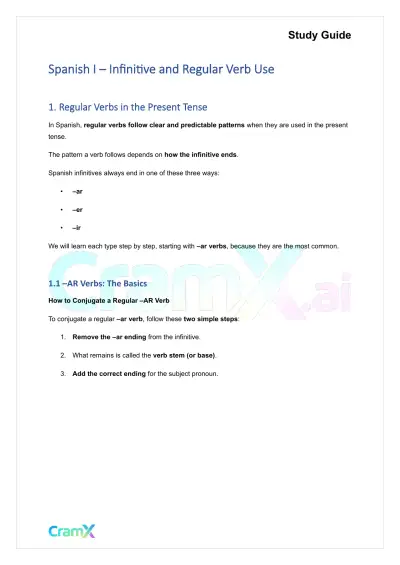 Quick Guides
Spanish I - Infinitive and Regular Verb Use
World Languages
38 pagesMar 2026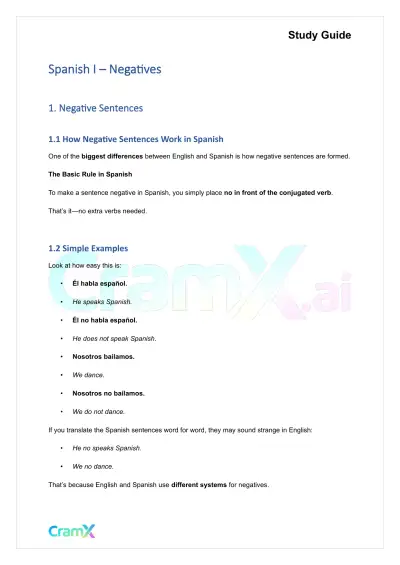 Quick Guides
Spanish I - Negatives
World Languages
19 pagesMar 2026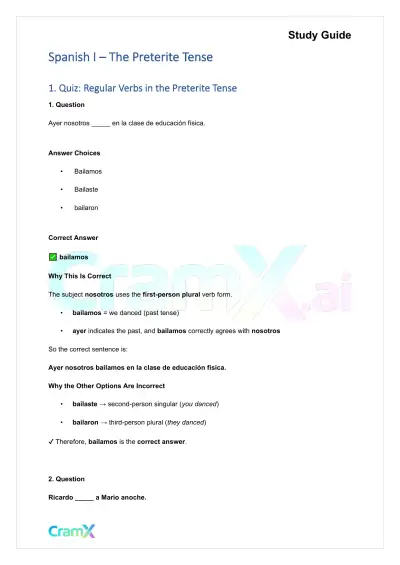 Quick Guides
Spanish I - The Preterite Tense
World Languages
52 pagesMar 2026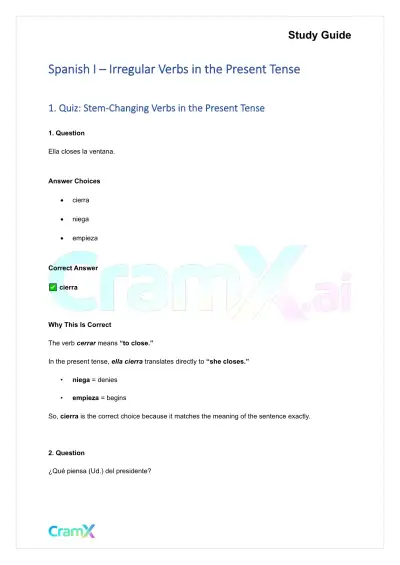 Quick Guides
Spanish I - Irregular Verbs in the Present Tense
World Languages
43 pagesMar 2026 Quick Guides
Spanish I - Commands
World Languages
29 pagesMar 2026 Quick Guides
Spanish I - Thematic Vocabulary
World Languages
27 pagesMar 2026 Quick Guides
Spanish I - Reflexive, Prepositional, and Demonstrative Pronouns
World Languages
20 pagesMar 2026 Quick Guides
Spanish I - Basic Sentence Structure
World Languages
14 pagesMar 2026
Study this document with CramX
Once it is in your library, every tool can work from it.