

Spanish I - Verb Charts
- World Languages
- Texas A&M University
- 97 pages
- Shared March 2026
Preview 10 of 97 pages
See the first 10 pages exactly as they appear in the document.
Page 1 Read page 1 as text
Study Guide Spanish I – Verb Charts 1. The Verb Comer 1.1 Introduction to Comer The verb comer means “to eat.” It is a regular – er verb , which means it follows the same pattern as other – er verbs in Spanish. Here are its main forms: • Infinitive: comer (to eat) • Gerund: comiendo (eating) • Past participle: comido (eaten) 1.2 Present Tense of Comer Use the present tense to talk about: • What you eat now • What you eat usually or regularly The endings follow the normal – er verb pattern .
Page 2 Read page 2 as text
Study Guide Examples: • Yo como – I eat • Tú comes – You eat • Nosotros comemos – We eat 1.3 Preterite Tense of Comer Use the preterite tense to talk about: • Actions that were completed in the past • Things that happened once or at a specific time Again, comer stays regular in this tense. 1.4 Imperfect Tense of Comer The imperfect tense is used to describe: • What you used to do • Habitual actions in the past • Background information in a story The endings are consistent and easy to recognize.
Page 3 Read page 3 as text
Study Guide 1.5 Command Forms of Comer Commands are used to tell someone to do something or not to do something . Spanish commands change depending on: • Who you are talking to ( tú, usted, ustedes ) • Whether the command is affirmative or negative Examples: • Come – Eat! (tú, affirmative) • No comas – Don’t eat! (tú, negative) • Coma – Eat! (usted, affirmative) • No coman – Don’t eat! (ustedes, negative) Summary • Remember: comer is regular , so no stem changes! • Focus on the endings , not the stem. • Use the image tables as a quick reference while practicing.
Page 4 Read page 4 as text
Study Guide 2. The Verb Escribir The Spanish verb escribir means “to write.” It is a regular – ir verb , which means it follows the same pattern as other – ir verbs in all tenses. Key Forms to Remember • Infinitive: escribir → to write • Gerund: escribiendo → writing • Past participle: escrito → written These forms are commonly used when talking about actions in progress or completed actions. 2.1 Present Tense of Escribir We use the present tense to talk about what someone writes now or writes regularly . Present Tense Conjugation • yo escribo – I write • tú escribes – you write • él / ella / usted escribe – he/she/you (formal) write • nosotros / nosotras escribimos – we write • vosotros / vosotras escribís – you all write (Spain) • ellos / ellas / ustedes escriben – they/you all write
Page 5 Read page 5 as text
Study Guide 2.2 Preterite Tense of Escribir The preterite tense is used for actions that were completed in the past . Preterite Tense Conjugation • yo escribí – I wrote • tú escribiste – you wrote • él / ella / usted escribió – he/she/you (formal) wrote • nosotros / nosotras escribimos – we wrote • vosotros / vosotras escribisteis – you all wrote (Spain) • ellos / ellas / ustedes escribieron – they/you all wrote Tip: Even though nosotros escribimos looks the same in the present and preterite, the meaning depends on the context .
Page 6 Read page 6 as text
Study Guide 2.3 Imperfect Tense of Escribir The imperfect tense describes actions that used to happen , happened often , or were ongoing in the past . Imperfect Tense Conjugation • yo escribía – I used to write / was writing • tú escribías – you used to write • él / ella / usted escribía – he/she/you (formal) used to write • nosotros / nosotras escribíamos – we used to write • vosotros / vosotras escribíais – you all used to write (Spain) • ellos / ellas / ustedes escribían – they/you all used to write Helpful Hint: Look for words like always, usually, often, or used to when deciding to use the imperfect tense. 2.4 Command Forms of Escribir Commands are used when telling someone to do something or not to do something .
Page 7 Read page 7 as text
Study Guide Command Forms • Usted o Affirmative: escriba o Negative: no escriba • Ustedes o Affirmative: escriban o Negative: no escriban • Tú o Affirmative: escribe o Negative: no escribas Remember: Negative commands always use “no” before the verb. Summary • Escribir is a regular – ir verb • It means to write • Important forms: escribiendo , escrito • You now know how to use it in: o Present tense o Preterite tense o Imperfect tense o Commands
Page 8 Read page 8 as text
Study Guide 3. The Verb Ir The Spanish verb ir means “to go.” It is an irregular verb , which means it does not follow the usual patterns in most tenses. Because of this, its forms must be memorized. Basic Forms of Ir • Ir = to go • Gerund : yendo ( going ) • Past participle : ido ( gone ) Don’t worry if these look different from other verbs — you’ll see them often, so they’ll get easier with practice! 3.1 Present Tense of Ir We use the present tense to talk about what is happening now or what someone usually does . Notice how every form is different — that’s what makes ir irregular!
Page 9 Read page 9 as text
Study Guide 3.2 Preterite Tense of Ir The preterite tense is used to talk about completed actions in the past . Fun fact: These forms are the same as the verb ser in the preterite tense — context helps you know which verb is being used. 3.3 Imperfect Tense of Ir The imperfect tense is used to describe ongoing actions in the past , habits, or background information. The imperfect tense of ir is regular , so it’s easier to remember.
Page 10 Read page 10 as text
Study Guide 3.4 Command Forms of Ir Commands are used when telling someone to do something or not to do something . Commands for Ir Remember: affirmative tú commands are often irregular, and ir is a perfect example! Summary • Ir means to go and is highly irregular • Present and preterite forms must be memorized • Imperfect tense is regular and easier • Command forms change depending on who you are speaking to 4. The Verb Ser 4.1 Ser means “to be.” It is one of the most important verbs in Spanish. Important: The verb ser is irregular in almost all forms and tenses. That means it does not follow normal conjugation rules, so you need to memorize many of its forms. 4.2 Basic Forms of Ser • Infinitive: ser (to be) • Gerund: siendo (being) • Past participle: sido (been) These forms are used with other verbs to make different tenses.
87 more pages in the full document
Unlock it once and it stays in your library, ready to chat with or turn into flashcards.
Unlock the full documentMore World Languages study materials
See all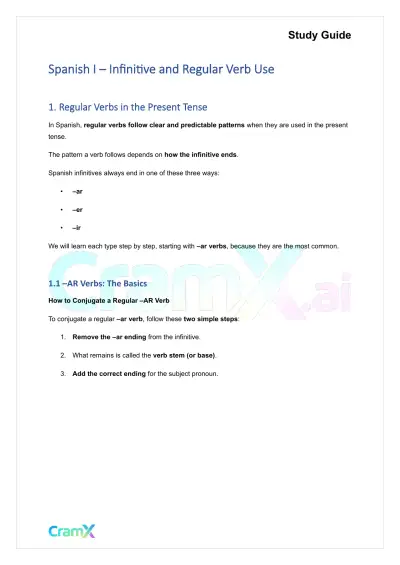 Quick Guides
Spanish I - Infinitive and Regular Verb Use
World Languages
38 pagesMar 2026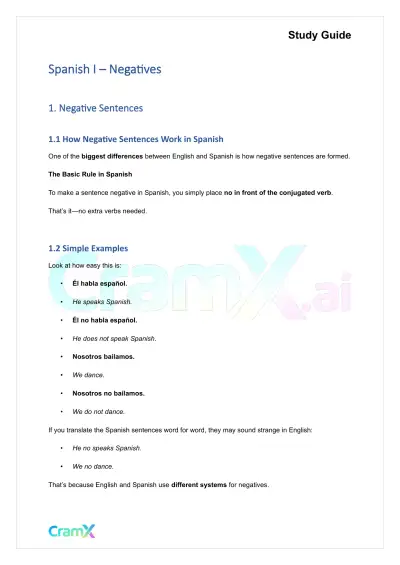 Quick Guides
Spanish I - Negatives
World Languages
19 pagesMar 2026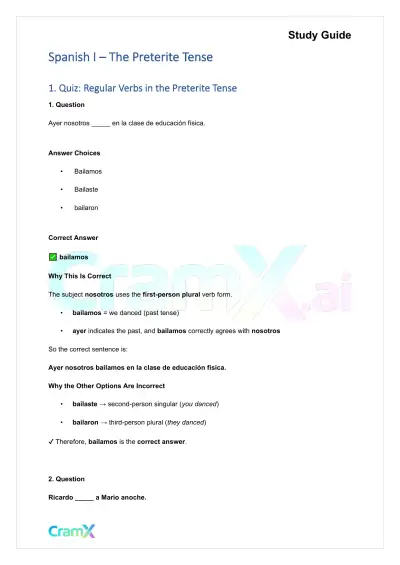 Quick Guides
Spanish I - The Preterite Tense
World Languages
52 pagesMar 2026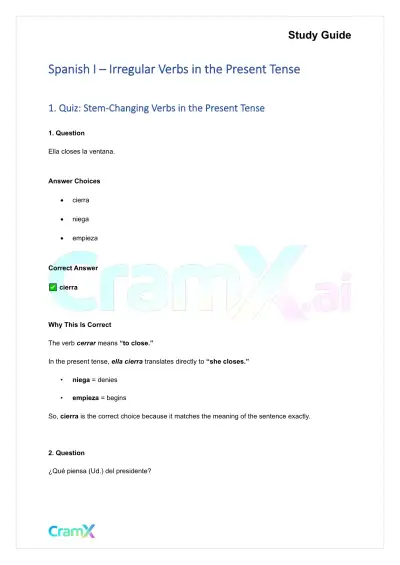 Quick Guides
Spanish I - Irregular Verbs in the Present Tense
World Languages
43 pagesMar 2026 Quick Guides
Spanish I - Commands
World Languages
29 pagesMar 2026 Quick Guides
Spanish I - Thematic Vocabulary
World Languages
27 pagesMar 2026 Quick Guides
Spanish I - Reflexive, Prepositional, and Demonstrative Pronouns
World Languages
20 pagesMar 2026 Quick Guides
Spanish I - Basic Sentence Structure
World Languages
14 pagesMar 2026
Study this document with CramX
Once it is in your library, every tool can work from it.