

ACC555 Final Exam
- Accounting
- Strayer University
- 12 pages
- Shared May 2025
Final exam covering advanced accounting principles.
Preview 4 of 12 pages
See the first 4 pages exactly as they appear in the document.
Page 1 Read page 1 as text
ACC55 5 Final Exam 1. The 10,000 accounts receivable of DEF Company have a total book value of $120,000. A CPA has selected and audited a sample of 100 accounts with a total book value of $1,000 and an audited value of $1,200. Using the ratio estimation technique, the estimated total audited value of the population is: A. $100,000. B. $120,000. C. $140,000. D. $144,000 2 The 10,000 accounts receivable of DEF Company have a total book value of $120,000. A CPA has selected and audited a sample of 100 accounts with a total book value of $1,000 and an audited value of $1,200. Using the mean - per - unit estimation technique, the estimated total audited value of the population is: A. $100,000. B. $120,000. C. $140,000. D. $144,000. 3 Using the mean - per - unit estimation method an auditor has properly calculated the estimated total audited value of a population as $200,000. Her sample included 200 of the population's 40,000 items. She found that, in her sample the average audited value was $1 less than the average book value. What was the average audited value in the sample? A. $4. B. $5. C. $6. D. $10. 4 Using difference estimation, an auditor has taken a sample of 200 from a population's 40,000 items; that population has a book value of $200,000. She found that in her sample the average audited value was $4.20, while the average book value was $5.20. What is the estimated total audited value of the population? A. $160,000. B. $161,538. C. $168,000. D. $200,000. 5. Using ratio estimation, an auditor has taken a sample of 200 from a population's 40,000 items; that population has a book value of $200,000. She found that in her sample the average audited value was $4.20, while the average book value was $5.20. What is the estimated total audited value of the population?
Page 2 Page 3 Read page 3 as text
A. $160,000. B. $161,538. C. $168,000. D. $200,000. 6. Using mean - per - unit estimation, an auditor has taken a sample of 200 from a population's 40,000 items; that population has a book value of $200,000. She found that in her sample the average audited value was $4.20, while the average book value was $5.20. What is the estimated total audited value of the population? A. $160,000. B. $161,538. C. $168,000. D. $200,000. 7. If the projected misstatement in a nonstatistical sampling is $8,000, while the tolerable misstatement is $9,000, what would an auditor likely conclude? A. Since the projected misstatement is less than the tolerable misstatement, the account is not misstated. B. Since the projected misstatement is less than the tolerable misstatement, the account is misstated. C. The risk is high that the account is materially misstated. D. The analysis has been improperly performed since the projected misstatement is unequal to the tolerable misstatement. 8. A dual purpose test simultaneously. A. Addresses two different accounts. B. Functions as a substantive test and as a test of controls. C. Functions as an analytical procedure and a substantive test. D. Substantiates an ending balance and the transactions making up the balance. 9. The 1000 accounts receivable of Winco Company have a total book value of $20,000 (Average book value = $20). Bob Duffo, CPA, has selected and audited a sample of 50 accounts with the following mean values: 1. Book value of $19. 2. Audited value of $19.60. What is the estimated total audited value using mean per unit sampling? A. $19,000. B. $19,600. C. $20,000. D. $20,632. 10. The 1000 accounts receivable of Winco Company have a total book value of $20,000 (Average book value = $20). Bob Duffo, CPA, has selected and audited a sample of 50 accounts with the following mean values: 1. Book value of $19.
Page 4 Read page 4 as text
2. Audited value of $19.60. What is the estimated total audited value using difference estimation sampling? A. $19,387. B. $19,400. C. $19,600. D. $20,600. 11. Which of the following is correct concerning "window dressing" for cash? A. A segregation of duties within the cash function effectively eliminates its occurrence. B. It generally involves manipulation of inventory. C. It is illegal, and an audit is designed to provide reasonable assurance of its detection. D. Many forms of it require no action by the auditors. 12. Which of the following statements is not correct? A. Cash is important to the audit process because of its vulnerability to misappropriation, despite the fact that the balance at the balance sheet date may be immaterial. B. Payroll cash account balances kept on an imprest basis are more easily controlled than others not so kept. C. Confirmation of cash should only be performed as of the balance statement date because the auditor expresses an opinion as of that date. D. Reviewing interbank transfers is important to the auditor because of the possibility that the client may be engaged in kiting. 13. The auditors use a bank cutoff statement to compare: A. Deposits in transit on the year - end cash general ledger account to deposits in the cash receipts journal. B. Checks dated prior to year - end to the outstanding checks listed on the year - end bank reconciliation. C. Deposits listed on the cutoff statement to disbursements in the cash disbursements journal. D. Checks dated subsequent to year - end to the outstanding checks listed on the year - end bank statement. 14. A practical and effective audit procedure for the detection of lapping is: A. Preparing an interbank transfer schedule. B. Comparing recorded cash receipts in detail against items making up the bank deposit as shown on duplicate deposit slips validated by the bank. C. Tracing recorded cash receipts to postings in customers' ledger cards. D. Preparing a proof of cash. 15. Which of the following is not a control that generally is established over cash transactions? A. Separating cash handling from recordkeeping. B. Centralizing the receipt of cash. C. Depositing each day's receipts intact.
8 more pages in the full document
Unlock it once and it stays in your library, ready to chat with or turn into flashcards.
Unlock the full documentMore Accounting study materials
See all Solved Assignments
ACC555: Fraud Examination : SAS 99 and Its Impact on Auditing Practices in Fraud Detection
Accounting
6 pagesMay 2025 Solved Assignments
ACC555 Final Exam: Auditing and Accounting Principles
Accounting
13 pagesMay 2025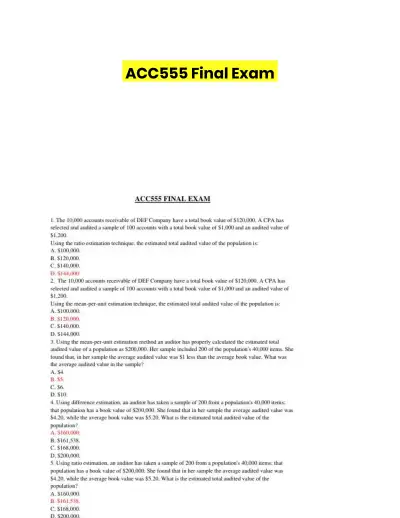 Solved Assignments
ACC555 Final Exam
Accounting
11 pagesMay 2025 Textbook Guides
Introduction to Financial Accounting, 11th Edition Solution Manual
Accounting
524 pages173downloadsFeb 2025 Textbook Guides
Solution Manual For International Accounting, 4th Edition
Accounting
309 pages161downloadsFeb 2025 Textbook Guides
Solution Manual For Managerial Accounting, 7th Edition
Accounting
361 pages159downloadsFeb 2025 Class Notes
Class Notes For Advanced Accounting, 4th Edition
Accounting
149 pages159downloadsFeb 2025 Textbook Guides
Financial Accounting 6th Canadian Edition Solution Manual
Accounting
867 pages156downloadsFeb 2025
Study this document with CramX
Once it is in your library, every tool can work from it.