

Accounting Principles II – Managerial and Cost Accounting Concepts
- Accounting
- Texas A&M University
- 20 pages
- Shared March 2026
Preview 6 of 20 pages
See the first 6 pages exactly as they appear in the document.
Page 1 Read page 1 as text
Study Guide Accounting Principles II – Managerial and Cost Accounting Concepts 1. Managerial Accounting vs. Financial Accounting Accounting information is useful for both people inside the business and people outside it . However, these groups need different kinds of information , which is why accounting is divided into financial accounting and managerial accounting . Why Do We Need Two Types of Accounting? Financial statements give an overall picture of how a company is doing. These statements are used by: • Investors • Creditors • Analysts • Government agencies • Company management For example: • The balance sheet shows the total value of inventory . • The income statement shows the total cost of goods sold . However, these reports do not show details about individual products , such as how much it costs to produce one specific item. This information is not shared with the public . What Does Management Need? People who manage the business need much more detailed information . They use accounting data to:
Page 2 Read page 2 as text
Study Guide • Decide what to produce • Control costs • Plan for the future • Evaluate performance This detailed information comes from managerial accounting . Key Differences Between Managerial and Financial Accounting The table shows how managerial accounting and financial accounting differ in several important ways: • Users ○ Managerial accounting is used by internal managers . ○ Financial accounting is used by external users such as investors and creditors. • Rules and Guidelines
Page 3 Read page 3 as text
Study Guide ○ Managerial accounting is flexible and can be adapted to management’s needs. ○ Financial accounting must follow GAAP , which is strict and standardized. • Purpose ○ Managerial accounting helps with decision - making and control . ○ Financial accounting provides general information for investment and credit decisions. • Frequency of Reports ○ Managerial reports are prepared whenever needed . ○ Financial reports are usually prepared quarterly and annually . • Independent Review ○ Managerial accounting does not require an independent audit. ○ Financial accounting often requires an auditor’s opinion . • Type of Information ○ Managerial accounting provides detailed, project - specific information , often using estimates. ○ Financial accounting provides general - purpose information with very few estimates. 2. Manufacturing Financial Statements Manufacturing companies prepare financial statements that are slightly more complex than those of service or merchandising companies. This is because manufacturers produce goods , not just buy or sell them. As a result, they use different inventory accounts and have special types of assets on their balance sheets. 1. Inventory Accounts in a Manufacturing Company Unlike service or merchandising businesses, manufacturing companies use three separate inventory accounts . Each account represents a different stage in the production process.
Page 4 Read page 4 as text
Study Guide 1. Raw Materials Inventory This includes all materials and parts that have been purchased but have not yet been used in production. 2. Work - in - Process (WIP) Inventory This includes products that are currently being manufactured but are not yet finished . It contains: ○ Raw materials already used ○ Direct labor costs ○ Other manufacturing costs incurred so far 3. Finished Goods Inventory This includes completed products that are ready to be sold to customers. At any given time, a manufacturing company’s total inventory is made up of raw materials, work - in - process, and finished goods . 2. Reporting Inventory on Financial Statements The value of each inventory type is disclosed in the financial statements . Companies may: • Show each inventory type separately on the balance sheet , or • Provide the details in the footnotes to the financial statements Both methods are acceptable as long as the information is clearly reported. 3. Long - Term Assets of a Manufacturing Company In the long - term asset section of a manufacturer’s balance sheet, you will usually find: • Factory buildings • Manufacturing equipment • Small tools and machinery Many manufacturers also own patents related to their products or production processes.
Page 5 Read page 5 as text
Study Guide The capitalized cost of patents is reported under the intangible assets section of the balance sheet. 4. Income Statement and Cost of Goods Sold The income statement of a manufacturing company looks similar to that of a merchandising company , with one important difference. When calculating cost of goods sold , a manufacturer uses only the Finished Goods Inventory account . Raw materials and work - in - process inventories are not directly included in this calculation. 5. Comparison of Cost of Goods Sold: Manufacturer vs. Merchandiser The table demonstrates how cost of goods sold is calculated differently: • Manufacturers
Page 6 Read page 6 as text
Study Guide ○ Start with beginning finished goods inventory ○ Add cost of goods manufactured ○ Subtract ending finished goods inventory • Merchandisers ○ Start with beginning merchandise inventory ○ Add cost of goods purchased ○ Subtract ending merchandise inventory This highlights that manufacturers focus on production , while merchandisers focus on purchasing and resale . 3. Costing Terminology When looking at an income statement, expenses are classified into two main types : product costs and period costs . Understanding the difference between these two is very important in accounting, especially for manufacturing businesses. 1. Product Costs Product costs are costs that are assigned to inventory . These costs are not immediately expensed. Instead, they stay in inventory until the product is sold. Once the product is sold, these costs become part of cost of goods sold . In a manufacturing company , product costs are also called manufacturing costs . Examples of manufacturing product costs include: • Raw materials used • Direct labor • Factory supervisor’s salary • Factory utilities Even service companies can have product costs. For example, the cost of performing an audit or preparing a legal document may be accumulated as inventory until the service is completed.
14 more pages in the full document
Unlock it once and it stays in your library, ready to chat with or turn into flashcards.
Unlock the full documentMore Accounting study materials
See all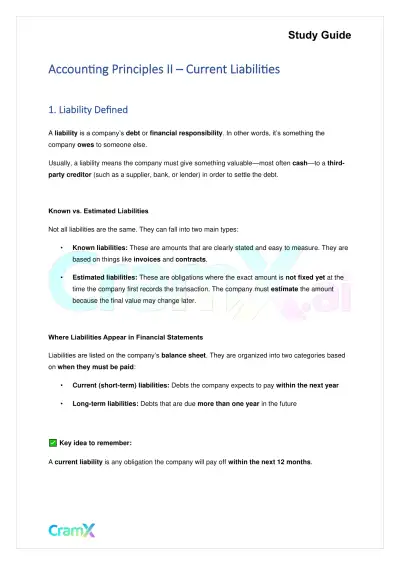 Quick Guides
Accounting Principles II – Current Liabilities
Accounting
15 pagesMar 2026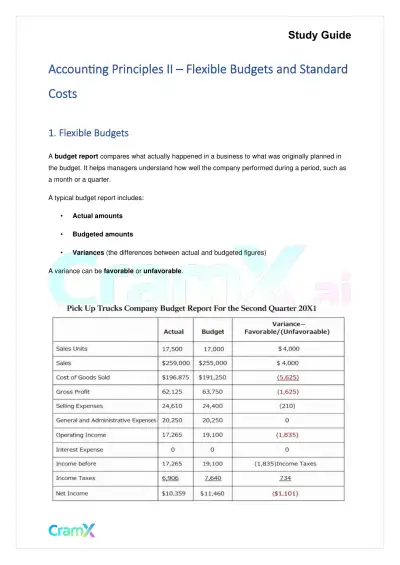 Quick Guides
Accounting Principles II – Flexible Budgets and Standard Costs
Accounting
23 pagesMar 2026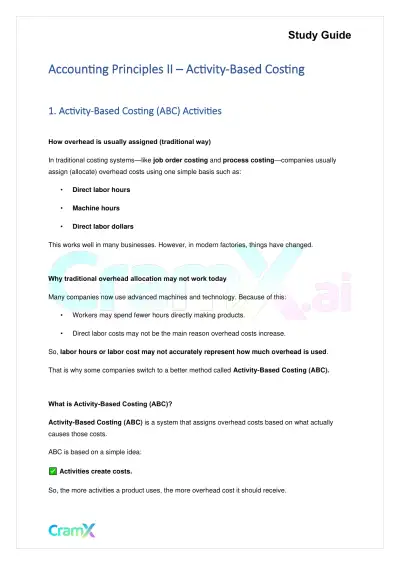 Quick Guides
Accounting Principles II – Activity-Based Costing
Accounting
13 pagesMar 2026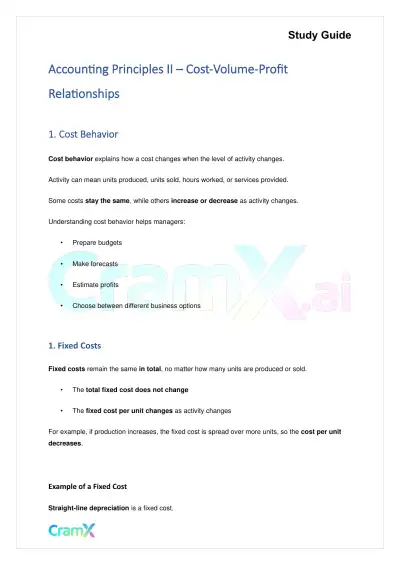 Quick Guides
Accounting Principles II – Cost-Volume-Profit Relationships
Accounting
20 pagesMar 2026 Quick Guides
Accounting Principles II – Traditional Cost Systems
Accounting
31 pagesMar 2026 Quick Guides
Accounting Principles II – Capital Budgeting
Accounting
13 pagesMar 2026 Quick Guides
Accounting Principles II – Partnerships
Accounting
23 pagesMar 2026 Quick Guides
Accounting Principles II – Investments
Accounting
19 pagesMar 2026
Study this document with CramX
Once it is in your library, every tool can work from it.