

Accounting Principles II – Partnerships
- Accounting
- Texas A&M University
- 23 pages
- Shared March 2026
Preview 7 of 23 pages
See the first 7 pages exactly as they appear in the document.
Page 1 Read page 1 as text
Study Guide Accounting Principles II – Partnerships 1. Characteristics of a Partnership What Is a Partnership? A partnership is a business owned by two or more people who agree to work together to earn a profit. It is an unincorporated form of business, meaning it is not legally separate from its owners. Many small businesses — such as retail shops, service providers, and professional practices — are organized as partnerships. 1. The Partnership Agreement A partnership agreement can be oral or written , but a written agreement is strongly recommended . Putting everything in writing helps prevent confusion and disagreements later. A good partnership agreement should clearly explain: • Who the partners are • Each partner’s duties and responsibilities • How profits and losses will be shared • Rules for adding more investment or making withdrawals • Guidelines for admitting new partners • Procedures for a partner’s withdrawal • Steps for dissolving (liquidating) the partnership For income tax purposes , the partnership itself does not pay income tax . Instead, it files an information return . Each partner reports their share of the partnership’s net income or loss on their personal tax return . 2. Limited Life A partnership does not have an unlimited life unless the agreement says otherwise.
Page 2 Read page 2 as text
Study Guide • If the agreement sets a specific number of years, the partnership ends at that time. • If no time period is stated, the partnership automatically ends when a partner: ○ Dies ○ Becomes unable to perform required duties ○ Declares bankruptcy ○ Chooses to withdraw Whenever a partner leaves or a new partner joins, a new partnership agreement is required if the business continues. However, with proper planning and documentation, the business can keep operating smoothly without disrupting daily activities. 3. Mutual Agency In a partnership, each partner acts as an agent of the business. This means: • Any partner can legally enter into contracts on behalf of the partnership • The partnership is bound by agreements that appear related to normal business activities Because of this authority — and the risk involved — it is important for partners to trust one another . Partners can limit another partner’s authority, but those limits only apply if outside parties are informed . It is the partners’ responsibility to make sure third parties know about any restrictions. 4. Unlimited Liability In most partnerships, partners have unlimited liability . This means: • If the partnership cannot pay its debts, partners may have to use personal assets to cover them • If one partner cannot pay their share, creditors may demand payment from the other partners A partnership where all partners have unlimited liability is called a general partnership . A limited partnership includes two types of partners: • General partners , who manage the business and have unlimited liability
Page 3 Read page 3 as text
Study Guide • Limited partners , who usually do not manage the business and risk only the amount they invested A limited partnership must have at least one general partner , and it often includes LLP in its name. Ease of Formation Partnerships are relatively easy to form. Other than registering the business , there are few legal requirements compared to corporations. Transfer of Ownership While a partnership is easy to dissolve, ownership cannot be transferred freely . Any transfer of ownership — whether to a new partner or an existing one — requires the approval of the remaining partners . 5. Management Structure and Operations In most partnerships, the partners are actively involved in daily operations . This hands - on involvement makes decision - making faster and more flexible. • Formal meetings are usually not required • Partners can make decisions quickly • Changes in strategy, structure, or major purchases can be approved without extra layers of authorization 6. Relative Lack of Regulation Most government regulations are designed for corporations , not partnerships. Even though there are more partnerships and sole proprietorships than corporations, corporations typically generate much higher sales and profits , which is why they face more regulation and reporting requirements. Number of Partners
Page 4 Read page 4 as text
Study Guide Partnerships work best with a small number of partners . Informal decision - making becomes more difficult as the number of partners increases — especially when all partners are involved in running the business. 2. Partnership Accounting 1. Overview of Partnership Accounting Accounting for a partnership is very similar to accounting for a sole proprietorship , with one key difference: There is more than one owner. Because of this: • Each partner has their own capital account • Each partner also has a separate withdrawal account Capital Accounts A partner’s capital account is used to record: • The partner’s investments in the business • The partner’s share of net income or loss Withdrawal Accounts A withdrawal account tracks the amount a partner takes out of the business for personal use during the year. At the end of the accounting period: • Net income or loss is closed to each partner’s capital account • Withdrawal accounts are also closed to the related capital accounts
Page 5 Read page 5 as text
Study Guide Asset Contributions to a Partnership When a partnership is formed — or when a new partner joins — partners may contribute assets instead of cash . How Non - Cash Assets Are Recorded The partnership records contributed assets at their: • Fair market value , or • Net realizable value (for receivables) Example: If a new partner contributes: • Accounts receivable → recorded at the amount expected to be collected • Equipment → recorded at current fair market value Important rules: • Existing allowance for doubtful accounts is not transferred • Existing accumulated depreciation is not transferred • The partnership sets up its own depreciation and allowance accounts Income Allocation in a Partnership The partnership agreement should clearly explain how net income or loss is shared . If the Agreement Is Silent If the agreement does not specify a method: Net income or loss is split equally among partners. Important Reminder About Salaries Partners are owners , not employees:
Page 6 Read page 6 as text
Study Guide • They do not earn salaries • Any “salary” or “interest” mentioned is a method for dividing net income , not an expense Partners may withdraw cash during the year, often based on expected income. If the partnership uses accrual accounting , partners pay tax on their share of income whether or not cash is withdrawn . 2. Closing Net Income to Capital Accounts Once net income is calculated: • It is transferred to partners’ capital accounts through closing entries • Allocating income does not mean cash is paid Example: Equal Allocation Dee’s Consultants earns $60,000 net income and has three partners sharing equally. Each partner receives: • $60,000 ÷ 3 = $20,000
Page 7 Read page 7 as text
Study Guide 3. Allocating Income Using Ratios and Percentages Percentage Method If partners agree to split income: • 50%, 40%, and 10% Each partner’s share = Net income × ownership percentage Ratio Method (2 : 3 : 1) Steps: 1. Add the ratio numbers: 2 + 3 + 1 = 6 total shares 2. Convert to fractions: ○ Sue: 2/6 ○ Dee: 3/6 ○ Jeanette: 1/6 3. Multiply each fraction by total net income Result for $60,000: • Sue → $20,000
16 more pages in the full document
Unlock it once and it stays in your library, ready to chat with or turn into flashcards.
Unlock the full documentMore Accounting study materials
See all Quick Guides
Accounting Principles II – Current Liabilities
Accounting
15 pagesMar 2026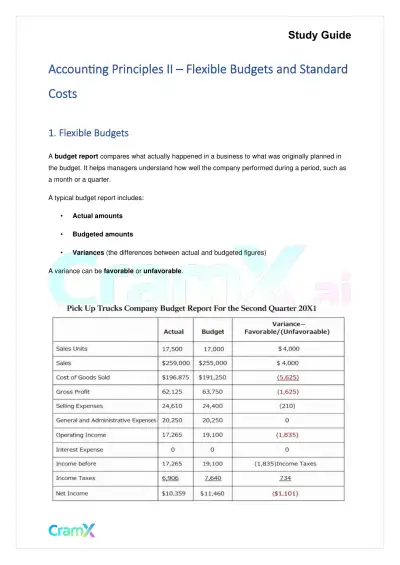 Quick Guides
Accounting Principles II – Flexible Budgets and Standard Costs
Accounting
23 pagesMar 2026 Quick Guides
Accounting Principles II – Activity-Based Costing
Accounting
13 pagesMar 2026 Quick Guides
Accounting Principles II – Cost-Volume-Profit Relationships
Accounting
20 pagesMar 2026 Quick Guides
Accounting Principles II – Traditional Cost Systems
Accounting
31 pagesMar 2026 Quick Guides
Accounting Principles II – Capital Budgeting
Accounting
13 pagesMar 2026 Quick Guides
Accounting Principles II – Managerial and Cost Accounting Concepts
Accounting
20 pagesMar 2026 Quick Guides
Accounting Principles II – Investments
Accounting
19 pagesMar 2026
Study this document with CramX
Once it is in your library, every tool can work from it.