

Accounting Principles II – Incremental Analysis
- Accounting
- Texas A&M University
- 14 pages
- Shared March 2026
Preview 5 of 14 pages
See the first 5 pages exactly as they appear in the document.
Page 1 Read page 1 as text
Study Guide Accounting Principles II – Incremental Analysis 1. Introduction to Incremental Analysis Making Managerial Decisions Managers make decisions by looking at both financial and nonfinancial information. Usually, financial information is checked first . This helps managers see whether an option is even worth considering. If the numbers look good, managers then think about other important factors, such as: • The effect on employees • The company’s public image • Environmental impact • The community • Business partners or alliances Only after reviewing both financial and nonfinancial factors do managers make a final decision. What Is Incremental Analysis? Incremental analysis is a tool used to help managers compare different options. It is also called marginal analysis or differential analysis . The main goal of incremental analysis is to: • Identify revenues and costs that change between alternatives • Ignore revenues and costs that stay the same • Focus on how each option will affect future income This makes decision - making clearer and more logical.
Page 2 Read page 2 as text
Study Guide 1. Everyday Example: Lease or Buy a Car A simple way to understand incremental analysis is to think about deciding whether to lease or buy a car . • Leasing a car : ○ Requires a regular monthly payment ○ The car is returned at the end of the lease unless a final payment is made ○ The car does not legally belong to the person leasing it ○ Lease payments are recorded as expenses on the income statement For example, a lease payment of $300 per month results in an annual expense of $3,600 . • Buying a car : ○ Requires paying the full purchase price, either in cash or through a loan ○ The car becomes an asset ○ If money is borrowed, a liability is also recorded ○ These amounts appear on the balance sheet , not just as expenses Because of these differences, the financial statements for leasing and buying look very different. 2. Comparing Two Alternatives Using Incremental Analysis Incremental analysis helps compare alternatives by focusing only on what changes . In the example shown in the table: • Alternative B generates $23,000 more net income than Alternative A • From a financial perspective, Alternative B appears better However, this is not the final decision . Management must still evaluate nonfinancial factors before choosing which alternative to accept.
Page 3 Read page 3 as text
Study Guide 3. Key Concepts in Incremental Analysis Before applying incremental analysis, it is important to understand three key terms. 1. Relevant Costs (and Revenues) • These are revenues and costs that differ between alternatives • Only these amounts matter when making a decision • Costs or revenues that stay the same are ignored • Some textbooks call changing revenues relevant benefits 2. Sunk Costs • A sunk cost is a cost that has already been incurred • It cannot be changed or avoided , no matter what decision is made • Because of this, sunk costs are ignored in incremental analysis Example: The book value of a machine already owned does not change whether the company replaces it or not. 3. Opportunity Costs • An opportunity cost is a benefit that is given up when one option is chosen over another • Even though it does not appear in accounting records, it is still important for decision - making
Page 4 Read page 4 as text
Study Guide Example: Using factory space for one product means losing the chance to use it for another. 2. Examples of Incremental Analysis Incremental analysis (also called marginal or differential analysis ) helps managers make better decisions by focusing only on what changes between alternatives. Instead of looking at total costs and revenues, it compares relevant revenues and relevant costs and shows how each option affects future operating income . This method is widely used in managerial accounting because it simplifies complex decisions and keeps attention on the most important information. Common Uses of Incremental Analysis Incremental analysis is commonly applied in the following situations: • Accepting additional (special order) business • Making or buying parts or products • Selling products now or processing them further • Eliminating a business segment • Allocating scarce resources (sales mix decisions) Each example below shows how incremental analysis is used in real business decisions. 1. Accepting Additional Business (Special Orders) The Situation The Party Connection prepares complete party kits for celebrations. It is currently operating at 75% of capacity . Key information: • Selling price (regular): $25 per packet
Page 5 Read page 5 as text
Study Guide • Cost per packet: $20.50 • Current production: 84,000 packets • Full capacity: 112,000 packets A special overseas customer offers to buy 15,000 packets at $20 per packet . This order will not affect current sales , and the company has enough unused capacity to fill it. 1. Initial (Incorrect) Analysis Using the regular cost structure, selling at $20 appears to create a loss of $0.50 per unit , or $7,500 total . This makes the order look unattractive — but this analysis is incorrect because it includes costs that do not change .
9 more pages in the full document
Unlock it once and it stays in your library, ready to chat with or turn into flashcards.
Unlock the full documentMore Accounting study materials
See all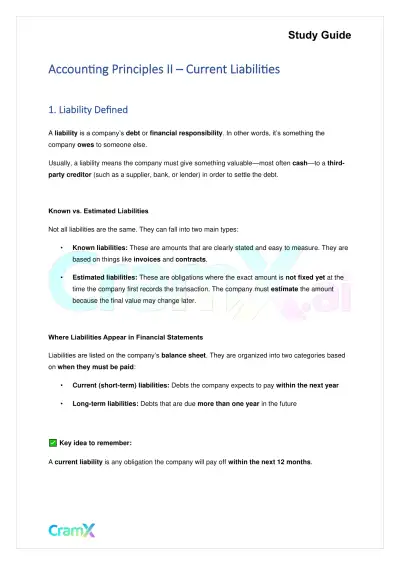 Quick Guides
Accounting Principles II – Current Liabilities
Accounting
15 pagesMar 2026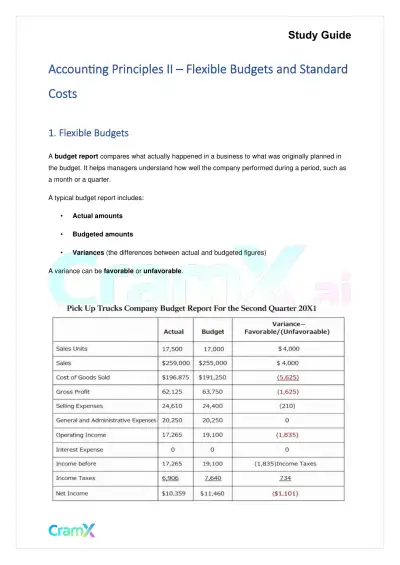 Quick Guides
Accounting Principles II – Flexible Budgets and Standard Costs
Accounting
23 pagesMar 2026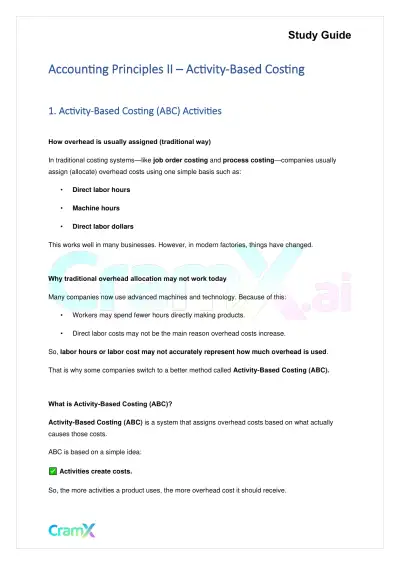 Quick Guides
Accounting Principles II – Activity-Based Costing
Accounting
13 pagesMar 2026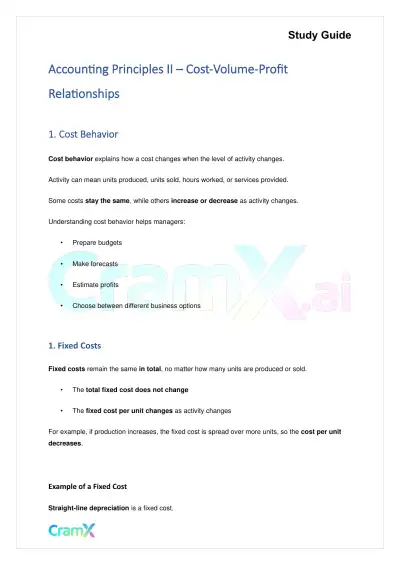 Quick Guides
Accounting Principles II – Cost-Volume-Profit Relationships
Accounting
20 pagesMar 2026 Quick Guides
Accounting Principles II – Traditional Cost Systems
Accounting
31 pagesMar 2026 Quick Guides
Accounting Principles II – Capital Budgeting
Accounting
13 pagesMar 2026 Quick Guides
Accounting Principles II – Managerial and Cost Accounting Concepts
Accounting
20 pagesMar 2026 Quick Guides
Accounting Principles II – Partnerships
Accounting
23 pagesMar 2026
Study this document with CramX
Once it is in your library, every tool can work from it.