

Accounting Principles II – Investments
- Accounting
- Texas A&M University
- 19 pages
- Shared March 2026
Preview 6 of 19 pages
See the first 6 pages exactly as they appear in the document.
Page 1 Read page 1 as text
Study Guide Accounting Principles II – Investments 1. Introduction to Investments Companies often have more cash on hand than they need for their day - to - day operations. Instead of letting this extra money sit unused, they may choose to invest it. Investing allows a company to earn additional income, such as interest or dividends , while the cash is not immediately needed. 1. Why Do Companies Invest? There are a few common reasons companies invest their excess cash: • To earn income: Short - term investments can generate interest or dividend revenue. • For strategic goals: A company might invest in another business, for example by buying its stock, to support long - term plans such as expansion or partnerships. No matter the reason, once a company invests its cash, that investment must be reported in the company’s financial statements. 2. How Investments Appear on the Balance Sheet Investments are shown on the balance sheet , but they are usually listed separately from cash. This helps users of financial statements clearly see how much money is tied up in investments rather than available for immediate use. Investments are classified as: • Short - term assets if the company plans to sell or use them soon. • Long - term assets if the company intends to hold them for a longer period. The classification depends on both the type of investment and management’s plan for how long it will be held.
Page 2 Read page 2 as text
Study Guide 3. Types of Investments Companies Can Choose Companies have many investment options, including: • Certificates of deposit (CDs) • U.S. Treasury bills • Bonds and notes • Mutual funds • Bonds issued by other companies • Stock of other companies Each type of investment has different risks and returns, so companies choose based on their financial goals and needs. 4. Accounting for Different Investments It’s important to know that investments in bonds and investments in stocks are accounted for differently . Because these investments work in different ways, the accounting entries used to record them are not the same. This chapter will explore those differences in more detail. Overall, investments help companies put unused cash to work while supporting both short - term income and long - term strategies. 2. Accounting for Debt Securities Debt securities are a common type of investment for companies. Let’s break this topic down step by step so it’s clear, logical, and easy to follow. What Is a Debt Security? A debt security is an investment in bonds issued by: • The government, or • A corporation When a company buys bonds, it is essentially lending money and earning interest in return.
Page 3 Read page 3 as text
Study Guide 1. Recording the Purchase of Bonds When a company purchases bonds, the total cost of the investment is recorded in an asset account called Debt Investments . What counts as acquisition cost? The acquisition cost includes: • The price paid for the bonds , and • Any investment fees or broker’s commissions These costs are combined and recorded together because they represent the total amount invested. Example: Buying Bonds Suppose Computers Galore buys: • Five bonds with a face value of $1,000 each • Interest rate of 10% • On July 1 • Purchase price: $5,500 • Broker’s fees: $50 Total acquisition cost = $5,550
Page 4 Read page 4 as text
Study Guide Journal Entry on July 1 • Debit Debt Investments for $5,550 • Credit Cash for $5,550 This entry shows that cash was used to acquire the bond investment. 2. Recording Interest Revenue Bonds usually pay interest on specific dates. In this case, the bonds pay interest twice a year : • June 30 • December 31 Calculating Interest For December 31: • Principal: $5,000 (5 bonds × $1,000) • Interest rate: 10% • Time: 6 months (6/12 of a year)
Page 5 Read page 5 as text
Study Guide Journal Entry on December 31 • Debit Cash for $250 • Credit Interest Revenue for $250 This records the interest income earned from the bonds. 3. Holding or Selling Bonds After purchasing bonds, a company can either: 1. Hold them until maturity , or 2. Sell them before maturity Each option is handled differently in accounting. Bonds Held to Maturity If the company plans to keep the bonds until they mature: • They are classified as a long - term investment • Any difference between: ○ The bond’s maturity value , and
Page 6 Read page 6 as text
Study Guide ○ The cost of the bonds ○ is amortized over the life of the bonds and reported on the income statement. 4. Selling Bonds Before Maturity If the company plans to sell the bonds: • Their value changes with the market • A gain or loss is recorded at the time of sale Calculating Gain or Loss A gain or loss is the difference between: • Book value of the bond, and • Cash received from the sale Example: Selling One Bond at a Loss Total acquisition cost was $5,550 for five bonds. If one bond is sold on June 1 for $1,050 :
13 more pages in the full document
Unlock it once and it stays in your library, ready to chat with or turn into flashcards.
Unlock the full documentMore Accounting study materials
See all Quick Guides
Accounting Principles II – Current Liabilities
Accounting
15 pagesMar 2026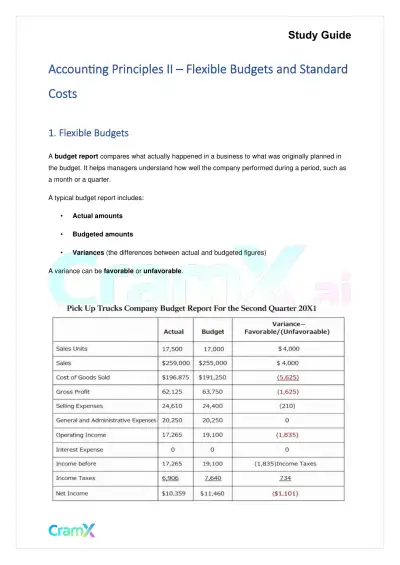 Quick Guides
Accounting Principles II – Flexible Budgets and Standard Costs
Accounting
23 pagesMar 2026 Quick Guides
Accounting Principles II – Activity-Based Costing
Accounting
13 pagesMar 2026 Quick Guides
Accounting Principles II – Cost-Volume-Profit Relationships
Accounting
20 pagesMar 2026 Quick Guides
Accounting Principles II – Traditional Cost Systems
Accounting
31 pagesMar 2026 Quick Guides
Accounting Principles II – Capital Budgeting
Accounting
13 pagesMar 2026 Quick Guides
Accounting Principles II – Managerial and Cost Accounting Concepts
Accounting
20 pagesMar 2026 Quick Guides
Accounting Principles II – Partnerships
Accounting
23 pagesMar 2026
Study this document with CramX
Once it is in your library, every tool can work from it.