

Accounting Principles II – Current Liabilities
- Accounting
- Texas A&M University
- 15 pages
- Shared March 2026
Preview 5 of 15 pages
See the first 5 pages exactly as they appear in the document.
Page 1 Read page 1 as text
Study Guide Accounting Principles II – Current Liabilities 1. Liability Defined A liability is a company’s debt or financial responsibility . In other words, it’s something the company owes to someone else. Usually, a liability means the company must give something valuable — most often cash — to a third - party creditor (such as a supplier, bank, or lender) in order to settle the debt. Known vs. Estimated Liabilities Not all liabilities are the same. They can fall into two main types: • Known liabilities: These are amounts that are clearly stated and easy to measure. They are based on things like invoices and contracts . • Estimated liabilities: These are obligations where the exact amount is not fixed yet at the time the company first records the transaction. The company must estimate the amount because the final value may change later. Where Liabilities Appear in Financial Statements Liabilities are listed on the company’s balance sheet . They are organized into two categories based on when they must be paid : • Current (short - term) liabilities: Debts the company expects to pay within the next year • Long - term liabilities: Debts that are due more than one year in the future Key idea to remember: A current liability is any obligation the company will pay off within the next 12 months .
Page 2 Read page 2 as text
Study Guide 2. Accounts Payable Accounts payable are amounts a business owes to suppliers for goods or services it has already received but has not paid for yet . These are also called trade payables , because they come from normal day - to - day business purchases. No Formal Loan Agreement Accounts payable exist because the business is trusted to pay later using good faith credit . That means the supplier believes the company will pay on time. A key point is that no formal note (promise - to - pay document) is signed . So, it’s not a loan — it’s simply an unpaid bill. Common Examples of Accounts Payable Businesses often create accounts payable when they buy things like: • Merchandise (items to resell) • Supplies (materials the business uses) When these items are purchased “on account” (buy now, pay later), the amount owed is recorded as accounts payable . When Does the Company Pay? The payment timing depends on two main things: 1. Credit terms of the purchase (the rules for how long the business has to pay) 2. Whether the company can take advantage of any discounts offered for early payment Quick takeaway: Accounts payable = money owed to suppliers for purchases made on credit, without signing a formal note.
Page 3 Read page 3 as text
Study Guide 3. Payroll Liabilities What are Payroll Liabilities? Payroll liabilities are amounts a company owes because of payroll . These are different from accounts payable , because payroll liabilities are connected to employees and payroll taxes , not regular suppliers. Whenever employees work, the company becomes responsible for paying: 1. Employees’ take - home pay (net pay) 2. Money withheld from employees’ pay (and owed to other parties) 3. Extra payroll taxes the employer must pay 1) Paying Employees: Gross Pay vs. Net Pay 1. Gross Earnings (Gross Pay) Gross earnings are the employee’s total pay before any deductions . To record this, the company uses an expense account like: • Wages Expense or Salaries Expense 2. Net Pay (Take - Home Pay) Net pay is what employees actually receive on payday. It is: Gross Pay − (Required Deductions + Voluntary Deductions) This “net pay” becomes a liability because the company still owes that amount to employees until it is paid. The liability account used is usually:
Page 4 Read page 4 as text
Study Guide • Wages Payable • Salaries Payable • Accrued Wages Payable 2) Payroll Withholdings = Liabilities (Not Expenses) When an employer withholds money from an employee’s paycheck, the company must later send that money to the correct organization. So, withheld amounts are recorded as liabilities , because the business is only holding the money temporarily . Important point: These withheld amounts are NOT expenses of the employer. The employer is simply acting as an intermediary (middle person), collecting money from employees and paying it to third parties.
Page 5 Read page 5 as text
Study Guide 3) Required vs. Voluntary Deductions A) Required Deductions These are deductions the law requires the employer to take out of employee pay. Common required deductions include: 1. Income Tax Withholding This may include: • Federal income tax • State income tax (if required) • Local income tax (if required) The amount withheld depends on: • employee earnings, and • the employee’s withholding allowances Withholding allowances come from the employee’s W - 4 form . An employee must complete a W - 4 before payroll can be processed. The employer uses government tax tables to calculate the correct income tax withholding, then pays the withheld amounts to the IRS .
10 more pages in the full document
Unlock it once and it stays in your library, ready to chat with or turn into flashcards.
Unlock the full documentMore Accounting study materials
See all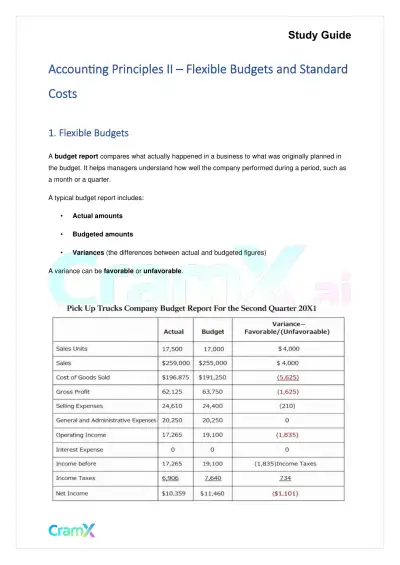 Quick Guides
Accounting Principles II – Flexible Budgets and Standard Costs
Accounting
23 pagesMar 2026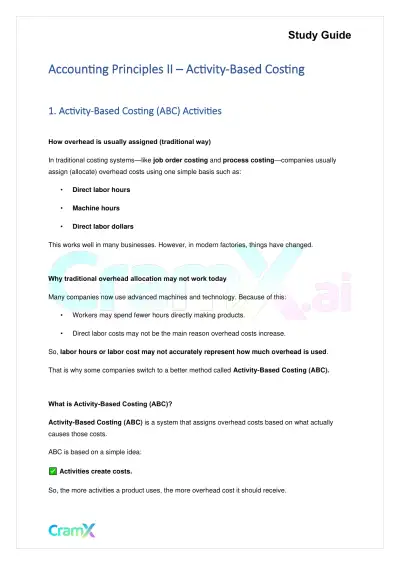 Quick Guides
Accounting Principles II – Activity-Based Costing
Accounting
13 pagesMar 2026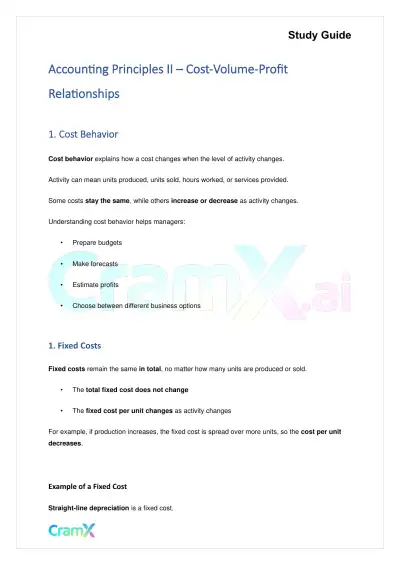 Quick Guides
Accounting Principles II – Cost-Volume-Profit Relationships
Accounting
20 pagesMar 2026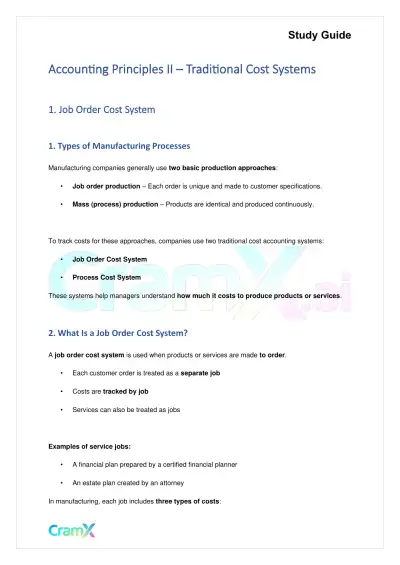 Quick Guides
Accounting Principles II – Traditional Cost Systems
Accounting
31 pagesMar 2026 Quick Guides
Accounting Principles II – Capital Budgeting
Accounting
13 pagesMar 2026 Quick Guides
Accounting Principles II – Managerial and Cost Accounting Concepts
Accounting
20 pagesMar 2026 Quick Guides
Accounting Principles II – Partnerships
Accounting
23 pagesMar 2026 Quick Guides
Accounting Principles II – Investments
Accounting
19 pagesMar 2026
Study this document with CramX
Once it is in your library, every tool can work from it.