

Accounting Principles II – Capital Budgeting
- Accounting
- Texas A&M University
- 13 pages
- Shared March 2026
Preview 4 of 13 pages
See the first 4 pages exactly as they appear in the document.
Page 1 Read page 1 as text
Study Guide Accounting Principles II – Capital Budgeting Capital Budgeting Techniques Capital budgeting is the process companies use to decide whether to invest in long - term projects, such as new equipment, buildings, or technology. These projects usually involve large amounts of money , so companies must be very careful when making these decisions. Because companies usually have limited capital , each potential project is carefully evaluated using: • Quantitative analysis (numbers and calculations), and • Qualitative factors (such as risk, strategy, and future growth). Most capital budgeting decisions focus on cash inflows and cash outflows , not net income from accrual accounting. This is because cash flows show the actual movement of money. Some companies simplify cash flow calculations by adding net income + depreciation and amortization . Others take a more detailed approach and separately estimate: • Cash inflows from customers • Cost savings • Proceeds from selling assets • Salvage value • Cash outflows for equipment, operating costs, interest, and repairs Example: The Cottage Gang The Cottage Gang is considering purchasing new equipment for its boat rental business. Key details of the project: • Equipment cost: $150,000 • Useful life: 7 years • Salvage value: $5,000
Page 2 Read page 2 as text
Study Guide • Annual cash inflows: $250,000 • Annual cash outflows: $200,000 • Annual net cash flow: $50,000 1. Payback Technique What is the Payback Period? The payback period measures how long it takes for a company to recover its initial investment in cash . In simple terms, it tells us how quickly the project “pays back” the money invested. 1. Payback Formula (Equal Cash Flows) 2. Payback Period for the Cottage Gang The Cottage Gang invested $150,000 and expects $50,000 in net cash inflow each year. Calculation: • $150,000 ÷ $50,000 = 3.0 years This means the company will recover its investment in three years . Why Shorter Payback Is Better A shorter payback period means the company gets its money back faster. Whether a payback period is acceptable depends on company policy. For example: • Some companies require payback within two years
Page 3 Read page 3 as text
Study Guide • Others require the payback period to be shorter than the asset’s useful life 3. Payback with Unequal Cash Flows When annual cash flows are not the same each year , the payback period is found using cumulative net cash flows . Example: A project costs $150,000 , with the following net cash inflows: The investment is recovered partway through Year 4 , giving a payback period of 3.25 years . 4. Limitations of the Payback Method Although easy to use, the payback method has weaknesses: • It ignores the timing of cash flows • It ignores cash flows after payback • It does not consider the time value of money Two projects may have the same payback period but very different cash flow patterns and project lives.
Page 4 Read page 4 as text
Study Guide 2. Net Present Value (NPV) Why NPV Matters Money received today is worth more than money received in the future. This idea is called the time value of money . The Net Present Value (NPV) method accounts for this by discounting future cash flows back to today using the company’s required rate of return . NPV Basics To calculate NPV, you need: • Cash inflows • Cash outflows • Required rate of return (discount rate) NPV for the Cottage Gang (Equal Cash Flows) Assume a required rate of return of 12% . • Annual net cash flow: $50,000 • Useful life: 7 years • Present value annuity factor at 12% for 7 years: 4.5638 Present value of annual cash flows: • $50,000 × 4.5638 = $228,190 Present value of salvage value: • $5,000 × 0.4523 = $2,262 Total present value of inflows:
9 more pages in the full document
Unlock it once and it stays in your library, ready to chat with or turn into flashcards.
Unlock the full documentMore Accounting study materials
See all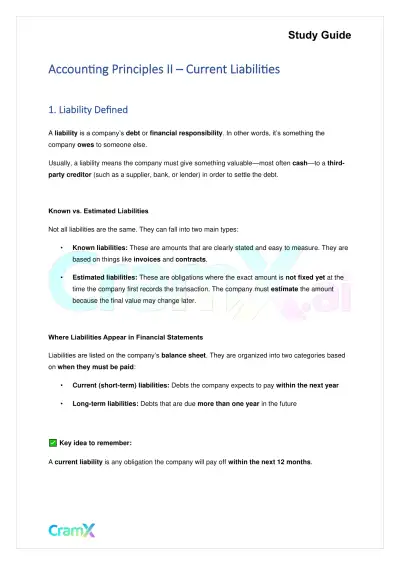 Quick Guides
Accounting Principles II – Current Liabilities
Accounting
15 pagesMar 2026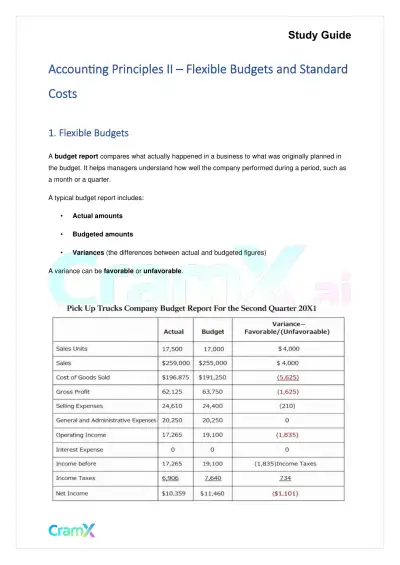 Quick Guides
Accounting Principles II – Flexible Budgets and Standard Costs
Accounting
23 pagesMar 2026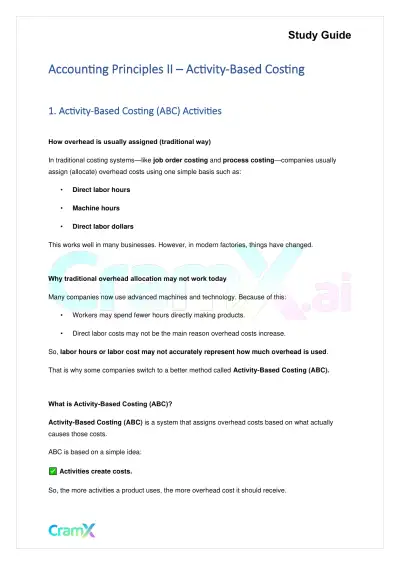 Quick Guides
Accounting Principles II – Activity-Based Costing
Accounting
13 pagesMar 2026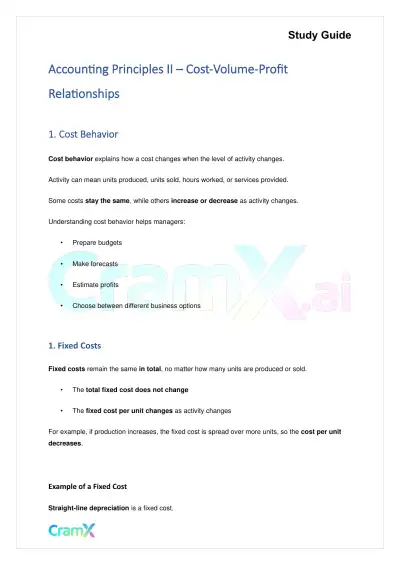 Quick Guides
Accounting Principles II – Cost-Volume-Profit Relationships
Accounting
20 pagesMar 2026 Quick Guides
Accounting Principles II – Traditional Cost Systems
Accounting
31 pagesMar 2026 Quick Guides
Accounting Principles II – Managerial and Cost Accounting Concepts
Accounting
20 pagesMar 2026 Quick Guides
Accounting Principles II – Partnerships
Accounting
23 pagesMar 2026 Quick Guides
Accounting Principles II – Investments
Accounting
19 pagesMar 2026
Study this document with CramX
Once it is in your library, every tool can work from it.