

Intermediate Accounting: IFRS Edition, 3rd Edition Class Notes
- Accounting
- 319 pages
- Shared February 2025
- 62 downloads
Master key topics with Intermediate Accounting: IFRS Edition, 3rd Edition Class Notes, your perfect class companion.
Preview 31 of 319 pages
See the first 31 pages exactly as they appear in the document.
Page 1 Read page 1 as text
CHAPTER 1 Financial Reporting and Accounting Standards LEARNING OBJECTIVES 1. Describe the growing importance of global financial markets and its relation to financial reporting. 2 . Identify the major financial statements and other means of financial reporting. 3 . Explain how accounting assists in the efficient use of scarce resources. 4 . Explain the need for high - quality standards. 5 . Identify the objective of financial reporting. 6 . Identify the major policy - setting bodies and their role in the standard - setting process. 7 . Explain the meaning of IFRS. 8 . Describe the challenges facing financial reporting.
Page 2 Page 3 Read page 3 as text
CHAPTER REVIEW 1. Chapter 1 describes the environment that has influenced both the development and use of the financial accounting process. The chapter traces the development of financial accounting standards, focusing on the groups that have had or currently have the responsibility for developing such standards. Certain groups other than those with direct responsibility for developing financial accounting standards have significantly influenced the standard - setting process. These various pressure groups are also discussed in Chapter 1. Global Markets 2. (L.O. 1) World markets are becoming increasingly intertwined. And, due to technological adva nces and less onerous regulatory requirements, investors are able to engage in financial transactions across national borders, and to make investment, capital allocation, and financing decisions involving many foreign companies. As a result, an increasing number of investors are holding securities of foreign companies, and a significant number of foreign companies are found on national exchanges. The move toward adoption of international financial reporting standards has and will continue to facilitate this movement . 3. ( L .O. 2 ) Financial accounting is the process that culminates in the preparation of financial reports on the enterprise for use by both internal and external parties. 4. Financial statements are the principal means through which a company communicates its financi al information to those outside it. The financial statements most frequently provided are (1) the statement of financial position, (2) the income statement or stat ement of comprehensive income, (3) the statement of cash flows, and (4) the statement of changes in equity. Note disclosures are an integral part of each financial statement. Other means of financial reporting include the president’s letter or supplementary sche dules in the corporate annual report, prospectuses, and reports filed with government a gencies. 5. ( L .O. 3 ) Accounting is important for markets, free enterprise, and competition because it assists in providing information that leads to capital allocation. Reliable information leads to a better , more effective process of capital allocation , which in turn is critical to a healthier economy. 6. ( L .O. 4 ) To facilitate efficient capital allocation, investors need relevant information and a faithful representation of that information to enable them to make comparisons across borders. A single, widely accepted set of high - quality accounting standards is a necessity to ensure adequate comparability. In order to achieve this goal the following element must be present : a. A s ingle set of high - quality accounting standards established by a single standard - setting body. b. Consistency in application and interpretation. c. Common disclosures.
Page 4 Read page 4 as text
d. Common high - quality auditing standards and practices. e. A c ommon approach to regulatory review and enforcement. f. Education and training of market participants. g. Common delivery systems (e.g., eXtensible Business Reporting Language — XBRL). h. A c ommon approach to corporate governance and legal frameworks around the world. 7. The major standard - setters of the world, coupled with regulatory authorities, now recognize that capital formation and investor understanding is enhanced if a single set of high - quality accounting standards is developed. Objective of Financial Reporting 8. ( L .O. 5 ) The objective of general - purpose financial reporting is to provide financial information about the reporting entity that is useful to present and potential equity investors, lenders, and other creditors in making decisions about providing resources to the entity . a. General - purpose financial statements provide at the least cost the most useful information possible to a wide variety of users. b. Equity investors and creditors are the primary user group s and have the most critical and immediate need s for information in the financial statements. Investors and creditors need this information to assess a company’s ability to generate net cash inflows and to understand management’s ability to protect and enhance the assets of a company. c. The entity perspective means that the company is viewed as being separate and distinct from its investors ( both shareholders and creditors ). Therefore, the assets of the company belong to the company, not a specific creditor or shareholder. Financial report ing focused only on the needs of the shareholder — the proprietary perspective — is not considered appropriate. d. Decision - usefulness means that information contained in the financial statements should help investors assess the amounts, timing, and uncertainty of prospective cash inflows from dividends or interest, and the proceeds from the sale, redemption, or maturity of securities or loans. In order for investors to make these assessments, the financial statements and related explanations must provide information about the company’s economic resources, the claims to those resources, and the changes in them. 9. Information generated using the accrual basis of accounting provides a better indication of a company’s present and continuing ability to generate favorable cash flows than the cash basis .
Page 5 Read page 5 as text
Standard - Setting Organizations 10. ( L .O. 6 ) The main international standard setting organization is the International Accounting Standards Board (IASB), based in London, United Kingdom . The IASB issues International Financia l Reporting Standards (IFRS) which are used by most foreign exchanges . 1 1 . The two organizations that have a role in international standard - setting are the International Organization of Securities Commissions (IOSCO) and the IASB. (A detailed discussion of the U.S system is provided at the book’s companion website) a. The IOSCO does not set accounting standards ; it is dedicated to ensuring that the global markets can operate in an efficient and effective basis. b. The member agencies have agreed to: (1) Cooperate together to promote high standards of regulation in order to maintain just, efficient, and sound markets. (2) Exchange information on their respective experiences in order to promote the development of domestic markets. (3) Unite their efforts to establish standards and an effective surveillance of international securities transactions. (4) Provide mutual assistance to promote the integrity of the markets by a rigorous application of the standards and by effective enforcement against offenses. 12. IOSCO recommends that its members allow multinational issuers to use IFRS in cross - folder offerings and listings, as supplemented by reconciliation , disclosure, and interpretation where necessary, to address outstanding substantive issues at a national or regional level. 13. The international standard - setting structure is composed of the following four organizations : a. The IFRS foundation (22 trustees) provides oversight to the IASB, IFRS Advisory C ouncil , and IFRS Interpretations C ommittee. It appoints members, reviews effectiveness, and helps in fundraising efforts for these organizations. b. The International Accounting Standards Board (IASB) consisting of 1 3 members, develops in the public interest, a single set of high - quality, enforceable, and global international financial reporting standards for general - purpose financial statements. c. The IFRS Advisory Co uncil ( 4 0 or more members) provides advice and council to the IASB on major policies and technical issues. d. The IFRS Interpretations Committee ( 14 members ) assists the IASB through the timely identification, discussion, and resolution of financial reporting issues within the framework of IFRS. 14. In addition, as part of the governance structure, a Monitoring Board was created. It establishes a link between accounting standard - setters and those public authorities that generally oversee them (e.g. IOSCO). It also provides political legitimacy to the overall organization.
Page 6 Read page 6 as text
1 5 . The IASB has a thorough, open and transparent due process in establishing financial accounting standards. It consists of the following elements: a. An independent standard - setting board overseen by geographically and professionally diverse body of trustees. b. A thorough and systematic process for developing standards. c. Engagement with investors, regulators, business leaders, and the global accountancy profession at every stage of the process. d. Collaborative efforts with the worldwide standard - setting community. 1 6 . To implement its due process, the IASB follows specific steps to develop a typical IFRS. a. Topics are identified and placed on the Board’s agenda. b. Research and analysis is conducted and preliminary views of pros and cons are issued . c. Public hearings are held on the proposed standard. d. The Board evaluates research and public response s and issues an exposure draft . e. The Board evaluates the responses and changes the exposure draft, if necessary. Then the final standard is issued. 1 7 . The following characteristics of the IASB are meant to reinforce the importance of an open, transparent, and independent due process . a. Membership: The Board consists of 1 3 well - paid members, from different countries, serving 5 - year renewable terms. b. Autonomy: The IASB is not part of any professional organization. It is appointed by and answerable only to the I FRS Foundation . c. Independence: Full - time IASB members must sever all ties with their former employer. Members are selected for their expertise in standard - setting rat her than to represent a given country. d. Voting: Nine of 1 6 votes are needed to issue a new IFRS. 1 8 . The IASB issues three major types of pronouncements. a. International Financial Reporting Standards: To date the IASB has issued 1 7 standards. In a ddition, the previous international standard - setting body, the International Accounting Standards Committee (IASC) issued 4 1 International Accounting Standards (IAS) . Those that have not been amended or superseded are considered under the umbrella of IFRS. b. Conceptual Framework for Financial Reporting: The IAS B issued the Framework for the Preparation and Presentation of Financial Statements (referred to as the Framework) with the intent to create a conceptual framework that would serve as a tool for solving existing and emerging problems in a consisten t manner. However, the
Page 7 Read page 7 as text
Framework is not an IFRS and does not define standards for any particular measurement or disclosure issue. Nothing in the Framework overrides any specific IFRS. c. International Financial Reporting Interpretations: Interpretations are issued by the IFR S I nterpretations C ommittee and are considered authoritative and must be followed. Over t wenty have been issued to date. These interpretations cover (1) newly identified financial reporting issues not specifically dealt with in IFRS, and (2) issues where unsatisfactory or conflicting interpretations have developed, or seem likely to develop, in the absence of authoritative guidance. 1 9 . (L.O. 7) The IASB has no regulatory mandate and no enforcement mechanism. It relies on other regulators to enforce the use of its standards. For example, the European Union requires publicly traded member country companies to use IFRS. Any company indicating that it prepares its financial statements in conformity with IFRS must use all of the standards and interpretations. The hierarchy of authoritative pronouncements is: IFRS, IAS, Interpre ta tions issued by either the IFR S I nterpretation C ommittee or its predecessor the IAS Interpretations Commit t ee , the Conceptual Framework for Financial Reporting , an d pronouncements of other standard - setting bodies that use a similar conceptual framework to develop accounting standards (e.g., U.S . GAAP). Financial Reporting Challenges 20 . ( L .O. 8 ) Although IFRS are developed by using sound research and a conceptual framework that has its foundation in economic reality, a certain amount of pressure and influence is brought to bear by groups interested in or affected by IFRS. The IASB does not exist in a vacuum, and politics and special - interest pressure remain a part of the standard - setting process. 21 The expectations gap is the difference between what the public thinks accountants should do and what accountants think they can do . It has been highlighted by the many accounting scandals that have occurred. In order to meet the needs of society with highly transparent, clean, and reliable systems, considerable costs will be incurred. 2 2 . The significant financial reporting challenges facing the accounting profession are: a. Non - financial measurements such as customer satisfaction indexes, backlog infor - mation, and reject rates on goods purchased. b. Forward - looking information . c. Soft assets (intangibles). d. Timeliness .
Page 8 Read page 8 as text
2 3 . In accounting, ethical dilemmas are encountered frequently. The whole process of ethi cal sensitivity and selection among alternatives can be complicated by pressures that may take the form of time pressure, job pressures, client pressures, personal pressures, and peer pressures. And, there is no comprehensive ethical system to provide guidelines. 2 4 . Con ver gence to a single set of high - quality global financial reporting standards is a real possibility. For example, t he IASB and the FASB (of the United S tates) have sp ent the last 1 6 years working to converge their standards. 2 5 . In addition, U.S. and European regulators have agreed to recognize each other’s sta ndards for listing on the various world securities exchanges. As a result, costly reconciliation re - quirements have been eliminated and hopefully will lead to greater comparability and tran sparency.
Page 9 Read page 9 as text
LECTURE OUTLINE The material in this chapter usually can be covered in one on two class sessions, depending on whether the chapter appendix is discussed. A. (L.O. 1) Global Markets and IFRS. 1. World markets are becoming more intertwined. 2. An increasing number of investors are holding securities in foreign companies. 3. A n increasing number of foreign companies are found on national exchanges. 4. Companies have expanded choices of where to raise capital through debt or equity. 5. The move toward adoption of international financial reporting standards has and will continue to facilitate this movement. B. (L.O. 2 ) What are the major financial statements and other means of financial reporting? Identification, measurement, and communication of financial information (discuss difference between financial statements and financial reporting). a. Financial statement s: (1) Income statement o r statement of comprehensive income. (2) Statement of financial position. (3) Statement of cash flows. (4) Statement of changes in equity. (5) Note disclosures. b. Financial reporting: (1) President’s letter or supplementary schedules in the annual report. (2) Prospectuses. (3) Reports filed with government agencies. (4) News releases and management forecasts. (5) Social or environmental impact statements.
Page 10 Read page 10 as text
C. (L.O. 3 ) How does accounting assist in the allocation of scarce resource? 1. A world of scarce resources. Accounting helps to identify efficient and inefficient users of resources. 2. Capital allocation. Accounting assists in the effective capital allocation p rocess by providing financial reports to interested users. 3. Changing user needs. Accounting will continue to be faced with challenges to providing information needed for an efficient capital allocation process. D. ( L .O. 4 ) Why the need for high - qualit y standards? 1. To facilitate efficient capital allocation. 2. In order to ensure adequate comparability across borders, a single, widely accepted set of high - quality accounting standards is a necessity. 3. Identify the elements involved: a. A single set of high - quality accounting standards established by a single standard - setting body. b. Consistency in application and interpretation. c. Common disclosures. d . Common high - quality auditing standards and practices. e . Common approach to regulatory review and enforcement. f . Education and training of market participants. g . Common delivery systems. h . Common approach to corporate governance and legal frameworks around the w orld. 4. Major standard - setters and regulatory authorities around the world recognize that capital formation and investor understanding will be enhanced by a single set of high - quality accounting standards. E. ( L .O. 5 ) Define the objective of financial reporting. 1. To provide financial information about the reporting entity that is useful to present and potential equity investors, lenders, and other creditors in making decisions about providing resources to the entit y .
Page 11 Read page 11 as text
2. Describe the elements of the objective: a. General - Purpose Financial Statements: provide the most useful information possible to a wide variety of users for the least cost. b. Equity Investors and Creditors : are the primary user group and have the most critical and immediate need for information in financial reports, in order to: (1) Assess an entity’s ability to generate net cash inflows, and (2) Understand management’s ability to protect and enhance the assets of the entity. c. Entity Perspective: companies are viewed as separate and distinct from both their shareholders and creditors . (1) The assets of the entity are viewed as belonging to the entity, not any specific creditor or shareholder. (2) The proprietary perspective , which focuses solely on the needs of the share holders is not appropriate. e. Decision - Usefulness: information contained in the financial statements should be useful to investors in order to: (1) Assess the amounts, timing, and uncertainty of prospective cash inflows from dividends or interest, and (2) The proceeds from the sale, redemption, or maturity of securities or loans. (3) The accrual basis of accounting provides more useful information than the cash basis. F. ( L .O. 6 ) Identify the major standard - setting bodies and their role s in the standard - setting process. 1 . International Organization of Securities Commissions (IOSCO): ( a ) Does not set accounting standards. ( b ) Dedicated to ensuring that global markets operate in an efficient and effective basis. ( c ) Regulates the world’s securities and futures markets . (d) Supports development and use of IFRS as a set of high - quality international standards in cro s s - border offerings and listings.
Page 12 Read page 12 as text
2. International standard - setting structure. a . International Financial Reporting Standards Foundation ( IFRS Foundation ): (1) Selects members of the IASB , the IFRS Advisory Council , and the IFRS Interpretations committee . (2) Funds their activities. (3) Oversees their activities. (4) 22 Trustees b . International Accounting Standards Board (IASB): Develops a single set of high quality enforceable, and global IFRS for general - purpose financial statements. d. IFRS Advisory Council: Consults with the IASB on major polic ies and technical issues. e. IFRS Interpretations Committee: (1) Assists the IASB in the timely identif ication , discussi o n and resol ution of financial reporting issues within the framework of IFRS . (2) 14 members . G. Discuss the elements comprising due process: 1. An independent standard - setting board overseen by a geographically and profession - ally diverse body of trustees. 2. A thorough and systematic process for developing standards. 3. Engagement with investors, regulators, business leaders, and the global accountancy profession at every stage of the process. 4. Collaborative efforts with the worldwide standard - setting community. F. Describe the specific steps the IASB takes to implement due process: 1. Topics identified and placed on the Board’s agenda. 2. Research and analysis conducted and preliminary views of pros and cons issued (Discussion Papers). 3. Public hearings on proposed standard. 4. Board evaluates research and public response and issues exposure draft. 5. Board evaluates responses and changes exposure draft, if necessary. Final standard issued. Requires nine of 16 members to vot e in favor of the new standard before issuance .
Page 13 Read page 13 as text
G. Discuss the characteristics of the IASB. 1. Membership 2. Autonomy 3. Independence 4. Voting H. The IFRS issues 3 major types of pronouncements. 1. International Financial Reporting Standards (IFRS) (includes remaining Interna - tional Accounting Standards (IAS) ) 2. Conceptual Framework for Financial Reporting 3. International Financial Reporting Standards Interpretations I. ( L .O. 7 ) IFRS hierarchy. 1 . Hierarchy of pronouncements in the following order : a. IFRS, International Accounting Standards (IAs) that have not been amended a superseded by the IASB, IFRS Interpretations, and IAS Interpretations . b. Conceptual Framework for Financial Reporting . c. P ronouncements of other standard - setting bodies that use a similar conceptual framework (e.g. U.S. GAAP) . J. ( L .O. 8 ) Describe the challenges facing financial reporting. 1. IFRS in a Political Environment. a. Describe pressure groups, their composition, and their interests. b. Discuss the impact of accounting on the interests of each group. 2. The expectations gap : What people think accountants should be doing v er s us what accountants think they can do. 3. Describe significant financial reporting issues: a. Non - financial measurements b. Forward - looking information c. Soft assets d. Timeliness
Page 14 Read page 14 as text
4. Discuss the steps to take in solving an ethical dilemma. a. Recognize an ethical dilemma exists. b. Identify and analyze the elements of the dilemma. c. Identify and analyze the alternatives available. d. Select the best or most ethical alternative. 5. Discuss some of the steps taken to date that demonstrate how international convergence is occurring . K. Global Accounting Insights 1. Why a single set of international accounting standards is needed. a. Multinational corporations b. Mergers and acquisitions c. Information technology d. Financial markets 2. U. S. GAAP versus IFRS a. Similarities b. Differences
Page 15 Read page 15 as text
CHAPTER 2 Conceptual Framework for Financial Reporting LEARNING OBJECTIVES 1. Describe the usefulness of a conceptual framework. 2. Describe efforts to construct a conceptual framework. 3. Understand the objective of financial reporting. 4. Identify the qualitative characteristics of accounting information. 5. Define the basic elements of financial statements. 6. Describe the basic assumptions of accounting. 7. Explain the application of the basic principles of accounting. 8. Describe the impact that the cost constraint has on reporting accounting information.
Page 16 Read page 16 as text
CHAPTER REVIEW 1. Chapter 2 outlines the development of a conceptual framework for financial accounting and reporting by the IASB. The entire conceptual framework is affected by the environmental aspects discussed in Chapter 1. It is composed of the basic objective, fundamental concepts , and operational guidelines. These notions are discussed in Chapter 2 and should enhance your understanding of the topics covered in intermediate account ing. Conceptual Framework 2. ( L .O. 1) A conceptual framework is important as a coherent system of concepts that flow from an objective and the objective identifies the purpose of financial reporting. By building upon an established body of concepts, a s oundly developed conceptual framework lead s to more useful and con sistent pronouncements over time and allows the accounting profession to solve new and emerging practical problems more quickly . 3. ( L .O. 2) Although the IASB issued the Conceptual Framew ork for Financial Reporting in 2010 , it remains a work in process. The framework consists of three levels. The first level identifies the objective of financial reporting. The second level provides the qualitative characteristics that make accounting information useful and the elements of financial statements. The third level identifies the assum ptions, principles and constraints that describe the reporting environment. Working together the IASB and the FASB developed the converged concept statements on the objective of financial reporting and qualitative characteristics of accounting information. Both Boards are now working on their own individual schedules to address the remaining elements of the framework. First Level: Basic Objective 4. ( L .O. 3) The objective of financial reporting is the foundation of the Conceptual Framework. The objective of general - purpose financial reporting is to provide financial information about the reporting entity that is useful to present and potential equity investors, lenders, and other creditors in making decisions about providing resources to the entity . 5. An implicit assumption is that users need reasonable knowledge of business and financial accounting matters to understand the information contained in financial s tatements. This means that financial statement preparers assume a level of competence on the part of users, which impacts the way and the extent to which companies report information. Second Level: Fundamental Concepts 6. ( L .O. 4) The second level bridg es the “why” or objective of accounting with the “how of accounting that addresses recognition, measurement and financial presentation. The fundamental qualities that make accounting information useful for decision making are relevance and faithful representation. a. Relevance: Accounting information is relevant if it is capable of making a difference in a decision. Financial information is capable of making a difference when it has
Page 17 Read page 17 as text
predictive value, confirmatory value, or both. If the monetary size of an item could influence a user’s discussion, then the item is material and must be disclosed. (1) Predictive Value: Financial information has value as an input to predictive processes used by potential investors in forming their expectations of a company’s future. (2) Confirmatory Value: Financial information that helps users confirm or correct prior expectations. (3) Materiality: Materiality i s a company - specific aspect of relevance. Information is material if omitting or misstating would make a difference in users’ decisions . It requires evaluating both the relative size and importance of an item. While companies and auditors adopt a general rule of thumb is that anything under 5 percent of net income is considered immaterial , this depends upon specific rules; companies must consider both quantitative and qualitative factors when determining materiality thresholds. b. Faithful Representation: Means that the numbers and descriptions contained in the financial statements match what really existed or happened. To be a faithful representation, information must be complete, neutral, and free from error. (1) Completeness: The financial statements include all the information that is necessary for faithful representation of the economic phenomena that it purports to represent. (2) Neutrality: Information is neutral if it is unbiased, i.e., it is not presented in a manner that favors one set of interested parties over another. (3) Free from error: Does not mean total freedom from error. It means that the information presented is as accurate as possible, given that any estimates are based on the best information available at the time. 7. The enhancing qualities are complementary to the fundamental qualitative characteristics. They include comparability, verifiability, timeliness, and understandability. a. Comparability: Information that is measured and reported in a similar manner for different companies is considered comparable. It enables users to identify the real similarities and differences in economic events between companies. Another type of comparability is c onsistency , which is present when a company applies the same accounting treatment to similar events, from period to period. b. Verifiability: Occurs when independent measurers, using the same methods, obtain similar results. c. Timeliness: Means having information available to decision - makers before it loses its capacity to influence decisions. d. Understandability: Is the quality of information that lets reasonably infor med users see the connection between their decisions and the information contained in the
Page 18 Read page 18 as text
financial statements. Understandability is enhanced when information is classified, characterized, and presented clearly and concisely. 8. ( L .O. 5) The IASB classif ies the elements of the financial statements into two groups. The first group describes amounts of resources and claims to resources at a moment in time. The second group describes transactions, events and circumstances that affect a company during a period time. a. Resources and claims to resources at a moment in time. (1) Asset: A resource controlled by the entity as a result of past events and from which future economic benefits are expected to flow to the entity. (2) Liability: A present obligation of the entity arising from past events, the settle ment of which is expected to result in an outflow from the entity of resources embo dying economic benefits. (3) Equity: The residual interest in the assets of the entity after deducting all its liabilities. b. Transactions, events, and circumstances that affect a company during a period of time . (1) Income: Increases in economic benefits during the accounting period in the form of inflows or enhancements of assets or decreases of liabilities that result in increases in equity, other than those relating to contributions from equity participants. (2) Expenses: Decreases in economic benefits during the accounting period in the form of outflows or depletions of assets or incurrences of liabilities that result in decreases in equity, other than those relating to distributions to equity partici pants. Third Level: Recognition, Measurement, and Disclosure Concepts 9. ( L .O. 6) In the practice of financial accounting, certain basic assumptions are important to an understanding of the manner in which information is presented. The following five basic assumptions underlie the financial accounting structure. a. Economic Entity A ssumption: Means that economic activity can be identified with a particular unit of accountability. In other words, a company keeps its activity separate and distinct from its owners and any other business unit. b. Going Concern Assumption: In the absence of information to the contrary, a c ompany is assumed to have a long li f e. The legitimacy of the cost principle is dependent upon the going concern assumption , whereby depreciation and amortization policies are justified and appropriate only if there is some permanence to the company’s continuance. c. Monetary Unit Assumption: Money is the common denominator of economic activity and provides an appropriate basis for accounting measurement and analysis. The monetary unit is assumed to remain relatively stable over the years in terms of
Page 19 Read page 19 as text
purchasing power. Therefore, this assumption disregards any inflation or deflation in the economy in which the company operates. d. Periodicity Assumption: The life of a company can be divided into artificial time periods for the purpose of providing periodic reports on the economic activities of the company. e. Accrual Basis of Accounting: Transactions that change a company’s financial statements are recorded in the periods in which the events occur. The cash basis of accounting is prohibited under IFRS because it violates both the revenue recognition principle and the expense recognition principle. 10. ( L .O. 7) The basic principles of accounting are used to record and report transaction . The four basic principles of accounting are: a. Measurement Principles: We currently have two acceptable measurement principles: historical cost and fair value. Choosing whic h principle to follow generally reflects the trade off between relevance and faithful representation. (1) Historical Cost : IFRS requires many assets and liabilities be reported at their acquisition price, or cost, sometimes referred to as historical cost. Using cost has an important advantage: It is thought to be a faithful representation of the amount paid for a given item. Many users favor historical cost because it provides a verifiable benchmark for measuring historical trends . (2) Fair Value: Is a market - based measure. At acquisition , historical cost and fair value are identical. In subsequent periods, as market and economic conditions change, the two values may diverge. It is felt that where fair value information is available, it provides more relevant information about the expected future cash flows related to an asset or liability. The IASB allows companies the option to use fair value, known as the fair value option , for the measurement basis of financial assets and financial liabilities. b. Revenue Recognition Principle: When a company agrees to perform a service or sell a product it has a performance obligation . Therefore, revenue is recognized in the period in which the performance obligation is satisfied. c. Expense Recognition Principle: Recognition of expenses is related to the consumption of assets or incurring of liabilities . The expense recognition principle is implemented in accordance with the definition of expense by matching efforts (expenses) with accomplishment s (revenues). Some costs are difficult to associate with revenues and must be allocated to expense based on a “rational and systematic” allocation policy. Product costs , like materials, labor, and overhead, are expense d when the units they are attached to are sold. Period costs , like officers’ salaries or other administrative expenses, are expense d as incurred. d. Full Disclosure Principle: Financial statements should include sufficient information to permit a knowledgeable user to make an informed decision about t he financial condition of the company in question. Users can find financial information (1) within
Page 20 Read page 20 as text
the main body of the financial statements, (2) in the notes to those statements, or (3) as supplementary information. 11. ( L .O. 8) In providing information with the qualitative characteristics that make it useful, companies, must consider an overriding factor that limit s the reporting . This is referred to as the cost constraint . a. Cost - Benefit Relationship: Rule - making bodies and governmental agencies use cost - benefit analysis before making final their informational requirements. The difficulty in cost - benefit analysis is that the costs and especially the benefits are not always evident or measurable. (1) Costs : The costs are of several kinds: costs of collecting and processing, of disseminating, of auditing, of potential litigation, of disclosure to competitors, and of analysis and interpretation. (2) Benefits : Benefits to preparers may include greater management control and access to capital at a lower cost. User benefits may include receiving better information for allocation of resources, tax assessment, and rate regulation. b. The IASB seek s input on costs and benefits of new standards during the due process procedure and attempts to determine that the costs imposed by each proposed pronouncement is justified by the overall benefits of the fin ancial information gained . LECTURE OUTLINE The material in this chapter can usually be covered in two class sessions. The first class session can be used for lecture and discussion of the concepts presented in the chapter. The second class session can be used to develop student’s understanding of these concepts by applying them to specific accounting situations. Students frequently believe th at they understand the concepts but have difficulty correctly identifying improper accounting procedures in practical situations. Apparently, students are not alone in this difficulty. A. (L.O. 1) Need for a Conceptual Framework. 1. Build on and relate to an established body of concepts. 2. Issue more useful and consistent pronouncements over time. 3. Increase financial statement users’ understanding of and confidence in financial reporting . 4. Enhance comparability among companies’ financial statements. 5. Provide a framework for quickly solving new and emerging practical problems. B. (L.O. 2) Development of a Conceptual Framework with three levels . C. (L.O. 3) First Level: Basic Objective. (Recall that this was discussed in Chapter 1).
Page 21 Read page 21 as text
1. F inancial i nformation that is useful to present and potential equity investors , lenders and other credi tors in making decisions about providing resources to the entity . 2. Financial i nformation that is helpful to capital providers may also be useful to other users of financial reporting who are not capital providers. D. (L.O. 4) Second Level: Fundamental Concepts. 1. Qualitative characteristics. The overriding criterion for evaluating accounting information is that it must be useful for decision making. a. Fundamental qualities of useful accounting information. (1) Relevance. Accounting informat ion is relevant if it is capable of making a difference in a decision. Relevant information includes: (a) Predictive value. (b) Confirmatory value. (c) Materiality (2) Faithful Representation. For accounting information to be useful, the n umbers and descriptions contained in the financial statements must faithfully represent what really existed or happened. To be a faithful representation, information must be: (a) Complete (b) Neutral (c) Free from error b . Enhancing qualities of useful information distinguish more useful information from less useful information. (1) Comparability . Information that is measured and reported in a similar manner for different companies is considered comparable. Consistency , another type of comparability, is when a company applies the same accounting treatment to similar events, from period to period. (2) Verifiability . When independent measurers, using the same methods, obtain similar results. (3) Timeliness . Having information available to decision - makers before it loses its capacity to influence decisions. (4) Understandability . When information lets reasonably informed users see the connection between their decisions and the information contained in the financial statements.
Page 22 Read page 22 as text
2. (L.O. 5) Elements. (See text page 37 for definitions.) Items a - c are elements at a moment in time. Items d and e are elements during a period of time. a. Asset. b. Liability. c. Equity. d. Income. e. Expenses. E. (L.O. 6) Third Level: Reco gnition, Measurement, and Disclosure Concepts. 1. Basic Assumptions. a. Economic entity assumption — economic activity can be identified with a particular unit of accountability. b. Going concern assumption — companies will have a long enough life to justify depreciation and amo r tization. c. Monetary unit assumption — the monetary unit (i.e., the euro) is the most effective means of expressing to interested parties changes in capital and exchanges of goods and services. A second assumption is that the monetary unit ignores price - level changes, like inflation and deflation . d. Periodicity assumption — activities of an enterprise can be divided into artificial time periods. e. Accrual basis of accounting — revenues are recognized when earned and exp e nses are recognized when incurred. 2. (L.O. 7) Basic Principles of Accounting. a. Measurement principles (1) Historical Cost P rinciple . Objective and verifiable. (2) Fair value . A market - based measure. The IASB allows companies to choose the fair value option to measure financial assets and finan cial liabilities , because they believe it to better assess future cash flows . b. Revenue recognition principle — revenue is recognized in the accounting period in which the performance obligation is satisfied. c. Expense recognition principle — efforts (expenses) should be matched with accomplishments (revenues) , if feasible.
Page 23 Read page 23 as text
Practical rules for expense recognition: Analyze costs to determine whether a relationship exists with revenue. (a) When a direct relationship exists, then expense costs against revenues in the period when the revenue is recognized. (b) When a relationship exists but is difficult to identify, then allocate costs rationally and systematically to expense s in the periods benefited. (c) When little if any relationship exists, expense costs as incurred. d. Full disclosure principle — revealing in financial statements any facts of sufficient importance to influence the judgment and decisions of an informed reader. (Develop concept of reasonably prudent investor.) Discuss the use of the notes to the financial statements and the supplementary information presented in financial report s . 3. (L.O. 8) Cost Constraint: Financial information benefits must outweigh the costs of producing the information. a. Cost - benefit relat ionship — the benefit to be derived from having accounting information should exceed the cost of providing it. Frequently it is easier to assess the costs than it is to determine the benefits of providing a particular item of information. b. The IASB’s due process procedure solicits cost - benefit information for proposed pronouncements.
Page 24 Read page 24 as text
CHAPTER 3 The Accounting Information System LEARNING OBJECTIVES 1. Understand basic accounting terminology. 2. Explain double - entry rules. 3. Identify steps in the accounting cycle. 4. Record transactions in journals, post to ledger accounts, and prepare a trial balance. 5. Explain the reasons for preparing adjusting entries. 6. Prepare financial statements from the adjusted trial balance. 7. Prepare closing entries. 8. Prepare financial statements for a merchan dising company. * 9 . Differentiate the cash basis of accounting from the accrual basis of accounting. * 10 . Identify adjusting entries that may be reversed. * 11 . Prepare a 10 - column worksheet.
Page 25 Read page 25 as text
CHAPTER REVIEW * Note: All asterisked (*) items relate to material contained in the Appendices to the chapter. 1. Chapter 3 presents a concise yet thorough review of the accounting process. The basic elements of the accounting process are identified and explained, and the way in which these elements are combined in completing the accounting cycl e is described. Accounting Information System 2. (L.O. 1) The accounting information system collects and process es transaction data and disseminates the financial information to interested parties. Factors that shape these systems include: the nature of the business, the transactions in which it engages, the size of the firm, the volume of data to be handled, and the informational demands of management and other users. Financial accounting rests on a set of concepts used in identifying, recording, classifying, and interpreting information related to the transactions and other events of a business enterprise. To understand the accounting process, one must be aware of the basic terminology employed in collecting accounting data . The basic terminology includes: event, transaction, account, real accounts, nominal accounts, ledger, journal, posting, trial balance, adjusting entries, financial statements, and closing entries. These terms refer to the various activities that make up the accounting cycle. As we review the steps in the accounting cycle, the individual terms will be defined. 3. (L.O. 2) Double - entry accounting refers to the process used in recording transactions. The terms debit and credit are used in the accounting process to indicate the effect a transaction has on account balances. The debit side of any account is the left side; the right side is the credit side. Assets and expenses are increased by debits and decreased by credits. Liabilities, equity, and revenues are decreased by debits and increased by credits. 4. In a double - entry system, for every debit there must be a credit and vice - versa. This leads us to the accounting equation: Assets = Liabilities + Equity. 5. The equity section of the statement of financial position reports the owners’ interest in the assets of the company. A corporation uses Share Capital, Share Premium, Dividends, and Retained Earnings. A sole proprietorship or a partnership uses a Capital account and a Drawing account. 6. In a corporation, dividends, revenues, and expenses are transferred to retained earnings at the end of a period, so a change in any one of these three accounts affects equity. The Accounting Cycle 7. (L.O. 3) The first step in the accounting cycle is analysis of transactions and selected other events. The purpose of this analysis is to determine which events represent transactions that should be recorded.
Page 26 Read page 26 as text
8. Events can be classified as external or internal. External events are those between an entity and its environment, whereas internal events relate to transactions totally within an entity. 9. (L.O. 4) Transactions are initially recorded in a journal, sometimes referred to as the book of original entry. A general journal is merely a chronological listing of transactions expressed in terms of debits and credits to particular accounts. No distinction is made in a general journal concerning the type of transaction involved. In addition to a general journal, specialized journals are used to accumulate transactions possessing common characteristics. 10. The next step in the accounting cycle involves transferring amounts entered in the journal to the general ledger. The ledger is a book that usually contains a separate page for each account. Transferring amounts from a journal to the ledger is called posting. Transactions recorded in a general journal must be posted individually, whereas entries made in specialized journals are generally posted by columnar total. 11. The next step in the accounting cycle is the preparation of a trial balance. A trial balance is a list of all open accounts in the general ledger and their balances. An entity may prepare a trial balance at any time in the accounting cycle. A trial balance prepared after posting has been completed serves to check the mathematical equality of debits and credits in the posting process and provides a listing of accounts to be used in preparing financial statements. A trial balance does not prove that a company recorded all transactions or that the ledger is correct, because numerous errors may exist even though the trial balance columns agree. 12. (L.O. 5) Preparation of adjusting journal entries is the next step in the accounting cycle. Adjusting entries are entries made at the end of accounting period to bring all accounts up to date on an accrual accounting basis so that correct financial statements can be prepared. Adjusting entries are necessary to achieve a proper matching of revenues and expenses in the determination of net income for the current period and to achieve an accurate statement of the assets and equities existing at the end of the period. One common characteristic of adjusting entries is that they affect at least one real account (asset, liability, or equity account) and one nominal account (revenue or expense account ). Adjusting entries can be classified as prepaid expenses, unearned revenues , accrued revenues, and accrued expenses. 13. Prepaid expenses and unearned revenues refer to situations where cash has been paid or received but the corresponding expense or revenue will not be recognized until a future period. Accrued revenues and accrued expenses are revenues and expenses recognized in the current period for which the corresponding payment or receipt of cash is to occur in a future period. Estimated items are expenses such as bad debts and depreciation whose amounts are a function o f unknown future events or developments. 14. After adjusting entries are recorded and posted, an adjusted trial balance is prepared. 15. (L.O. 6) From the adjusted trial balance , a company can directly prepare its financial statements.
Page 27 Read page 27 as text
16. (L.O. 7) A fter financial statements have been prepared, nominal (revenues and expenses ) accounts should be reduced to zero in preparation for recording the transactions of the next period. This closing process requires recording and posting of closing entries. All revenue and expense accounts are reduced to zero by closing them through the Income Summary account. The net balance in the Income Summary account is equal to net income or net loss for the period. The net income or net loss for the period is transferred to an equity account. For a corporation, the equity account is Retained Earning s , for proprie - torships and partnerships, it is a capital account. In a corporation, d ividends are closed directly to Re tained Earning s . 17. A third trial balance may be prepared after the closing entries are recorded and posted. This post - closing trial balance shows that the company has properly journalized and posted the closing entries. 18. A final step, preparing reversing entries, is optional. This step is discussed in learning objective 10 , see paragraph 25 below. 19. In summary, the steps in the accounting cycle performed every fiscal period are as follows: a. Enter the transactions of the period in appropriate journals. b. Post from the journals to the ledger (or ledgers). c. Prepare an unadjusted trial balance (trial balance). d. Prepare adjusting journal entries and post to the ledger(s). e. Prepare a trial balance after adjusting (adjusted trial balance). f. Prepare the financial statements from the adjusted trial balance. g. Prepare closing journal entries and post to the ledger(s). h. Prepare a trial balance after closing (post - closing trial balance). i. Prepare reversing entries ( optional ) and post to the ledger(s). Financial Statements for a Merchandising Company 20 . (L.O. 8) The income statement for a merchandising company differs from that of a service company because a product is being sold rather than a service. This difference requires classifying amounts into categories such a gross profit on sales, income from operation s, income before taxes, and net income. E arnings per share is still shown on the fa ce of the income statement.
Page 28 Read page 28 as text
21. The retained earnings statement is still formatted the same way: net income is added to the beginning retained earnings balance, and then dividends are deducted to arrive at ending retained earnings. 22. The only change made to the statement of financial position is the inclusion of a new current asset inventory. 23. The closing entries for a merchandising company include a new revenue ac count , s ales revenue, and a new expense account, cost of goods sold. Cash - Basis Accounting Versus Accrual - Basis Accounting * 24 . (L.O. 9 ) Cash - Basis Accounting Versus Accrual - Basis Accounting, is presented in Appendix A of Chapter 3 for the purpose of dem onstrating the difference between cash basis and accrual - basis accounting. Under the strict cash basis of accounting, revenue is recognized only when cash is received, and expenses are recorded only when cash is paid or dispersed . The accrual basis of accounting recognizes revenue when it is earned and expenses when incurred , without regard to the time of receipt or payment of cash. Using Reversing Entries * 25 . (L.O. 10 ) Appendix B covers preparation and posting of reversing entries, the final optional step in the accounting cycle. A reversing entry is made at the beginning of the next accounting period and is the exact opposite of the adjusting entry made in the previous period. The recording of reversing entries a s an optional step in the accounting cycle may be performed at the beginning of the next accounting period. The entries subject to reversal are the adjusting entries for accrued revenues and accrued expenses recorded at the close of the previous accounting period. Using a Worksheet : The Accounting Cycle Revisited * 26 . (L.O. 11 ) Appendix C covers the use of a ten - column worksheet, which serves as an aid to the accountant in adjusting the account balances and preparing the financial statements. The worksheet provides an orderly format for the accumulation of information necessary f or preparation of financial statements. Use of a worksheet does not replace any financial statements, nor does it alter any of the steps in the accounting cycle. Instead, the worksheet is an informal tool that helps to accumulate and sort information needed for the financial statements.
Page 29 Read page 29 as text
LECTURE OUTLINE Chapter 3 provides a review of accounting procedures throughout the accounting cycle. Depending on time constraints and students’ accounting course background, Chapter 3 can be approached in several different ways: (1) Spend 2 - 3 class sessions reviewing the chapter and Appendices 3 - A through 3 - C. (2) Spend 1 - 2 class sessions reviewing selected portions of the chapter and Appendix 3 - A. (3) Omit the chapter entirely. It is assumed that all students have completed at least one course in financial accounting. Therefore, students should already be familiar with the mechanics of journalizing, posting, and preparing adjusting entries and financial statements, etc. An important objective of a review of these procedural details is to prepare students: (1) to progress from mere memorization of required journal entries to an understanding of the entries’ impact on the financial statements, and (2) to visualize the effect of errors (both the failure to record transactions and the improper recording of transactions) on the financial statements. The following lecture outline can be expanded upon or reduced to suit the needs of your class. A. (L.O. 1) Basic Terminology. Review the 11 terms defined on text page 3 - 4 . B. (L.O. 2) Double - Entry Accounting. Review the mechanics of debits and credits and the accounting equation . C. (L.O. 3) The Accounting Cycle. 1. Identifying and Recording Transactions and Other Events 2 . (L.O. 4) Journalization. a. General Journal. b. Special Journals. 3 . Posting to the Ledger. 4 . Trial Balance. 5 . (L.O. 5) Adjusting Entries. The ability to classify adjusting entries into one of these four categories is necessary to an understanding of reversing entries. a. Prepaid expenses. b. Unearned revenues. c. Accrued liabilities (expenses). d. Accrued assets (revenues). 6. Prepare an adjusted trial balance. 7 . (L.O. 6) Prepare financial statements from adjusted trial balance.
Page 30 Read page 30 as text
8 . (L.O. 7) Prepare closing entries. a. Temporary accounts vs. permanent accounts. b. Post - closing trial balance. c. Reversing entries. D. (L.O. 8) Financial statements for a merchandising company. 1. Income statement a. Net sales b. Cost of goods sold c. Gross profit on sales d. Selling and administrative expenses e. Income from operations f. Other revenues and gains g. Other expenses and losses h. Income before income taxes i. Income taxes j . Net income 2. Retained earnings statement a. Beginning Retained Earnings plus Net income b . Less Dividends is equal to Ending Retained Earnings 3. Statement of financial position a. Non - current assets b. Current assets – Inventory c. Cash d . Equity e . Non - current liabilities f . Current liabilities
Page 31 Read page 31 as text
4. Closing entries a. Sales revenue closed to Income Summary b. Cost of goods sold and other expenses closed to Income Summary c. Income Summary closed to Retained Earnings c. Dividends closed to Retained Earnings E . (L.O. 9 ) APPENDIX 3 - A. Cash basis versus accrual - basis accounting. 1. Strict cash basis. Recognize revenue when cash is received and expenses when cash is paid. a. Used by small businesses and individual taxpayers. b. Not in conformity with IFRS. 2. Modified cash basis. Recognize revenue when cash is received. Depreciable assets are capitalized and depreciated; prepaid assets are capitalized and expensed as used; and all other expenses are recognized as paid. Used by service organizations ( accountants , lawyers, doctors, and architects). 3. Accrual basis. Revenues are recognized when earned and expenses when incurred. 4. Conversion from cash to accrual basis. F (L.O. 10 ) APPENDIX 3 - B. Using reversing entries. 1 . Use of reversing entries is optional. 2 . In an accounting system which uses reversing entries, the following types of adjusting entries should be reversed: a. adjusting entries for unearned and prepaid items where the original amount was entered in a revenue or expense account. b. adjusting entries for all accrued items. G . (L.O. 11 ) APPENDIX 3 - C. Using a worksheet: The accounting cycle revisited. 1. The worksheet does not replace the financial statements. 2. Worksheet columns. 3. Preparing the worksheet. 4. Preparing the financial statements from a worksheet.
288 more pages in the full document
Unlock it once and it stays in your library, ready to chat with or turn into flashcards.
Unlock the full documentMore Accounting study materials
See all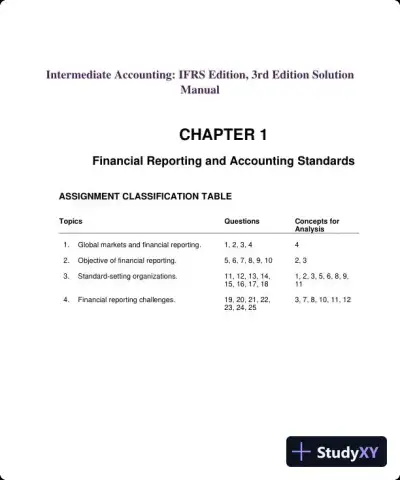 Textbook Guides
Intermediate Accounting: IFRS Edition, 3rd Edition Solution Manual
Accounting
1767 pages91downloadsFeb 2025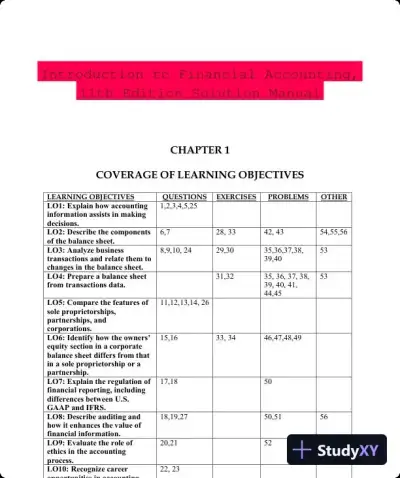 Textbook Guides
Introduction to Financial Accounting, 11th Edition Solution Manual
Accounting
524 pages173downloadsFeb 2025 Textbook Guides
Solution Manual For International Accounting, 4th Edition
Accounting
309 pages161downloadsFeb 2025 Textbook Guides
Solution Manual For Managerial Accounting, 7th Edition
Accounting
361 pages159downloadsFeb 2025 Class Notes
Class Notes For Advanced Accounting, 4th Edition
Accounting
149 pages159downloadsFeb 2025 Textbook Guides
Financial Accounting 6th Canadian Edition Solution Manual
Accounting
867 pages156downloadsFeb 2025 Textbook Guides
Accounting Theory, 7th Edition Solution Manual
Accounting
325 pages153downloadsFeb 2025 Textbook Guides
Financial Accounting, 9th Edition Solution Manual
Accounting
1024 pages134downloadsFeb 2025
Study this document with CramX
Once it is in your library, every tool can work from it.