

Solution Manual for Detecting Accounting Fraud: Analysis and Ethics
- Accounting
- 114 pages
- Shared February 2025
- 34 downloads
Strengthen your problem-solving skills with Solution Manual for Detecting Accounting Fraud: Analysis and Ethics, your essential study tool.
Preview 31 of 114 pages
See the first 31 pages exactly as they appear in the document.
Page 1 Read page 1 as text
1 Chapter 1 Introduction to the Problem of Accounting Fraud SOLUTIONS True/False Questions : 1. False 2. False 3. False (The Sarbanes - Oxley Act was passed in 2002 . ) 4. True 5. False 6. False 7. True 8. False ( The Dodd - Frank Act revised and increased the power of the SEC . ) 9. False ( They usually neither admit nor deny the findings.) 10. True Fill - in - the - Blank Questions : 11. Section 404 12 . audit 13 . b anking 14. damages 15. 2010 16 . agents 17. lower (But not by much. Byrne, Lavelle, Byrnes, and Vickers, May 2002, reported that in 2001, “CEOs of large corporations made 411 times as much as the average factory worker.” The Institute for Policy Studies pointed out: “The pay gap between CEOs and average American workers has grown from 195 - to - 1 in 1993 to 354 - to - 1 in 2012 . ” ) 18. Volcker 19. Adelphia 20. toxic or risky
Page 2 Page 3 Read page 3 as text
DETECTING ACCOUNTING FRAUD 2 Multiple - Choice Questions : 21 . c Explanation: The SEC is a government regulatory body and was not complicit in the fraud, nor was its role examined or faulted by the Bankruptcy Examiner. • Answers a, b, and d are incorrect because Thornburgh found gatekeeping failures in WorldCom‘s internal audit structure and with its external auditors and its board of direc tors . 22. b Explanation: In many cases , senior management compensation agreements included stock options that would provide significant additional remuneration if analysts’ earnings expectations were met. • Answers a, c, and d are incorrect because they were not cited as common reasons to orchestrate frauds. 23. b Explanation: • Answers a, c, and d are true statements. 24. d Explanation: Directors with no stake in the company , and who are not officers in the company, would be least likely to succumb to pressures. • Answers a , b, and c ar e incorrect because Levitt believed that situations described in a, b, and c could undermine many directors’ abilities to act autonomously . 25. a Explanation: The major objectives of Dodd - Frank are to “reshape the U.S. regulatory system in a number of areas including but not limited to consumer protection, trading restrictions, credit ratings, regulation of financial products, corporate governance and disclosure, and transparency” (“The Laws” 2012). • Answer a is correct because Dodd - Frank does not attempt to increase the number of audit firms. 26. d Explanation: All of the changes mentioned , plus others, have resulted from Dodd - Frank. 27. a
Page 4 Read page 4 as text
Chapter 1: Introduction to the Problem of Accounting Fraud 3 Explanation: Through Dodd - Frank’s whistleblower program , whistleblowers are offered more protectio n than under Sarbanes - Oxley, and they can now receive monetary awards from the SEC which is pursuing whistleblower tips very seriously . • Answers b, c, and d are incorrect because whistleblowers are taken seriously by the SEC and they can receive monetary awards. 28. a Explanation: The director who works for a competing company, Raining Raisins , may have a conflict of interests. • The employment status of the other directors would be unlikely to result in conflicts of interest. 29. d Explanation: According to SOX, an audit partner cannot be the lead or reviewing auditor of the same company for more than five years. • Answers a, b, and c would be unlikely to influence the ability of Ethical Auditors to carry out an impartial audit. 30 . a Explanation: Answers b and c were instituted by the SEC only after the Dodd Frank Act of 2010.
Page 5 Read page 5 as text
Chapter 2: Ethics at Work 1 1 Chapter 2 Ethics at Work SOLUTIONS 1 True/False Questions : 1. False Explanation: Virtue ethics focuses on character traits of a virtuous person and thus offers no strict rules on how to act. 2. False Explanation: Virtue ethics is agent centered, while consequentialism is concerned with the effects of an action. 3. False Explanation: Business ethics is a type of applied ethics. Meta e thics is concerned with what constitutes the good and the bad, while business ethics deals with the ethics of particular situations and within a particular discipline . 4. False Explanation: This is one of the limits of consequentialism . A lthough it judges an action by the consequences, it is unable to predict every possible consequence . 5. False Explanation: Utilitarians judge actions by the utility they produce, thus it is a form of consequentialism . 6. True Explanation: This is the hallmark of deontology . 7. False Explanation: This is the goal of virtue ethics . 8. False Explanation: The purp ose of the audit is t o give an independent opinion on the financial statements . 9. False 1 Solutions for this chapter provided by Kate Jackson, Ph.D. student in Theological Ethics, Boston College.
Page 6 Read page 6 as text
DETECTING ACCOUNTING FRAUD 2 2 Explanation: The rights approach is often co mbined with the duties approach since a right often produces a reciprocal duty. 10. True Explanation: A specific transaction can cause a specific person to have the right to have a loan repaid. Fill - in - the - Blank Questions : 11 . Kant 12. maximize 13. allocated 14 . need 15 . c haracter 16 . Aristotle 17 . u tilitarianism 18. hedonism 19. stakeholders 20. t elos Multiple - Choice Questions : 21. a Explanation: Utilitarianism is a form of consequentialism that refers to all the approaches in the study of morality that evaluate conduct or actions in terms of the consequences that they produce. • Answers b. and c. are incorrect because they do not refer to the consequences of an action. 22. b Explanation: According to Kant’s categorical imperative, the end does not justify the means. • Answers a, b, and c are all consistent with Kant’s categorical imperative. If Kant thought the end justified the means, he would have been a consequentialist. 23. c
Page 7 Read page 7 as text
Chapter 2: Ethics at Work 3 3 Explanation: According to the virtue theory of ethical behavior, the most important aspect of morality is found within an individual’s character. • Answer a is incorrect because deontology emphasizes duty • Answer b is incorrect be utilitarianism emphasizes consequences 24. b Explanation: An unwavering commitment to duty is the hallmark of deontology. • Answers a, c, and d are all associated with virtue. According to Aristotle, virtues are developed by habit, adhering to the mean between extremes, and behavior related t o human flourishing. 25. a Explanation : Anne would be using some of the consequences of her possible response to guide her behavior. 26. b Explanation : She would be using her sense of duty (in this case telling the truth ) to guide her behavior. Duty is the guiding principle of deontology. 27. a Explanation : This type of thinking is considered a shortcoming of consequentialism . At times, it can permit egregious acts i n the name of the greater good . 28. a Explanation : Another limit of consequentialism is that the scope of the consequences is often unclear. 29. b Explanation : A utonomy is not a cardinal virtue. • The cardinal virtues are: courage, temperance, wisdom, and justice. 30. c Explanation : Self - defense rights were not identified by Sterba • Sterba identified action rights, in persona rights, in rem rights, and recipient rights. For Discussion : 31. Reponses will vary. Here are some possible reactions:
Page 8 Read page 8 as text
DETECTING ACCOUNTING FRAUD 4 4 Possible Virtue Possible Description Honesty Preparing f inancial statements that fairly represent the entity’s financial position and the results of its operations Diligence Working hard and with accuracy to get a job done; finishing a task one is given Courage Speaking out against unethical business practice s; refusing to prepare fraudulent financial statements. Wisdom Knowing when to speak out Fairness Not having favorites ; keeping all users of financial statements in mind Generosity Spending time on mentoring less experienced accountants. Consideri ng the cultivation of virtues, since virtue ethics is about the virtuous person, often virtue ethics is taught by example and/or through narrative. A way to teach business virtues might be through a story about a virtuous accountant. Students may elect to write a tale about a virtuous accountant that teaches lessons about how a virtuous person may respond to difficult ethical business dilemmas. Aristotle thought virtues were cultivated through habit. In this view, small and regular behaviors shape character. To cultivate the virtue of generosity, for example, one might start on a small - scale by giving a dollar to a homeless person on the street, bringing brownies to give out at work, or being generous with one’s time by genuinely asking and listening to how a co - worker is doing. Also in this view, one does not magically become a courageous whistle - blower, for example, but rather the virtue of courage is fostered through day - to - day courageous acts, such as speaking out against gossip, admitting when one makes a mistake, and offering one’s suggestions at a work meeting. 32. Reponses will vary. Here are some possible reactions: Those who assert that virtues in business are related to virtues in personal life may support their answer s with some of the following beliefs: virtues exist in unity; virtues are developed
Page 9 Read page 9 as text
Chapter 2: Ethics at Work 5 5 through habit ; a person’s life cannot be compartmentalized, but must be treated as an integrated whole. If someone believes virtues are developed through habit, as Aristotle thought, that person is likely to assume that vices in one’s personal life will lead to vices in one’s business practice. For example, if a husband lies to his wife, he will become habituated to lying, making it easier to lie on balance sheets. Conversely , the husband who is a good communicator and who is always honest with his wife is more likely to communicate well and value honesty in the workplace. Others may regard one’s personal life as distinct from one’s professional life. This group may believe that personal and professional lives have an impermeable barrier and/or are governed by entirely different, and thus unrelated, virtues. For instance, one may believe that intimate relationships require a totally different set of virtues than business relationships, and thus these are unrelated. And/or one may not think virtues are acquired through habit and so lying to one’s spouse does not make it easier or more likely that one will lie on balance sheets. Some may think that the virtues exist in unity because they belong to one agent. In this view, it is unlikely that one is very honest and at the same time lacks courage. For example, one could not be very honest without courage because courage is necessary to tell the truth in difficult situations. Also, being honest can help to foster courage as a commitment to honesty inspires courage. Others may think it is entirely possible to possess some virtues and some vices because they regard the virtues as unrelated. This group may choose seemingly disparate virtues to make this case. For example, a person who is honest, but not just, such as a manager who is very honest about his or her biases against certain employees. 33. Reponses will vary. Here are some possible reactions: Some may think intention matters in so far as a right action is not truly right unless it is motivated by good intentions. Others may think intention matters inso far a s a wrong action is permissible if it is for the right reasons. This logic follows the saying , “The end justifies the means.” Some may think intention is important, but that it does not determine if an action is right or wrong.
Page 10 Read page 10 as text
DETECTING ACCOUNTING FRAUD 6 6 A strict consequentialist may believe that only consequences count, so even if one’s intentions are coming from a good place, it is only the outcome that matters. For example, someone wants to improve the business of a group of farmers and gives them a popular grain seed that unintentionally wipes out all their crops. Although the person meant well, the consequentialist may assert that the consequences indicate that the person acted wrongly. (Issues of intent also bring up notions of culpability, which are beyond the scope of this chapter. However, it is important to note that there is a distinction between causal culpability — causing the destruction of crops, in this case — and moral culpability , i.e. the extent to which one is morally responsible for the destruction of the crops.) To the strict deontologist, an action performed out of a sense of duty has more moral value than the same action taken because of its likely consequences in that specific situation. Virtue ethics is most able to take into account intent because it is concerned with the character of the whole person and with all of that person’s character traits. 34. Reponses will vary. Here are some possible reactions: The best answer will first define happiness. One definition of happiness is that it is a type of persistent, peaceful joy (as opposed to an ecstatic, manic, euphoric, and fleeting feeling). This background joy remains constant during temporary disappointments and difficulties. For some, acting ethically is accompanied by happiness even when acting ethically is hard. For example, standing up for a co - worker who is being picked on may not make one popular at work and it may not be easy, but it may also be accompanied by a sense of calm and satisfaction knowing that one acted ethically . Wrong actions may be accompanied by great anxiety, such as when one is involved in a web of lies or when one cheats on a test. Others will think that the costs of right action may be too great. For example, it does not feel good to become a pariah at work for standing up for a c o - worker who is picked on. It is possible that s ome may think that they would feel happier if they cheat ed on a test rather than fail ed a class and had to repeat it . 35 ( a ) . Reponses will vary. Here are some possible reactions:
Page 11 Read page 11 as text
Chapter 2: Ethics at Work 7 7 For some, this example is the quintessential reason why duty ethics are vital. Here, the manager’s sen se of duty overrides her negative feelings for the employee, enabling the employee to receive the deserved promotion based on timely and accurate work over the last two years. Thus, this example illustrates why duty and reason are crucial to business practice. Others will feel slighted that the promotion is not inspired by the manager’s opinion that the employee is a likeable and congenial worker. These people may want to be promoted because the boss has a positive attitude towards them, and not because the boss is following protocol, rules, and duty. 35 ( b ) . Reponses will vary. Here are some possible reactions: For some, the managing partner’s ability to offer a promotion in spite of her biased feelings will show great integrity and fairness. Letting reason and not emotions guide her decisions will be looked upon by some as very ethical. Others will not be impressed that the boss gave the promotion only because she felt duty - bound to do so. They will think that her lack of authentic and genuine enthusiasm for the employee undermines the morality behind her actions. These people may think that abiding by rules and duties are not enough to make someone an ethical person and that the boss should feel the genuine desire to give the promotion. 36. Reponse s will vary. Some things to consider include pay disc repancies between men and women; promotions for men and women; the presence of a ‘glass ceiling’ for women; how maternity leave is tr eated for fathers and mothers in the workplace; and social expectations of men and women in the workplace. For instance , are women and men sometimes held to different standards of dress in the business world ? Are they held to different standards of beh avior? Is there a difference between how co - workers perceive a long response from a woman versus a long response from a man? If there is a differenc e, which attitude is rewarded? Is there a difference or a perceived difference in the way women and men approach taking risks in business? If there is a difference, which approach is rewarded? Is there a difference or a perceived difference in the way women and men promote themselves? If there is a difference,
Page 12 Read page 12 as text
DETECTING ACCOUNTING FRAUD 8 8 which approach is rewarded? Is there a difference or a perceived difference between ma le and female styles of management ? If so, which style is most likely to be rewarded or respected ? C ASE STUDY: Peter Madoff, Brother of Bernard Madoff and Former Chief Compliance Officer and Senior Managing Director of Bernard L. Madoff Investment Securities, LL C a (i). Stakeholder Consequence Source Peter Madoff Temporary gain of wealth, luxurious lifestyle, prestige ; Followed by long - term money loss, imprisonment, embarrassment, separati on from family , despised by clients & former friends U.S. Attorney Preet Bharara said, “He will now be jailed well into old age, and he will forfeit virtually every penny he has.” Law abiding taxpayers Paid taxes when Madoff did not IRS - CI Acting Special Agent in Charge T oni Weirauch said, “One of the consequences of the concealment is that the IRS was hindered from performing its lawful duty, thus harming our nation’s law abiding taxpayers, along with the defrauded victim s. ” Special Agent Robert L. Panella said, “During today’s plea, Peter Madoff admitted to his role in a fraud scheme that harmed the savings of thousands of investors.” IRS IRS was hindered from performing its lawful duty; public money was lost Thousands of investors who were defrauded Lost money, sometimes lost most of their retirement savings & had to return to work; fooled, cheated, lied to
Page 13 Read page 13 as text
Chapter 2: Ethics at Work 9 9 Employees Economic security lost, benefits lost, Inability to support family Special Agent Robert L. Panella said that Madoff “undermine[d] the financial well - being of workers.” Madoff also “Failed to protect the integrity of employee benefit plan assets….” Regulators Were all tricked into believing falsehoods; were unable to perform their jobs appropriately “Madoff created numerous false compliance documents in which he stated that he had performed compliance reviews of the trading in the BLMIS IA business on a regular basis, when, in reality, the reviews were never performed. The false statements were designed to mislead regulators, auditors, and IA clients” Auditors Were all tricked into believing falsehoods; were unable to perform their jobs appropriately Thought they were investing in an elite, thriving company See above quote. “The numerous false statements in the Forms ADV created the false appearance that BLMIS’s IA business had a small number of highly sophisticated clients and far fewer assets under management than was actually the case.” IA [Investment Advisory] clients Bernard L. Madoff Investment Securities (BLMIS) clients His wife Marion Short - term gain of money; long - term loss of money and life - style, separation from father/husband, severe embarrassment “The government has entered into a settlement with Madoff’s family that requires the forfeiture of all of his wife Marion’s and daughter Shana’s assets and assets belonging to other family members.” Daughter Shana Short - term gain of money; long - term loss of money and life - style, separation from father/husband, See above quote.
Page 14 Read page 14 as text
DETECTING ACCOUNTING FRAUD 10 10 a (ii). Based on the cons equences discussed above, it seems as if all stakeholders suffered negative consequences. The positive consequences for Madoff and his family were enjoyed in the short - term only. Based on the utilitarian notion to choose the action that gives the greatest good to the greatest number, Madoff should not have committed his crimes. a (iii). Egoism is a type of consequentialism that judges actions by the benefits for only oneself . According to the article, Madoff was only concerned about himself and his favorites : “ DOL - EBSA New York Regional Director Jonathan Kay said, ‘Today’s plea is a testament to the good work and strong collaboration among multiple federal agencies. This agency remains committed to protecting worker benefit plans from those who would defraud them for personal gain.’” Special Agent Panella said that Peter Madoff “personally benefited from proceeds gained as a result of these false statements.” Many people suffered for Madoff’s narcissistic actions: “Manhattan U.S. Attorney Preet Bharara said, ‘Peter Madoff enabled the largest fraud in human history….We are not yet finished calling to account everyone responsible for the epic fraud of Bernard Madoff and the epic pain of his many victims.’” If Peter Madoff had considered the consequences for people other than himself, he may have acted differently . b (i). Responses should take the following into account: Duty How Madoff Fell Short of His Duty Fulfill his commitment to conduct reviews “He certified that periodic reviews established the firm’s compliance with internal and regulatory rules. In fact, Peter Madoff conducted no reviews. He severe embarrassment
Page 15 Read page 15 as text
Chapter 2: Ethics at Work 11 11 certified that his examination of the firm’s trading process established its integrity. He did not — indeed, he could not — c onduct any such examination:” “ He made a pretense of compliance; he was really about complicity.” (Janice K. Fedarcyk) Honesty • “Madoff created false and misleading BLMIS compliance documents.” • “False reports that were filed with the U.S. Securities and Exchange Commission (SEC)….” • “The numerous false statements in the Forms ADV created the false appearance that BLMIS’s IA business….” Civic responsibility Evading taxes: • Peter Madoff received approximately $15,700,000 from Bernard L. Madoff and his wife and executed sham promissory notes to make it appear that the transfers were loans, in order to avoid paying taxes; • Madoff gave approximately $9,900,000 to family members, and in order to avoid paying taxes, executed sham promissory notes to make it appear that the transfers of these funds were loans; • Madoff did not pay taxes on approximately $7,750,000 that he received from BLMIS; • Madoff received approximately $16,800,000 from Bernard L. Madoff from two sham trades, and disguised the proceeds of the trades as long - term stock transactions in order to take advantage of the lower tax rate for long - term capital gains; • Madoff charged approximately $175,000 in personal expenses to a corporate American Express card and did not report those expenses as income. Madoff also arranged for his wife to have a “no - show” job at BLMIS from which she received between approximately $100,000 to $160,000 per year in salary, a 401(k), and other benefit s to which she was not entitled. Fairness “Madoff agreed with others to send the $300 million that remained in the IA accounts to preferred employees, family members, and friends”
Page 16 Read page 16 as text
DETECTING ACCOUNTING FRAUD 12 12 Duty to take care of his employees Robert L. Panella said that Madoff, “Failed to protect the integrity of employee benefit plan assets and personally benefited from proceeds gained as a result of these false statements .” b (ii). Responses may vary. Some students may argue that reason and duty were not sufficient to prevent Madoff from unethical behavior and that companies need more oversight and/or there should be stricter laws governing accounting practices and /or we need better compliance of the laws already in place. Others may maintain that Madoff lacked a moral compass and a character strong enough to withstand th e temptation to enrich himself. Others may argue that he did not consider the consequences of his actions. c (i). Responses will vary, but should include that consequentialism accounts for the far - reaching repercussions of Madoff’s specific actions and deontology does not. Consequentialism identifies all of the stake holders affected by Madoff’s fraud as well as the far - reaching consequences. On the other hand, deontology focuses on the unwavering commitment to principle and duty, in this case, for example, the moral imperative to be honest at all times. c (ii). Some students may find consequen tialism more persuasive for the reason that it forces one to consider the far - reaching consequences to all the stakeholders. Some may think the consequences are the most egregious parts of the act, while others will think skirting obligations are the worst parts of the crime. They may believe that a commitment to the moral imperative to always tell the truth would best prevent this kind of offense. c (iii). Some students will think one system is best for all cases, while others will think each issue needs its own system. There are also those who may believe that when faced with an ethical dilemma, one should analyze it in terms of all three frameworks. d.
Page 17 Read page 17 as text
Chapter 2: Ethics at Work 13 13 Responses may vary, but should include the fo llowing : (Answers are in bold) Using the American Accounting Association Ethical Decision - Making Model : 1. Determine the facts — who, what, when, where, and how? What do we know or need to know, if possible, that will help define the problems? Who ? A chief compliance officer working for Madoff What ? Securities fraud , tax fraud co nspiracy, falsifying books and records , and making false statements to investors When? 1996 - 2008 Where? Bernard L. Madoff Investment Securities ( BLMIS ) , New York, NY. How? “Madoff created false and misleading BLMIS compliance documents, as well as false reports that were filed with the U.S. Securities and Exchange Commission (SEC) that materially misstated the nature and scope of BLMIS’s Investment Advisory (IA) business.” 2. Define the ethical issue. a) List the significant stakeholders See answer to Case Study Question a (i) above b) Define the ethical issues Make sure prec isely what the ethical issue is; for example: conflicts involving rights, questions over limits of an obligation, etc. Securities fraud, tax - fraud conspiracy, fa lsifying books and records, making false statements to investors , lying to family and friends 3. Identify major principles, rules, or values. For example, integrity, quality, respect for persons, and profit. Honesty, fairness, integrity, duties to employees 4. Specify the alternatives. List the major alternative courses of action, including those that represent some form of compromise or point between simply doing or not doing something. In this case, it does not seem that a moral compromise was possible — it is never permissible to misrepresent one’s company, or to cheat and steal from one’s clients. 5. Compare values and alternatives. See if a clear decision is evident. Determine if there is one principle or value, or combination, which is so compelling that the proper alternative is clear — for example, correcting a defect that is almost certain to cause loss of life. All major ethical frameworks would appear to lead to the conclusion that the chief compliance officer should not turn a blind eye to the fraud .
Page 18 Read page 18 as text
DETECTING ACCOUNTING FRAUD 14 14 6. Assess the consequences. Identify short and long, and positive and negative consequences for the major alternatives. The common short - run focus on gain or loss needs to be measured against long - run considerations. This step will often reveal an unanticipated result of major importance. See a nswer to Case Study Question a (i) above 7. Make your decision. Balance the consequences against your primary principles or values and select the alternative that best fits. It is likely that all approaches will lead to the decision that this fraud was morally wrong and should not be committed.
Page 19 Read page 19 as text
1 Chapter 3 The Sizzling Saga of Sunbeam SOLUTIONS Ethics at Work : a. Suggested response: Developed by Jeremy Bentham (1748 – 1832), utilitarianism maintains that the right action ethically is the action that maximizes the “good.” As consequentialist philosophy has developed over the years, different philosophers have specified different definitions of the “good,” or what should be maximized, but the unifying thread is that all consequentialists judge actions according the sum of the net “good” that actions cause among all those who are affected by the action. To the strict utilitarian, it is the aggregate “pleasure” for all parties concerned that will determine whether the action is right. Therefore, when applying this framework, we have to consider all of the stakeholders in the decis ion by Sunbeam’s management to issue financial statements that included future periods’ sales revenue in Sunbeam’s then current periods’ income statements. According to John Stuart Mill, we have to consider all the people (stakeholders) — or groups of people — who would enjoy an increase in pleasure or suffer an increase in pain as a result of the overstatement of sales and accounts receivable in Sunbeam’s income statements and balance sheets. Sunbeam was unethical in issuing financial statements that improperly timed Sunbeam’s revenu e rec ognition because this increased only Sunbeam’s own short - term financial gains and did not consider how this unethical behavior could eventually affect the long - term health of the company, as well as its employees, investors, and family members of anyone with connections to the company. In addition, before Sunbeam was forced to declare bankruptcy, it introdu ced its notorious and ruthless downsizing strategy, leading to the closure of a number of plants. At the time of these downsizings, co okie - jar reserves were created that were later reversed into earnings. Here is how these moves affected potential stakeholders:
Page 20 Read page 20 as text
DETECTING ACCOUNTING FRAUD 2 • Investors ―Recognizing future sales in the current period inflates current earnings and usually inflates the stock price. Investors bought stock at inflated prices and lost money because future sales had already been taken into the current period’s sales. When Sunbeam eventually declared bankruptcy, shareholders received nothing. • Employees of the company — Many at Sunbeam lost their jobs and also lost their benefits, such as health - care insurance and pensions. • Family members — Relatives of Sunbeam’s employees suffered hardships when family members lost their jobs. • Financial institutions — Banks that lent Sunbeam money lost about 66 percent of their loans. • Other businesses — Companies doing business with Sunbeam lost money when Sunbeam went bankrupt. b. Suggested response: The justice decision - making model aims to identify the right or the moral action. Once all the stakeholders are identified, this model emphasizes that all parties involved must be treated equally and fairly. This model focuses on distributive justice, or the fair distribution of justice. When it comes to insider trading, it can be argued that the seller and the buyer of the shares are not being treated equally. The true information as to the company’s sales and earnings is not equally distributed to the two parties involved in the sale. Because of this unequal treatment, it would be argued under the justice approach that insider trading is unethical. ASSIGNMENTS True/False Questions: 1. False 2. True 3. True 4. True
Page 21 Read page 21 as text
Chapter 3: The Sizzling Saga of Sunbeam 3 5. False 6. False 7. True 8. True 9. False 10. True Fill - In - the - Blank Questions: 11. allocated 12. re maining or continuing 13. memory 14. accelerating 15. reserve for returns 16. in con clusive 17. deductions 18. quarter - end 19. excess 20. special Multiple Choice Questions : 21. c Explanation: Ownership will only pass from Ace to its customer once the goods have been shipped from Ace to the customer (FOB shipping). If the goods have been shipped from Ace’s head office to its branch office, this does not constitute shipping to the customer. On December 31, the inventory belonged to Ace. • Answers a and b are incorrect because Ace cannot recognize a sale before January 5. • Answer d is incorrect because the packing case should be included in Ace’s inventory. 22. b
Page 22 Read page 22 as text
DETECTING ACCOUNTING FRAUD 4 Explanation: Item I inventory is part of Bolt’s inventory because ownership of the goods on consignment remains with Bolt until the retail customer sells the goods. Item II inventory passed to Bolt’s customer when Bolt shipped the goods to its customer (FOB shipping). • Answer a is incorrect because Item II inventory has passed from Bolt to its customer. • Answer c is incorrect because the goods sent on consignment have not been sold until the consignee sells them. • Answer d is incorrect because Item II inventory has been sold (FOB shipping). 23. d Explanation: Both a and b are correct. Answer a is correct because the buyer, not the seller, must request a bill and hold sale for it to be recognized as revenue before the goods are shipped. Answer b is correct because the buyer must have a substantial business reason for requesting a bill and hold sale for the seller to recognize the sale before shipping. • Answer c is incorrect because with a bill and hold sale the seller recognizes the cost of goods sold. 24. c Explanation: A sale can only be recognized once the risks of ownership have passed to the buyer, and the FOB destination clause delays this transfer until the goods are shipped in March. • Answer a is incorrect because, in this case, the buyer does have a legitimate, substantial business reason for placing the order early. • Answer b is incorrect because, with bill and hold sales, the cost of goods sold and the sales revenue are both recognized. • Answer d is incorrect because sales do not have to be paid for in order to be recognized as sales. 25. a Explanation: The back - dated order increases sales by $10,000 and increases operating income by $6,000 ($10,000 - $4,000). • Answer b is incorrect because net CFFO would not be overstated. • Answer c is incorrect because CFFO would not be overstated.
Page 23 Read page 23 as text
Chapter 3: The Sizzling Saga of Sunbeam 5 • Answer d is incorrect because net income would be overstated by $6,000, excluding income tax effects. 26. b Explanation: Operating income would increase by $6,000 ($10,000 less $4,000). CFFO would not increase. To arrive at CFFO, d educt the increase in account receivable of $10,000 and add the $4,000 decrease in inventory from the extra operating income of $6,000. • Answers a, c, and d are incorrect. See the explanation for Answer b above. 27. d Explanation: Operating income will be stated as $25,000 + $15,000 - $10,000 = $30,000, which is an increase of $5,000. • Answer a is incorrect beca use CFFO will n ot increase . • Answer b is incorre ct because CFFO will not increase. • Answer c is incorrect. See the explanation for Answer d above. 28. a Explanation: The accounts receivable balance will be $65,000 ($50,000 + $15,000) • Answer b is incorrect, because operating income will be $30,000($25,000 + $15,000 - $10,000). • Answer c is incorrect bec ause CFFO will not increase . • Answer d is incorrect because operating income will be $30,000 ($25,000 + $15,000 - $10,000). 29. d Explanation: Sunbeam’s restructuring expense decreased net income. The other side of the entry increased the restructuring reserve on the balance sheet. • Answer a is incorrect; net income decreased. • Answer b is incorrect; the reserves increased. • Answer c is incorrect; an expense does not increase income. 30. a Explanation: Sunbeam provides an example of improper revenue recognition via improper timing of revenue. The sales revenue that it recorded related to real orders for goods that
Page 24 Read page 24 as text
DETECTING ACCOUNTING FRAUD 6 ordinarily would have been placed in later periods. (The next chapter deals with improper revenue recognition via recording fictitious revenue and the improper valuation of revenue.) • Answers b, c, and d all describe methods that Sunbeam did use to recognize future periods’ sales. For Discussion 31. Suggested response : It must be understood that the recognition of future revenue in the current period takes the next period’s revenue into this period. As a consequence, that portion of the next period’s revenue cannot be reorganized in the later period. Even if the fraud is repeated in the next period, that period would only recognize one period’s revenue and earnings, whereas the current period recognizes more than one period’s revenues and earnings. The result of this will likely be an increase in the stock price in the current period and a decrease in the stock price in a later period. Shareholders who purchased stock at the inflated price will suffer a loss as the stock price falls after the spike in revenues and earnings. The perpetrators of early recognition of revenue frauds prepare misleading financial statements. Whenever anyone intentionally misleads another person and that deception causes a financial loss, a fraud has been committed. Since early recognition of revenue can cause others financial loss, the perpetrators bear the same responsibility for fraud. 32. Suggested response: Managers have an incentive to understate net income in one period in order to overstate it in a future period because, with this scheme, the expense for the creation of the restructuring reserve is often disclosed “below the line” of operating income. As a result, it is regarded as a “non - recurring” expense. Therefore, it may not impact the stock price as much as if the expense were recognized before the calculation of operating income. Perpetrators of this kind of fraud often release the overstated reserve into earnings “above the line” of operating income in the future period where the income is considered to be recurring. This makes the company appear to be more profitable than it really is and falsely boosts the stock price.
Page 25 Read page 25 as text
Chapter 3: The Sizzling Saga of Sunbeam 7 Short - Answer Questions : 33. Typically, when companies overstates a restructuring reserve for the purpose of creating a cookie - jar reserve to reverse into profits in a later period, they disclose the restructuring expense in the income statement as a special charge below operating income. Although this reduces net income, it does not reduce operating income. 34. The sale and the cost of goods sold are recognized in the current period in the income statement. As long as the goods are sold at a mark - up, operating income is increased. Because the customer pays only in the later period, there is no increase in CFFO in the period that the bill and hold sale is recognized. Looking at the indirect method, the amount stated for CFFO is derived by beginning with the net income and deducting the increase in accounts receivable and other current assets. Decreases in current assets are added back. The bill and hold sale increases accounts receivable and decreases inventory. The net effect is that the transaction does not increase CFFO. 35. When a segment or product line is closed, all of its revenue is lost. Many fixed costs that are allocated over segments are not directly traceable to a particular segment. As a result, even if the expense could be avoided if the entire company were liquidated, closing just one segment might not reduce the cost. For example, a CEO’s salary will probably not decrease if one segment is closed. If the salary cost remains constant, it will be allocated over the remaining segments, which now carry more costs and might report less profit after a segment was closed. In this instance, the remaining revenue is decreased by a greater amount than expenses are decreased. 36. The increase in this ratio shows that recorded sales are increasing at a faster percentage than payments by customers. This could be caused by a decreasing ability of customers to pay, or it could be that the revenue has been recorded earlier than in the past or that the revenue is completely fictitious. While the signal is not proof of any of these items, it is not a good
Page 26 Read page 26 as text
DETECTING ACCOUNTING FRAUD 8 sign. Unless one can identify a legitimate reason behind an increase in this ratio, it is a signal that the quality of the revenue reported may be deteriorating. 37. Often, a restructuring reserve includes a write - down of inventory below cost, on the grounds that the company expect s the inventory to be sold at a loss. When companies overstate this expected loss and write down the inventory in the current period — and then sell the inventory close to the regular selling price in the future period — it causes a large gross margin to be reported in the later period if the company includes the recording of these sales in its disclosure of operating income.
Page 27 Read page 27 as text
Chapter 3: The Sizzling Saga of Sunbeam 9 Exercises : 38. Year 1 Year 2 Year 3 Accounts receivable as a percentage of sales: 15% 20% 37.5% 39. Net income $100 ,000 Depreciation 5,000 Decrease in inventory 10,000 Increase in accounts receivable (40,000) Increase in accounts payable 5,000 Cash flow from operations $ 80,000 40 (a). Debit restructuring expense $20,000 Credit restructuring reserve $20,000 40 (b). Income Statement Sales $160,000 Cost of goods sold 60,000 Gross margin 100,000 Selling & administrative expenses 40,000 Operating income 60,000 Restructuring expense 20,000 Income before tax ation 40,000 Taxation 12,000 Net income $ 28,000 CASE STUDY : Bea zer Homes USA, INC. NOTE: Question a (below) refers to the sale and leaseback transactions. a (1).
Page 28 Read page 28 as text
DETECTING ACCOUNTING FRAUD 10 The model homes were eventually truly sold at the end of the lease term. Therefore, the revenue was eventually earned. However , the sale - leaseback agreement enabled Beazer to recognize the sale at the beginning of the lease term , while the company was still using the homes as marketing models and while it still participated in the appreciation of the value of the homes . Therefore, this was a case of “improper timing of revenue.” a ( 2 ) . Beazer built a few model homes in each housing development for marketing purposes. Historically, Beazer entered into sale - leaseback agreements for 20 percent to 30 percent of these model homes. These agreements allowed Beazer to recognize revenue on the sale of the model homes while it was still using the homes as marketing models. However, in 2006, Beazer began to increase the percentage of the model homes for which it entered into sale - leaseback agreements to 70 percent. In this way, it was able to recognize sales revenue of $117 million on more of the homes it had not yet sold outright . This was, of course, a much higher percentage of homes than normally had been leased back as marketing models. Further, in terms of these sale - leaseback agreements, Beazer retained the “right to receive a percentage of the appreciation of the model home upon its sale at the end of the lease term” (AAER 2884, par. 1.4). This disqualified the agreements from being recognized as sales at the beginning of the lease term. a ( 3 ) . Signals of Beazer’s Fraudulent Reporting for Scheme #1: I mproper Recognition of Revenue via Sales - Leaseback Arrangements: o Signal #1: The first signal of an overstatement of revenue is when a company’s accounts receivable increases as a percentage of sales ▪ Beazer’s Accounts Receivable - to - Sales Ratios: 2004: 1.81% ( $70,574/$3,907,109) 2005: 3.24% ($161,880/$4,995,353) 2006: 6.11 % ($333,571/$5,462,003) 2007: 1.3% ($45,501/$3,490,819) From 2004 to 200 6 , Beazer’s accounts receivable as a percentage of sales more than tripled.
Page 29 Read page 29 as text
Chapter 3: The Sizzling Saga of Sunbeam 11 o Signal #2: Another signal of improper revenue recognition , or of a severe operating problem, is a sudden change in gross profit margin as a percentage of sales. The situation becomes even more s evere if there is a sudden downward fluctuation of the gross margin. In 2006, Beazer’s gross profit margin was 23.08%; one year later, the gross profit margin had plunged to - 1.87%. ▪ Beazer’s Gross Profit Margins: 2004: 20.66% ( $807,377/$3,907,109) 2005: 23.46% ($1,172,053/$4,995,353) 2006: 23.08% ($1,260,685/$5,462,003) 2007: - 1.87% ( - $65,430/$3,490,819) o Signal #3 : A third signal of improper revenue recognition occurs when cash flow from operations (CFFO) lags behind operating income. In the case of Beazer Homes, the accelerated sales were simply not turning into cash received at the rate that they should have been if they were legitimate sales . CFFO was significantly negative while operating income was positive for the fiscal years 2004 - 2006. This signal was an extremely strong indication that income was overstated. b (1). Beazer Homes recorded its land inventory in “land inventory acc ounts” in its general ledger . The land inventory accounts were debited with the purchase cost of the land plus common developments costs , such as the cost of sewer systems, including future estimated development costs. As the houses were sold, the associated land inventory account was reduced and a cost - of - sales expense was recognized. However, the “land expense recorded for any particular house sale was necessarily an estimate” (AAER 2884, par. 3). According to the SEC’s action, “in various quarters during fiscal years 2000 through 2005, Beazer overallocated land inventory expense to individual properties sold” (AAER 2884, par. 9). This overstatement caused the land inventory account to eventually record a negative balance. These credit balances on the land inventory accounts acted “in effect as improper
Page 30 Read page 30 as text
DETECTING ACCOUNTING FRAUD 12 reserves …. Beginning a t least by the second quarter of 2006, Beazer … began to reverse the excess reserves existing in the land inventory account, which increased their current period earnings” (AAER 2884, par. 10). According to the SEC complaint, these manipulations under stated Beazer’s net income by $42 million between fiscal years 2000 and 2005 and overstated net income by over $1.2 million during 2006. The company also reduced its cumulative net loss for the first two quarters of 2007 by $1 million (AAER 2884, par. 12). b ( 2 ) . The inflated credits to the land inventory account acted as an overstated inventory reserve. This is similar to Sunbeam’s overstated restructuring reserves, and they were later partly reversed i nto earning s, as Sunbeam’s cookie - jar reser ves were released into earnings in later periods. b (3). On creation of the reserve, Beazer increased cost of sales, which would clearly be seen as a normal recurring expense, whereas on the creation of its restructuring reserve, Sunbeam disclosed the restructuring expense as a special charge, which would likely be seen as a non - recurring expense. Sunbeam’s restructuring expense, at the time of the creation of the cookie - jar reserve, could have had less of a negative effect on investors’ expectations of Sunbeam’s future recurring profits.
Page 31 Read page 31 as text
1 Chapter 4 Hocus Pocus SOLUTIONS Ethics at Work a. Suggested response: The deontologist (from the Greek deon, which means “duty”) chooses moral action not because of its consequences in the specific circumstances , but because it is the right thing to do. Kant, the leading deontologist, went even further by saying that if you perceive telling the truth as a duty, you must always tell the truth for that reason itself. Moreover, you must tell the truth at all times, even if telling the truth could cause negative consequences. Few would argue that financial statements should not be truthful. To the deontologist, once you accept truth telling as a maxim, you must always present truthful financial statements. In fact, there is a moral imperative to present truthful financial statements. Therefore, according to deontology, any scheme to manipulate Xerox’s financial statements would have been regarded as unethical. b. These are broad questions and can be answered in a number of ways. Here is one possible response: It is important to note a distinction between legal behavior and ethical behavior. Everyone can think of situations in which one has to go beyond merely keeping within the letter of the law. Ultimately, GAAP rules aim to fairly and accurately present a company’s financial position and the results of its operations. When GAAP rules do not achieve this, the company’s annual report must find a way to disclose this. For example, the Management Discussion and Analysis (MD&A) can and should present further clarification on various issues. Companies need to be aware that they should abide by both the letter of the law and the spirit of the law. For example, PepsiCo’s 2011 Annual Report addresses this issue as follows :
83 more pages in the full document
Unlock it once and it stays in your library, ready to chat with or turn into flashcards.
Unlock the full documentMore Accounting study materials
See all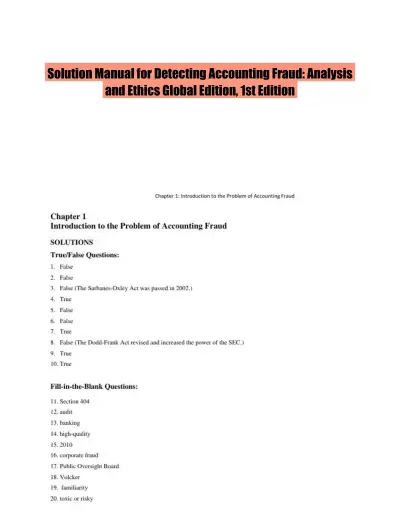 Textbook Guides
Solution Manual for Detecting Accounting Fraud: Analysis and Ethics Global Edition, 1st Edition
Accounting
112 pagesMay 2025 Textbook Guides
Introduction to Financial Accounting, 11th Edition Solution Manual
Accounting
524 pages173downloadsFeb 2025 Textbook Guides
Solution Manual For International Accounting, 4th Edition
Accounting
309 pages161downloadsFeb 2025 Textbook Guides
Solution Manual For Managerial Accounting, 7th Edition
Accounting
361 pages159downloadsFeb 2025 Class Notes
Class Notes For Advanced Accounting, 4th Edition
Accounting
149 pages159downloadsFeb 2025 Textbook Guides
Financial Accounting 6th Canadian Edition Solution Manual
Accounting
867 pages156downloadsFeb 2025 Textbook Guides
Accounting Theory, 7th Edition Solution Manual
Accounting
325 pages153downloadsFeb 2025 Textbook Guides
Financial Accounting, 9th Edition Solution Manual
Accounting
1024 pages134downloadsFeb 2025
Study this document with CramX
Once it is in your library, every tool can work from it.