

Solution Manual For Forensic Accounting and Fraud Examination, 2nd Edition
- Accounting
- 345 pages
- Shared February 2025
- 74 downloads
Ace your coursework with Solution Manual For Forensic Accounting and Fraud Examination, 2nd Edition, designed to simplify complex topics.
Preview 31 of 345 pages
See the first 31 pages exactly as they appear in the document.
Page 1 Read page 1 as text
Chapter 01 - Introduction to Forensic Accounting and Fraud Examination 1 - 1 Chapter 1 Introduction to Forensic Accounting and Fraud Examination Teaching Notes This chapter presents the opportunity to get students excited about the field s of forensic accounting and fraud examination . Suggested points to stress: • General o Forensic Accounting breaks out from the traditional image of accounting as boring. o There are many specialty opportuni ties within forensic accounting. o Fraud Examination is one very important opportunity within forensic accounting. o Forensic accounting is a challenging field that requires many special skills . • Learning Objectives o LO1: Define forensic accounting and fraud examination . ▪ Differentiate from traditional accounting o LO2: Describe the difference between forensic accounting and auditing. ▪ Forensic accounting includes auditing, special auditing methods, and other services in additional to auditing (e.g., litigation support) o LO3: Explain the role of forensic accountants and fraud examiners . ▪ Forensic accountants are needed in almost every area of business. Where there is money involved, a forensic accountant can play a role. Fraud examiners are needed to assist in preventing, detecting, investigating, and reporting on fraud. o LO4: Identify the knowledge and skills that forensic accountants and fraud examiners are expected to possess. ▪ Must not only be good with accounting numbers, but also with psychology, IT, and so on. The AICPA offers a special forensic accounting certification to CPAs . o LO5: Describe the opportunities that exist for those who choose to work as forensic accountants and fraud examiners . ▪ Some specialties within forensic accounting (e.g., expert testimony, expert consultant) can result in some of the highest - paying career opportunities in business. o LO6: Identify the organizations that support the work of forensic accountants and fraud examiners . ▪ The organizations and professional certifications demonstrate that forensic accounting is a well - recognized accounting specialty.
Page 2 Page 3 Read page 3 as text
Chapter 01 - Introduction to Forensic Accounting and Fraud Examination 1 - 2 Review Questions 1. To what does the word forensic pertain? a. Financial audits when fraud is involved. These types of audits are forensic audits, but the term “forensic” applies in a more general sense. b. A particular type of accounting Forensic accounting is one type of accounting, but the term “forensic” applies in a more general sense. c. Matters relating to law and courts of law. Correct. Forensic is a general term that relates to law and courts of law. d. Prosecutorial investigations. These represent forensic investigations, but the term “forensic” is more broadly applicable. 2. For an act to be considered fraud, which of the following ingredient is required? a. Large loss. Fraud can involve losses of any size. b. Legal entity (e.g., a corporation, partnership, or trust). Fraud can be committed against both legal entities and individuals. c. Intentional harm. Fraud can involve accidental harm or harm not realized by the victim. For example, if by fraud one steals an object from someone, tha t someone is still a victim of fraud even if she never misses the stolen object. d. Intentional action or inaction. Correct. Fraud generally does not include accidents. 3. Which of the following is outside the area of forensic accounting? a. Corporate acquisitions. Forensic accountants routinely review documents and provide consulting services in relation to acquisitions. b. Divorce. For example, forensic accountants might search for hidden assets in a divorce proceeding. c. Contract disputes. For example, forensic accountants might search for evidence of fraud in contract disputes. d. None of the above. Correct . None of the above is outside of the area of forensic accounting.
Page 4 Read page 4 as text
Chapter 01 - Introduction to Forensic Accounting and Fraud Examination 1 - 3 4. Which area of accounting is most closely associated with forensic accounting? a. Information systems. b. Managerial accounting. c. Consulting. d. Auditing. Correct. Fraud investigation and examination, a primary area within forensic accounting relies heavily on auditing techniques. All of the above areas of accounting are at least somewhat related to forensic accounting, although strictly speaking consulting is not an area of accounting but rather a mode of accounting practice. 5. The Sarbanes - Oxley Act requires which of the following? a. Auditors to receive specialized training in the act. Auditors must be familiar with PCAOB standards relating to the act, but such familiarity is not really specialized training. b. The CEO to certify the financial statements. Correct. One of the primary requirements of the act is to require ceos and ceos to certify the financial statements under liability for criminal penalty. c. Management to institute a zero tolerance policy for fraud. d. None of the above. 6. How do the objectives differ for forensic accountants ( fas ) and external financial auditors ( efes )? a. Fas are more thorough. Both fas and efas must do their work thoroughly. b. Efas audit a broader range of transactions. Although this may be correct in a particular case of fraud, fas must potentially audit the full range of transactions. c. Efas tend to concentrate their work more. The opposite is true. d. Fas tend to concentrate their work more. Correct. Fas tend to focus on particular problem areas, such as areas of suspected fraud. 7. How many categories does the American Institute of Certified Accountants use to classify forensic accounting? a. 1. b. 2. Correct. The 2 categories are investigative services and litigation services. c. 3. d. 4.
Page 5 Read page 5 as text
Chapter 01 - Introduction to Forensic Accounting and Fraud Examination 1 - 4 8. A forensic accountant who determines the amount of lost profits due to business interruption would be working in which of the following areas? a. Valuation. Correct. In this case, the forensic accountant would be assigning a value to lost profits. b. Estimation. c. Financial determination. d. Auditing. 9. Corporate scandals prompted companies to begin us ing which of the following? a. Forensic audits. Forensic audits are focused an d intensive, and most useful when a particular area of focus can be identified from the circumstances. b. Fraud - intensive audits. Fraud - intensive audits are most applicable when fraud is suspected in a particular area. c. Proactive fraud checkups. Correct. Corporate executive are eager take proactive measures to avoid becoming another scandal. d. Internal control systems. This answer is also correct to a letter extent. Further, companies don’t just begin using internal control systems because of the scandals. Companies have always used internal control systems. 10. Which of the following is the most recognized fraud credential ? a. CPA. While CPAs may be generally competent to investigate fraud, the CPA is not a fraud - specific credential. b. CMA. c. CFE. Correct. The CFE is a fraud - specific credential, and it happens to be the most widely - recognized fraud - specific credential. d. None of the above. Discussion Questions 11. Contrast and compare the role of the following: a. The internal auditor. b. The external auditor. c. The external forensic accounting consultant in an external audit. The internal auditor focuses on maintaining adequate internal control processes. The external auditor focuses on attesting to financial statements. The external forensic accounting consultant in an external audit is likely to focus on a specific area of concern, one that is likely to involve suspected or actual fraud.
Page 6 Read page 6 as text
Chapter 01 - Introduction to Forensic Accounting and Fraud Examination 1 - 5 12. Mary Soto, the controller of the My Citizens Company, has gone over its inventory records many times and is concerned that one or more company employees has stolen large amounts of the company’s inventory. However, she is not absolutely sure that any theft has actually taken place because large portions of the written and computer records are missing for unknown reasons. Still, rough calculations, based on total purchases and sales, show that perhaps 20% of the inventory is missing. Mary spoke to her internal auditors and demanded that they give her an explanation, but they said no explanation was possible without the missing records. What should Mary Soto do? Should she contact the police? Should she hire an external forensic accountant? How might a forensic accountant help in this case? Specifically, what could the forensic accountant do that the Mary’s internal auditors could not do? It is unlikely that the police would respond to this situation, since there is no strong evidence that any fraud has been committed. The police aren’t likely to spend significant amounts of resources without any evidence that any crime has been committed. A forensic accounting consultant might be able to help in reconstructing the records, but in the absence of sufficient records it may be impossible to ever find out what happened. However, if the fraud is ongoing, the forensic accountant might be helpful in providing sufficient documentation for the police to investigate or even make an arrest. The forensic accountant might also advise Mary on how to make proper off - site backups of critical accounting data. 13. Section 404 of the Sarbanes - Oxley Act requires companies to perform self - assessments of risks for business processes that affect financial reporting. What are some business processes that could result in risks affecting financial reporting? The accounting system itself is a business process. Poor security and weak controls in the accounting system could lead to errors o r intentional miscalculations in r eporting. Failures in other business processes could also lead to incorrect financial reporting: internal auditing and management review of reports. 14. List the various elements of fraud within the organization. Give several examples of each. This is a thinking question, since the various types of fraud are not discussed in this chapter. But common sense provides a basic list. Various types of fraud include, for example, theft of assets, theft of information, improper purchases, and improper hiring. Assets can be stolen by their unauthorized conversion to personal use and embezzlement. Information can be stolen in a variety of ways; examples of such ways include by smuggling disks out of the office and by emailing information to unauthorized. Improper hiring may include, for example, hiring friends or family without disclosing the relationship, or by hiring friends or family and improperly inflating their salaries or wage rates.
Page 7 Read page 7 as text
Chapter 01 - Introduction to Forensic Accounting and Fraud Examination 1 - 6 15. How important are information technology skills to the forensic accountant? Give five examples of ways that forensic accountants use information technology skills. IT skills are very important to the forensic accountant. The main areas of forensic accounting include auditing and investigation. Both these areas involve computers and information technology. Examples: 1) forensic auditing in an IT environment, 3) security consulting, 3) expert testimony in computer crimes, 4) recovering erased data from computers used in computer crimes, 5) tracing the source of an email message relating to a computer crime. 16. Explain the roles played by forensic accountants in areas besides those relating to fraud. Examples of non - fraud - related forensic accounting roles include valuation, dispute resolution, due diligence in mergers and acquisitions, expert testimony in divorce or bankruptcy proceedings. 17. List and explain the most important skills required of forensic accountants. Forensic accountants must be skilled a working with people, with communications, must have excellent analytical and investigative skills, and have good overall accounting skills. Forensic accountants must also have various specialized skills, including those in the areas of valuation and expert consulting and expert testimony. Results of investigations and analyses are of little value unless the forensic accountant is skilled at communicating such results to others. 18. What are some special considerations for forensic accountants in working with law enforcement investigations? Evidence and the chain of custody for evidence must not be compromised in any way. Suspects’ rights must be protected. 19. Westag Mills Company is considering a merger with a competitor. Westag’s CEO has hired a forensic accounting firm to investigate the competitor. What types of investigations could the forensic accounting firm conduct? What types of external assistance could the forensic accounting firm need? The forensic accountant might investigate the competitor’s financial statements for possible fraud. The forensic accountant might also provide valuation estimates for the competitor, for assets the competitor proposes to offer in consideration for the merger. In the case of valuing the competitor’s assets, the forensic accountant might need to hire specialized appraisers to estimate the value of specific assets.
Page 8 Read page 8 as text
Chapter 01 - Introduction to Forensic Accounting and Fraud Examination 1 - 7 20. Whom should you call first if you suspect fraud in your company, your forensic accounting firm, or your external audit firm? Why? You could contact either firm first. If your external audit firm is large, there is a good chance it provides forensic accounting services. Further, if the suspected fraud is likely to materially affect the financial statements, then it is important to at least notify the external audit firm. On the other hand, if your audit firm is small, it might be best to call your forensic accountant first, though you should still notify your external auditor of any events that could have a material impact on the financial statements.
Page 9 Read page 9 as text
Chapter 02 - The Forensic Accounting Legal Environment 2 - 1 Chapter 2 The Forensic Accounting Legal Environment Teaching Notes This chapter presents the opportunity for students to get their first view of the “forensic” side of forensic accounting. Suggested points to stress: • General • Chapter 1 should have developed the students’ enthusiasm for forensic accounting. In that chapter they learned that forensic accountants need specialized skills and knowledge. The logical place to begin with specialized knowledge is the legal system, since, as students learned, “forensic” refers to legal matters. • This chapter focuses on criminal versus civil procedures, though both are discussed in parallel. This is because business schools routinely offer business law courses, which covers civil procedures. It’s also the authors’ experience that the criminal side of the law tends to generate more enthusiasm in accounting students, much because of their experience with television shows and movies. • Finally, many courses in law devote little or no attention to trial procedures and rules of evidence. But such information is critical to forensic accountants who are likely to gather evidence for trials, and possibly serve as expert consultants and witnesses for trials. • Students can be motivated by explaining to them how expert witnesses can garner thousands of dollars for a brief amount of court testimony as an expert witness. Of course, accountants have to establish themselves as experts and develop their experience and training, but the place to begin is in understanding how the legal processes work. • Learning Objectives • LO1: Explain the sources of U.S. law. o The procedures relating to arrests (e.g., Miranda rights), investigations (e.g., search warrants), and trials (e.g.) are shaped by the Bill of Rights • LO2: Explain the basic structure of the U.S. court systems. o Forensic accountants need to be able to work with attorneys, and to communicate well with them they need to have some basic understanding of the court systems. o Forensic accountants don’t need to be attorneys, but they do need to have a basic understanding of the law.
Page 10 Read page 10 as text
Chapter 02 - The Forensic Accounting Legal Environment 2 - 2 • LO3: Understand the general issues relating to investigations. o The section covers basic concepts (such as the fraud triangle and chain of custody) that are developed more in later chapters. • LO4: Describe arrest and pretrial procedures. o Before students read this chapter, ask them how they define “being arrested.” Many will not realize that no arrest really takes place unless there is a formal booking process. Some might also be surprised to learn that one can be charge with a crime (by an indictment or citation) without first being arrested. • LO5: Explain basic criminal trial procedures. o The discussion on the rules of evidence is especially relevant to later chapters. The discussion explains how the expert witness is given a privileged position in court by being exempted from the personal knowledge rule. • LO6: Describe and contrast and compare various common law financial crimes. o Before beginning this chapter, ask students to define embezzlement. Then ask them if the secretary for a finance manager commits embezzlement when she secretly uses her boss’s password to send her checks in the mail. She covers up the fraud by using the same account to add false supporting details for the payment transactions. This isn’t embezzlement because the secretary never has legal custody of the funds she steals. The main point is that student will typically not know the difference between larceny, embezzlement, and, perhaps, robbery. o Many students will be surprised with the degree of criminal liability that can derive from participating in a conspiracy. • LO7: Explain various major federal criminal statutes relating to financial crimes. Review Questions 1. The usual penalty in a civil case is: a. Monetary damages. b. Imprisonment. c. Equitable relief. d. Any of the above. e. Only a and c. Correct. In civil cases, courts routinely award monetary damages or equitable relief. Imprisonment applies to criminal cases.
Page 11 Read page 11 as text
Chapter 02 - The Forensic Accounting Legal Environment 2 - 3 2. The burden of proof in a criminal case is: a. Beyond a reasonable doubt. Correct. For civil cases the burden of proof is the preponderance of the evidence. b. The preponderance of the evidence. c. More than 50 percent of the evidence. d. 100 percent assurance. e. Probable cause. f. All of the above . 3. Which of the following is/are a source of law in the United States? a. Case law. b. Constitutional law. c. Administrative law. d. Statutory law. e. a, b, and d only. f. All of the above . Correct. 4. The first 10 amendments to the U.S. Constitution are commonly referred to as: a. The Privileges and Immunities clauses. b. The Bill of Rights. Correct. The Bill of Rights provides many of the rights applicable to criminal proceedings. c. The enabling clauses. d. The Declaration of Independence. 5. Direct appeals of U.S. district court cases are heard by the: a. U.S. Supreme Court. The Supreme Court hears very few cases relative to the total number of cases. b. State Supreme Court . Appeals of federal courts are not heard in state courts. c. U.S. district court of appeals . Correct . This is the best answer. The U.S. district court of appeals is also called the U.S. circuit court of appeals. d. Original trial judge. e. All of the above.
Page 12 Read page 12 as text
Chapter 02 - The Forensic Accounting Legal Environment 2 - 4 6. Which of the following has the discretion to bring charges against a suspect? a. Judge. b. Prosecutor. c. Defense attorney. d. Grand jury. e. Either b or d. Correct . Grand juries also have broad investigative powers and can keep their proceedings secret. In federal courts, grand jury indictments are required for felonies. In state courts, prosecutors can typically bring indictments for felonies without the use of grand juries. f. None of the above. 7. Which of the following elements must be present in a criminal matter? a. Intent. In some cases, a willful disregard for the consequences of one’s actions may yield a crime. For example, injuries stemming from reckless driving generally lead to criminal liability. b. Premeditation. Second - degree murder is murder without premeditation. c. Guilty act. d. Damages. Correct. Although damages tend to exist, at least theoretically, in m any crimes, it is the act itself along with one’s state of mind that generally defines a crime. For example, it is generally illegal to conspire to commit a crime, and the mere act of conspiring creates a criminal offense even if the actual crime is never committed. e. All of the above. f. a and c. Correct. 8. Which of the following does not occur at an arraignment? a. Bail is set. b. Defendant enters a plea. c. Prosecutor presents the defendant a written list of the charges being brought. d. Pretrial motions are heard. Correct. Arraignments typically take only a few minutes, even with arguments over bail. e. Defendant may request a court - appointed lawyer. 9 . What is name of the process by which the judge could rule out certain evidence? a. Voir dire. Voir dire is the process of questioning prospective jurors. b. Motion in la mine. Correct . Such motions are typically heard at the very beginning of the trial process and before witnesses are called. c. Double jeopardy. d. Exclusionary process. e. Prima facie process.
Page 13 Read page 13 as text
Chapter 02 - The Forensic Accounting Legal Environment 2 - 5 10. Which of the following is/are an exception to the hearsay rule? a. Dying declaration. b. State of mind. c. Business and governmental records. d. Excited utterance. e. Prior inconsistent statements. f. All of the above. Correct. 11. Identify the communication(s) not privileged. a. Doctor patient. b. Spouse spouse. c. Teacher student. d. Clergy congregant. e. Attorney client. f. All of the above. Correct . In some cases, laws may permit the privilege to be abandoned in favor of the public good or in cases where important evidence can not be obtained in any other way. 12. The crime of intentionally and permanently converting another’s property to one’s own use is: a. Burglary. b. Embezzlement. With embezzlement it is typically illegal to temporarily convert another’s property to one’s own use. Also, with embezzlement, the property must first be entrusted to the person committing the crime. c. Larceny. Correct. When there is intent to only convert the property temporarily, a different crime may arise. For example, borrowing a car without permission generally leads to the crime of joy riding and not larceny. d. Robbery. e. Fraud. f. Extortion. 13. The crime of using the threat of force to gain some benefit from a victim is: a. Robbery. Correct . Robbery requires the threat of force to be in the presence of the victim. b. Extortion. Correct . Extortion involves the threat of future force. c. Larceny. d. Embezzlement. e. Fraud. f. Aiding and abetting.
Page 14 Read page 14 as text
Chapter 02 - The Forensic Accounting Legal Environment 2 - 6 True/ False Please revise any false statement to make it true. 14. In a criminal investigation, the prosecutor represents the interest of the defrauded party. False . In a criminal investigation, the prosecutor represents “the people” 15. In a criminal case, there is no constitutional right to a jury trial. False . The sixth amendment provides the right to a jury in a criminal matter. 16. A state constitution may not override the U.S. Constitution. True . The US Constitution is the supreme law. State constitutions may provide additional protections, but may not restrict the US Constitution. 17. A U.S. district court is considered a trial court. True . 18. The judge is responsible for deciding which charges are brought against a defendant in a criminal matter. False . The prosecutor or District Attorney is responsible for determining which charges are brought against a defendant. 19. A search warrant or arrest warrant is always required before arresting a suspect. False . Sometimes, an office only requires probable cause to search or make an arrest. 20. More than one charge may be brought against a suspect in a certain situation. True . 21. Suspects are entitled to an attorney before being booked for a crime. False . There is no right to an attorney until the suspect has been booked. 22. Discovery in a criminal trial usually favors the defense. True.
Page 15 Read page 15 as text
Chapter 02 - The Forensic Accounting Legal Environment 2 - 7 23. Hearsay evidence is not allowed at a preliminary hearing. False . The purpose of a preliminary hearing is to weed out the cases not strong enough for trial, accordingly, the judge will hear all evidence, including hearsay in determining whether amateur should be set for trial. 24 The defense is not required to call any witnesses on the defendant’s behalf. True. 25 A jury verdict of not guilty in a criminal case may be appealed by the prosecution. False . This would subject the defendant to double jeopardy. 26. Generally, an attorney is allowed to ask leading questions of a witness. False . Generally, leading questions are only allowed on cross - examination. 27. Attorney - client privilege extends to the forensic accountant hired by the attorney. True. 28. All communication between an attorney and a client are privileged. False . Information about future crimes is not privileged. 29. Recruiting or hiring someone to commit a crime is called aiding and abetting. False . This is the crime of solicitation. 30. To be convicted of 18 USC 96 (RICO), at least two federal or state crimes must be committed. True. D iscussion Questions 31. What does the term full faith and credit mean, as indicated in the Article 4 of the U.S. Constitution? The full faith and credit concept requires that states “recognize” the public acts, records, and judicial proceedings of other states
Page 16 Read page 16 as text
Chapter 02 - The Forensic Accounting Legal Environment 2 - 8 32. Explain the concept of double jeopardy. Double jeopardy is the process of being tried for the same crime twice, which is not permitted under the Fifth Amendment of the U.S. Constitution, although individuals may be tried separately in state and federal courts for the same crime. Once the jury is seated in a jury trial or when the first witness takes the stand in a bench trial, the criminal defendant is said to be in jeopardy and after that point, the defendant cannot be retried for the same crime if there is a verdict of not guilty or the judge 33. Explain how the concept of preemption applies when there is a conflict between local laws, state laws, and federal laws. The general principle of preemption applies to statutory laws: When there is a conflict between federal, state, or local statutes, the statutes of the higher authority preempt those of the lower authority. This prevents states making laws that conflict with U.S. laws. For example, New York could not pass a law that exempts its citizens from paying U.S. income taxes. 34. Discuss how case law evolves. In other words, once a case has been decided, what would be the process for changing the result? Case law evolves from appellate decisions. When the appellate decisions disagree from one court (or jurisdiction) to the next, the Supreme Court may render a decision that resolves the differences between the lower courts. 35. Who is responsible for enforcing administrative laws? Enforcement of laws generally falls under the executive branch of government. 36. Explain the jurisdictional limitations of the federal courts. Federal courts all have limited jurisdiction. The U.S. district courts try only cases that involve criminal or civil federal law. The only exception is “diversity jurisdiction,” which means that these courts have jurisdiction over civil disputes between citizens of different states for amounts more than $75,000.
Page 17 Read page 17 as text
Chapter 02 - The Forensic Accounting Legal Environment 2 - 9 37. Discuss the rights, duties, and obligations of a forensic accountant hired to assist in a civil or criminal investigation. This is a thinking question, since the answer is not explicitly spelled out in the text. Various rights may be applicable in the court systems, such as the general rights of those who participate in trials. Duties and obligations include compliance with applicable laws and regulations, and ethical conduct. 38. What are the elements of the fraud triangle? Pressure, opportunity, and rationalization. 39. Is a search warrant always required to obtain evidence? No. Evidence in plain sight may sometimes be seized, evidence can be supplied voluntarily, and subpoenas instead of search warrants are often used. 40. What is the fruit of the poisonous tree doctrine? Under the fruits of the poisonous tree doctrine, evidence subsequently obtained because of a defective search warrant or improper procedure can be excluded from evidence in court. An exception may exist when the evidence could have or would have been obtain anyway by other means. 41. What is the purpose of discovery? The general exchange of information and evidence between prosecutors and defendants is called discovery . In the interests of promoting justice, avoiding surprises during trials, and in facilitating the more rapid settlement of cases, prosecutors are typically required to provide the defense copies of the arrest records, search warrants, witness statements, and, in general, access to all evidence in the case. However, local discovery rules vary from one jurisdiction to the next, and in federal courts, prosecutors are not required to supply the defense pretrial statements from government witnesses. In some jurisdictions and circumstances defendants may also have discovery obligations. In civil cases, both the plaintiff and defendant are required to submit to discovery from the opposing side. 42. Why is hearsay allowed in a preliminary hearing? Preliminary hearings seek to weed out weak cases, and since there is no determination of guilt or innocence, their rules of evidence are much more lax.
Page 18 Read page 18 as text
Chapter 02 - The Forensic Accounting Legal Environment 2 - 10 43. What is the voir dire process? In the voir dire process, the attorneys or the judge asks potential jurors questions about their attitudes and backgrounds and may automatically exclude some jurors using “peremptory challenges.” Additional jurors may also be excluded if an attorney can show just cause for, say, extreme bias, but judges routinely accept the word of prospective jurors who promise to set aide admitted biases. 44. What options does a defense attorney have to counter the testimony of a witness? The defense attorney can cross examine the witness and/or call defense witnesses to counter the witness’s testimony. 45. Discuss the importance of jury instructions. The final part of the jury trial before the case goes to the jury is that the judge gives jury instructions on the legal principles that the jury must apply to the case. The jury instructions are critical because they typically define the elements of the crimes (or civil wrongs) under consideration, reasonable doubt, permissible considerations in evaluating the credibility of the witnesses, and the mechanics of the deliberations. 46. Discuss the rules of evidence. In criminal trials, the rules of evidence control both the content of the evidence and the manner in which it is presented. In federal and most state courts, the rules of evidence are set forth in statutory codes. The number one rule relating to evidence is that it can be introduced only if it is shown to be relevant, meaning that the attorney must logically connect it to the questions at hand. However, not all relevant evidence is admitted. For example, judges may exclude relevant evidence that is deemed to be overly prejudicial or inflammatory to the emotions. A second major rule of evidence, the personal knowledge rule , is that witnesses can testify only to things that they personally know through one or more of their own senses. The major exception to the personal knowledge rule applies to expert witnesses , who are permitted to draw expert conclusions based on facts admitted into evidence. For example, a handwriting expert could testify that in her opinion, a defendant forged a given document, even though the expert did not personally witness the act of forgery.
Page 19 Read page 19 as text
Chapter 02 - The Forensic Accounting Legal Environment 2 - 11 A third major rule of evidence content excludes certain written and oral statements made out of court. One type of statement that is excluded is a hearsay statement , which is a witness statement that may be offered into evidence for its own truth. There are many exceptions to the hearsay rule: dying declarations, excited utterances, defendant admissions, statements that show someone’s state of mind, written government and business records, and prior inconsistent statements. Most of these exceptions are fairly self - evident, but the state - of - mind exception deserves some explanation. Any out - of - court statements that indicate a person’s emotions, beliefs, or intent generally may be admitted despite the fact that they were made out of court if they are otherwise admissible. For example, the defense could impeach a prosecution eyewitness by introducing another witness who heard the eyewitness speaking angrily and jealously about the defendant one day before the alleged crime took place. Another important rule of evidence content relates to the chain of custody, which applies to tangible evidence (exhibits) introduced into evidence. The general requirement is that before a tangible exhibit can be introduced, the attorney must show that it is what it is purported to be and that it has not been changed in any material way since the alleged crime was committed. The rules relating to the manner of witness testimony prohibit the attorney from asking on direct examination leading questions that suggest a particular answer. On the other hand, the attorney may ask leading questions on cross - examination. Some other types of questions are completely forbidden, including those that “badger” the witnesses, questions that assume facts not in evidence, questions that misquote witnesses, and questions that ask the witness to speculate or draw improper conclusions, 47. What element is common to the crimes of solicitation, arson, forgery, and burglary? These crimes all, like crimes in general, involve intent. 48. Discuss the consequences of violating the Sarbanes - Oxley Act of 2002. In effect, SOX’s main effect on criminal liability is not to create new crimes but to increase penalties for crimes such as mail and wire fraud, which were increased from 5 to 20 years in prison, for example. The act does, however, establish criminal liability (10 to 20 years in prison) for corporate officers who either fail to certify or improperly certify the financial statements of their companies. The act also makes it a crime (with 5 years in prison) for an independent auditor not to maintain its working papers from an audit for 5 years.
Page 20 Read page 20 as text
Chapter 02 - The Forensic Accounting Legal Environment 2 - 12 49. Compare and contrast the role of the forensic accountant in the investigation of a civil matter as compared to a criminal matter. Are there any similarities in the nature of the investigations? Are the goals of the investigation the same? Is there any specific training a forensic accountant would need to conduct the different investigations? The criminal and civil processes are very similar. Criminal cases may need to involve law enforcement, and in criminal cases the discovery rules favor the defendant much more than they do in civil cases. 50. Suppose the laws of a certain state require the use of either a Subchapter S corporation or a limited partnership in operating an accounting practice. What happens if the U.S. Constitution is amended prohibiting accounting firms from operating as limited partnerships? What options would an existing accounting firm have once the constitution is amended? Would the firm be required to change its method of operation ? The U.S. Constitution is the supreme law of the land, and so state laws mandating accounting firms to operate as limited partnerships would become invalid. Also, accounting firms could no longer operate as limited partnerships even if they wanted to. States would likely introduce new laws to cover the situation. 51. Why are the legal standards different for criminal and civil matters? Separately identify the differences between these two types of matters from the perspectives of the defendant and the plaintiff/prosecutor. The main difference in legal standards involves the burden of proof required by the prosecutor versus the plaintiff. In criminal cases, the prosecutor must prove guilt beyond a reasonable doubt. On the other hand, plaintiffs in civil cases must prove their cases by a preponderance of the evidence. 52. In the investigation of a criminal or civil matter, how does the forensic accountant obtain the necessary information? Discuss the use of all investigative tools, including the subpoena, the grand jury, and the search warrant. In criminal cases law enforcement may subpoena information when there is probably cause that a crime has been committed. Subpoenas can sometimes take weeks to obtain the desired information and may or may not require a judge’s signature, depending on the jurisdiction. Warrants, on the other hand, are normally signed by a judge and permit authorities to immediately seize evidence. Warrants are normally needed to seize evidence contained in a suspect’s home.
Page 21 Read page 21 as text
Chapter 02 - The Forensic Accounting Legal Environment 2 - 13 Grand juries normally have subpoena power, and the power to summon witnesses and compel them to give testimony under oath. In civil cases, attorneys typically act as officers of the court and issue subpoenas as part of the discovery process. 53. Why is bail required? Are there any mitigating factors that could decrease the amount of bail? Are there any charges for which there is no bail? What protection does a bail bond seller have ? Bail is a “security deposit” aimed at insuring the defendant will appear for trial. Bail bond sellers typically require collateral (such as a home mortgage) to ensure they can collect the full amount of the bail in the event that the defendant does not appear for trial. Judges consider many factors in setting bail, including the nature of the crime, the strength of the prosecution’s evidence, and the background of the accused. Judges can waive bail for any charges ; the amount of bail is typically at the discretion of the judge. 54. Discuss the constitutional right of a defendant to have a jury trial. Are there instances when a defendant would prefer to have a trial by judge? Would the prosecutor have a preference? Discuss the benefits and detriments of both jury and judge trials from each perspective. Federal judges are appointed for life and relatively immune to political pressure. Therefore in federal cases a defendant might prefer a trial by judge in a case in which it appears likely the jury will be negatively affected by political pressures. In some cases, judges might be more capable of handling complex technical issues and thus be preferable for this reason. Jury trials often favor the defendant, especially in criminal cases in which a unanimous verdict is required, because the defense is able to participate in the jury selection process, and it takes only one dissenting vote to prevent a conviction. 55. Which side has the burden of proof in a trial? Are there instances when the burden lies with the opposite party? Are there instances when the burden lies with both parties? In general the burden of proof lies with the plaintiff or prosecutor. But as a practical matter, the burden can shift to the defense after a prosecutor or plaintiff puts on a case with very strong evidence. When such happens the defendant will likely lose the case unless he presents a case to the jury or judge.
Page 22 Read page 22 as text
Chapter 02 - The Forensic Accounting Legal Environment 2 - 14 56. Why does the hearsay rule exist? When are exceptions to the hearsay rule allowed? Is there any consistency between the rule and exceptions; in other words, can you devise an explanation as to why allowing exceptions to the hearsay rule does not violate the rationale for it? The hearsay rule exists because the defendant has a right to question those who testify against her. It’s impossible to cross examine someone who does not appear in court. There are many exceptions to the hearsay rule: dying declarations, excited utterances, defendant admissions, statements that show someone’s state of mind, written government and business records, and prior inconsistent statements. In general, hearsay exceptions do not prevent a defendant from cross examining hearsay witnesses. 57. Discuss different crimes that have arisen because of the use of computers. Is the common theme of these crimes the use of a computer or the underlying act that is involved? Would any of these crimes still exist if accomplished without the use of a computer? Technology makes certain crimes easier, especially crimes that involved theft of information. Computer networks, including the Internet, make it possible for hackers and unauthorized users to access centralized database and quickly steal large amounts of information. This in turn can lead to crimes such as identity theft. Computers also tend to make it more difficult to identify the perpetrators of crimes. Computer hackers leave not fingerprints or blown - off safe doors. Most computer - related crimes would in fact exist without computers, though many of them would be less prevalent.
Page 23 Read page 23 as text
Chapter 02 - The Forensic Accounting Legal Environment 2 - 15 58. Review each of the following amendments ( the Bill of Rights) to the U.S. Constitution. Evaluate each amendment and explain how its provisions would affect both a prosecutor and a defense attorney. The Bill of Rights, have an especially important impact on civil and criminal procedures. The Fourth Amendment prevents unreasonable searches, the Fifth Amendment sets the right against double jeopardy (being tried twice for the same crime), the right against - self incrimination (testifying against oneself), and the foundation for due process (the right to be given notices of charges or claims and the opportunity to defend against them). The Sixth Amendment grants the right to a speedy trial, a jury, an attorney in criminal cases, to confront accusers, and to compel witnesses to testify. The Seventh Amendment grants the right to a jury trial in certain civil cases; the Eighth Amendment forbids excessive bail and cruel and unusual punishment; the Ninth Amendment states that the set of citizens’ rights can be broader that those elaborated in the Constitution. The Tenth Amendment states that whatever authority is not vested in the federal government rests in the states. 59. Research the fraud triangle. Specifically look for its application to accountants (the AICPA Web site is http://www.aicpa.org ) . Discuss specific steps the forensic accountant could take in each area of the triangle to combat fraud. Pressure: Run credit checks on prospective employees. Employees with credit problems may be under pressure to steal. Opportunity: This is the one are in which the business has a good deal of control. Strong internal controls and ethics systems tend to reduce opportunities to defraud the company. Rationalization: Background checks and personality tests may help to identify some who are at higher risk for defrauding the company. Promoting close relationships between the company and employees can help inspire loyalty to the company.
Page 24 Read page 24 as text
Chapter 02 - The Forensic Accounting Legal Environment 2 - 16 60. Find examples of each of the following as it pertains to the role of a forensic accountant: Statutory law. Administrative law. Constitutional law. Case law. Statutory law: tax laws (IRS Tax Code), criminal statutes Administrative law: SEC Regulations Constitutional law: defendants’ rights in criminal cases Case law: applicable law in civil disputes 61. You are studying for your criminal law final. To help you prepare for your exam, you created flashcards identifying different steps in the criminal process. Arrange the cards so they are in the order in which they occur in the criminal process. Attach a brief explanation of each step. The cards in alphabetical order are: Appeal Arraignment Arrest Closing argument Discovery Opening argument Plea bargain Pretrial motion Search warrant Bill of Rights Flash cards reordered: Bill of Rights — pertains to all phases Search warrant — incriminating information based on probable cause Arrest — formal process of taking defendant into custody and booking the defendant Plea bargain — often takes place before any trial Arraignment — formal charges read to the defendant, bail set, attorney appointed if needed Discovery — obtaining information about the prosecutor’s case Pretrial motion — motions to exclude evidence, transfer jurisdiction, reduce bail, and so on Opening argument — beginning of trial Closing argument — after witnesses have been called Appeal — after verdict is rendered
Page 25 Read page 25 as text
Chapter 02 - The Forensic Accounting Legal Environment 2 - 17 Amendment I Congress shall make no law respecting an establishment of religion, or prohibiting the free exercise thereof; or abridging the freedom of speech, or of the press; or the right of the people peaceably to assemble, and to petition the government for a redress of grievances. Amendment II A well regulated militia, being necessary to the security of a free state, the right of the people to keep and bear arms, shall not be infringed. Amendment III No soldier shall, in time of peace be quartered in any house, without the consent of the owner, nor in time of war, but in a manner to be prescribed by law. Amendment IV The right of the people to be secure in their persons, houses, papers, and effects, against unreasonable searches and seizures, shall not be violated, and no warrants shall issue, but upon probable cause, supported by oath or affirmation, and particularly describing the place to be searched, and the persons or things to be seized. Amendment V No person shall be held to answer for a capital, or otherwise infamous crime, unless on a presentment or indictment of a grand jury, except in cases arising in the land or naval forces, or in the militia, when in actual service in time of war or public danger; nor shall any person be subject for the same offense to be twice put in jeopardy of life or limb; nor shall be compelled in any criminal case to be a witness against himself, nor be deprived of life, liberty, or property, without due process of law; nor shall private property be taken for public use, without just compensation. Amendment VI In all criminal prosecutions, the accused shall enjoy the right to a speedy and public trial, by an impartial jury of the state and district wherein the crime shall have been committed, which district shall have been previously ascertained by law, and to be informed of the nature and cause of the accusation; to be confronted with the witnesses against him; to have compulsory process for obtaining witnesses in his favor, and to have the assistance of counsel for his defense. Amendment VII In suits at common law, where the value in controversy shall exceed twenty dollars, the right of trial by jury shall be preserved, and no fact tried by a jury, shall be otherwise reexamined in any court of the United States, than according to the rules of the common law.
Page 26 Read page 26 as text
Chapter 02 - The Forensic Accounting Legal Environment 2 - 18 Amendment VIII Excessive bail shall not be required, nor excessive fines imposed, nor cruel and unusual punishments inflicted. Amendment IX The enumeration in the Constitution, of certain rights, shall not be construed to deny or disparage others retained by the people. Amendment X The powers not delegated to the United States by the Constitution, nor prohibited by it to the states, are reserved to the states respectively, or to the people.
Page 27 Read page 27 as text
Chapter 03 - Fundamentals I: Accounting Information Systems 3 - 1 Chapter 3 Fundamentals I: Accounting Information Systems Teaching Notes This chapter provides students with a basic understanding of business processes and internal control processes. Even students who have already had a course in AIS may benefit from the coverage, even if only for review purposes. Suggested points to stress: • General • The materials in this chapter are essential for students to properly understanding auditing, and auditing is essential for students to understand fraud examination, and fraud examination is a primary area of forensic accounting. • Students with no accounting (or AIS) background need to master the materials in this chapter along with auditing, before covering the fraud examination chapter. • Learning Objectives • LO1: Explain the meaning of business processes. o Students without a systems background are accustomed to an organization - chart view of the business enterprise. In this chapter, they learn about how business processes span multiple departments and don’t follow the organization chart. o Many students will already be familiar with the accounting cycle, which traces transactions from journals, to ledgers, to the financial statements. The accounting cycle should be distinguished from business processes, which flow along different lines. Actually, the accounting cycle is a business process in of itself, distinct from the basic transaction cycles. • LO2: Identify and explain the basic transaction cycles. o The major operations of the business can be explained by the basic transaction cycles. • LO3: Define and explain business processes. o Students should be asked to compare the SAP view covered in the chapter to the transaction cycle view. Ask the students to explain what is included in the SAP view but not in the transaction cycle view. Student will observe that other business processes exist besides those in the basic transaction cycles.
Page 28 Read page 28 as text
Chapter 03 - Fundamentals I: Accounting Information Systems 3 - 2 • LO4: Apply internal control principles to business situations. o The most difficult thing for many students to grasp is the extent of the activities that accountants should not perform in order to maintain segregation of duties. For example, accountants should not open the mail, as it might contain payment from customers. (Accountants should not handle checks.) Similarly, the person who opens the mail should not be posting payments to accounts receivables or reconciling bank statements. • LO5: Define systems development and discuss major development issues o This chapter provides very brief coverage of systems development. Rather the focus is on tools most relevant to auditing and fraud examination. Review Questions 1. A business process is a set of coordinated activities and tasks that a. Create secure systems. b. Constitute a transaction cycle. c. Accomplish some organizational goal. Correct. d. Do none of the above. 2. Generally accepted accounting principles (GAAP) dictate which of the following? a. The structure of the four basic transaction cycles. Although there are four basic transaction cycles, they are dictated by economic circumstances and not by GAAP. b. The structure of the three basic transaction cycles. c. The structure of the five basic transaction cycles. d. None of the above. Correct. 3. Which of the following is a term some business processes are called? a. Inbound or outbound transaction loops. b. Cycles. Correct Some business processes are called cycles because they repeat themselves over and over again. c. Iterative processes. d. None of the above. 4. SAP is organized in a. ERP groups. b. Cycles. c. Modules. Correct . d. None of the above
Page 29 Read page 29 as text
Chapter 03 - Fundamentals I: Accounting Information Systems 3 - 3 5. In SAP, the revenue, expenditure, production, and finance cycles are incorporated into which of the following areas? a. Operations and ERP logistics supply chain. b. ERP operations and financials. c. Operations and ERP financials Correct . This can be seen from the SAP figure in the chapter. e. Sales, services, and product deployment. f. None of the above. 6. In practice, which way do companies tend to develop their information systems? a. Life cycle. b. Modular. Correct. For example, companies may focus on modules for inventories, sales orders, supply chain management, or customer relations management. c. Cycle based. d. Grouped. e. None of the above. 7. Those auditing the financial statements are most concerned about which of the following? a. System optimization. b. Transaction cycles. c. Flow of transactions through the accounts. Correct . Auditors typically trace transactions as they flow through the accounts and make their way to the financial statements. d. Overall operational effectiveness. e. None of the above. 8. On which of these does internal control focus? a. Processes. Correct . Internal control is a process in of itself. b. Processes outcomes. c. Process effectiveness. d. None of the above. 9. When properly implemented, internal controls a. Eliminate large loss exposures. b. Eliminate material risks. c. Minimize loss exposures. Correct . Internal control never provides assurance that particular losses will be prevented or eliminated. Rather, internal control reduces the risk that losses will occur. d. Prevent large losses. e. None of the above.
Page 30 Read page 30 as text
Chapter 03 - Fundamentals I: Accounting Information Systems 3 - 4 10. Which of the following is not a specific objective of internal control? a. Ensuring compliance with applicable laws, regulations, professional rules, and contractual obligations. b. Promoting strategic, tactical, and operational efficiency and effectiveness. c. Promoting ethics in the corporate culture. Correct. While ethics are essential, promoting ethics is not one of the specific objectives of internal control. Rather, it is one means of achieving the specific objectives of internal control. d. All of the above are specific objectives of internal control. 11. In many types of frauds, such as embezzlement, the cover - up is a. The easiest part of the fraud. b. The most difficult part of the fraud. Correct . Embezzlement is normally only possible when an employee has control over both the accounting records and cash. In this case, it’ s relatively easy for the employee to steal cash. For example, an employee with control of the daily cash deposits could simply pocket part of one day’s deposits; that would take only a moment. But it would be much more difficult for the employee to manipulate the accounting records to cover up the theft. c. The defining characteristic of the fraud. d. The primary characteristic of the fraud. 12. Segregation of duties relates primarily to which of the following? a. Control activities. Correct . Segregation of duties serves as a foundation for internal control, and internal control processes cannot function without segregation of duties. Other control activities include, for example, adequate documentation and records and controlled access to assets. b. Information and communication. c. The control environment. d. None of the above. 13. Approval applies to transactions that a. Have been not yet been authorized. b. Are pending authorization. c. Are fully authorized. Correct. Authorization permits the initiation of a transaction. Approval ratifies the authorization and permits continued processing of the transaction. For example, a manager might authorize a purchase requisition, but both purchasing and accounting approvals may be required before the purchase can be completed. d. All of the above.
Page 31 Read page 31 as text
Chapter 03 - Fundamentals I: Accounting Information Systems 3 - 5 14. Segregation of duties applies to separating which three functions? a. Sales, purchasing, and expenditures. b. Ordering, receiving, and accounting c. Accounting, authorization, and custody. Correct . d. None of the above. 15. Audit trail permits auditors to a. Balance and reconcile accounts. Auditors may do some reconciliation as crosschecks, but the ability to do this is not directly linked to the existence of an audit trail. b. Provide SOX - compliant documentation to the SEC. c. Trace of the flow of transactions backward from accounts to source documents. Correct . This process is sometimes called vouching. This is a primary means that auditors use to verify the validity of account balances. d. None of the above. 16. When fully operating, control processes a. Must be periodically monitored. b. Do not require monitoring. c. Must be continually monitored. Correct. Control processes are of little value if they don’t function. The only way to be sure they are functioning all the time is to monitor them continually. d. Must be monitored when failures are evident. 17. Two types of transaction processing controls are a. Operating controls and planning controls. b. Application and environmental controls. c. Planning and efficiency controls. d. None of the above. Correct . The two main types of transaction controls are general controls and application controls. 18. Application controls help ensure a. Data accuracy, integrity, efficiency. b. Elimination of errors. c. Accuracy, integrity, and security. Correct. Application controls help ensure the accuracy, integrity, and security of the processes of collecting input data, processing input data, and distributing processed data, respectively d. All of the above.
314 more pages in the full document
Unlock it once and it stays in your library, ready to chat with or turn into flashcards.
Unlock the full documentMore Accounting study materials
See all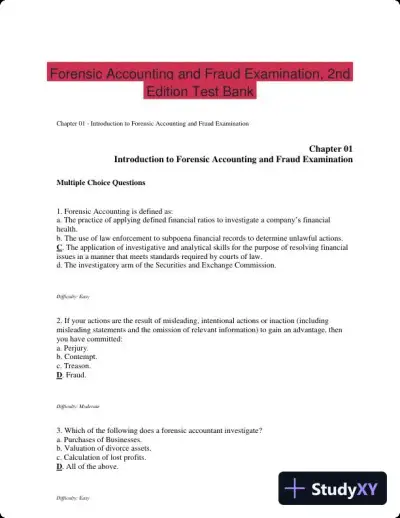 Exam Guides
Forensic Accounting and Fraud Examination, 2nd Edition Test Bank
Accounting
246 pages71downloadsFeb 2025 Textbook Guides
Introduction to Financial Accounting, 11th Edition Solution Manual
Accounting
524 pages173downloadsFeb 2025 Textbook Guides
Solution Manual For International Accounting, 4th Edition
Accounting
309 pages161downloadsFeb 2025 Textbook Guides
Solution Manual For Managerial Accounting, 7th Edition
Accounting
361 pages159downloadsFeb 2025 Class Notes
Class Notes For Advanced Accounting, 4th Edition
Accounting
149 pages159downloadsFeb 2025 Textbook Guides
Financial Accounting 6th Canadian Edition Solution Manual
Accounting
867 pages156downloadsFeb 2025 Textbook Guides
Accounting Theory, 7th Edition Solution Manual
Accounting
325 pages153downloadsFeb 2025 Textbook Guides
Financial Accounting, 9th Edition Solution Manual
Accounting
1024 pages134downloadsFeb 2025
Study this document with CramX
Once it is in your library, every tool can work from it.