

Survey of Accounting 4th Edition Solution Manual
- Accounting
- 817 pages
- Shared May 2025
Survey of Accounting 4th Edition Solution Manual makes textbook problem-solving simple, with detailed answers that make learning fun.
Preview 16 of 817 pages
See the first 16 pages exactly as they appear in the document.
Page 1 Read page 1 as text
1 - 7 ANSWERS TO QUESTIONS - CHAPTER 1 1. Stakeholders are the parties that use accounting information. Stakeholders with a direct interest include owners, managers, creditors, suppliers, and employees. These individuals are directly affected by what happens to the business. Stakeholders with an indirect interest include financial analysts, brokers, attorneys, government regulators, and news reporters. These individuals use information in the financial reports to advise and influence their clients. Students may give many different answers under the above categories depending on their level of experience in business. All students are direct users of accounting information related to tuition and fees, financial aid, and account balances. 2. Accounting provides information that is useful in making decisions by all participants in the market for resource goods and services, both profit - oriented and nonprofit oriented. Because accounting’s role is so important, it is often called the language of business. 3. The primary mechanism used to allocate resources in the U.S. is competition for resources in the open market. 4. A market is a group of people or organizations that come together for the purpose of exchanging items of value. 5. The market for business resources involves three distinct participants: consumers, conversion agents, and resource owners. See Exhibit 1 - 1 that illustrates how market trilogy is involved in resource allocation. 6. Financial Resource : money
Page 2 Page 3 Read page 3 as text
1 - 8 Physical Resource : natural resources (i.e. land, forests, mine ore, petroleum, etc.), buildings, machinery and equipment, furniture and fixtures Labor Resource : includes both intellectual and physical labor; i.e. employees 7. Investors expect a distribution of the business’s profits as a return on their financial investment (capital allocation). Creditors lend financial resources to businesses and receive interest as a return or profit on the loan. 8. Financial accounting provides information that is useful to external resource providers. Managerial accounting provides information that is useful to managers in operating an organization (i.e., internal users). 9. Not - for - profit or nonprofit entities provide goods or services to consumers for humanitarian or special reasons rather than to earn a profit for owners. For example, certain not - for - profit entities allocate resources to provide for research of diseases or social/environmental welfare; others allocate resources to promote the arts and provide education. 10. The U.S. rules of accounting information measurement are called generally accepted accounting principles (GAAP). 11. Careers in public accounting consist of providing services to the general public from a public accounting firm. These services include auditing, tax and consulting services. Careers in private accounting usually consist of working for a specific company (which would be a client of the public accounting firm) providing a wide variety of services to the company including recording transactions, preparing financial statements, internal auditing and others. 12. Items reported on the financial statements are organized into classes or categories called elements. The ten elements of financial statements are:
Page 4 Read page 4 as text
1 - 9 1. Assets 2. Liabilities 3. Equity (Stockholders’ Equity) 4. Investments by Owners (Contributed Capital) 5. Revenue 6. Expenses 7. Distributions (Dividends) 8. Net Income 9. Gains 10. Losses Accounts are specific items or subclassifications of the elements. Examples of accounts include cash, land and common stock. 13. Assets, the economic resources of a business, are used to produce earnings. 14. The assets of a business belong to that business entity and there may be claims on the assets. Claims on the assets belong to resource providers. 15. Creditors are individuals and/or institutions that have provided goods or services to the business which are not yet paid for, or loaned money to the business. These parties have first claim to the assets of the business, and the owners have a residual interest in the assets. 16. The term “liabilities” is used to describe creditors' claims on the assets of a business. 17. The accounting equation is: ASSETS – LIABILITIES = STOCKHOLDERS’ EQUITY or ASSETS = LIABILITIES + STOCKHOLDERS’ EQUITY Assets are the economic resources used by a business for the production of revenue. Liabilities are obligations of a business to relinquish assets, provide services, or accept other obligations. Equity , also called “residual interest” or “net assets”, is the portion
Page 5 Read page 5 as text
1 - 10 of the assets remaining after the creditors' claims have been satisfied (i.e., Assets – Liabilities). 18. The owners ultimately bear the risk and collect the rewards associated with operating a business. 19. A double - entry bookkeeping system is one in which every transaction affects at least two accounts. A transaction can affect both assets and claims (liabilities and equity) or only assets or only claims. In order to “balance” the accounting equation, every transaction requires a “double entry.” 20. Capital is acquired from owners by issuing stock to them. When stock is issued, the assets of the business increase and the stockholders’ equity increases. 21. Assets that are acquired by issuing common stock are the result of investments by owners. Assets that are acquired by using retained earnings are assets the business acquires through its earnings activities. 22. Revenue increases the asset side of the accounting equation and also increases the retained earnings account in the stockholders’ equity section of the equation. 23. The three primary sources of assets are (1) investments by owners (issue of stock), (2) borrowing from creditors, and (3) earnings activities. 24. Retained earnings are a result of a business retaining its earned assets, rather than distributing those earnings to its owners. 25. Distributions to owners, called dividends, decrease the asset side of the accounting equation and also decrease the retained earnings account in the stockholders’ equity section of the equation. 26. Dividends and expenses are similar in that they both decrease assets and affect the accounting equation in the same way (i.e. reduction of retained earnings). However, dividends differ from expenses
Page 6 Read page 6 as text
1 - 11 because of the nature of the decline in assets. Expenses reduce assets as the result of a firm's efforts to earn revenue. Dividends reduce assets because of a transfer of wealth to the owners. 27. (1) Income Statement - measures the difference between the asset increases and the asset decreases that were associated with operating a business during a particular accounting period. (2) Statement of Changes in Stockholders’ Equity - explains the effects of transactions on stockholders’ equity during the accounting period. (3) Balance Sheet - lists the assets and the corresponding claims against the entity as of a particular date. (4) Statement of Cash Flows - explains how a company obtained and used cash during the accounting period. 28. The balance sheet provides information about the enterprise at a particular point in time. 29. A net loss occurs when expenses exceed revenues in a given accounting period. 30. (1) Operating activities - explain the cash generated from revenue and the cash paid for expenses. (2) Investing activities - include cash received or spent by the business on productive assets used in the business, and investments in debt or equity of other companies. (3) Financing activities - include cash inflows and outflows from the company's transactions with its owners and inflows and outflows from its borrowing activities. 31. Asset accounts are arranged on the balance sheet in accordance with their level of liquidity (those that can be most quickly converted to cash are listed first).
Page 7 Read page 7 as text
1 - 12 32. Articulation refers to the interrelationships among the various elements of the financial statements. 33. Temporary accounts are used to capture information for a single accounting period. The balances in temporary accounts are transferred out of the accounts at the end of the accounting period. Temporary accounts have zero balances at the beginning of an accounting period. Temporary accounts include revenue accounts, expense accounts and dividends. Permanent accounts carry over from one accounting period to the next. Retained Earnings is a permanent account. 34. The historical cost concept requires that most assets be reported at the amount paid for them regardless of their increase or decrease in value. It is related to the qualitative characteristic of verifiability in that information can be independently verified. The historical cost is verified, while a change in value is subjective. 35. An asset source transaction results in an increase in an asset account and an increase in one of the claims accounts; i.e., investments by owners (equity), borrowing funds from creditors (liabilities), or earnings activities (revenue). An asset use transaction results in a decrease in an asset account and a decrease in either liabilities or equity; i.e., the payment of a liability, the payment of an expense, or a dividend. An asset exchange transaction is a transaction in which one asset is exchanged for another; i.e., purchase of land with cash. A claims exchange transaction will be covered in a later chapter. 36. While the contents of annual reports vary from company to company, all annual reports contain: Management’s discussion and analysis (MD&A) Financial statements Notes to the financial statements Auditor’s report
Page 8 Read page 8 as text
1 - 13 37. U.S. GAAP, generally accepted accounting principles in the United States, are the measurement rules established by the (FASB) Financial Accounting Standards Board. The FASB is a privately funded organization with the primary authority for establishing accounting standards in the United States. International Financial Reporting Standards (IFRS) are issued by the International Accounting Standards Board and are an attempt to set a common standard to be used in different countries. IFRS is used by global companies and there is a move underway to merge GAAP and IFRS. SOLUTIONS TO EXERCISES - SERIES A - CHAPTER 1 EXERCISE 1 - 1 The three types of resources available to conversion agents are: 1. Financial resources 2. Physical resources 3. Labor resources Note to instructor: The memo should discuss the fact that the resource owners are those who own resources that are desired by others, either in the original form or in a converted form. The conversion agents are the parties that acquire the resource and supply it to consumers either in the original form or in a converted form with value added by the conversion. The consumers are the ultimate users of the resources. It should also include a discussion of the role of the private accountant and the allocation of resources. For example, p rivate accountants prepare the annual reports that businesses (conversion agents) use to communicate information to investors and creditors (financial resource providers). In other words, they are the information providers. The most appropriate designation for p rivate accountants is the attainment of a Certified Management Accountant (CMA). However, many private accountants get their start in public accounting and are therefore CPAs as well as CMAs.
Page 9 Read page 9 as text
1 - 14
Page 10 Read page 10 as text
1 - 15 EXERCISE 1 - 2 a. The three areas of service provided by public account ant s are auditing, tax and consulting. b. The private accountant generally works for a specific company. Some of the functions performed include classifying and recording transactions, billing customers, collecting amounts due, ordering merchandise, paying suppliers, preparing and analyzing financial statements, developing budgets, assessing performance and making decisions.
Page 11 Read page 11 as text
1 - 16 EXERCISE 1 - 3 Entities Distribution of Cash Ray Steen (personal account) Personal account was decreased by the $ 10 0 ,000 cash deposited in the Steen Enterprises’ business account. Steen Enterprises Cash account increased by the $ 10 0 ,000 cash deposited by Mr. Steen . Cash account increased by $ 6 0,000 cash borrowed from First Bank . Cash account increased by $ 75 ,000 cash invested by Stan Rhoades . Cash account decreased by $ 150 ,000 cash used to purchase building. Cash account increased by $ 56 ,000 cash revenue earned. Cash account decreased by $ 31 ,000 cash payment to employees for salaries. First Bank Cash account decreased by $ 6 0,000 cash loaned to Steen Enterprises. Stan Rhoades, father - in - law, personal account Cash decreased by $ 75 ,000 cash invested in Steen Enterprises. Zoro Realty Company Cash increased by $ 1 5 0,000 received from Steen Enterprises to purchase building. Steen Enterprises’ customers Cash decreased by $ 56 ,000 when customers paid for services performed. Steen Enterprises’ employees Cash increased by $ 31 ,000 when employees received payment for salaries.
Page 12 Read page 12 as text
1 - 17 EXERCISE 1 - 4 Accounting Equation Stockholders’ Equity Common Retained Company Assets = Liabilities + Stock + Earnings A 142,000 = 30,000 + 50,000 + 62,000 B 50,000 = 15,000 + 10,000 + 25,000 C 85,000 = 20,000 + 25,000 + 40,000 D 215,000 = 60,000 + 100,000 + 55,000
Page 13 Read page 13 as text
1 - 18 EXERCISE 1 - 5 Hansen Enterprises Accounting Equation Stockholders’ Equity Event Number Assets = Liabilities + Common Stock Retained Earnings 1. I NA I NA 2. I NA NA I 3. D NA NA D 4. D D NA NA 5. I/D NA NA NA 6. D NA NA D
Page 14 Read page 14 as text
1 - 19 EXERCISE 1 - 6 a. Foster Corp. Accounting Equation for 2014 Assets = Liabilitie s + Stockholders’ Equity Event Cash + Land = Notes Payable + Com. Stock + Retained Earnings Acct. Title/RE Bal. 1/1/13 30,000 16,000 10,000 20,000 16,000 1. Pur. Land (20,000) 20,000 NA NA NA NA 2. Issued stk. 10,000 NA NA 10,000 NA NA 3. Provide Svc. 90,000 NA NA NA 90,000 Revenue 4. Paid Exp. (65,000) NA NA NA (65,000) Oper. Exp. 5. Loan 20,000 NA 20,000 NA NA NA 6. Paid Div. (5,000) NA NA NA (5,000) Dividend 7. Land Value NA NA NA NA NA NA Totals 60,000 + 36,000 = 30,000 + 30,000 + 36,000 b. Assets = Liabilities + Stockholders’ Equity $96,000 = $30,000 + $66,000 c. The balances of total assets, liabilities and stockholders’ equity will be the same on January 1, 2015 as the balances on December 31, 2014. (See b. above)
Page 15 Read page 15 as text
1 - 20 EXERCISE 1 - 7 a. Assets = Liabilities + Stockholders’ Equity Cash = Note Payable + Common Stock + Retained Earnings 156,000 = 85,600 + 52,400 + ? Retained Earnings = $156,000 – $85,600 – $52,400 = $18,000 b. & c. Post Company Effect of 2014 Transactions on the Accounting Equation Assets = Liabilities + Stockholders’ Equity Notes Common Retained Event Cash = Payable + Stock + Earnings Beginning Balances 156,000 85,600 52,400 18,000 1. Earned Revenue 36,000 NA NA 36,000 2. Paid expenses (20,000) NA NA (20,000) 3. Paid dividend (3,000) NA NA (3,000) Ending Balance 169,000 = 85,600 + 52,400 + 31,000 d. Cash = Note Payable + Common Stock + Retained Earnings 169,000 = 85,600 + 52,400 + 31,000 Liabilities + Stockholders’ Equity = $85,600 + $52,400 + $31,000 = $169,000 Assets = Liabilities + Stockholders’ Equity $169,000 = $169,000 e. The beginning and ending balances in the cash account were $156,000 and $169,000 respectively. The beginning balance in the common stock account was $52,400. This balance did not change during the accounting period. The reason the cash balance changed but the common stock balance did not was because the accounting events that Post experienced during the 2014 accounting period affected the cash account but not the common stock account.
Page 16 Read page 16 as text
1 - 21 EXERCISE 1 - 8 a. Assets = Liabilities + Stockholders’ Equity Cash Notes Payable Salaries Expense Land Accounts Payable Common Stock Office Furniture Utilities Payable Service Revenue Trucks Interest Expense Supplies Utilities Expense Computers Operating Expenses Building Rent Revenue Dividends Supplies Expense Gasoline Expense Retained Earnings Dividends b. No. The number of accounts will vary depending on the level of detail the reporting entity chooses to provide , as well as the type of company and industry in which it operates. More accounts provide financial statement users with more information about the reporting entity. However, the cost of keeping records on many accounts often outweighs the benefit of providing more information. For example, in this problem the company kept all of the trucks in one account (i.e. Trucks). If the company wanted to provide more detail the company could have created a separate account for each truck. If the company wanted even more detail the company could break the truck into different components and provide an account for each component of the truck (i.e. engine, frame, wheels, tires, etc.). Providing accounts for each truck component would be very difficult and time consuming and would not necessarily change any decision made by a financial statement user. Therefore, it makes more sense to aggregate all trucks and truck components into one account. Deciding the number of accounts to report is a subjective cost/benefit analysis. The goal is to provide financial statement users with detail (i.e. more accounts) when the benefit of the additional information outweighs the cost of providing the information. Remember, it is the stockholders who are
801 more pages in the full document
Unlock it once and it stays in your library, ready to chat with or turn into flashcards.
Unlock the full documentMore Accounting study materials
See all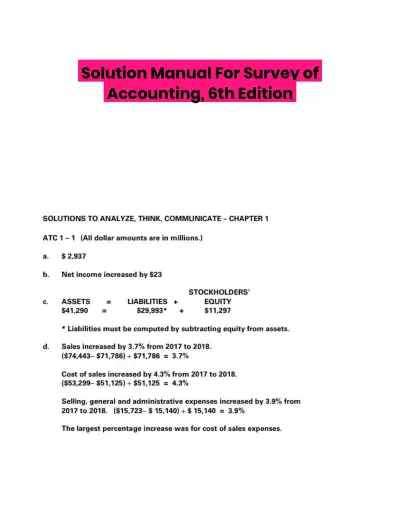 Textbook Guides
Solution Manual For Survey of Accounting, 6th Edition
Accounting
877 pagesMay 2025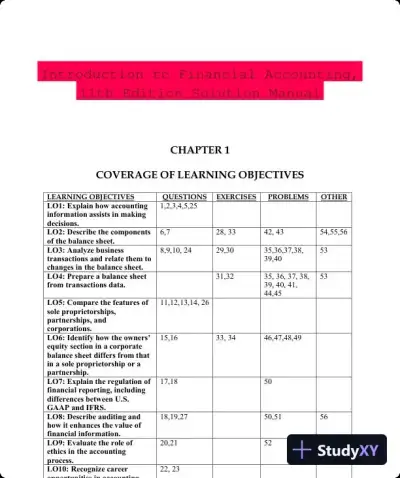 Textbook Guides
Introduction to Financial Accounting, 11th Edition Solution Manual
Accounting
524 pages173downloadsFeb 2025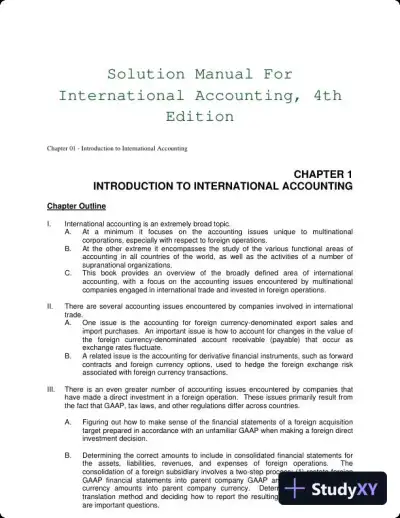 Textbook Guides
Solution Manual For International Accounting, 4th Edition
Accounting
309 pages161downloadsFeb 2025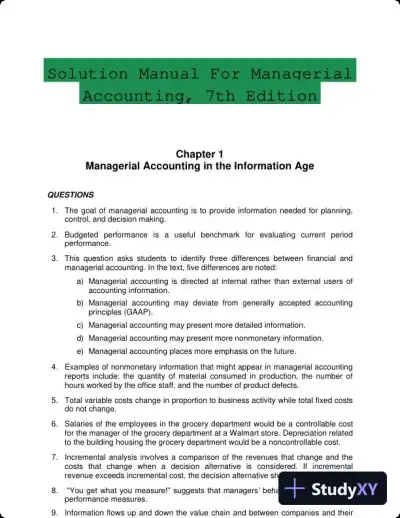 Textbook Guides
Solution Manual For Managerial Accounting, 7th Edition
Accounting
361 pages159downloadsFeb 2025 Class Notes
Class Notes For Advanced Accounting, 4th Edition
Accounting
149 pages159downloadsFeb 2025 Textbook Guides
Financial Accounting 6th Canadian Edition Solution Manual
Accounting
867 pages156downloadsFeb 2025 Textbook Guides
Accounting Theory, 7th Edition Solution Manual
Accounting
325 pages153downloadsFeb 2025 Textbook Guides
Financial Accounting, 9th Edition Solution Manual
Accounting
1024 pages134downloadsFeb 2025
Study this document with CramX
Once it is in your library, every tool can work from it.