

Test Bank For Horngren's Cost Accounting: A Managerial Emphasis, 16th Edition
- Accounting
- 1542 pages
- Shared May 2025
Study smarter with Test Bank For Horngren's Cost Accounting: A Managerial Emphasis, 16th Edition, covering high-yield topics, revision notes, and exam-style questions.
Preview 16 of 1542 pages
See the first 16 pages exactly as they appear in the document.
Page 1 Read page 1 as text
1 Copyright © 2018 Pearson Education, Inc. Cost Accounting: A Managerial Emphasis, 16e (Horngren) Chapter 1 The Manager and Management Accounting 1.1 Objective 1.1 1) Management accounting ________. A) focuses on estimating future revenues, costs, and other measures to forecast activities and their results B) provides information about the company as a whole C) reports information that has occurred in the past that is verifiable and reliable D) provides information that is generally available only on a quarterly or annual basis Answer: A Explanation: Management accounting has a forward - looking orientation as opposed to financial accounting which has a historical perspective. Diff: 1 Objective: 1 AACSB: Analytical thinking 2) Managers use management accounting information to ________. A) help external users such as investors, banks, regulators, and suppliers B) communicate, develop, and implement strategies C) communicate a firm's financial position to investors, banks, regulators, and other outside parties D) ensure that financial statements are consistent with the SEC rules Answer: B Diff: 1 Objective: 1 AACSB: Analytical thinking 3) Financial accounting ________. A) focuses on the future and includes activities such as preparing next year's operating budget B) must comply with GAAP (generally accepted accounting principles) C) is the process of measuring, analyzing, and reporting financial and nonfinancial information related to the costs of acquiring or using resources in an organization D) is prepared for the use of department heads and other employees Answer: B Diff: 1 Objective: 1 AACSB: Analytical thinking 4) Which of the following would most likely be the user of financial accounting information? A) factory shift supervisor B) distribution manager C) current shareholder D) department manager Answer: C Diff: 1 Objective: 1 AACSB: Analytical thinking
Page 2 Page 3 Read page 3 as text
2 Copyright © 2018 Pearson Education, Inc. 5) The primary user of management accounting information is a(n) ________. A) the controller B) a shareholder evaluating a stock investment C) bondholder D) external regulator Answer: A Diff: 1 Objective: 1 AACSB: Analytical thinking 6) Financial accounting provides the primary source of information for ________. A) decision making in the assembly and finishing department B) improving distribution and customer service C) preparing the income statement for shareholders and other external parties D) planning next year's plans and specifically; the operating budget Answer: C Diff: 1 Objective: 1 AACSB: Analytical thinking 7) Which of the following is true of management accounting information? A) It focuses on documenting past business actions of a firm. B) It is prepared based on SEC rules and FASB accounting principles. C) It is prepared for shareholders. D) It helps with the coordination of elements of the value chain. Answer: D Diff: 2 Objective: 1 AACSB: Analytical thinking 8) Which of the following statements refers to management accounting information? A) There are no regulations governing the reports. B) The reports are generally delayed and historical. C) The audience tends to be stockholders, creditors, and tax authorities. D) It primarily measures manager's compensation on reported financial results. Answer: A Diff: 2 Objective: 1 AACSB: Analytical thinking 9) Which of the following groups would be least likely to receive detailed management accounting reports? A) stockholders B) sales managers C) production supervisors D) distribution managers Answer: A Diff: 1 Objective: 1 AACSB: Analytical thinking
Page 4 Read page 4 as text
3 Copyright © 2018 Pearson Education, Inc. 10) Management accounting information typically includes ________. A) tabulated results of customer satisfaction surveys B) the cost of producing a product C) the percentage of units produced that are defective D) All of these answers are correct. Answer: D Diff: 1 Objective: 1 AACSB: Application of knowledge 11) Cost accounting ________. A) measures the costs of acquiring or using resources in an organization B) measures the financial and nonfinancial information that helps managers make decisions to fulfill the goals of an organization C) coordinates product design, production, and marketing decisions and evaluate a company's performance D) communicates information to investors, banks, regulators, and other outside parties Answer: A Diff: 1 Objective: 1 AACSB: Analytical thinking 12) Which of the following differentiates cost accounting and financial accounting? A) The primary users of cost accounting are the investors, whereas the primary users of financial accounting are the managers. B) Cost accounting deals with product design, production, and marketing strategies, whereas financial accounting deals mainly with pricing of the products. C) Cost accounting measures only the financial information related to the costs of acquiring fixed assets in an organization, whereas financial accounting measures financial and nonfinancial information of a company's business transactions. D) Cost accounting measures information related to the costs of acquiring or using resources in an organization, whereas financial accounting measures a financial position of a company to investors, banks, and external parties. Answer: D Diff: 2 Objective: 1 AACSB: Analytical thinking 13) Which of the following is true of financial accounting information? A) It is prepared based on cost - benefit analysis. B) It is primarily used by managers to make internal business decisions. C) It focuses on the past - oriented financial performance of a company. D) It only measures the cash transactions of a company. Answer: C Diff: 2 Objective: 1 AACSB: Analytical thinking
Page 5 Read page 5 as text
4 Copyright © 2018 Pearson Education, Inc. 14) A data warehouse or infobarn ________. A) is reserved for exclusive use by the CFO B) is primarily used for financial reporting purposes C) stores information used by different managers for multiple purposes D) gathers only nonfinancial information Answer: C Diff: 1 Objective: 1 AACSB: Analytical thinking 15) Which of the following is true of cost accounting? A) It is a subset of management accounting and therefore its information is used only to meet the needs of managers. B) It is used only by manufacturers. C) It is part of both management and financial accounting systems. D) The distinction between management accounting and cost accounting is clear - cut. Answer: C Diff: 2 Objective: 1 AACSB: Analytical thinking 16) Which of the following deals with management accounting? A) identifying the costs of acquiring the resources of the company B) developing budgets C) preparing the income statement D) preparing the statement of cash flows Answer: B Diff: 1 Objective: 1 AACSB: Analytical thinking 17) Financial accounting is concerned primarily with ________. A) external reporting to investors, creditors, and government authorities B) cost planning and cost controls C) product design and marketing strategies D) providing information for strategic and tactical decisions Answer: A Diff: 1 Objective: 1 AACSB: Analytical thinking
Page 6 Read page 6 as text
5 Copyright © 2018 Pearson Education, Inc. 18) Financial accounting provides a historical perspective, whereas management accounting emphasizes ________. A) the future B) past transactions C) a current perspective D) reports to shareholders Answer: A Diff: 1 Objective: 1 AACSB: Analytical thinking 19) Rules for measurement and reporting for management accounting ________. A) state that information must only be useful to management. B) do not need to follow GAAP but must meet the cost - benefit test. C) must follow GAAP. D) must follow GAAP, IRS rules or government standards. Answer: B Diff: 2 Objective: 1 AACSB: Analytical thinking 20) The approaches and activities of managers in short - run and long - run planning and control decisions that increase value for customers and lower costs of products and services are known as ________. A) value chain management B) enterprise resource planning C) cost management D) customer value management Answer: C Diff: 1 Objective: 1 AACSB: Analytical thinking 21) Financial accounting information focuses on internal reporting. Answer: FALSE Explanation: Management accounting information focuses on internal reporting and financial accounting focuses on external reporting. Diff: 1 Objective: 1 AACSB: Analytical thinking 22) Cost accounting provides information for both management accounting and financial accounting professionals. Answer: TRUE Diff: 2 Objective: 1 AACSB: Analytical thinking
Page 7 Read page 7 as text
6 Copyright © 2018 Pearson Education, Inc. 23) Management accounting information and reports do not have to follow set principles or rules such as GAAP but should be useful to its audience and meet the cost/benefit test. Answer: TRUE Diff: 1 Objective: 1 AACSB: Analytical thinking 24) Management accounting ensures communication of an organization's financial position to investors, banks, and regulators. Answer: FALSE Explanation: Financial accounting, not management accounting, ensures communication of an organization's financial position to investors, banks, and regulators. Diff: 1 Objective: 1 AACSB: Analytical thinking 25) The balance sheet and income statement are primarily management accounting reports. Answer: FALSE Explanation: The balance sheet and income statement are primarily financial accounting reports produced for owners, investors, and other external parties that provide capital or regulate the business. Diff: 1 Objective: 1 AACSB: Analytical thinking 26) Financial accounting is broader in scope than management accounting in that financial accounting can include external reporting and reporting that helps managers plan and control operations. Answer: FALSE Explanation: Management accounting is broader in scope than financial accounting as it can encompass some GAAP issues such as inventory valuation and cost of goods sold and it also provides reporting to help managers make decisions and plan and control operations. Diff: 1 Objective: 1 AACSB: Analytical thinking 27) Cost accounting measures and reports short - term, long - term, financial, and non financial information. Answer: TRUE Diff: 2 Objective: 1 AACSB: Analytical thinking 28) Cost accounting is the process of measuring, analyzing, and reporting financial and nonfinancial information related to the costs of acquiring or using resources in an organization. Answer: TRUE Diff: 1 Objective: 1 AACSB: Analytical thinking
Page 8 Read page 8 as text
7 Copyright © 2018 Pearson Education, Inc. 29) Management accounting has to strictly follow the rules of generally accepted accounting principles for the purposes of measurement and reporting. Answer: FALSE Explanation: Internal measures and reports do not have to follow GAAP. Usefulness and the cost/benefit approach are the guiding principles of management accounting. Diff: 2 Objective: 1 AACSB: Analytical thinking 30) For management accounting, internal measurement and reporting are based on cost - benefit analysis. Answer: TRUE Diff: 2 Objective: 1 AACSB: Analytical thinking 31) Management accounting report time spans can vary from one hour to many years, while financial accounting report time periods usually span a quarter or a year. Answer: TRUE Diff: 1 Objective: 1 AACSB: Analytical thinking 32) Financial accounting provides an organization's past - oriented information such as the previous years' financial statements. Answer: TRUE Explanation: Financial accounting provides an organization's past - oriented information such as the previous years' financial statements. Diff: 1 Objective: 1 AACSB: Analytical thinking 33) Cost management not only helps reduce costs but also improve customer satisfaction and the quality of a firm's products. Answer: TRUE Diff: 1 Objective: 1 AACSB: Analytical thinking
Page 9 Read page 9 as text
8 Copyright © 2018 Pearson Education, Inc. 34) For each report listed below, identify whether the major purpose of the report is for (1) routine internal reporting, (2) nonroutine internal reporting, or for (3) external reporting to investors and other outside parties. Item: a. study detailing sale information of the top - ten selling products b. weekly report of total sales generated by each store in the metropolitan area c. annual Report sent to shareholders d. monthly report comparing budgeted sales by store to actual sales Answer: a. (2) nonroutine internal reporting b. (1) routine internal reporting c. (3) external reporting to investors and other outside parties d. (1) routine internal reporting Diff: 3 Objective: 1 AACSB: Application of knowledge 35) Describe management accounting and financial accounting. Answer: Management accounting provides information to internal decision makers of the business such as top executives, managers, sales representatives, and production supervisors. Its purpose is to help managers predict and evaluate future results. Reports are generated often and usually broken down into smaller reporting divisions such as department or product line. There are no rules to be complied with since these reports are for internal use only. Management accounting embraces more extensively such topics as the development and implementation of strategies and policies, budgeting, special studies and forecasts, influence on employee behavior, and nonfinancial as well as financial information. Financial accounting, by contrast, provides information to external decision makers such as investors and creditors. Its purpose is to present a fair picture of the financial condition of the company. Reports are generated quarterly or annually and report on the company as a whole. The financial statements must comply with GAAP (generally accepted accounting principles). A CPA audits, or verifies, that GAAP is being followed. Diff: 3 Objective: 1 AACSB: Analytical thinking 36) Cost accounting provides information for both management accounting and financial accounting professionals. Explain. Answer: Cost accounting is the process of measuring, analyzing, and reporting financial and nonfinancial information related to the costs of acquiring or using resources in an organization. For example, calculating the cost of a product is a cost accounting function that meets both the financial accountant's inventory - valuation needs and the management accountant's decision - making needs such as deciding how to price products and choosing which products to promote. Diff: 3 Objective: 1 AACSB: Analytical thinking
Page 10 Read page 10 as text
9 Copyright © 2018 Pearson Education, Inc. 37) There is an overlap or intersection between management accounting and financial accounting. Explain. Answer: Management accounting develops the cost information that is necessary to value inventory for the balance sheet and cost of goods sold for the income statement. GAAP requires absorption costing. Diff: 2 Objective: 1 AACSB: Analytical thinking 38) What competitive advantage could a company obtain from having a successful cost management program? Answer: There are three broad outcomes from a successful cost management program: 1) costs are reduced with no loss in customer value. In this scenario, a company might gain a competitive advantage by lowering its price with no loss in profit, or maintain the same price and increase profit; 2) customer value is increased with no change in costs. This scenario might increase customer satisfaction resulting in increased customer loyalty and perhaps increase the overall demand for the product; 3) customer value might be increased while costs are reduced simultaneously. This scenario would result in the benefits described in both 1) and 2). Diff: 3 Objective: 1 AACSB: Analytical thinking 1.2 Objective 1.2 1) Which of the following statements concerning an organization's strategy is true? A) Strategy specifies how an organization matches its own capabilities with the opportunities in the marketplace to accomplish its objectives. B) Cost accountants formulate strategy in an organization since they have more inputs about costs. C) A good strategy will always overcome poor implementation. D) Businesses usually follow one of two broad strategies: offering a quality product at a high price, or offering a unique product or service priced lower than the competition. Answer: A Diff: 2 Objective: 2 AACSB: Analytical thinking 2) Strategy specifies ________. A) how an organization matches its own capabilities with the opportunities in the marketplace B) standard procedures to ensure quality products C) incremental changes for improved performance D) the demand created for products and services Answer: A Diff: 2 Objective: 2 AACSB: Analytical thinking
Page 11 Read page 11 as text
10 Copyright © 2018 Pearson Education, Inc. 3) Which of the following is not a concern for management accountants in formulating a strategy? A) identifying the most important warehouse location for the distribution of goods B) substituting products that exist in the marketplace C) strategizing compliance with GAAP (Generally Accepted Accounting Principles) D) maintaining adequate fixed assets available to implement the strategy Answer: C Explanation: This is more of a concern of financial accountants than of management accountants. Diff: 2 Objective: 2 AACSB: Analytical thinking 4) Strategy is formulated ________. A) by identifying the most important customers B) by forecasting the composition of adequate fixed assets C) based on the qualified opinion of external auditors D) by eliminating sunk costs Answer: A Diff: 2 Objective: 2 AACSB: Analytical thinking 5) In designing strategy, a company must match its opportunities in the marketplace with ________. A) environmental friendly goals B) its resources and capabilities C) branding opportunities D) the requirements of credit rating agencies Answer: B Diff: 2 Objective: 2 AACSB: Analytical thinking 6) Which of the following statements about customer value is true? A) Customer value is shown in a corporation's balance sheet. B) Creating value for customers is an important part of planning and implementing strategy. C) Customer value is the only focus that helps managers to formulate strategies. D) Customer value is lost with increase in costs of the product. Answer: B Diff: 2 Objective: 2 AACSB: Analytical thinking 7) A company's strategy specifies how an organization matches its capabilities with the opportunities in the marketplace. Answer: TRUE Diff: 2 Objective: 2 AACSB: Analytical thinking
Page 12 Read page 12 as text
11 Copyright © 2018 Pearson Education, Inc. 8) The two broad strategies that companies follow are cost leadership strategy and product differentiation strategy. Answer: TRUE Diff: 1 Objective: 2 AACSB: Analytical thinking 9) The best - designed strategies are valuable, whether or not they are effectively implemented. Answer: FALSE Explanation: Implementation is essential or the strategy is useless. Diff: 1 Objective: 2 AACSB: Analytical thinking 10) The key to a company's success is creating value for customers while differentiating itself from its competitors. Answer: TRUE Diff: 1 Objective: 2 AACSB: Analytical thinking 11) The key to a company's success is always to be the low cost producer in a particular industry. Answer: FALSE Explanation: The low cost producer in a particular industry will not necessarily be successful. Diff: 2 Objective: 2 AACSB: Analytical thinking 12) Management accountants work closely with managers in various departments to formulate strategies by providing information about the sources of competitive advantage. Answer: TRUE Diff: 2 Objective: 2 AACSB: Analytical thinking 13) Management accountants should have little or no role in deciding on a company's strategy. Answer: FALSE Explanation: Management accountants should play a significant role in deciding on a company's strategy. Diff: 1 Objective: 2 AACSB: Analytical thinking 14) Companies can decide on an appropriate strategy based strictly on internally available information. Answer: FALSE Explanation: Companies must obtain external information as well as internal information to decide on an appropriate strategy. Diff: 2 Objective: 2 AACSB: Analytical thinking
Page 13 Read page 13 as text
12 Copyright © 2018 Pearson Education, Inc. 15) Strategic cost management describes cost management that specifically focuses on strategic issues. Answer: FALSE Explanation: Strategic cost management describes cost management that specifically focuses on strategic issues. Diff: 2 Objective: 2 AACSB: Analytical thinking 16) Identifying a company's most important customers helps to formulate a strategy. Answer: TRUE Diff: 1 Objective: 2 AACSB: Analytical thinking 17) The best - designed strategies and the best - developed capabilities are useless unless they are effectively executed. Answer: TRUE Diff: 1 Objective: 2 AACSB: Analytical thinking 18) Describe the major differences between management accounting and financial accounting for the following: 1. Primary users 2. Focus and emphasis 3. Rules of measurement and reporting Answer: 1. The primary users of management accounting information are managers of the organization. The primary users of financial accounting are external users such as investors, banks, regulators, and suppliers. 2. Management accounting is future oriented. Financial accounting is past oriented. 3. Management accounting measurement and reporting does not have to follow GAAP but are based on cost - benefit analysis. Financial accounting measurement and reporting must be prepared in accordance with GAAP and be certified by external, independent auditors. Diff: 3 Objective: 2 AACSB: Analytical thinking 19) What is strategy? Briefly describe the two broad types of strategies that companies may choose to pursue. Answer: Strategy specifies how an organization matches its own capabilities with the opportunities in the marketplace to accomplish its objectives. In other words, strategy describes how a company will compete. Companies follow one of two broad strategies. One is provide a quality product or service at low prices. The other is to compete on their ability to offer a unique product or service that is generally offered at a higher price. Diff: 2 Objective: 2 AACSB: Analytical thinking
Page 14 Read page 14 as text
13 Copyright © 2018 Pearson Education, Inc. 20) Briefly describe the list of items that managers undertake to formulate strategies. Answer: ONE: Identifying the most important customers, and how the company can be competitive and deliver value to them. TWO: Identifying the substitute products existing in the marketplace, and how do they differ from our product in terms of features, price, cost, and quality. THREE: Identifying most critical capability - whether it is technology, production or marketing. FOUR: Checking the adequacy of cash available to fund the strategy, or will additional funds need to be raised - through issue of debt or equity. Diff: 3 Objective: 2 AACSB: Analytical thinking 21) Generally, companies follow one of two broad strategies: offering a quality product at a low price, or offering a unique product or service priced higher than the competition. Assume you are opening a small food outlet across the street from your campus. How might that business be operated under each of the two broad strategies? Consider the following specific operational areas: a. target customers b. products offered c. product pricing d. location choice e. advertising content f. advertising media
Page 15 Read page 15 as text
14 Copyright © 2018 Pearson Education, Inc. Answer: The purpose of this question is to explore some of the differences in business operations as a result of a broad strategic choice. Answers will differ from student to student, but you should see some specific themes. Operational Area Low Price Strategy Differential Strategy Target customers Target customers might be students on a tight budget. Target customers might be more wealthy students, faculty, or perhaps neighbors who live nearby. Products offered Few products, heavy emphasis on tight cost control, probably set up as a high volume operation. High quality products, probably a reasonable choice, restaurant might have a lot of ambience. Product pricing Priced at or lower than the competition in the area. Higher priced products. Location choice Convenient to the target customers. Not as convenient, perhaps in a higher - end shopping or entertainment area. Customers might seek out the high quality and be willing to travel a bit for it. Advertising content Advertising would emphasize the low price of the products offered. Advertising would emphasize quality or ambience. Advertising media Media that would be looked at by the target customers, such as student newspapers. Media that would be looked at by the target customer, local magazines and newspapers. Diff: 3 Objective: 2 AACSB: Application of knowledge 22) Generally, companies follow one of two broad strategies: offering a quality product at a low price, or offering a unique product or service priced higher than the competition. Is it possible to follow a strategy that is "in the middle"? Answer: There is some dispute about the correct answer to this question. Some will argue that it is not good for companies to get "caught in the middle" because the customer might get confused as to whether or not the company is competing on price or is trying to make some other appeal. If the customer is confused about how the company is giving them value, they might perceive they are getting no value and abandon the product to a competitor with a clearer customer value proposition. The other side of the argument is that cost management is a necessary part of any strategy and even if the company chooses to pursue a differential strategy, management of the company should always be seeking ways to manage costs and increase customer value simultaneously regardless of their strategy. The student should be able to articulate one or the other arguments coherently. Diff: 3 Objective: 2 AACSB: Application of knowledge
Page 16 Read page 16 as text
15 Copyright © 2018 Pearson Education, Inc. 1.3 Objective 1.3 1) Place the four business functions in the order they appear along the value chain: Customer service Design Marketing Production A) Customer Service, Design, Production, Marketing B) Customer Service, Marketing, Production, Design C) Design, Production, Marketing, Customer Service D) Design, Customer Service, Production, Marketing Answer: C Diff: 2 Objective: 3 AACSB: Analytical thinking 2) R&D, production, and customer service are business functions that are all included as part of ________. A) the value chain B) benchmarking C) customer relationship management D) the supply chain Answer: A Diff: 1 Objective: 3 AACSB: Analytical thinking 3) The value chain is the sequence of business functions in which ________. A) value is deducted from the products or services of an organization B) producing and delivering the product or service is of prime importance C) products and services are evaluated with respect to their value to the supply chain D) usefulness is added to the products or services of an organization Answer: D Diff: 2 Objective: 3 AACSB: Analytical thinking 4) ________ is the generation of, and experimentation with, ideas related to new products, services, or processes. A) Research and development B) Design of products, services, or processes C) Production D) Marketing Answer: A Diff: 1 Objective: 3 AACSB: Analytical thinking
1526 more pages in the full document
Unlock it once and it stays in your library, ready to chat with or turn into flashcards.
Unlock the full documentMore Accounting study materials
See all Textbook Guides
Horngren's Cost Accounting: A Managerial Emphasis, 16th Edition Solution Manual
Accounting
41 pages72downloadsFeb 2025 Textbook Guides
Horngren's Cost Accounting: A Managerial Emphasis, 16th Edition Solution Manual
Accounting
1446 pagesMay 2025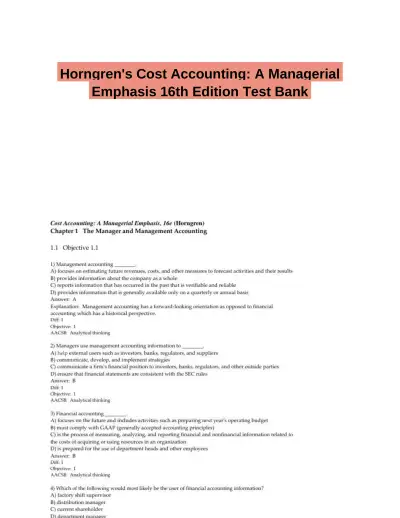 Exam Guides
Horngren's Cost Accounting: A Managerial Emphasis 16th Edition Test Bank
Accounting
1542 pagesMay 2025 Textbook Guides
Introduction to Financial Accounting, 11th Edition Solution Manual
Accounting
524 pages173downloadsFeb 2025 Textbook Guides
Solution Manual For International Accounting, 4th Edition
Accounting
309 pages161downloadsFeb 2025 Textbook Guides
Solution Manual For Managerial Accounting, 7th Edition
Accounting
361 pages159downloadsFeb 2025 Class Notes
Class Notes For Advanced Accounting, 4th Edition
Accounting
149 pages159downloadsFeb 2025 Textbook Guides
Financial Accounting 6th Canadian Edition Solution Manual
Accounting
867 pages156downloadsFeb 2025
Study this document with CramX
Once it is in your library, every tool can work from it.