

Solution Manual for Modern Control Systems, 13th Edition
- Electrical Engineering & Electronics
- 748 pages
- Shared May 2025
Solution Manual for Modern Control Systems, 13th Edition makes tackling textbook exercises a breeze, with clear and concise answers to every problem.
Preview 16 of 748 pages
See the first 16 pages exactly as they appear in the document.
Page 1 Read page 1 as text
C H A P T E R 1 Introduction to Control Systems There are, in general, no unique solutions to the following exercises and problems. Other equally valid block diagrams may be submitted by the student. Exercises E1.1 Describe typical sensors that can measure each of the following: a. Linear position → ultrasonic transducer b. Velocity (or speed) → Doppler radar c. Non-gravitational acceleration → inertial measurement unit d. Rotational position (or angle) → rotary encoder e. Rotational velocity → gyroscope f. Temperature → thermocouple g. Pressure → barometer h. Liquid (or gas) flow rate → velocimeter i. Torque → torquemeter j. Force → load cell k. Earth's magnetic field → magnetometer l. Heart rate → electrocardiograph E1.2 Describe typical actuators that can convert the following: a. Fluidic energy to mechanical energy → hydraulic cylinder b. Electrical energy to mechanical energy → electric motor c. Mechanical deformation to electrical energy → piezoelectric actuator d. Chemical energy to kinetic energy → automobile engine e. Heat to electrical energy → thermoelectric generator 1
Page 2 Page 3 Read page 3 as text
2 CHAPTER 1 Introduction to Control Systems E1.3 A microprocessor controlled laser system: Controller Error Current i(t) Power out Desired power output Measured power - Laser Process processor Micro- Power Sensor Measurement E1.4 A driver controlled cruise control system: Desired speed Foot pedal Actual auto speed Visual indication of speed Controller - Process Measurement Driver Car and Engine Speedometer E1.5 Although the principle of conservation of momentum explains much of the process of fly-casting, there does not exist a comprehensive scientific explanation of how a fly-fisher uses the small backward and forward mo- tion of the fly rod to cast an almost weightless fly lure long distances (the current world-record is 236 ft). The fly lure is attached to a short invisible leader about 15-ft long, which is in turn attached to a longer and thicker Dacron line. The objective is cast the fly lure to a distant spot with dead- eye accuracy so that the thicker part of the line touches the water first and then the fly gently settles on the water just as an insect might. Wind disturbance Controller - Process Measurement Rod, line, and cast
Page 4 Read page 4 as text
Exercises 3 E1.6 An autofocus camera control system: One-way trip time for the beam Distance to subject Lens focusing motor K 1 Lens Conversion factor (speed of light or sound) Emitter/ Receiver Beam Beam return Subject E1.7 Tacking a sailboat as the wind shifts: Desired sailboat direction Actual sailboat direction Measured sailboat direction Wind Error - Process Measurement Actuators Controller Sailboat Gyro compass Rudder and sail adjustment Sailor E1.8 An automated highway control system merging two lanes of traffic: Desired gap Actual gap Measured gap Error - Process Measurement Actuators Controller Active vehicle Brakes, gas or steering Embedded computer Radar
Page 5 Read page 5 as text
4 CHAPTER 1 Introduction to Control Systems E1.9 A skateboard rider maintaining vertical orientation and desired speed: Desired vertical orientation & speed Rider orientation & speed Errors - Process Measurement Actuators Controller Rider repositioning & propelling Rider Rider & Skateboard Rider E1.10 Human biofeedback control system: Measurement Desired body temp Actual body temp Visual indication of body temperature Message to blood vessels - Process Controller Body sensor Hypothalumus Human body TV display E1.11 E-enabled aircraft with ground-based flight path control: Corrections to the flight path Controller Gc(s ) Aircraft G(s ) - Desired Flight Path Flight Path Corrections to the flight path Controller Gc(s ) Aircraft G(s ) - Desired Flight Path Flight Path Ground-Based Computer Network Health Parameters Health Parameters Meteorological data Meteorological data Optimal flight path Optimal flight path Location and speed Location and speed
Page 6 Read page 6 as text
Exercises 5 E1.12 Unmanned aerial vehicle used for crop monitoring in an autonomous mode: G c( s ) G ( s ) - Camera Ground photo Controller UAV Specified Flight Trajectory Location with respect to the ground Flight Trajectory Map Correlation Algorithm Trajectory error Sensor E1.13 An inverted pendulum control system using an optical encoder to measure the angle of the pendulum and a motor producing a control torque: Error Angle Desired angle Measured angle - Pendulum Process Optical encoder Measurement Motor Actuator Torque Voltage Controller E1.14 In the video game, the player can serve as both the controller and the sen- sor. The objective of the game might be to drive a car along a prescribed path. The player controls the car trajectory using the joystick using the visual queues from the game displayed on the computer monitor. Error Game objective Desired game objective - Video game Process Player (eyesight, tactile, etc.) Measurement Joystick Actuator Player Controller
Page 7 Read page 7 as text
6 CHAPTER 1 Introduction to Control Systems Problems P1.1 An automobile interior cabin temperature control system block diagram: Desired temperature set by the driver Automobile cabin temperature Measured temperature Error - Process Measurement Controller Automobile cabin Temperature sensor Thermostat and air conditioning unit P1.2 A human operator controlled valve system: Desired fluid output * Error * Fluid output * = operator functions Visual indication of fluid output * - Process Measurement Controller Valve Meter Tank P1.3 A chemical composition control block diagram: Desired chemical composition Error Chemical composition Measured chemical composition - Process Measurement Controller Valve Mixer tube Infrared analyzer
Page 8 Read page 8 as text
Problems 7 P1.4 A nuclear reactor control block diagram: Desired power level Output power level Error Measured chemical composition - Process Measurement Controller Ionization chamber Reactor and rods Motor and amplifier P1.5 A light seeking control system to track the sun: Ligh intensity Desired carriage position Light source Photocell carriage position Motor inputs Error - Process Controller Motor, carriage, and gears K Controller Trajectory Planner Dual Photocells Measurement P1.6 If you assume that increasing worker’s wages results in increased prices, then by delaying or falsifying cost-of-living data you could reduce or elim- inate the pressure to increase worker’s wages, thus stabilizing prices. This would work only if there were no other factors forcing the cost-of-living up. Government price and wage economic guidelines would take the place of additional “controllers” in the block diagram, as shown in the block diagram. Initial wages Prices Wage increases Market-based prices Cost-of-living - Controller Industry Government price guidelines K 1 Government wage guidelines Controller Process
Page 9 Read page 9 as text
8 CHAPTER 1 Introduction to Control Systems P1.7 Assume that the cannon fires initially at exactly 5:00 p.m.. We have a positive feedback system. Denote by ∆ t the time lost per day, and the net time error by E T . Then the follwoing relationships hold: ∆ t = 4 / 3 min . + 3 min . = 13 / 3 min . and E T = 12 days × 13 / 3 min ./ day . Therefore, the net time error after 15 days is E T = 52 min . P1.8 The student-teacher learning process: Desired knowledge Error Lectures Knowledge Measured knowledge - Controller Process Teacher Student Measurement Exams P1.9 A human arm control system: Visual indication of arm location z y u e d s - Controller Process Measurement Desired arm location Arm location Nerve signals Eyes and pressure receptors Brain Arm & muscles Pressure
Page 10 Read page 10 as text
Problems 9 P1.10 An aircraft flight path control system using GPS: - Process Measurement Actuators Controller Aircraft Global Positioning System Computer Auto-pilot Ailerons, elevators, rudder, and engine power Desired flight path from air traffic controllers Flight path Measured flight path Error P1.11 The accuracy of the clock is dependent upon a constant flow from the orifice; the flow is dependent upon the height of the water in the float tank. The height of the water is controlled by the float. The control system controls only the height of the water. Any errors due to enlargement of the orifice or evaporation of the water in the lower tank is not accounted for. The control system can be seen as: Desired height of the water in float tank Actual height - Process Controller Flow from upper tank to float tank Float level P1.12 Assume that the turret and fantail are at 90 ◦ , if θ w = θ F -90 ◦ . ⁄ The fantail operates on the error signal θ w - θ T , and as the fantail turns, it drives the turret to turn. x y Wind * * W T F Fantail Turret = Wind angle = Fantail angle = Turret angle W T F Torque T W Error - Process Controller Gears & turret Fantail
Page 11 Read page 11 as text
10 CHAPTER 1 Introduction to Control Systems P1.13 This scheme assumes the person adjusts the hot water for temperature control, and then adjusts the cold water for flow rate control. Desired water temperature Actual water temperature and flow rate Cold water Desired water flow rate Measured water flow Measured water temperature Error - Process Controller - Measurement Human: visual and touch Valve adjust Valve adjust Hot water system Cold water system Hot water P1.14 If the rewards in a specific trade is greater than the average reward, there is a positive influx of workers, since q ( t ) = f 1 ( c ( t ) − r ( t )) . If an influx of workers occurs, then reward in specific trade decreases, since c ( t ) = − f 2 ( q ( t )) . - Error - Process Controller f 1 ( c ( t )- r ( t )) f 2 ( q ( t )) q ( t ) Total of rewards c ( t ) Average rewards r ( t ) P1.15 A computer controlled fuel injection system: Desired Fuel Pressure Fuel Pressure Measured fuel pressure - Process Measurement Controller Fuel Pressure Sensor Electronic Control Unit High Pressure Fuel Supply Pump and Electronic Fuel Injectors
Page 12 Read page 12 as text
Problems 11 P1.16 With the onset of a fever, the body thermostat is turned up. The body adjusts by shivering and less blood flows to the skin surface. Aspirin acts to lowers the thermal set-point in the brain. Body temperature Desired temperature or set-point from body thermostat in the brain Measured body temperature - Process Measurement Controller Internal sensor Body Adjustments within the body P1.17 Hitting a baseball is arguably one of the most difficult feats in all of sports. Given that pitchers may throw the ball at speeds of 90 mph (or higher!), batters have only about 0.1 second to make the decision to swing—with bat speeds aproaching 90 mph. The key to hitting a baseball a long dis- tance is to make contact with the ball with a high bat velocity. This is more important than the bat’s weight, which is usually around 33 ounces. Since the pitcher can throw a variety of pitches (fast ball, curve ball, slider, etc.), a batter must decide if the ball is going to enter the strike zone and if possible, decide the type of pitch. The batter uses his/her vision as the sensor in the feedback loop. A high degree of eye-hand coordination is key to success—that is, an accurate feedback control system. P1.18 Define the following variables: p = output pressure, f s = spring force = Kx , f d = diaphragm force = Ap , and f v = valve force = f s - f d . The motion of the valve is described by ¨ y = f v /m where m is the valve mass. The output pressure is proportional to the valve displacement, thus p = cy , where c is the constant of proportionality. Screw displacement x ( t ) y Valve position Output pressure p ( t ) f s - Diaphragm area c Valve Constant of proportionality A K Spring f v f d
Page 13 Read page 13 as text
12 CHAPTER 1 Introduction to Control Systems P1.19 A control system to keep a car at a given relative position offset from a lead car: Throttle Position of follower u Reference photo Relative position Desired relative position Position of lead - Controller Video camera & processing algorithms Follower car Actuator Fuel throttle (fuel) Lead car - P1.20 A control system for a high-performance car with an adjustable wing: Desired road adhesion Road adhesion Measured road adhesion Road conditions - Process Measurement Controller Tire internal strain gauges Race Car K Actuator Adjustable wing Computer P1.21 A control system for a twin-lift helicopter system: Desired altitude Altitude Measured altitude Separation distance Desired separation distance Measured separation distance - - Measurement Measurement Radar Altimeter Controller Pilot Process Helicopter
Page 14 Read page 14 as text
Problems 13 P1.22 The desired building deflection would not necessarily be zero. Rather it would be prescribed so that the building is allowed moderate movement up to a point, and then active control is applied if the movement is larger than some predetermined amount. Desired deflection Deflection Measured deflection - Process Measurement Controller K Building Hydraulic stiffeners Str ain gauges on truss structure P1.23 The human-like face of the robot might have micro-actuators placed at strategic points on the interior of the malleable facial structure. Coopera- tive control of the micro-actuators would then enable the robot to achieve various facial expressions. Desired actuator position Voltage Actuator position Measured position Error - Process Measurement Controller Amplifier Position sensor Electro- mechanical actuator P1.24 We might envision a sensor embedded in a “gutter” at the base of the windshield which measures water levels—higher water levels corresponds to higher intensity rain. This information would be used to modulate the wiper blade speed. Desired wiper speed Wiper blade speed Measured water level - Process Measurement Controller K Water depth sensor Wiper blade and motor Electronic Control Unit
Page 15 Read page 15 as text
14 CHAPTER 1 Introduction to Control Systems P1.25 A feedback control system for the space traffic control: Desired orbit position Actual orbit position Measured orbit position Jet commands Applied forces Error - Process Measurement Actuator Controller Satellite Reaction control jets Control law Radar or GPS P1.26 Earth-based control of a microrover to point the camera: Microrover Camera position command Controller Gc(s ) Camera position command Camera Position Receiver/ Transmitter Rover position Camera Measured camera position G(s ) Measured camera position Sensor P1.27 Control of a methanol fuel cell: Methanol water solution Controller Gc(s ) Recharging System G R (s ) Fuel Cell G(s ) - Charge Level Desired Charge Level Measured charge level Sensor H(s )
Page 16 Read page 16 as text
Advanced Problems 15 Advanced Problems AP1.1 Control of a robotic microsurgical device: Controller G c( s ) Microsurgical robotic manipulator G ( s ) - End-effector Position Desired End-effector Position Sensor H ( s ) AP1.2 An advanced wind energy system viewed as a mechatronic system: WIND ENERGY SYSTEM Physical System Modeling Signals and Systems Sensors and Actuators Computers and Logic Systems Software and Data Acquisition COMPUTER EQUIPMENT FOR CONTROLLING THE SYSTEM SAFETY MONITORING SYSTEMS CONTROLLER ALGORITHMS DATA ACQUISTION: WIND SPEED AND DIRECTION ROTOR ANGULAR SPEED PROPELLOR PITCH ANGLE CONTROL SYSTEM DESIGN AND ANALYSIS ELECTRICAL SYSTEM DESIGN AND ANALYSIS POWER GENERATION AND STORAGE SENSORS Rotor rotational sensor Wind speed and direction sensor ACTUATORS Motors for manipulatiing the propeller pitch AERODYNAMIC DESIGN STRUCTURAL DESIGN OF THE TOWER ELECTRICAL AND POWER SYSTEMS AP1.3 The automatic parallel parking system might use multiple ultrasound sensors to measure distances to the parked automobiles and the curb. The sensor measurements would be processed by an on-board computer to determine the steering wheel, accelerator, and brake inputs to avoid collision and to properly align the vehicle in the desired space.
732 more pages in the full document
Unlock it once and it stays in your library, ready to chat with or turn into flashcards.
Unlock the full documentMore Electrical Engineering & Electronics study materials
See all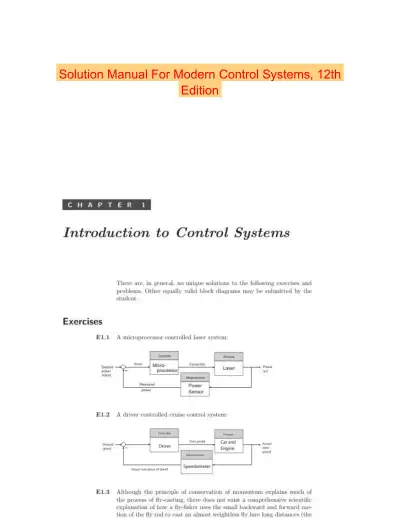 Textbook Guides
Solution Manual For Modern Control Systems, 12th Edition
Electrical Engineering & Electronics
749 pagesMay 2025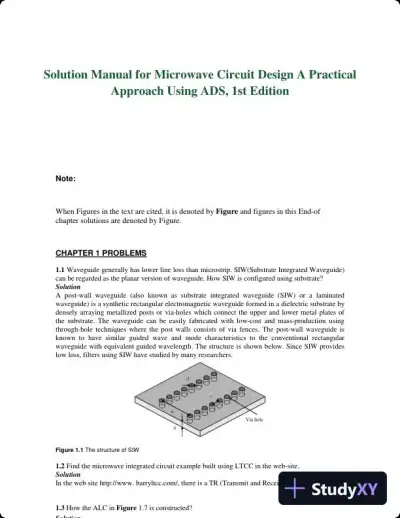 Textbook Guides
Solution Manual for Microwave Circuit Design A Practical Approach Using ADS, 1st Edition
Electrical Engineering & Electronics
121 pages154downloadsFeb 2025 Exam Guides
Power System Analysis And Design, 6th Edition Test Bank
Electrical Engineering & Electronics
40 pages132downloadsFeb 2025 Textbook Guides
Solution Manual For Electronics Fundamentals: A Systems Approach, 1st Edition
Electrical Engineering & Electronics
278 pages93downloadsFeb 2025 Textbook Guides
Solution Manual for Fundamentals of Electromagnetics with Engineering Applications, 1st Edition
Electrical Engineering & Electronics
56 pagesMay 2025 Document
HW4_Solution
Electrical Engineering & Electronics
17 pagesFeb 2026 Class Notes
Electronic Commerce, 12th Edition Class Notes
Electrical Engineering & Electronics
196 pagesMay 2025 Textbook Guides
Electronic Commerce, 12th Edition Solution Manual
Electrical Engineering & Electronics
134 pagesMay 2025
Study this document with CramX
Once it is in your library, every tool can work from it.