

English - Noun Person, Place, Thing, Idea, or Acti
- English
- Texas A&M University
- 33 pages
- Shared March 2026
Preview 10 of 33 pages
See the first 10 pages exactly as they appear in the document.
Page 1 Read page 1 as text
Study Guide English – Noun: Person, Place, Thing, Idea, or Activity 1. Proper Nouns Let’s start with proper nouns . A proper noun is a noun that names a specific person, place, event, or group . Because it refers to something unique, it is always capitalized . Here are a few examples of proper nouns: • Eleanor Roosevelt (a specific person) • Niagara Falls (a specific place) • Dracula (a specific character) • the Federal Bureau of Investigation (a specific organization) • the Great Depression (a specific historical event) 1.1 Avoid Overusing Capital Letters Sometimes, writers use capital letters too often, even when they are not needed. This can make writing look confusing or unpolished. For example: • The Manhattan Project should be capitalized because it was a specific historical project — the World War II effort to develop the first nuclear weapons. • However, the word project should not be capitalized when it is used in a general way, such as a student project or a club’s project to clean the campus . In these cases, project is a common noun , not a proper noun. 1.2 A Closer Look at Historical Terms The same rule applies to historical events:
Page 2 Read page 2 as text
Study Guide • The Great Depression is capitalized because it names a specific period of economic hardship that began with the stock market crash in 1929. • But when the word depression is used to talk about economic hardship in general, it is not capitalized , because it is no longer referring to that specific historical event. 1.3 When Capitalization Can Vary In some situations, capitalization can be flexible. For example, certain companies or organizations follow their own style rules. A company might choose to capitalize job titles like Manager or Director in official documents. However, outside of these special cases, unnecessary capitalization is often used just to make a word seem more important. This is something you should try to avoid in your own writing. 2. Quiz: Proper Nouns Question 1 C omplete this sentence: A proper noun names ________. Answer Choices • an important person at a special event • a specific person, place, event, or group • a famous person as the subject of a sentence Correct Answer a specific person, place, event, or group Why This Is Correct • Proper nouns name specific things, not general ones. • Examples include India, Mount Everest, World War II, and Amazon .
Page 3 Read page 3 as text
Study Guide Question 2 Which of the following shows a group of ONLY proper nouns? Answer Choices • Chicago, Grand Canyon, Mayor Jansen • Civil War, war against terrorism, director of the museum • Hawaiian Islands, chief of staff, state senator Correct Answer Chicago, Grand Canyon, Mayor Jansen Why This Is Correct • Each item names a specific place or person. • The other choices include common nouns like director and chief of staff . Question 3 Complete this sentence: Proper nouns should be ________. Answer Choices • lowercased • capitalized • italicized Correct Answer capitalized
Page 4 Read page 4 as text
Study Guide Why This Is Correct • Capital letters help show that a noun is specific. • Proper nouns are always capitalized, no matter where they appear in a sentence. Question 4 Which sentence shows CORRECT use of a proper noun? Answer Choices • Why isn't the mayor leading our city's trade delegation to China? • Why isn't the Mayor leading our city's trade delegation to China? • Why isn't the Mayor leading our city's Trade Delegation to China? Correct Answer Why isn't the Mayor leading our city's trade delegation to China? Why This Is Correct • Mayor is capitalized because it refers to a specific person. • China is a proper noun and is correctly capitalized. • trade delegation is a common noun and should not be capitalized. Question 5 Which sentence is INCORRECT? Answer Choices • Vancouver, London, Athens, and Los Angeles are finalists to host the next Olympics. • Vancouver, London, Athens, and los angeles are finalists to host the next olympics. • Neither a nor b
Page 5 Read page 5 as text
Study Guide Correct Answer Vancouver, London, Athens, and los angeles are finalists to host the next olympics. Why This Is Correct • Los Angeles and Olympics are proper nouns and must be capitalized. • Sentence A correctly capitalizes all proper nouns. 3. Verbs Used as Nouns In English, words can sometimes do more than one job. One common example is when a verb is used as a noun . When this happens, the verb changes form and takes on a new role in the sentence. This kind of verb - turned - noun is called a gerund . What Is a Gerund? A gerund is a noun made from the – ing form of a verb . Even though it looks like a verb, it acts like a noun in the sentence. A gerund can function as: • the subject of a sentence, or • the object of a sentence Example: Sleeping sometimes serves as an escape from studying . In this sentence: • Sleeping comes from the verb sleep and acts as the subject . • Studying comes from the verb study and acts as an object . Both words end in – ing , but they are doing the job of nouns.
Page 6 Read page 6 as text
Study Guide 3.1 Common Problems with Gerunds Gerunds can be tricky, especially when a noun or pronoun comes before them . Here’s an important rule to remember: When a noun or pronoun comes before a gerund, use the possessive form. Example: Jana’s sleeping was sometimes an escape from studying. Here, Jana’s is possessive because it shows whose sleeping it is. 3.2 How to Check If You’re Using a Gerund Correctly A helpful trick is to replace the gerund with a regular noun and see if the sentence still sounds right. Example: Jana’s slumber was sometimes an escape from studying. This sentence sounds correct, just like: Jana’s sleeping was sometimes an escape from studying. But this sentence does not sound right: Jana slumber was sometimes an escape from studying. This test helps you confirm that the possessive form is needed. 3.3 Even When It Looks Like an Object S ometimes, the word before a gerund may look like an object, but you should still use the possessive form . Correct: Jana was annoyed by Bill’s studying . Incorrect: Jana was annoyed by Bill studying .
Page 7 Read page 7 as text
Study Guide 4. Quiz: Verbs Used as Nouns Question 1 Choose the TRUE statement. Answer Choices • Verbs used as nouns in a sentence are called gerunds. • Verbs used as nouns in a question are called queries. • Verbs used as nouns are always called possessives. Correct Answer Verbs used as nouns in a sentence are called gerunds. Why This Is Correct • A gerund is a verb form that functions as a noun. • The other choices are not grammatical terms. Question 2 Which underlined verb phrase is the subject of the sentence? Answer Choices • Before collecting evidence , the police officer questioned a suspect. • The police officer questioned a suspect, then began collecting evidence . • Collecting evidence at the crime scene took hours of police time. Correct Answer Collecting evidence at the crime scene took hours of police time.
Page 8 Read page 8 as text
Study Guide Why This Is Correct • Collecting evidence is a gerund phrase. • It acts as the subject of the sentence. Question 3 Which is a TRUE statement about gerunds? Answer Choices • A gerund is usually plural. • A gerund phrase usually ends in - ing . • A gerund phrase is usually possessive. Correct Answer A gerund phrase usually ends in - ing . Why This Is Correct • Gerunds always end in - ing . • They are not automatically plural or possessive. Question 4 Which sentence shows the possessive case before the gerund? Answer Choices • His loud snoring woke his two roommates. • He woke his two roommates by snoring loudly. • Snoring loudly he woke his two roommates.
Page 9 Read page 9 as text
Study Guide Correct Answer His loud snoring woke his two roommates. Why This Is Correct • his is a possessive pronoun. • It correctly comes before the gerund snoring . Question 5 Choose the TRUE statement. Answer Choices • Pronouns should not precede a gerund phrase in a sentence. • Gerund phrases must contain pronouns in a sentence. • A noun or pronoun should be in the possessive case if it precedes a gerund. Correct Answer A noun or pronoun should be in the possessive case if it precedes a gerund. Why This Is Correct • Possessive nouns or pronouns show who is performing the gerund action. • This is the correct grammatical structure. Question 6 Which sentence shows CORRECT use of a gerund?
Page 10 Read page 10 as text
Study Guide Answer Choices • Her brother's favorite pastimes are snowboarding, eating, and sleeping. • Snowboarding, eating, and sleeping are her brother's favorite pastimes. • Both a and b Correct Answer Both a and b Why This Is Correct • In both sentences, the - ing words function as nouns. • They correctly name activities and act as subjects or objects. 5. Collective Nouns A collective noun is a word that names a group of people or things . Instead of talking about each member one by one, a collective noun lets you refer to the group as a whole. In fact, the word group itself is a collective noun. Here are some common examples: • family • club • team • committee • staff • furniture • jury • Congress • audience • herd
23 more pages in the full document
Unlock it once and it stays in your library, ready to chat with or turn into flashcards.
Unlock the full documentMore English study materials
See all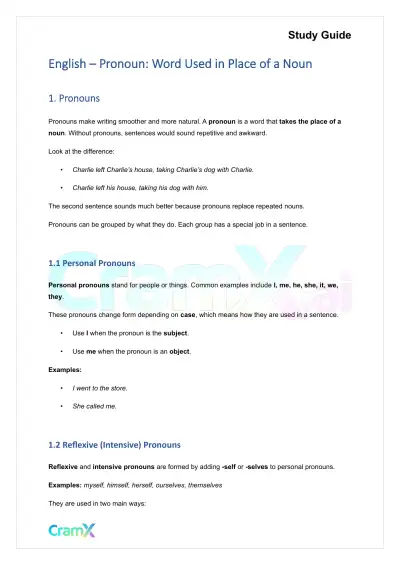 Quick Guides
English - Pronoun Word Used in Place of a Noun
English
51 pagesMar 2026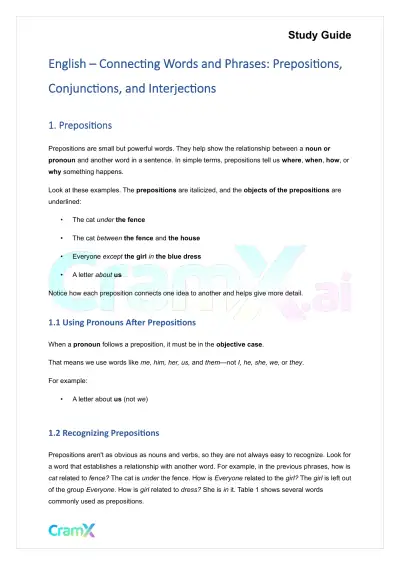 Quick Guides
English - Connecting Words and Phrases Preposition
English
19 pagesMar 2026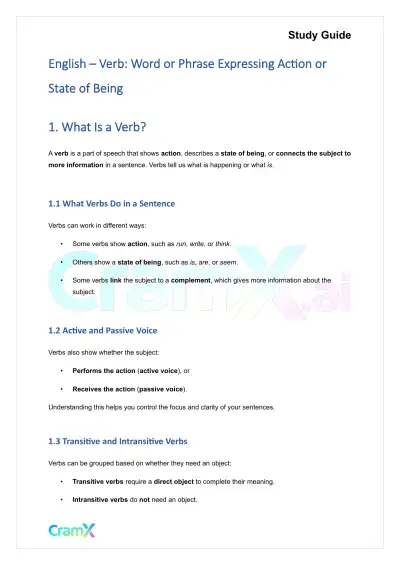 Quick Guides
English - Verb Word or Phrase Expressing Action or
English
60 pagesMar 2026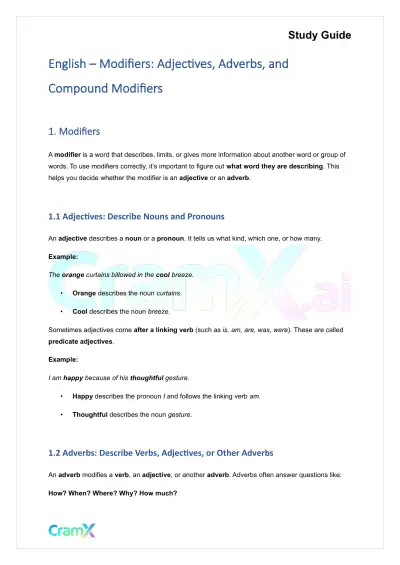 Quick Guides
English - Modifiers Adjectives, Adverbs, and Compo
English
33 pagesMar 2026 Exam Guides
Technical Communication, 14th Edition Test Bank
English
83 pages153downloadsFeb 2025 Class Notes
The Longman Reader, 12th Edition Lecture Notes
English
118 pages137downloadsFeb 2025 Class Notes
Lecture Notes for The Reid Guide for College Writers, 12th Edition
English
138 pages131downloadsFeb 2025 Class Notes
Lecture Notes for Technical Communication, 15th Edition
English
350 pages113downloadsFeb 2025
Study this document with CramX
Once it is in your library, every tool can work from it.