

Grammar - Dashes, Parentheses, and Quotation Marks
- English
- Texas A&M University
- 34 pages
- Shared March 2026
Preview 10 of 34 pages
See the first 10 pages exactly as they appear in the document.
Page 1 Read page 1 as text
Study Guide Grammar – Dashes, Parentheses, and Quotation Marks 1. What Are Dashes and Parentheses Dashes and parentheses are punctuation marks that interrupt a sentence to add extra information. They can help clarify your writing or provide additional details without breaking the flow completely. • Dashes ( — ) often create emphasis or a dramatic pause. • Parentheses ( ) usually include supplementary information that is less essential to the main sentence. • Brackets [ ] are used only when adding your own words inside parentheses or within a quotation to clarify or comment. 1. 1 Use Them Sparingly Beginning writers sometimes overuse dashes or parentheses, which can make writing feel cluttered or confusing. Good writing is usually direct and well - organized , so these marks should be used only when necessary . 2. Uses of the Dash A dash ( — ) is a punctuation mark that signals an interruption or emphasizes a point . It can be more dramatic than a comma and less formal than a colon. Dashes are versatile, but they should be used purposefully and sparingly . 2. 1. Indicating Interruptions Use a dash when you want to interrupt a sentence with a phrase or clause. • Single dash: interrupts the sentence once. She was extraordinarily tall — the tallest woman I'd ever seen. • Pair of dashes: encloses an interruption in the middle of a sentence. She walked in — the tallest woman I'd ever seen — and took a seat at the counter.
Page 2 Read page 2 as text
Study Guide 2. 2. Introducing a Restatement or Explanation Like a colon, a dash can introduce an explanation, restatement, or clarification — similar to saying that is , in other words , or namely . Begin the clause after the dash with a lowercase letter . Example: • The reporter relentlessly pursued the woman — he was determined to get her to make a statement. Tip: While colons are more formal, dashes are a bit more casual and conversational. 2. 3. Dashes with Commas When using dashes to set off interrupting elements , do not include commas. Correct: • She saw her sisters — all five of them — standing in front of the building. Incorrect: • She saw her sisters — all five of them — , standing in front of the building. 2. 4. Dashes with Quotation Marks • If the dash is not part of the quoted material , place it outside the quotation marks . “He wants the money” — I paused for effect — “and he wants it now.” • Use a dash within quotation marks to show unfinished dialogue , and omit commas or periods. “Help! Help! I can't seem to — ” She fell to the ground, gasping for breath. Key Takeaways • A dash highlights interruptions or adds emphasis. • It can replace a colon for restatements or explanations. • Avoid combining dashes with unnecessary commas. • Use dashes with quotations carefully — outside quotes for narrative interruption, inside quotes for unfinished dialogue. Dashes are powerful tools when you want to grab attention or clarify meaning , but overusing them can make writing feel choppy.
Page 3 Read page 3 as text
Study Guide 3. Quiz: Uses of the Dash Question 1 Choose the FALSE statement. Answer Choices • A dash serves a purpose similar to a comma, semicolon, or colon. • Use a dash if you don't want to interrupt the flow of a sentence. • Like a colon, a dash can be used to introduce a restatement of a word or phrase. Correct Answer Use a dash if you don't want to interrupt the flow of a sentence. Why This Is Correct • A dash does interrupt the flow of a sentence for emphasis. • Commas are used when you do not want an interruption. Question 2 Choose the TRUE statement. Answer Choices • A dash or a pair of dashes indicate an interruption in a sentence. • Dashes are used to indicate strong emotion by the speaker. • Dashes let the reader know that the verb is in the conditional tense. Correct Answer A dash or a pair of dashes indicate an interruption in a sentence.
Page 4 Read page 4 as text
Study Guide Why This Is Correct • Dashes signal sudden breaks, interruptions, or added emphasis. • They do not indicate emotion or verb tense. Question 3 Fill in the blank. If a dash indicates unfinished dialogue , place it ________ Answer Choices • within the quotation marks and omit commas or periods. • outside the quotation marks and add the final period. • within the quotation marks and add the final period. Correct Answer within the quotation marks and omit commas or periods. Why This Is Correct • The dash replaces ending punctuation. • It shows the speaker was interrupted. Question 4 Fill in the blank. If a dash is not part of a quotation, place it ________ Answer Choices • inside the quotation marks. • at the end of the quotation. • outside the quotation marks.
Page 5 Read page 5 as text
Study Guide Correct Answer outside the quotation marks. Why This Is Correct • Punctuation not belonging to quoted material is placed outside the quotation marks. Question 5 The plan for the new downtown arena (I can't wait to see it) will be unveiled tomorrow. One way to correctly rewrite the above sentence using dashes is ________ Answer Choices • The plan for the new downtown arena — I can't wait to see it — will be unveiled tomorrow. • The plan for the new downtown arena, — I can't wait to see it — ,will be unveiled tomorrow. • The plan for the new downtown arena, I can't wait to see it — !will be unveiled tomorrow. Correct Answer The plan for the new downtown arena — I can't wait to see it — will be unveiled tomorrow. Why This Is Correct • The dash pair correctly replaces parentheses for emphasis. • No commas or exclamation marks are needed. Question 6 Which sentence is CORRECT ? Answer Choices • Corporate wellness programs improve employee morale — And they reduce health insurance costs. • Corporate wellness programs improve employee morale, — and they reduce health insurance costs. • Corporate wellness programs improve employee morale — and they reduce health insurance costs.
Page 6 Read page 6 as text
Study Guide Correct Answer Corporate wellness programs improve employee morale — and they reduce health insurance costs. Why This Is Correct • The dash correctly joins two closely related independent clauses. • No extra commas or capitalization are needed. Question 7 Which sentence is CORRECT ? Answer Choices • The CEO wanted the wireless network installed — immediately — ! • The CEO wanted the wireless network installed — immediately! • The CEO wanted the wireless network installed immediately — ! Correct Answer The CEO wanted the wireless network installed — immediately! Why This Is Correct • The dash adds emphasis to immediately . • The exclamation mark ends the sentence correctly. 4. Problems with Dashes Dashes are very noticeable in writing, so using them too often can distract the reader . Keep this in mind: punctuation should clarify , not overwhelm, your writing.
Page 7 Read page 7 as text
Study Guide 4. 1. Don’t Overuse Dashes Because dashes stand out more than commas, it’s easy to overuse them. Only use a dash when you want to emphasize or interrupt a sentence — otherwise, stick to commas, parentheses, or other punctuation. Rule of thumb: Don’t let a dash become the star of your sentence. 4. 2. Don’t Confuse Dashes with Hyphens It’s important to distinguish between a dash and a hyphen : • Hyphen ( - ) : Joins words or breaks syllables. o Example: pre - existing • En dash ( – ) : Short dash used for ranges. o Example: April 1 – 5, pages 70 – 75 • Em dash ( — ) : Longer dash for interruptions or emphasis. o Typing tip: Type two hyphens ( -- ) with no spaces; most word processors will convert it automatically. Examples • Incorrect: o Ms. Persinger ‐ the most important official in the city ‐ okayed the plan. • Acceptable (typed with two hyphens): o Ms. Persinger ‐‐ the most important official in the city ‐‐ okayed the plan. • Better (em dash): o Ms. Persinger — the most important official in the city — okayed the plan. Key Takeaways 1. Use dashes sparingly to avoid distracting the reader. 2. Don’t confuse dashes with hyphens — they have different purposes. 3. Em dashes ( — ) are best for interruptions or emphasis; en dashes ( – ) are for ranges.
Page 8 Read page 8 as text
Study Guide 5. Quiz: Problems with Dashes Question 1 Which example shows CORRECT use of the dash or pair of dashes ? Answer Choices • The committee — one week before the official building dedication — scheduled a practice run - through. • The committee scheduled — a practice run - through one week before the official building dedication. • One week — before the official building dedication — the committee wanted to run through the ceremony. Correct Answer The committee — one week before the official building dedication — scheduled a practice run - through. Why This Is Correct • The pair of dashes correctly sets off an interrupting phrase. • The sentence remains clear and grammatically complete without the interrupting information. Question 2 Which example shows CORRECT use of the hyphen ? Answer Choices • The committee - one week before the official building dedication - scheduled a practice run - through. • The committee scheduled a practice run - through one week before the official building dedication. • One - week before the official building dedication, the committee wanted to run through the ceremony.
Page 9 Read page 9 as text
Study Guide Correct Answer The committee scheduled a practice run - through one week before the official building dedication. Why This Is Correct • No hyphen is needed in one week before . • The other choices misuse hyphens in place of dashes or where no hyphen belongs. Question 3 Which of the following is FALSE ? Answer Choices • Dashes and commas can often be used interchangeably in writing. • Do not overuse dashes in your writing as they could become a distraction. • Use dashes frequently, because the reader will notice them more than commas. Correct Answer Use dashes frequently, because the reader will notice them more than commas. Why This Is Correct • Dashes are meant for emphasis, not frequent use. • Overusing them distracts readers and weakens writing. Question 4 Which sentence about hyphens is TRUE ? Answer Choices • A hyphen is mainly used to break syllables of a word. • A hyphen is used to set off an interrupting phrase or clause in a sentence. • A hyphen and a dash are the same size and used for the same purpose.
Page 10 Read page 10 as text
Study Guide Correct Answer None of the above is true. Correction & Why To clarify for students: • A hyphen joins words or word parts ( well - known author ). • A dash sets off interruptions or adds emphasis. • They are not the same size and not used for the same purpose. 6. Uses of Parentheses Parentheses ( ) are punctuation marks used to set off extra or incidental information in a sentence. They are useful for adding minor comments, examples, explanations, or clarifications without disrupting the main sentence flow. 6 . 1. Setting Off Incidental Information Parentheses enclose information that is additional but not essential to the sentence. You could also use commas or dashes, but parentheses are less intrusive. Examples: • Some of the local store owners (Mr. Kwan and Ms. Lawson, for example) insisted that the street be widened. • Roger Worthington (a poorly drawn character in the novel) reveals the secret in the last chapter. Tip: Overusing parentheses can distract the reader, so use them sparingly. 6 . 2. Other Punctuation Marks with Parentheses • Before parentheses: Do not put a punctuation mark. • After parentheses: Place a comma only if the sentence would normally require it.
24 more pages in the full document
Unlock it once and it stays in your library, ready to chat with or turn into flashcards.
Unlock the full documentMore English study materials
See all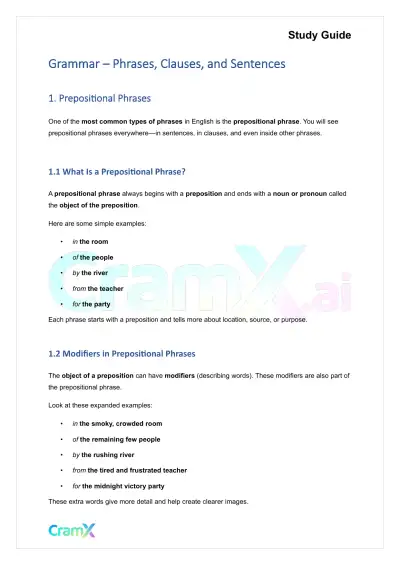 Quick Guides
Grammar - Phrases, Clauses, and Sentences
English
32 pagesMar 2026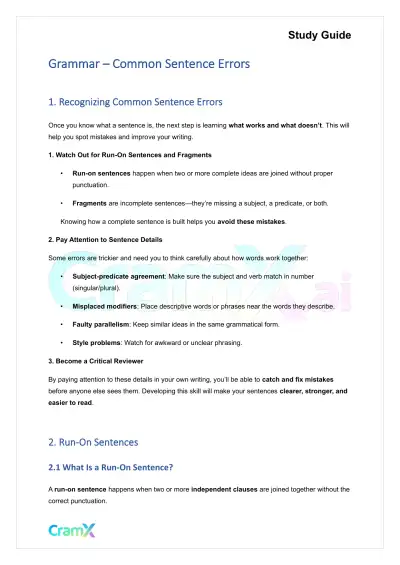 Quick Guides
Grammar - Common Sentence Errors
English
49 pagesMar 2026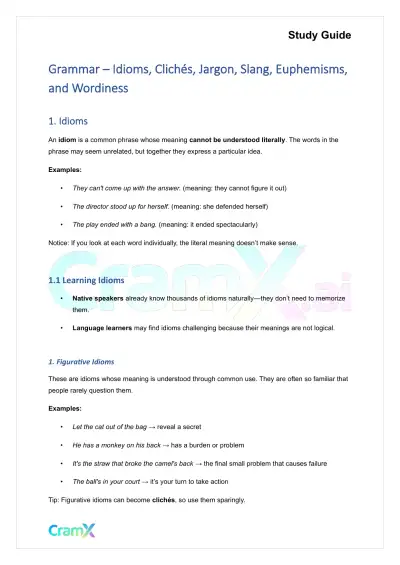 Quick Guides
Grammar - Idioms, Cliches, Jargon, Slang, Euphemisms, and Wordiness
English
54 pagesMar 2026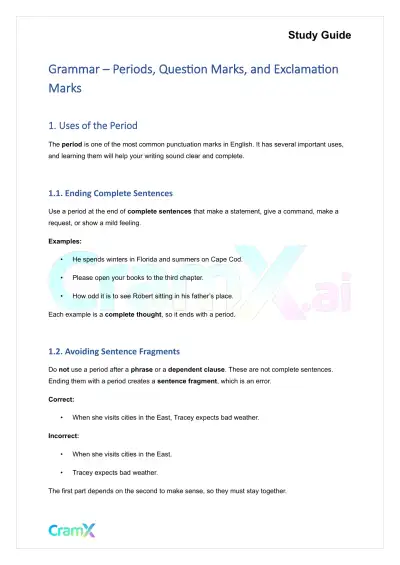 Quick Guides
Grammar - Periods, Question Marks, and Exclamation Marks
English
23 pagesMar 2026 Quick Guides
Grammar - Commas, Semicolons, and Colons
English
43 pagesMar 2026 Exam Guides
Technical Communication, 14th Edition Test Bank
English
83 pages153downloadsFeb 2025 Class Notes
The Longman Reader, 12th Edition Lecture Notes
English
118 pages137downloadsFeb 2025 Class Notes
Lecture Notes for The Reid Guide for College Writers, 12th Edition
English
138 pages131downloadsFeb 2025
Study this document with CramX
Once it is in your library, every tool can work from it.