

Grammar - Phrases, Clauses, and Sentences
- English
- Texas A&M University
- 32 pages
- Shared March 2026
Preview 10 of 32 pages
See the first 10 pages exactly as they appear in the document.
Page 1 Read page 1 as text
Study Guide Grammar – Phrases, Clauses, and Sentences 1. Prepositional Phrases One of the most common types of phrases in English is the prepositional phrase . You will see prepositional phrases everywhere — in sentences, in clauses, and even inside other phrases. 1.1 What Is a Prepositional Phrase? A prepositional phrase always begins with a preposition and ends with a noun or pronoun called the object of the preposition . Here are some simple examples: • in the room • of the people • by the river • from the teacher • for the party Each phrase starts with a preposition and tells more about location, source, or purpose. 1.2 Modifiers in Prepositional Phrases The object of a preposition can have modifiers (describing words). These modifiers are also part of the prepositional phrase. Look at these expanded examples: • in the smoky, crowded room • of the remaining few people • by the rushing river • from the tired and frustrated teacher • for the midnight victory party These extra words give more detail and help create clearer images.
Page 2 Read page 2 as text
Study Guide 1.3 How Prepositional Phrases Work in Sentences Prepositional phrases can function in two different ways . They can act as adjectives or adverbs . 1.4 Prepositional Phrases as Adjectives When a prepositional phrase describes a noun , it works like an adjective. Example: The woman in the trench coat pulled out her cell phone. Here, the phrase in the trench coat describes which woman is being talked about. It tells more about the noun woman . 1.5 Prepositional Phrases as Adverbs When a prepositional phrase modifies a verb , it works like an adverb. It often tells when , where , or how something happens. Example: Most of the audience dozed during the tedious performance . The phrase during the tedious performance explains when the audience dozed, so it modifies the verb dozed . 2. Quiz: Prepositional Phrases Question 1 Complete the following sentence. A phrase is a group of words that ________ Answer Choices • modifies another part of speech and has a subject and predicate • replaces a part of speech but doesn't have a subject and predicate • acts as a part of speech but doesn't have a subject and predicate
Page 3 Read page 3 as text
Study Guide Correct Answer acts as a part of speech but doesn't have a subject and predicate Why This Is Correct • A phrase does not contain both a subject and a predicate. • It functions as a single part of speech within a sentence. Question 2 Complete the following sentence. A clause is a group of words that ________ Answer Choices • has both a subject and a verb • has a pronoun and a gerund • has a verb but isn't a complete thought Correct Answer has both a subject and a verb Why This Is Correct • A clause must contain a subject and a verb . • Some clauses are complete thoughts (independent), while others are not (dependent). Question 3 Complete the following sentence. A prepositional phrase begins with ________
Page 4 Read page 4 as text
Study Guide Answer Choices • a predicate noun • a preposition • a positional adjective Correct Answer a preposition Why This Is Correct • Every prepositional phrase starts with a preposition . • It ends with an object of the preposition (and any modifiers). Question 4 Which sentence contains a prepositional phrase? Answer Choices • The two boys wrestled, and their father mowed the yard. • The two boys wrestled, and their father watched them. • The two boys wrestled on the floor , and their father watched them. Correct Answer The two boys wrestled on the floor , and their father watched them. Why This Is Correct • on the floor is a prepositional phrase. • It begins with the preposition on and explains where the boys wrestled.
Page 5 Read page 5 as text
Study Guide Question 5 Which sentence shows a prepositional phrase functioning as an ADJECTIVE ? Answer Choices • The woman in the yellow and blue scarf read the newspaper. • The woman reading the newspaper wore a yellow and blue scarf. • The woman wearing a yellow and blue scarf read the newspaper. Correct Answer The woman in the yellow and blue scarf read the newspaper. Why This Is Correct • in the yellow and blue scarf modifies the noun woman . • Prepositional phrases that describe nouns act as adjectives . Question 6 Which sentence shows a prepositional phrase functioning as an ADVERB ? Answer Choices • We won the match because our goalie blocked four shots. • Our goalie blocked four shots during the last five minutes . • Our goalie blocked four shots, and we won the match. Correct Answer Our goalie blocked four shots during the last five minutes . Why This Is Correct • during the last five minutes modifies the verb blocked . • It explains when the action happened, so it functions as an adverb .
Page 6 Read page 6 as text
Study Guide 3. Phrases Containing Verbals Some phrases are built around verbals — words that look like verbs but act as other parts of speech. The three main types of verbals are participles , gerunds , and infinitives . These verbals help add detail and meaning to sentences by acting as adjectives , nouns , or adverbs . 3.1 Participial Phrases A participial phrase begins with a present participle (ending in - ing ) or a past participle (often ending in - ed , - en , or an irregular form). It also includes any objects or modifiers that go with it. Participial phrases always act as adjectives . That means they describe a noun. Example: Breathing the fresh mountain air, Jim realized he had found paradise. • Breathing is the present participle. • the fresh mountain air is its object and modifiers. • The entire phrase describes Jim , so it works as an adjective. Another example: The soldiers, trapped by the enemy, threw down their weapons. • trapped is a past participle. • by the enemy is a prepositional phrase that modifies trapped . • The whole participial phrase describes soldiers . Notice that phrases can appear inside other phrases . This is very common in English. 3.2 Gerund Phrases A gerund phrase also begins with an - ing verb form, which can make it look like a participial phrase at first. The key difference is what it does in the sentence .
Page 7 Read page 7 as text
Study Guide A gerund phrase always acts as a noun , not an adjective. Like any noun, a gerund phrase can be: • the subject of a sentence • the object of a verb • the object of a preposition • a complement after a linking verb Unlike participial phrases, gerund phrases are essential to the meaning of the sentence. You cannot remove them without changing the sentence’s meaning. Examples: Riding the black stallion terrified Hugh. • Riding the black stallion is the subject of the verb terrified . The police officer reported seeing the suspect. • seeing the suspect is the direct object of reported . The senator made his reputation by talking loudly and often. • talking loudly and often is the object of the preposition by . Calling Uncle Robert is asking for trouble. • Calling Uncle Robert is the subject. • asking for trouble is a gerund phrase that completes the meaning of is . 3.3 Infinitive Phrases An infinitive phrase includes an infinitive (such as to sleep , to consider , to throw ) along with its objects and modifiers. Infinitive phrases usually act as nouns , but they can also function as adjectives or adverbs . Infinitive Phrases as Nouns To sleep all night was his only wish. • To sleep all night is the subject of the sentence. The representatives did not want to take an unpopular stand. • to take an unpopular stand is the direct object of did not want .
Page 8 Read page 8 as text
Study Guide 3.4 Infinitive Phrases as Adjectives He had plenty of money to spend foolishly. • to spend foolishly describes money . 3.5 Infinitive Phrases as Adverbs After the confrontation, she drove miles to clear her mind. • to clear her mind explains why she drove, so it modifies the verb. 3.6 Split Infinitives A split infinitive happens when an adverb is placed between “to” and the verb . Example of a split infinitive: • to wisely spend For a long time, splitting infinitives was considered incorrect. Today, it is generally acceptable , though many writers still avoid it unless it improves clarity. Preferred (not split): • They taught her to spend money wisely. Avoid if unnecessary: • They taught her to wisely spend money. 3.7 When Splitting Is Helpful Sometimes, not splitting an infinitive sounds awkward or makes the meaning unclear. We expect the population to more than double over the next twenty years. Here, splitting the infinitive sounds natural and clear. Other times, splitting avoids confusion:
Page 9 Read page 9 as text
Study Guide We wanted to further discuss Chinese efforts to modernize. This version clearly shows that further modifies discuss , not Chinese efforts . And sometimes it just sounds better: • He planned to quickly take the children to another room. 4. Quiz: Phrases Containing Verbals Question 1 Choose the TRUE statement. Answer Choices • A participial phrase begins with a past or present participle. • A participial phrase begins with a prepositional phrase. • A participial phrase begins with a predicate noun. Correct Answer A participial phrase begins with a past or present participle. Why This Is Correct • Participial phrases start with participles (verb forms ending in - ing , - ed , or irregular forms). • They function as adjectives and describe nouns. Question 2 Choose the TRUE statement. Answer Choices • A participial phrase is used as a noun in a sentence. • A participial phrase is used as a verb in a sentence. • A participial phrase is used as an adjective in a sentence.
Page 10 Read page 10 as text
Study Guide Correct Answer A participial phrase is used as an adjective in a sentence. Why This Is Correct • Participial phrases describe or modify nouns or pronouns. • They do not act as nouns or main verbs. Question 3 Which of the following contains a gerund phrase ? Answer Choices • The thought of rafting the rapids gave her nightmares. • After rafting the rapids, she had nightmares. • Both a and b Correct Answer Both a and b Why This Is Correct • rafting the rapids appears in both sentences. • In each case, rafting is a gerund (an - ing verb form acting as a noun). Question 4 Complete the sentence. A gerund phrase acts as a noun in a sentence and ________
22 more pages in the full document
Unlock it once and it stays in your library, ready to chat with or turn into flashcards.
Unlock the full documentMore English study materials
See all Quick Guides
Grammar - Common Sentence Errors
English
49 pagesMar 2026 Quick Guides
Grammar - Idioms, Cliches, Jargon, Slang, Euphemisms, and Wordiness
English
54 pagesMar 2026 Quick Guides
Grammar - Periods, Question Marks, and Exclamation Marks
English
23 pagesMar 2026 Quick Guides
Grammar - Commas, Semicolons, and Colons
English
43 pagesMar 2026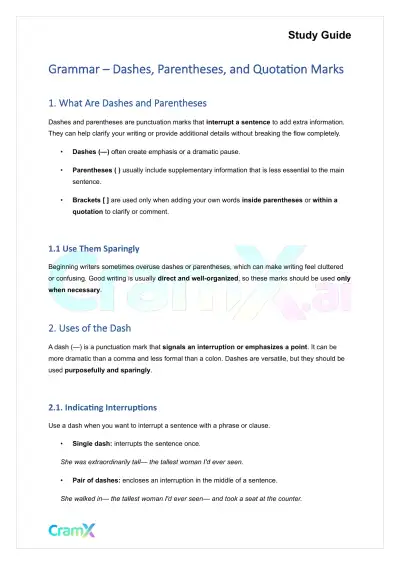 Quick Guides
Grammar - Dashes, Parentheses, and Quotation Marks
English
34 pagesMar 2026 Exam Guides
Technical Communication, 14th Edition Test Bank
English
83 pages153downloadsFeb 2025 Class Notes
The Longman Reader, 12th Edition Lecture Notes
English
118 pages137downloadsFeb 2025 Class Notes
Lecture Notes for The Reid Guide for College Writers, 12th Edition
English
138 pages131downloadsFeb 2025
Study this document with CramX
Once it is in your library, every tool can work from it.