

Grammar - Idioms, Cliches, Jargon, Slang, Euphemisms, and Wordiness
- English
- Texas A&M University
- 54 pages
- Shared March 2026
Preview 10 of 54 pages
See the first 10 pages exactly as they appear in the document.
Page 1 Read page 1 as text
Study Guide Grammar – Idioms, Clichés, Jargon, Slang, Euphemisms, and Wordiness 1. Idioms An idiom is a common phrase whose meaning cannot be understood literally . The words in the phrase may seem unrelated, but together they express a particular idea. Examples: • They can't come up with the answer. (meaning: they cannot figure it out) • The director stood up for herself. (meaning: she defended herself) • The play ended with a bang. (meaning: it ended spectacularly) Notice: If you look at each word individually, the literal meaning doesn’t make sense. 1.1 Learning Idioms • Native speakers already know thousands of idioms naturally — they don’t need to memorize them. • Language learners may find idioms challenging because their meanings are not logical. 1. Figurative Idioms These are idioms whose meaning is understood through common use. They are often so familiar that people rarely question them. Examples: • Let the cat out of the bag → reveal a secret • He has a monkey on his back → has a burden or problem • It's the straw that broke the camel's back → the final small problem that causes failure • The ball's in your court → it’s your turn to take action Tip: Figurative idioms can become clichés , so use them sparingly.
Page 2 Read page 2 as text
Study Guide 2. Prepositional Idioms These idioms rely on specific prepositions , which often seem arbitrary. The choice of preposition is idiomatic — there’s no logical rule. Examples: • She put up with him (correct) vs. She put on with him (incorrect) • At home (correct) vs. In home (incorrect) • Sick of him (correct) vs. Sick from him (incorrect) • Get in a car vs. get on a boat Some words form different idioms with different prepositions , so context matters. 1.2 Examples of Common Prepositional Idioms • accountable for (responsible for) — I am accountable for the errors in the book. • accountable to (answerable to someone) — I am accountable to the board of directors. • adapt from (a model) — He adapted the design from one he had seen in Europe. • adapt to (a situation, an environment) — The children soon adapted to the new school. • agree on or upon (something) — We agreed on a date for the meeting. • agree to (do something) — We agree to pay the damages. • agree with (people, opinions) — The women who were polled agreed with the judge. • annoyed at or with (a person) — The physician was annoyed at her for the interruption. • annoyed by (something) — The physician was annoyed by the constant interruptions. • assist at (an event) — He assisted at the service. • assist with (someone or something) — Mr. Nguyen assisted with the refreshments and the flowers. • contend for (a position, a prize) — The candidates have contended for the office twice. • contend with (an obstacle) — The candidate has to contend with his lack of personal charm. • depart for ( not to, a destination) — They depart for Canada tomorrow.
Page 3 Read page 3 as text
Study Guide • depart from (a destination, a tradition) — They departed from their routine today. • grateful for (a benefit) — I am grateful for my musical talent. • grateful to (a person) — I am grateful to you for the help. • impatient at (a delay) — They were impatient at having to wait so long. • impatient for (a result) — We are impatient for an answer from the administration. • impatient with (a person) — He was impatient with the clerk. • part from (leave) — I parted from the group early this year. • part with (a possession) — I parted with the Volvo reluctantly. 1.3 Tips for Learning Prepositional Idioms 1. Trust your ear : Listen to native speakers and read widely. 2. Check a dictionary : Many dictionaries list idioms with the correct preposition. 3. Practice in context : Using idioms correctly comes with experience, not just memorization. Key point: Prepositional idioms don’t follow logical rules , so learning the right preposition for each expression is essential. 2. Quiz: Idioms Question 1 Choose the TRUE statement about idiomatic expressions. Answer Choices • It's best to memorize all the idiomatic expressions in the English language. • There are thousands of idioms in English, and you cannot memorize them all. • Translate the idiom literally, and you will be able to understand the expression. Correct Answer There are thousands of idioms in English, and you cannot memorize them all.
Page 4 Read page 4 as text
Study Guide Why This Is Correct • Idioms are learned through use and context , not memorization. • Literal translation usually does not reveal the meaning. Question 2 Complete the definition. An idiom is ________ Answer Choices • a common expression meant to sound sarcastic and implausible to the listener or reader. • an idiotic expression repeatedly used by a cultural or language group. • a commonly used phrase or expression with a meaning different from a literal translation. Correct Answer a commonly used phrase or expression with a meaning different from a literal translation. Why This Is Correct • Idioms mean something other than what the individual words suggest. Question 3 Which of the following does NOT show an example of an idiomatic expression? Answer Choices • When it comes to golf, he's a real mad dog. • We'd better get down to brass tacks and finish this project. • The golf foursome finished the course before it started raining.
Page 5 Read page 5 as text
Study Guide Correct Answer The golf foursome finished the course before it started raining. Why This Is Correct • This sentence is literal and means exactly what it says. • The other choices use figurative expressions. Question 4 Which of the following shows an example of an idiomatic expression ? Answer Choices • His investments failed, and he lost the family nest egg. • He didn't invest wisely and lost a lot of money. • He shouldn't have invested so much in that risky project. Correct Answer His investments failed, and he lost the family nest egg. Why This Is Correct • Nest egg is an idiom meaning savings , not a literal egg. Question 5 Which sentence shows CORRECT use of a prepositional idiom ? Answer Choices • Curt was under the weather and didn't come to work today. • Curt was over the weather and didn't come to work today. • Curt was on the weather and didn't come to work today.
Page 6 Read page 6 as text
Study Guide Correct Answer Curt was under the weather and didn't come to work today. Why This Is Correct • Under the weather is a common idiom meaning not feeling well . Question 6 Which sentence shows CORRECT use of a prepositional idiom ? Answer Choices • Tran was fired off of his job on Friday afternoon. • Tran was fired from his job on Friday afternoon. • Neither a nor b Correct Answer Tran was fired from his job on Friday afternoon. Why This Is Correct • Fired from is the correct idiomatic preposition. • Off of is informal and incorrect in this context. 3. Clichés 3.1 What Are Clichés? Clichés are expressions that have been used so much they’ve lost their impact. Many clichés rely on figurative language — comparing one thing to another in a creative way. When a phrase is first created, it can be fresh and exciting. For example, expressions like “pretty as a picture,” “old as the hills,” “sharp as a tack,” and “smart as a whip” were once new and clever ways to describe things.
Page 7 Read page 7 as text
Study Guide Over time, though, these expressions became overused. Now, many writers avoid them because they feel tired and predictable. You’ll find clichés everywhere: online chats, social media, newspapers, magazines, and TV. People might say someone is “following his dream” or trying to “burst his bubble.” Sometimes “what you see is what you get,” but sometimes people have hidden agendas. Watch out for phrases like “real - life superheroes,” “unsung heroes,” “living legends,” “people who live in glass houses,” or “the man on the street.” 3.2 Common Examples of Clichés Some clichés are phrases that have been repeated so often they’ve become part of everyday language. Here are a few: • all bent out of shape • axe to grind • contributing factor • first and foremost • grave danger • go belly up • get an earful • grisly murder • once and for all • tried and true • vital role These expressions spread quickly, but because everyone uses them, they can make writing feel dull. Avoid them when you can. 3.3 Mixing Clichés Can Be Confusing Sometimes, people accidentally mix clichés and create funny or confusing phrases. For example, a TV reporter once said a man “signed his own death knell.” The reporter probably meant “signed his own death warrant” (meaning he caused his own destruction), but mixed it with “sounding the death knell” (meaning to signal the end of something).
Page 8 Read page 8 as text
Study Guide A knell is the sound of a bell tolling at a funeral — so obviously, you can’t literally sign a knell! Mixing clichés like this can confuse your audience. 3.4 How to Avoid Clichés Before using a common expression, think carefully: • Is there a more precise or descriptive way to say this? • Can you describe the feeling or action in your own words? For example, instead of saying “hopping mad” or “mad as a wet hen,” it’s stronger to simply say “he was enraged.” Also, don’t use a cliché and then apologize for it. Saying “Pardon my cliché, but…” draws attention to the overused phrase and weakens your writing. 3.5 Using Clichés in Creative Ways Sometimes, clichés can be fun if you use them in a new, surprising way. • Baseball legend Yogi Berra joked, “When you come to a fork in the road, take it.” • Civil rights activist H. Rap Brown said, “Violence is as American as cherry pie.” These twists catch the audience off guard and make a familiar expression feel fresh. But be careful — cleverness works only if it’s clear and effective, not just a bad joke. 4. Quiz: Clichés Question 1 When is it considered acceptable to use a cliché? Answer Choices • when you have mixed two different clichés in a sentence • on rare occasions when you can use a cliché in a new, unusual way • to communicate with people who are a lot older than you are
Page 9 Read page 9 as text
Study Guide Correct Answer on rare occasions when you can use a cliché in a new, unusual way Why This Is Correct • Clichés are usually avoided because they are overused. • Occasionally, a writer can refresh a cliché by using it creatively. Question 2 Which of the following shows an example of at least TWO clichés ? Answer Choices • sharp as a tack, down the street, childhood heroes • go belly up, over the hill, read between the lines • my next - door neighbor, all bent out of shape, a real bargain Correct Answer go belly up, over the hill, read between the lines Why This Is Correct • All three expressions are common clichés. • The other options contain mostly literal phrases. Question 3 Which of the following statements is TRUE ? Answer Choices • A cliché is a stale, overused figure of speech. • Many clichés rely on figurative language. • Both a and b
Page 10 Read page 10 as text
Study Guide Correct Answer Both a and b Why This Is Correct • Clichés lose impact through overuse. • Many originate from metaphors or other figurative language. Question 4 Which of the following statements is TRUE ? Answer Choices • Don't use clichés singly; use them in pairs. • If you are going to use a cliché in writing, apologize to the reader. • Don't use a cliché and then apologize to the reader for using it. Correct Answer Don't use a cliché and then apologize to the reader for using it. Why This Is Correct • Apologizing draws attention to weak writing. • It’s better to revise and remove the cliché altogether. Question 5 Which of the following statements is FALSE ? Answer Choices • Use clichés frequently because readers are familiar with these common expressions. • Avoid using clichés in writing because these expressions lack freshness and originality. • Clichés can spread quickly, but widespread use doesn't mean clichés communicate clearly.
44 more pages in the full document
Unlock it once and it stays in your library, ready to chat with or turn into flashcards.
Unlock the full documentMore English study materials
See all Quick Guides
Grammar - Phrases, Clauses, and Sentences
English
32 pagesMar 2026 Quick Guides
Grammar - Common Sentence Errors
English
49 pagesMar 2026 Quick Guides
Grammar - Periods, Question Marks, and Exclamation Marks
English
23 pagesMar 2026 Quick Guides
Grammar - Commas, Semicolons, and Colons
English
43 pagesMar 2026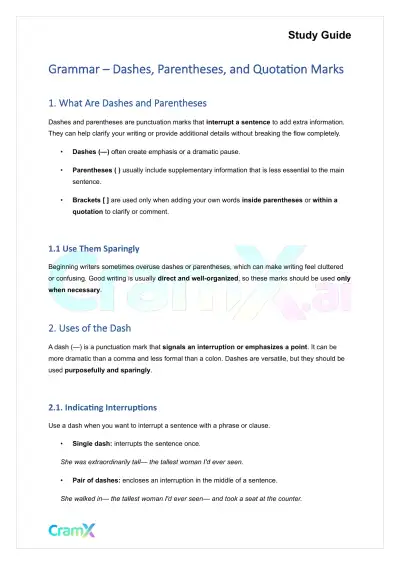 Quick Guides
Grammar - Dashes, Parentheses, and Quotation Marks
English
34 pagesMar 2026 Exam Guides
Technical Communication, 14th Edition Test Bank
English
83 pages153downloadsFeb 2025 Class Notes
The Longman Reader, 12th Edition Lecture Notes
English
118 pages137downloadsFeb 2025 Class Notes
Lecture Notes for The Reid Guide for College Writers, 12th Edition
English
138 pages131downloadsFeb 2025
Study this document with CramX
Once it is in your library, every tool can work from it.