

Grammar - Commas, Semicolons, and Colons
- English
- Texas A&M University
- 43 pages
- Shared March 2026
Preview 10 of 43 pages
See the first 10 pages exactly as they appear in the document.
Page 1 Read page 1 as text
Study Guide Grammar – Commas, Semicolons, and Colons 1. What Are Commas, Semicolons, and Colons Punctuation helps your writing sound clear and natural. Commas, semicolons, and colons act like road signs for readers — they tell us when to pause, stop briefly, or get ready for more information. Let’s look at each one in a simple, student - friendly way. 1.1 Commas: Small Pauses That Add Clarity Commas show short pauses or breaks in a sentence. They help ideas flow smoothly and make sentences easier to understand. Some writers forget to use commas, while others use too many. Both problems can make sentences confusing or hard to read. The good news is that comma rules are clear and not difficult to learn. Once you understand them, your writing will feel more organize d and polished. 1.2 Semicolons: Connecting Related Ideas Semicolons often confuse writers, but they have a clear purpose. A semicolon joins two independent clauses — complete ideas — that are closely related. It can also be used to separate items in a complex list. Think of a semicolon as a stronger comma but not as strong as a period. It helps link ideas that belong together. 1.3 Colons: Introducing What Comes Next Colons are used to point the reader toward something important that follows. They often introduce: • A list • A quotation or formal statement • An explanation or restatement of an idea A colon tells the reader, “Pay attention — more information is coming.”
Page 2 Read page 2 as text
Study Guide Use Them Wisely One key rule for semicolons and colons is to use them sparingly. When used correctly, they make your writing clearer and more effective. When overused, they can distract the reader. 2. Uses of the Comma Commas are small marks, but they do a lot of important work in writing. They help readers pause at the right moments, understand relationships between ideas, and avoid confusion. This section explains when to use commas, when not to use them, and how they affect meaning. 2.1 The Main Jobs of Commas Commas are commonly used in these situations: • After introductory clauses and phrases • To set off interruptions within a sentence • With nonrestrictive (nonessential) phrases and clauses • Between items or modifiers in a series • To join independent clauses when used with a coordinating conjunction When commas join independent clauses, they must be followed by a coordinating conjunction: for, and, nor, but, or, yet, so (often remembered as FANBOYS ). 2.2 Special Situations That Need Commas Commas are also used in certain standard cases, such as with: • Quotations • Dates • Addresses and locations • Numbers with four or more digits
Page 3 Read page 3 as text
Study Guide At the same time, commas should never be used: • Around restrictive (essential) clauses • Between a subject and its verb • Between a verb and its direct object 2.3 Thinking About Commas as You Learn When learning commas, keep two ideas in mind: 1. A comma usually signals a pause. 2. Some comma rules are flexible, as long as the meaning stays clear. Commas are the most commonly used punctuation mark inside sentences, and they also cause the most confusion. One reason is that different editors and writers use commas differently. Some writing styles use many commas, while others use very few. Over time, the general trend has been toward using fewer commas. 2.4 When a Comma Changes the Meaning Sometimes a comma is absolutely necessary because it changes the meaning of a sentence. Example: • Because I wanted to help, Dr. Hodges, I pulled the car over to the side of the road. • Because I wanted to help Dr. Hodges, I pulled the car over to the side of the road. In the first sentence, the commas show that the speaker is talking to Dr. Hodges. In the second sentence, Dr. Hodges is the person being helped. Many situations are less obvious than this, which is why careful comma use matters. 2.5 Joining Independent Clauses When you join two independent clauses with a coordinating conjunction, place a comma before the conjunction.
Page 4 Read page 4 as text
Study Guide Examples: • Ryan never answered these charges, but he was later forced to give up part of the money. • The novel lacks fully developed characters, and the plot is filled with unlikely coincidences. If the clauses are short and closely related, the comma is optional. Examples: • It was an admirable scheme and it would work. • It was an admirable scheme, and it would work. However, do not use a comma if the clauses are closely connected and no pause is needed. Correct: • The night was cold and the sky was clear. Incorrect: • The night was cold, and the sky was clear. 2.6 Avoiding Comma Splices A comma must always be paired with a coordinating conjunction when joining independent clauses. If it isn’t, you create a comma splice , which is an error. Correct: • It had been a tumultuous year that had taken everybody by surprise, and it left the revolutionaries worse off than before. Incorrect: • It had been a tumultuous year that had taken everybody by surprise, it left the revolutionaries worse off than before. 2.7 Commas After Introductory Clauses It is customary to use a comma after an introductory adverbial clause. If the clause is long, the comma is essential.
Page 5 Read page 5 as text
Study Guide Examples: • After she walked into the room, we stopped gossiping. • If you receive inappropriate material, acknowledge it by explaining why it won’t be published. If the clause is short and there is no risk of confusion, the comma may be omitted. Examples: • When she arrived we stopped gossiping. • After I turned sixteen I was allowed to stay out until midnight. 2.8 When a Missing Comma Causes Confusion Sometimes leaving out a comma makes a sentence confusing or even funny. Incorrect: • When we are cooking the children cannot come into the kitchen. Correct: • When we are cooking, the children cannot come into the kitchen. 2.9 Commas After Introductory Phrases A phrase is a group of words without a subject and verb. If an introductory phrase is more than a few words long, it is usually followed by a comma. Always use a comma if there is any chance of confusion. Examples: • By taking the initiative to seek out story leads, a reporter will make a good impression. • At the beginning of the lecture, most of the students were wide awake. • Unlike many performances of the symphony, this one was spirited and lively. • Before eating, Cameron always runs two miles on the beach. Even short phrases sometimes need commas to avoid misunderstanding.
Page 6 Read page 6 as text
Study Guide 2.10 Participial vs. Gerund Phrases A participial phrase at the beginning of a sentence is always followed by a comma. Example: • Smiling and shaking hands, the senator worked her way through the crowd. Do not confuse this with a gerund phrase , which acts as a noun and should not be followed by a comma. Compare: • Thinking of the consequences, she agreed not to release the memo. (comma needed) • Thinking of the consequences gave her a headache. (no comma) 2.11 Optional Commas After Short Phrases For very short introductory phrases, the comma is optional. Examples: • Later that day Jack and Linda drove to the ocean. • After the main course I was too full for dessert. A good test is to read the sentence aloud. If you naturally pause, use a comma. 2.12 Setting Off Interrupting Elements Some words and phrases interrupt the flow of a sentence and should be enclosed in commas. These include: • Conjunctive adverbs • Transitional phrases • Names used in direct address 2.13 Conjunctive Adverbs and Transitions Words like however, therefore, for example, and of course usually take a comma when they begin a sentence.
Page 7 Read page 7 as text
Study Guide Examples: • For example, you shouldn’t use acid on soft surfaces. • Therefore, he refused to go with us. When they interrupt a sentence, they are enclosed in commas. Examples: • As the project moves along, of course, you will gain independence. • One who excels at research, for example, might work in the library. 2.14 Direct Address Names or expressions used to speak directly to someone always need commas. Examples: • Fellow citizens, I ask for your support. • I tell you, Jason, I will not be forced into this. • Yes, readers, I am telling the truth. 2.15 Other Interruptions Any element outside the main sentence flow should usually be set off with commas. Examples: • It is too early, I believe, to call the police. • The historical tour, we were told, was organized by experts. Dashes and parentheses can also be used, but commas are better when you want the interruption to feel gentle. 2.16 Restrictive vs. Nonrestrictive Elements This is one of the most important comma rules. • Restrictive (essential) elements limit or define the noun. They do not use commas. • Nonrestrictive (nonessential) elements add extra information. They do use commas.
Page 8 Read page 8 as text
Study Guide Compare: • The women who arrived yesterday toured the island. (restrictive) • The women, who arrived yesterday, toured the island. (nonrestrictive) In the first sentence, only some women are meant. In the second, all the women are meant. More Examples • The workers who went on strike were replaced. (some workers) • The workers, who went on strike, were replaced. (all workers) Correct: • Workers who are over age sixty have difficulty finding jobs. Incorrect: • Workers, who are over age sixty, have difficulty finding jobs. 2.17 Practice with Restrictive and Nonrestrictive Elements • My brother, who is thirteen, watches too much TV. (extra information) • The man who took the pictures is being sued. (essential) • Cats, more independent than dogs, are good pets. (extra) • Cats who are fussy eaters are a challenge. (essential) 2.18 Commas with Appositives An appositive renames or identifies a noun. Nonrestrictive appositives are enclosed in commas. Examples: • Kublai Khan, grandson of Genghis, ruled China. • Jack Kerouac, a Beat Generation writer, became famous. Restrictive appositives are essential and do not use commas.
Page 9 Read page 9 as text
Study Guide Correct: • Shakespeare’s play Hamlet was written around 1600. Incorrect: • Shakespeare’s play, Hamlet , was written around 1600. 2.19 Commas in a Series (The Serial Comma) Commas separate items in a list. Using a comma before the final and is called the serial comma . Example: • Red, white, and blue Using the serial comma is clearer and avoids confusion. Many writers choose to use it consistently. Examples: • He bought a dishwasher, microwave, refrigerator, and washer. • The recipe calls for flour, sugar, eggs, and milk. Without the final comma, meanings can become unclear. 2.20 When Not to Use Commas in a Series Do not use commas if all items are joined by and or or . Correct: • He asked to see Martha and Helen and Eileen. Incorrect: • He asked to see Martha, and Helen, and Eileen. 2.21 Commas Between Modifiers Use commas between adjectives that equally describe a noun. Example: • It was a dark, gloomy, forbidding house.
Page 10 Read page 10 as text
Study Guide Do not place a comma between the last adjective and the noun it directly modifies. Correct: • a beautiful, spacious summer home 2.22 The Adjective Test Try reversing the adjectives: • If the sentence still makes sense, use commas. • If it does not, don’t. Example: • dark, gloomy, forbidding → works • spacious summer → does not 2.23 Commas with Quotation Marks Commas always go inside quotation marks. Examples: • He called her “the worst boss in the world,” and quit. • “I can’t believe you ate it,” she said. 2.24 Miscellaneous Uses of Commas Use commas in these situations: • With dialogue tags o He said, “Let’s go.” • In dates and addresses o December 10, 1962 o 1328 Sailor Road, Santa Paula, CA 93060 • Between locations o Boise, Idaho
33 more pages in the full document
Unlock it once and it stays in your library, ready to chat with or turn into flashcards.
Unlock the full documentMore English study materials
See all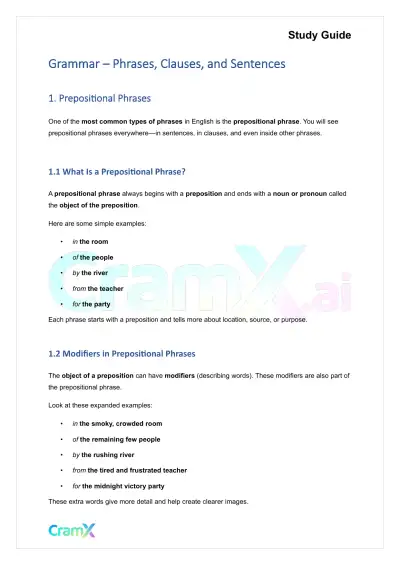 Quick Guides
Grammar - Phrases, Clauses, and Sentences
English
32 pagesMar 2026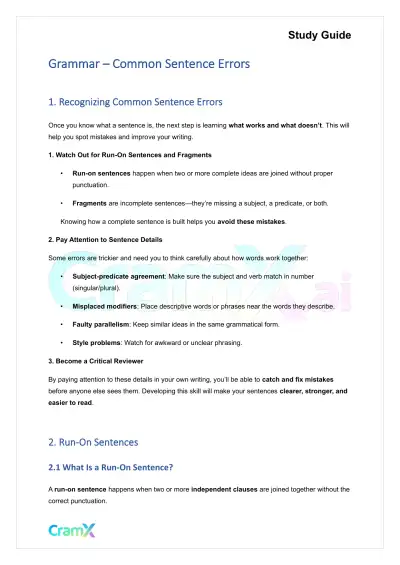 Quick Guides
Grammar - Common Sentence Errors
English
49 pagesMar 2026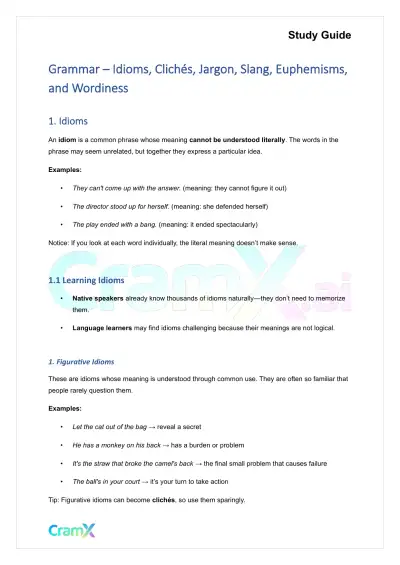 Quick Guides
Grammar - Idioms, Cliches, Jargon, Slang, Euphemisms, and Wordiness
English
54 pagesMar 2026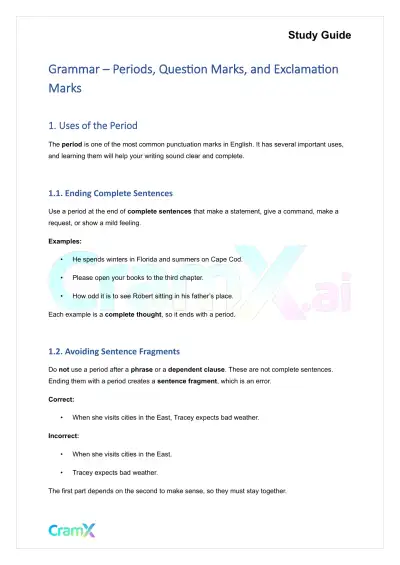 Quick Guides
Grammar - Periods, Question Marks, and Exclamation Marks
English
23 pagesMar 2026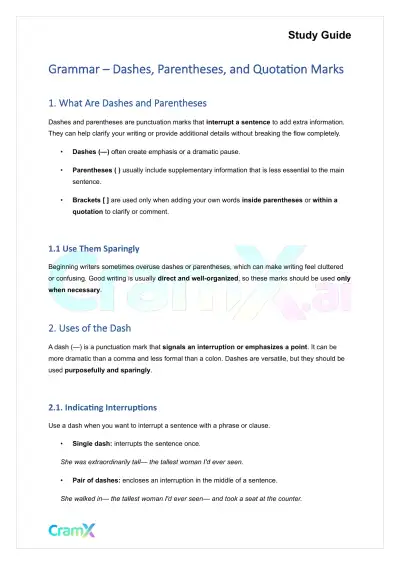 Quick Guides
Grammar - Dashes, Parentheses, and Quotation Marks
English
34 pagesMar 2026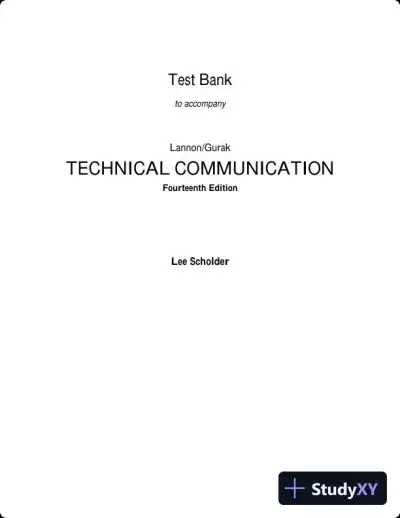 Exam Guides
Technical Communication, 14th Edition Test Bank
English
83 pages153downloadsFeb 2025 Class Notes
The Longman Reader, 12th Edition Lecture Notes
English
118 pages137downloadsFeb 2025 Class Notes
Lecture Notes for The Reid Guide for College Writers, 12th Edition
English
138 pages131downloadsFeb 2025
Study this document with CramX
Once it is in your library, every tool can work from it.