

Grammar - Periods, Question Marks, and Exclamation Marks
- English
- Texas A&M University
- 23 pages
- Shared March 2026
Preview 7 of 23 pages
See the first 7 pages exactly as they appear in the document.
Page 1 Read page 1 as text
Study Guide Grammar – Periods, Question Marks, and Exclamation Marks 1. Uses of the Period The period is one of the most common punctuation marks in English. It has several important uses, and learning them will help your writing sound clear and complete. 1. 1. Ending Complete Sentences Use a period at the end of complete sentences that make a statement, give a command, make a request, or show a mild feeling. Examples: • He spends winters in Florida and summers on Cape Cod. • Please open your books to the third chapter. • How odd it is to see Robert sitting in his father’s place. Each example is a complete thought , so it ends with a period. 1. 2. Avoiding Sentence Fragments Do not use a period after a phrase or a dependent clause . These are not complete sentences. Ending them with a period creates a sentence fragment , which is an error. Correct: • When she visits cities in the East, Tracey expects bad weather. Incorrect: • When she visits cities in the East. • Tracey expects bad weather. The first part depends on the second to make sense, so they must stay together.
Page 2 Read page 2 as text
Study Guide 1. 3. Courtesy Questions Sometimes a sentence looks like a question but is really a polite request. These are called courtesy questions . You can end them with either: • a period (more general and routine), or • a question mark (more direct and personal). Examples: • Would you please take your seat before the bell. • Would you please take your seat before the bell? Both are correct — the punctuation just changes the tone slightly. 1. 4. Periods in Abbreviations Many abbreviations use periods, but some do not. Here are the main rules to remember: Abbreviations that usually do use periods: • Titles and common terms: Mr., Dr., a.m., Tues., Sept. • Abbreviations ending in lowercase letters: yr., mo. Abbreviations that usually do not use periods: • Capital - letter abbreviations that don’t form another word: FBI, CIA, CNN, IOU • State abbreviations: AZ, CA, NY, WY • Measurement abbreviations: mph, rpm, ml, cm, gm Special case: • Use periods if the abbreviation could be confused with another word. o M.A. needs periods because ma is also a word. o USA does not need periods. If you’re ever unsure, it’s best to check a dictionary or style guide .
Page 3 Read page 3 as text
Study Guide 1. 5. Periods with Quotation Marks Always place the period inside quotation marks , even if the quoted words do not end with a period themselves. Examples: • Katie said, “I didn’t take the money.” • Aunt Francine insisted on calling her puppy “my little tootsie wootsie.” In the first sentence, the period belongs to the quotation. In the second sentence, the phrase itself doesn’t need a period — but the sentence does, so the period still goes inside the quotation marks. 1. 6. Periods with Abbreviations at the End of a Sentence When a sentence ends with an abbreviation, use only one period , not two. Example: • Twyla told her mother, “I won’t be satisfied until I earn my Ph.D.” The period in Ph.D. also serves as the period for the sentence. 2. Quiz: Uses of the Period Question 1 Choose the CORRECTLY punctuated sentence. Answer Choices • My neighbor was eager to meet the newest condo owner, Corben Wilson, M.D.. • My neighbor was eager to meet the newest condo owner, Corben Wilson, M.D. • My neighbor was eager to meet the newest condo owner, Corben Wilson, M.D Correct Answer My neighbor was eager to meet the newest condo owner, Corben Wilson, M.D.
Page 4 Read page 4 as text
Study Guide Why This Is Correct • M.D. already ends with a period. • An extra period is not added after abbreviations that end a sentence. Question 2 Choose the example that shows CORRECT use of the period(s) . Answer Choices • Before the fire department arrived. She had extinguished the fire on the stove. • Before the fire department arrived, she had extinguished the fire on the stove. • Both a and b Correct Answer Before the fire department arrived, she had extinguished the fire on the stove. Why This Is Correct • Choice a incorrectly places a period after a dependent clause. • Choice b correctly uses a comma and forms a complete sentence. Question 3 Choose the sentence that shows CORRECT placement of the period(s) . Answer Choices • James said, “I'm caught in traffic and can't pick up the children at school.” • James said, “I'm caught in traffic and can't pick up the children at school”. • James said. “I'm caught in traffic and can't pick up the children at school.”
Page 5 Read page 5 as text
Study Guide Correct Answer James said, “I'm caught in traffic and can't pick up the children at school.” Why This Is Correct • In American English, periods are placed inside quotation marks. • The dialogue tag is punctuated correctly. Question 4 Choose the sentence that shows INCORRECT placement of the period(s) . Answer Choices • “But I don't want to go with you,” the child whined. “I want to stay here and play.” • “But I don't want to go with you,” the child whined. “I want to stay here and play”. • Both a and b are correct. Correct Answer “But I don't want to go with you,” the child whined. “I want to stay here and play”. Why This Is Correct • The period is placed outside the quotation marks, which is incorrect in American English. • The first option is punctuated correctly. Question 5 Choose the TRUE statement. Answer Choices • Always place the period inside quotation marks, whether or not it is part of the quotation. • Always place the period outside quotation marks to close the entire sentence. • Place the period outside the quotation marks when the sentence is a direct request.
Page 6 Read page 6 as text
Study Guide Correct Answer Always place the period inside quotation marks, whether or not it is part of the quotation. Why This Is Correct • This is the standard rule in American English punctuation. Question 6 Complete the statement. Periods are used to end complete sentences that are ________ Answer Choices • statements, commands, requests, or mild exclamations. • statements, interjections, dependent clauses, or requests. • statements, requests, appositives, or exclamations. Correct Answer statements, commands, requests, or mild exclamations. Why This Is Correct • Periods are used for most sentence types that are not questions or strong exclamations. Question 7 Which of the following sentences should end with a period ? Answer Choices • All players must turn in their equipment before tomorrow • Players, please turn in your equipment before tomorrow • Both a and b
Page 7 Read page 7 as text
Study Guide Correct Answer Both a and b Why This Is Correct • Both sentences are statements or polite requests. • Neither requires a question mark or exclamation point. 3. Uses of the Question Mark The role of the question mark is to end a question, even when one question interrupts or comes after a statement. 3. 1. Ending a Question Use a question mark at the end of any direct question , even when the question appears in the middle of a sentence or comes after a statement. Examples: • Who knows? • I spoke to her — don’t you remember? — and she still refused to come. • No doubt Mailani thought she was doing the right thing, but don’t you agree she was wrong? In each case, a question is being asked, so a question mark is required. 3. 2. Questions with Modifying Phrases or Clauses Sometimes a question is followed by a phrase or clause that adds extra information. When this happens, place the question mark at the very end of the sentence , not right after the question itself. Example: • How could the mother be so certain of the driver’s identity, considering the shock she must have felt at seeing her daughter lying in the road? Even though the question begins earlier, the entire sentence is still one question.
16 more pages in the full document
Unlock it once and it stays in your library, ready to chat with or turn into flashcards.
Unlock the full documentMore English study materials
See all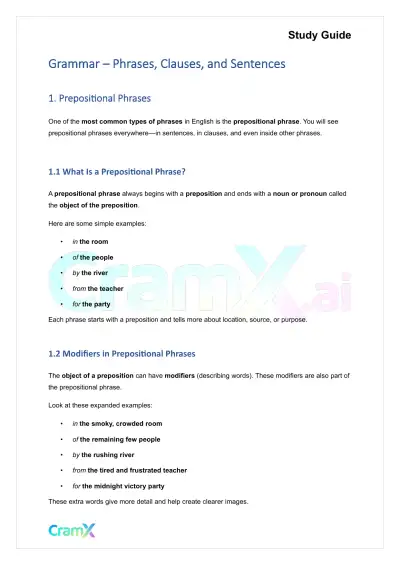 Quick Guides
Grammar - Phrases, Clauses, and Sentences
English
32 pagesMar 2026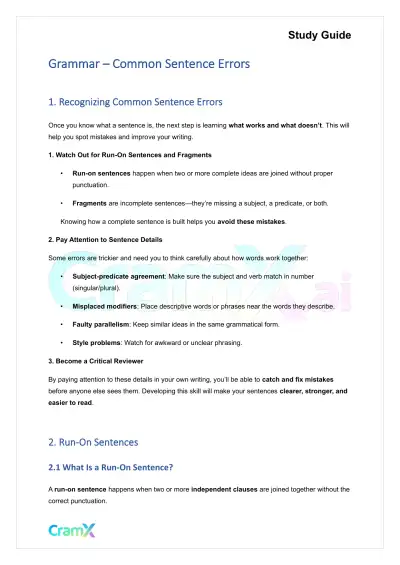 Quick Guides
Grammar - Common Sentence Errors
English
49 pagesMar 2026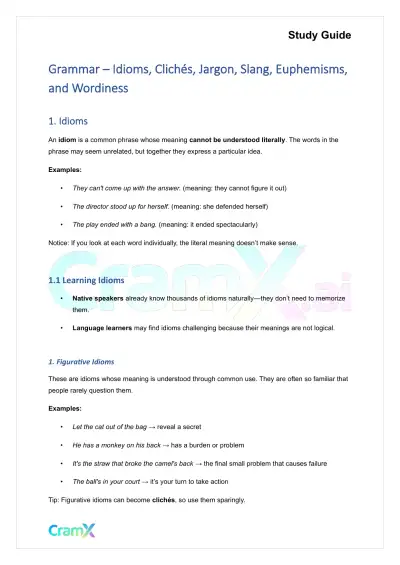 Quick Guides
Grammar - Idioms, Cliches, Jargon, Slang, Euphemisms, and Wordiness
English
54 pagesMar 2026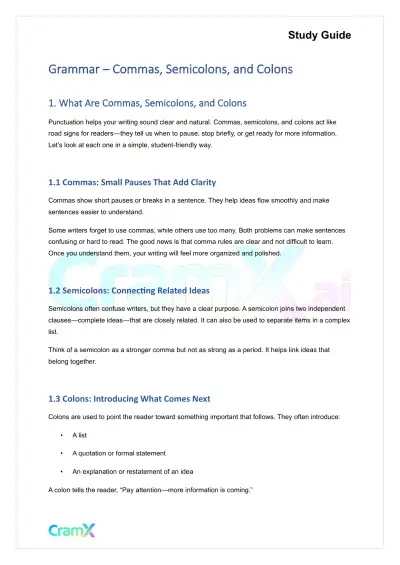 Quick Guides
Grammar - Commas, Semicolons, and Colons
English
43 pagesMar 2026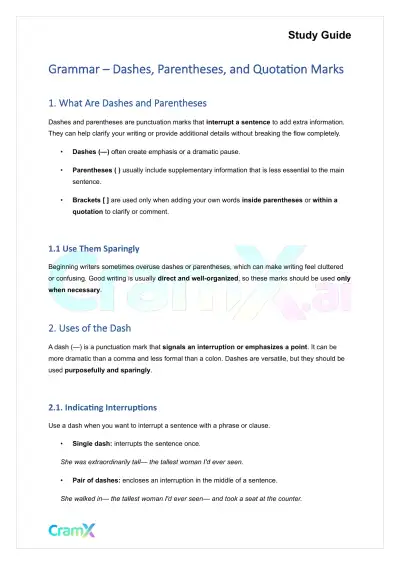 Quick Guides
Grammar - Dashes, Parentheses, and Quotation Marks
English
34 pagesMar 2026 Exam Guides
Technical Communication, 14th Edition Test Bank
English
83 pages153downloadsFeb 2025 Class Notes
The Longman Reader, 12th Edition Lecture Notes
English
118 pages137downloadsFeb 2025 Class Notes
Lecture Notes for The Reid Guide for College Writers, 12th Edition
English
138 pages131downloadsFeb 2025
Study this document with CramX
Once it is in your library, every tool can work from it.