

Theory And Practice Of Counseling And Psychotherapy, 10th Edition Test Bank
- Psychology
- 174 pages
- Shared February 2025
- 93 downloads
Master difficult topics with Theory And Practice Of Counseling And Psychotherapy, 10th Edition Test Bank, offering targeted practice for your exams.
Preview 31 of 174 pages
See the first 31 pages exactly as they appear in the document.
Page 1 Read page 1 as text
1. Evidence suggesting the concept of the unconscious includes all of the following except : a. dreams. b. posthypnotic suggestions. c. freeassociation. d. material derived from introspective techniques. ANSWER: d REFERENCES: page 61 2. A person who unconsciously exhibits overly nice behavior to conceal hostile feelings is probably using which ego defense? a. Displacement b. Reaction formation c. Introjection d. Projection ANSWER: b REFERENCES: page 62 3. One of the most important Freudian concepts, which consists of pushing unacceptable life events and painful feelings into the unconscious, is: a. repression. b. regression. c. displacement. d. rationalization. ANSWER: a REFERENCES: page 62 4. The ego defense mechanism in which a person exhibits behavior that clearly shows signs of reverting to less mature stages is ________? a. fixation b. rationalization c. regression d. introjection ANSWER: c REFERENCES: page 63 5. Attributing to others the qualities or traits that are unacceptable to our own ego is best described as: a. displacement. b. introjection. c. reaction formation. d. projection. ANSWER: d REFERENCES: page 62 Page 1
Page 2 Page 3 Read page 3 as text
6. Resolution of sexual conflicts and sex-role identity is a critical function of the: a. oral stage. b. anal stage. c. phallic stage. d. genital stage. ANSWER: c REFERENCES: page 63 7. Feelings of hostility, destructiveness, anger, rage, and hatred are associated with the: a. oral stage. b. anal stage. c. phallic stage. d. genital stage. ANSWER: b REFERENCES: page 63 8. The basic aim of psychoanalytic therapy is to: a. treat specific learning disorders. b. change overt behavior. c. correct irrational thinking. d. make the unconscious motives conscious. ANSWER: d REFERENCES: page 61 9. A major characteristic of the classical psychoanalytic therapist is: a. openness and self-disclosure. b. a deeply personal and sharing relationship. c. a sense of being anonymous. d. a focus on specific behavior and an objective appraisal of learned patterns of behavior. ANSWER: c REFERENCES: page 67 10. The “fundamental rule” for the client in psychoanalysis is: a. forming a contract with the therapist. b. willingness to do “homework assignments.” c. participating in free association. d. writing down dreams. ANSWER: c REFERENCES: page 68 Page 2
Page 4 Read page 4 as text
11. A more flexible variant of psychoanalysis is: a. psychoanalytically oriented psychotherapy. b. psychoanalytically oriented reality therapy. c. superego-oriented psychotherapy. d. psychoanalytic behavior analysis. ANSWER: a REFERENCES: page 59 12. The technique whereby the analyst explains the meaning of certain behavior is known as: a. transference. b. rationalization. c. countertransference. d. interpretation. ANSWER: d REFERENCES: page 74 13. The concept of resistance can best be described as all of the following except : a. everything that prevents a client from producing unconscious material. b. that which needs to be analyzed and interpreted. c. an inevitable part of psychoanalytic therapy. d. it is not valuable from a theoretical and clinical perspective. ANSWER: d REFERENCES: page 75 14. A person who manages his or her anxiety by distorting reality and failing to acknowledge painful events is most likely using: a. introjection. b. sublimation. c. denial. d. compensation. ANSWER: c REFERENCES: page 62 15. Directing energy toward another object or a person (when anxiety is reduced by focusing on a “safer target”) is known as: a. sublimation. b. repression. c. introjection. d. displacement. ANSWER: d REFERENCES: page 62 Page 3
Page 5 Read page 5 as text
16. Manufacturing “good” reasons to explain away a bruised ego, or to explain away failures or losses, is known as: a. rationalization. b. projection. c. displacement. d. introjection. ANSWER: a REFERENCES: page 62 17. The young adult who adopts his parent’s outdated political beliefs to avoid unpleasant feelings of anxiety is an example of: a. displacement. b. reaction formation. c. sublimation. d. introjection. ANSWER: d REFERENCES: page 63 18. The ego defense mechanism that consists of masking perceived weaknesses or developing certain positive traits to make up for limitations is known as: a. sublimation. b. compensation. c. introjection. d. reaction formation. ANSWER: b REFERENCES: page 63 19. The process of redirecting sexual energy into some form of socially acceptable behavior is known as: a. displacement. b. denial. c. compensation. d. sublimation. ANSWER: d REFERENCES: page 63 20. The Electra complex and the Oedipus complex are associated with what psychosexual stage of development? a. Anal stage b. Genital stage c. Oral stage d. Phallic stage ANSWER: d REFERENCES: page 65 Page 4
Page 6 Read page 6 as text
21. In Freud’s view, an individual experiencing neurotic anxiety feels: a. he has behaved in a manner that is inconsistent with his moral code. b. a realistic threat is present in the environment. c. he will not be able to control his instincts and will behave inappropriately. d. guilt associated with past actions. ANSWER: c REFERENCES: page 61 22. Freud used the term libido in which of the following ways? a. To refer to the death instincts b. To refer to the energy of all the life instincts c. To refer to sexual abuse d. To account for the aggressive drive ANSWER: b REFERENCES: page 59 23. What is the correct sequence of the psychosexual stages? a. Anal/phallic/latency/genital/oral b. Oral/anal/phallic/latency/genital c. Oral/anal/latency/genital/phallic d. Latency/oral/anal/phallic/genital ANSWER: b REFERENCES: page 63 24. In Erikson’s view, the major developmental task in adolescence is: a. intimacy vs. isolation. b. integrity vs. despair. c. identity vs. role confusion. d. initiative vs. guilt. ANSWER: c REFERENCES: page 65 25. A person experiencing persistent feelings of inadequacy has probably had difficulty attaining a sense of _________ during the_________ stage. a. intimacy; young adulthood b. identity; adolescent c. integrity; later life d. industry; school age ANSWER: d REFERENCES: page 65 Page 5
Page 7 Read page 7 as text
26. Jacqueline feels guilty whenever she considers taking a day off from work for personal reasons. Which of the psychic structures postulated by Freud is fueling her guilty feelings? a. The id b. The ego c. The superego d. The consciousness ANSWER: c REFERENCES: page 60 27. Self psychology and object relations theory emphasize all of the following except : a. the influence of critical factors in early development on later development. b. the origins, transformations and organizational functions of the self. c. the differentiation between self and others. d. different cultures maintain similar values. ANSWER: d REFERENCES: page 79 28. Which of the following statements is not true with regard to the relational approach to psychoanalysis? a. The approach is based on an egalitarian model. b. There is an exploration of the subjectivities of both client and therapist. c. Countertransference provides rich information about the client’s dynamics. d. Therapist anonymity is used to foster the transference relationship. ANSWER: d REFERENCES: page 80 29. The primary aim of time limited dynamic psychotherapy is to: a. explore sources of childhood trauma. b. deal exclusively with a single presenting problem. c. change the client’s repetitive patterns of relating to others. d. bring about catharsis. ANSWER: c REFERENCES: page 83 30. The main function of the ego is to: a. inhibit id impulses. b. seek pleasure in life. c. mediate between the instincts and the surrounding environment. d. strive for perfection. ANSWER: c REFERENCES: page 59 Page 6
Page 8 Read page 8 as text
31. All of the following are true about the superego except: a. it is the judicial branch of personality. b. it is the internalization of the standards of parents and society. c. it governs, controls and regulates the personality. d. it inhibits id impulses. ANSWER: c REFERENCES: page 60 32. Henry has the impulse to gamble excessively whenever he goes to Las Vegas. Aware of this, he has decided to turn down a job offer in Las Vegas to avoid the temptation to gamble. What part of Henry’s personality helped him to reach this decision? a. The id b. The ego c. The superego d. The unconscious ANSWER: c REFERENCES: page 60 33. If a person becomes fixated in the oral stage of development, later personality problems may include all of the following except : a. rejecting others’ love. b. fear of intimate relationships. c. mistrust of others. d. high self-esteem. ANSWER: d REFERENCES: page 63 34. According to Erickson, the basic struggle of early childhood involves: a. autonomy vs. shame and doubt. b. initiative vs. guilt. c. identity vs. role confusion. d. trust vs. mistrust. ANSWER: a REFERENCES: page 65 35. The developmental crisis involving initiative vs. guilt occurs during: a. school age. b. early childhood age. c. preschool age. d. adolescence. ANSWER: c REFERENCES: page 65 Page 7
Page 9 Read page 9 as text
36. A person who is suffering from feelings of alienation and isolation has probably failed to achieve a sense of ___________ during the ___________stage of development. a. identity; adolescence b. trust; infancy c. generativity; middle age d. intimacy; young adulthood ANSWER: d REFERENCES: page 65 37. Developmentally, Freud’s latency stage corresponds to Erickson’s stage of: a. trust versus mistrust. b. intimacy versus isolation. c. initiative versus guilt. d. industry versus inferiority. ANSWER: d REFERENCES: page 65 38. From a multicultural perspective, classical analysis may display all of the following characteristics except : a. discourage clients who do not hold upper-middle-class values. b. be problematic for clients from cultures that prefer a directive approach. c. underscore the role of important cultural and political factors in the client’s world. d. ambiguity is not inherent in most psychoanalytic approaches. ANSWER: d REFERENCES: page 85 39. All of the following are a part of Jung’s view of development except : a. individuation. b. the shadow. c. symbiosis. d. collective unconscious. ANSWER: c REFERENCES: page 78 40. Who developed the object-relations view that focuses on separation and individuation? a. Perls b. Satir c. Rogers d. Mahler ANSWER: d REFERENCES: page 81 Page 8
Page 10 Read page 10 as text
41. Because ego and consciousness are not the same, the slogan for psychoanalysis has shifted from “making the unconscious conscious” to: a. “making the ego conscious.” b. “where there was id, let there be ego.” c. “get rid of the id, kid!” d. “may the force be within you.” ANSWER: b REFERENCES: page 60 42. In order to meet the goals of psychoanalytic treatment, Rhonda must help her eating disordered clients to: a. reduce their symptoms and resolve their internal conflicts. b. replace negative self-talk with positive self-talk. c. make use of programs such as Weight Watchers or the Atkins diet plan. d. increase their support networks and develop social interest. ANSWER: a REFERENCES: page 66 43. Which of the following is not a component of the brief psychodynamic approaches? a. Use of interpretation early in the therapeutic relationship b. Targeting a specific interpersonal problem during the first session c. The therapist functioning as a blank slate d. Developing a strong working alliance ANSWER: c REFERENCES: page 83 44. All of the following are true about a therapist’s countertransference reactions except: a. they should be avoided. b. they have the potential to interfere with effective treatment. c. they can provide rich understanding of the client’s experience. d. they should be carefully monitored by the therapist. ANSWER: a REFERENCES: page 71 45. Which of the following statements is true about the relationship a client has with his or her analyst? a. The client is free to express any idea or feeling as long as it is not scandalous. b. The analyst is free to engage in spontaneous self-expression if a client makes an erroneous comment. c. The client is free to express any idea or feeling, no matter how irresponsible, scandalous, politically incorrect, selfish, or infantile. d. The client is encouraged to use “solution talk” and avoid talking about problems. ANSWER: c REFERENCES: page 68 Page 9
Page 11 Read page 11 as text
46. In object-relations theory, later relationships build upon: a. the child’s search for approval from the father. b. one’s birth order. c. one’s striving to overcome felt inferiority. d. the child’s search for a reconnection with the mother. ANSWER: d REFERENCES: page 81 47. Which statement below is not accurate with regard to the phenomenon of countertransference? a. Countertransference reactions are the weakest source of data for understanding the world of the client since they are so biased. b. Countertransference reactions are inevitable because all therapists have unresolved conflicts and personal vulnerabilities that are activated through their professional work. c. Most research on countertransference has dealt with its deleterious effects and how to manage these reactions. d. It is critical that therapists monitor their own feelings during therapy sessions and use their responses as a source for increased self-awareness and understanding of their clients. ANSWER: a REFERENCES: page 71 48. Individuals who display exhibitionistic traits, seek attention and admiration from others, and are extremely self- absorbed might have which of the following personality disorders? a. Narcissistic b. Dependent c. Borderline d. Obsessivecompulsive ANSWER: a REFERENCES: page 81 49. A person with a __________ personality disorder is characterized by instability, irritability, self-destructive acts, impulsive anger, and extreme mood shifts. This person is lacking a clear sense of identity, has poor impulse control, and an inability to tolerate anxiety. a. narcissistic b. dependent c. borderline d. obsessivecompulsive ANSWER: c REFERENCES: page 82 Page 10
Page 12 Read page 12 as text
50. The range of emotionally charged responses such as withdrawal, anger, love, annoyance, powerlessness, avoidance, overidentification, control, and sadness of the therapist are often associated with: a. transference. b. workingthrough. c. interpretation. d. countertransference. ANSWER: d REFERENCES: page 71 51. The ego is the original structure of personality. a. True b. False ANSWER: False REFERENCES: page 59 52. The Freudian view of human nature is deterministic. a. True b. False ANSWER: True REFERENCES: page 59 53. Traditional analytic therapists make more frequent interpretations of transferences and engage in fewer supportive interventions than is the case with psychodynamic therapists. a. True b. False ANSWER: True REFERENCES: page 68 54. Freud postulated the concepts of both life instincts and death instincts. a. True b. False ANSWER: True REFERENCES: page 59 55. According to Freud, consciousness constitutes the largest part of one’s psychological functioning. a. True b. False ANSWER: False REFERENCES: page 61 Page 11
Page 13 Read page 13 as text
56. Ego-defense mechanisms, by their very nature, imply psychopathology. a. True b. False ANSWER: False REFERENCES: page 61 57. Freud postulated the theory of sexuality. a. True b. False ANSWER: True REFERENCES: page 77 58. The major developmental task of the anal stage is acquiring a sense of trust. a. True b. False ANSWER: False REFERENCES: page 65 59. During the anal stage, children typically experience a range of negative feelings, including rage, hate, and hostility. a. True b. False ANSWER: True REFERENCES: page 65 60. According to Freudians, greediness and hoarding may develop as a result of not getting oral needs properly met. a. True b. False ANSWER: True REFERENCES: page 65 61. The phallic stage typically occurs during the ages of 1 to 3. a. True b. False ANSWER: False REFERENCES: page 65 62. The latency stage occurs between the ages of 5 to 12. a. True b. False ANSWER: True REFERENCES: page 65 Page 12
Page 14 Read page 14 as text
63. The Oedipal complex and the Electra complex are associated with the genital stage of development. a. True b. False ANSWER: False REFERENCES: page 65 64. Analytic therapists view transference as a factor that results from ineffective intervention on the therapist’s part. a. True b. False ANSWER: False REFERENCES: page 70 65. Typically, analytically oriented therapists assume an anonymous stance, which is sometimes called the “blank screen” approach, as a necessary way to foster transference. a. True b. False ANSWER: True REFERENCES: page 67 66. Free association is one of the basic tools used to gain access to the unconscious. a. True b. False ANSWER: True REFERENCES: page 68 67. Analytically oriented therapists typically interpret free associations, dreams, resistances, and transferences. a. True b. False ANSWER: True REFERENCES: page 68 68. Clients in analytic therapy typically free associate to various symbols in their dreams. a. True b. False ANSWER: True REFERENCES: page 74 69. Resistance, in the analytic view, results from either a conscious unwillingness on the part of the client to cooperate, or from the ineptness of the therapist in developing a sound therapeutic program. a. True b. False ANSWER: False REFERENCES: page 75 Page 13
Page 15 Read page 15 as text
70. The analysis of transference is a central technique in psychoanalysis. a. True b. False ANSWER: True REFERENCES: page 75 71. Psychoanalysis provides therapists with a conceptual framework for looking at behavior and understanding the origins and functions of present symptoms. a. True b. False ANSWER: True REFERENCES: page 89 72. The relational model of psychoanalysis regards therapy as an interactive process between the client and therapist. a. True b. False ANSWER: True REFERENCES: page 80 73. The relational model of psychoanalysis downplays the role of countertransference. a. True b. False ANSWER: False REFERENCES: page 80 74. Brief psychodynamic therapies target specific interpersonal problems during the initial session. a. True b. False ANSWER: True REFERENCES: page 83 75. Brief psychodynamic therapists tend to assume an active role in the therapy process. a. True b. False ANSWER: True REFERENCES: page 83 76. Psychodynamic group leaders do not interpret their client’s transferences. a. True b. False ANSWER: False REFERENCES: page 76 Page 14
Page 16 Read page 16 as text
77. The working-through process consists of repetitive and elaborate explorations of unconscious material and defenses, most of which originated in early childhood. a. True b. False ANSWER: True REFERENCES: page 70 78. In psychodynamic group work, symbolic figures from a client’s past may emerge. a. True b. False ANSWER: True REFERENCES: page 76 79. The psychoanalytic approach provides practitioners with a framework for understanding the origins and functions of symptoms. a. True b. False ANSWER: True REFERENCES: page 89 Page 15
Page 17 Read page 17 as text
1. Which person is not associated with the existential movement? a. Rollo May b. Victor Frankl c. Irvin Yalom d. B. F. Skinner ANSWER: d REFERENCES: page 136 2. The central goal of existential psychotherapy is to: a. decrease selfawareness. b. increase awareness. c. help clients reject the responsibility of choosing. d. keep the client from experiencing authentic existence. ANSWER: b REFERENCES: page 147 3. Finding the "courage to be" involves: a. confronting a specific phobia. b. learning to be alone. c. discarding old values. d. developing a will to move forward in spite of anxietyproducing situations. ANSWER: d REFERENCES: page 142 4. The British scholar working to develop training programs in existential therapy is: a. Roll May. b. Irvin Yalom. c. Emmy van Deurzen. d. J. Michael Russell. ANSWER: c REFERENCES: page 137 5. Which is not an essential aim of existential-humanistic therapy? a. To help clients become more present to both themselves and others b. To assist clients in identifying ways they block themselves from fuller presence c. To dispute clients’ irrational beliefs d. To challenge clients to assume responsibility for designing their present lives ANSWER: c REFERENCES: page 147 Page 1
Page 18 Read page 18 as text
6. Existential therapy is best considered as: a. an approach to understand the subjective world of the client. b. a school of therapy. c. a system of techniques designed to create authentic humans. d. a strategy for uncovering dysfunctional behavior. ANSWER: a REFERENCES: page 149 7. Which of the following was not part of Stan’s work in existential therapy? a. Challenging his feelings of loneliness b. Working on his inauthentic relationship with his siblings c. Confronting his responsibility for his drug and alcohol use d. Exploring Stan’s human potential ANSWER: b REFERENCES: page 155 8. Philosophically, the existentialists would agree that: a. the final decisions and choices rest with the therapist. b. people do not redefine themselves by their choices. c. a person cannot go beyond early conditioning. d. making choices can create anxiety. ANSWER: d REFERENCES: page 145 9. The characteristic existential theme includes: a. freedom and responsibility. b. resistance. c. transference. d. examining irrational beliefs. ANSWER: a REFERENCES: page 139 10. According to the existential viewpoint, death: a. makes life absurd. b. makes life meaningless and hopeless. c. gives significance to living. d. should not be explored in therapy. ANSWER: c REFERENCES: page 145 Page 2
Page 19 Read page 19 as text
11. In regards to techniques, existential practitioners believe: a. free association is essential to the growth and healing of the client. b. no set of techniques is considered essential. c. analysis of dysfunctional family patterns is imperative. d. role playing is the most important technique used. ANSWER: b REFERENCES: page 147 12. In a group based on existential principles, clients learn all of the following, except : a. that there are no ultimate answers for ultimate concerns. b. to view themselves through others’ eyes. c. to come to terms with the paradoxes of existence. d. that pain is not a reality of the human experience. ANSWER: d REFERENCES: page 152 13. __________ emphasizes the subjective and spiritual dimensions of human existence. a. Existential analysis b. Existential anxiety c. Self-awareness d. Existential guilt ANSWER: a REFERENCES: page 135 14. Existential therapy is: a. a deterministic approach to therapy. b. an expansion of the Adlerian school of therapy. c. a phenomenological approach to therapy. d. a structured approach to therapy. ANSWER: c REFERENCES: page 153 15. Existential therapists prefer to be thought of as: a. an observer-technician. b. philosophical companions, not as people who repair psyches. c. a teacher and coach. d. an advocate for social change. ANSWER: b REFERENCES: page 149 Page 3
Page 20 Read page 20 as text
16. When is the counseling process at its best from an existential viewpoint? a. When the client feels comfortable enough to engage in shame-attacking exercises outside of counseling sessions. b. When the deepest self of the therapist meets the deepest part of the client. c. When the therapist uses his or her influence to convince the client to let go of his or her anxiety. d. When sessions begin with progressive muscle relaxation exercises. ANSWER: b REFERENCES: page 150 17. Viktor Frankl’s approach to existential therapy is known as: a. individual psychology. b. logotherapy. c. reality therapy. d. redecision therapy. ANSWER: b REFERENCES: page 144 18. Which of the following is not true about Rollo May? a. He is most responsible for translating European existentialism into American psychotherapeutic theory and practice. b. He focuses on the subjective dimension of therapy. c. He is a significant spokesman for the existential approach in the United States. d. He believes that we can only escape anxiety by exercising our freedom. ANSWER: d REFERENCES: page 131 19. In regards to freedom and responsibility, existential therapy embraces three values. Which of the following is not one of these values? a. The freedom to become within the context of natural and self-imposed limitations b. The capacity to reflect on the meaning of our choices c. The capacity to act on the choices we make d. The freedom to choose our past and the choices of our parents ANSWER: d REFERENCES: page 139 Page 4
Page 21 Read page 21 as text
20. Ursula lived in New York City on 9/11. Ever since experiencing the aftermath of the terrorist attacks, she has felt anxiety about going to the upper level floors of tall buildings. As an existentially oriented therapist, you might conclude that: a. Ursula is highly neurotic. b. Ursula’s fears are completely unfounded. c. Ursula’s anxiety is normal in light of the traumatic experience she had on 9/11. d. Ursula is on the verge of becoming psychotic. ANSWER: c REFERENCES: page 145 21. Who was the Danish philosopher that addressed the role of anxiety and uncertainty in life? a. Medard Boss b. JeanPaul Sartre c. Soren Kierkegaard d. Martin Buber ANSWER: c REFERENCES: page 134 22. Existentialists contend that the experience of relatedness to other human beings: a. is a neurotically dependent attachment. b. should be based on our needs and theirs. c. is healthy when we are able to stand alone and tap into our own strength. d. is not necessary, since we are basically alone. ANSWER: c REFERENCES: page 142 23. According to existentialists, our search for meaning involves all of these except : a. discarding old values. b. meaninglessness. c. creating our own value system. d. exploring unfinished business. ANSWER: d REFERENCES: page 143 24. Therapy is viewed as a ___________________in the sense that the interpersonal and existential problems of the client will become apparent in the here and now of the therapy relationship. a. social microcosm b. “touchy feely” encounter c. living laboratory d. tension-filled encounter ANSWER: a REFERENCES: page 148 Page 5
Page 22 Read page 22 as text
25. The central theme running through the works of Viktor Frankl is: a. that freedom is a myth. b. the will to meaning. c. selfdisclosure as the key to mental health. d. the notion of selfactualization. ANSWER: b REFERENCES: page 130 26. According to Yalom, the concerns that make up the core of existential psychodynamics include all of the following, except : a. death. b. freedom. c. togetherness. d. meaninglessness. ANSWER: c REFERENCES: page 144 27. A statement that best illustrates “bad faith” is: a. Naturally I’m this way, because I grew up in an alcoholic family. b. I will not consider others in the choices I make. c. I must live by commitments I make. d. I am responsible for the choices that I make. ANSWER: a REFERENCES: page 136 28. For Sartre, existential guilt is what we experience when we: a. do not live by the Ten Commandments. b. fail to think about the welfare of others. c. allow others to define us or to make our choices for us. d. reflect on all that we might have done and failed to do. ANSWER: c REFERENCES: page 140 29. The therapist’s presence is: a. a condition of therapeutic change. b. a goal of therapeutic change. c. both a condition and a goal of therapeutic change. d. neither a condition nor a goal of therapeutic change. ANSWER: c REFERENCES: page 149 Page 6
Page 23 Read page 23 as text
30. Which of the following is not an example of how existential therapy is unlike many other therapies? a. It does not have a well-defined set of techniques. b. It stresses the I/Thou encounter in the therapy process. c. It focuses on the use of the specific techniques created for this theory. d. It allows for incorporation of techniques from many other approaches. ANSWER: c REFERENCES: page 149 31. Which of the following is not considered a basic dimension of the human condition? a. Capacity for self-awareness b. Striving for acceptance of others c. Establishing meaningful relationships with others d. Freedom and responsibility ANSWER: b REFERENCES: page 138 32. Being alone is a process by which we do all of the following except : a. learn to tolerate feelings of isolation. b. develop strength and self-reliance. c. develop a deep understanding of ourselves. d. reject the social overtures of others. ANSWER: d REFERENCES: page 142 33. The goals of existential therapy include all but_________. a. to help clients become more present to both themselves and others. b. to assist clients in identifying ways they block themselves from fuller presence. c. helping clients to eliminate anxiety in their lives. d. to encourage clients to choose more expanded ways of being in their daily lives. ANSWER: c REFERENCES: page 147 34. When working with a client living a restricted existence, an existential therapist would likely: a. explore the developmental origins of these feelings. b. develop a specific behavioral plan to help the client get “unstuck.” c. encourage the client to do a shame-attacking exercise. d. make the client aware of how his or her current ways of living are keeping him or her stuck. ANSWER: d REFERENCES: page 147 Page 7
Page 24 Read page 24 as text
35. In the book Staring at the Sun: Overcoming the Terror of Death (2008), ________________develops the idea that confronting death enables us to live in a more compassionate way. a. Martin Buber b. Justin Bieber c. Irvin Yalom d. Stephen King ANSWER: c REFERENCES: page 146 36. From a multicultural perspective, some clients may reject this approach because: a. it is founded on abstract, westernized notions that are not widely applicable. b. their life circumstances provide them with truly limited choices. c. death anxiety is not a central issue in all cultures. d. the use of techniques may be overwhelming for them. ANSWER: b REFERENCES: page 141 37. From a scientific perspective, existential psychotherapy: a. is well researched. b. lends itself easily to evaluation due to its clearly defined principles and techniques. c. fits well into the framework of evidence-based practice. d. is difficult to research because every psychotherapy experience is unique. ANSWER: d REFERENCES: page 159 38. The existential approach is particularly well-suited to clients who: a. are dealing with grief and loss. b. are victims of oppression. c. have limited intellectual capacities. d. suffer from severe mental illness. ANSWER: a REFERENCES: page 151 39. Existential therapy groups are particularly helpful for clients working on: a. self-actualization. b. issues of responsibility. c. reducing problematic behaviors. d. exploring family dynamics. ANSWER: b REFERENCES: page 152 Page 8
Page 25 Read page 25 as text
40. Time-limited existential treatments: a. can serve as a catalyst for clients to become actively and fully involved in each therapy session. b. are by definition, lacking in depth and richness. c. lack structure and clear goals. d. are well studied and shown to be effective. ANSWER: a REFERENCES: page 151 41. Rollo May has been instrumental in translating some concepts drawn from existential philosophy and applying them to psychotherapy. a. True b. False ANSWER: True REFERENCES: page 131 42. Existential therapy can best be considered as a system of highly developed techniques designed to foster authenticity. a. True b. False ANSWER: False REFERENCES: page 132 43. The outcomes of existential therapy have been submitted to rigorous empirical testing. a. True b. False ANSWER: False REFERENCES: page 159 44. Existential therapy grew out of a reaction to the limitations of both the psychoanalytic and deterministic stance. a. True b. False ANSWER: True REFERENCES: page 130 45. A central existential concept is that although we long for freedom we often try to escape from our freedom by defining ourselves as a fixed or static entity. a. True b. False ANSWER: True REFERENCES: page 139 Page 9
Page 26 Read page 26 as text
46. In the existential approach, techniques are primary, while subjective understanding of clients is secondary. a. True b. False ANSWER: False REFERENCES: page 159 47. Existential therapists strive to be their authentic selves when working with clients. a. True b. False ANSWER: True REFERENCES: page 159 48. According to existential thinking, effective therapy does not stop with awareness, for clients are challenged to take action based on their insights. a. True b. False ANSWER: True REFERENCES: page 147 49. From the existential viewpoint, anxiety is seen as a neurotic manifestation; thus the aim of therapy is to eliminate anxiety so clients can live comfortably. a. True b. False ANSWER: False REFERENCES: page 145 50. Existential anxiety is the unavoidable result of being confronted with the “givens of existence.” a. True b. False ANSWER: True REFERENCES: page 144 51. During the initial phase of counseling, existentially oriented therapists assist clients in identifying and clarifying their assumptions about the world. a. True b. False ANSWER: True REFERENCES: page 150 52. Existentialists claim that the use of specific techniques is the cornerstone of the approach. a. True b. False ANSWER: False REFERENCES: page 147 Page 10
Page 27 Read page 27 as text
53. According to the existential view, death makes life meaningless. a. True b. False ANSWER: False REFERENCES: page 148 54. A major criticism of the existential approach is that it lacks a systematic statement of the principles and practices of psychotherapy. a. True b. False ANSWER: True REFERENCES: page 159 55. This approach puts emphasis on the human quality of the therapeutic relationship. a. True b. False ANSWER: True REFERENCES: page 158 56. Martin Buber stressed the importance of presence, which allows for the creation of I/Thou relationships in therapy. a. True b. False ANSWER: True REFERENCES: page 135 57. Existential guilt is being aware of having evaded a commitment, or having chosen not to choose. a. True b. False ANSWER: True REFERENCES: page 140 58. The existential view is not designed to “cure” people of illness in the tradition of the medical model because people are not sick but are “sick of life or clumsy at living.” a. True b. False ANSWER: True REFERENCES: page 137 59. In the existential framework, inaction is a decision. a. True b. False ANSWER: True REFERENCES: page 138 Page 11
Page 28 Read page 28 as text
60. Existential therapy is especially appropriate for clients who are struggling with developmental crises. a. True b. False ANSWER: True REFERENCES: page 151 61. Existentially, humans both long for and wish to escape from their freedom. a. True b. False ANSWER: True REFERENCES: page 139 62. The existential approach can be used in a brief therapy context. a. True b. False ANSWER: True REFERENCES: page 151 63. Existential therapy is rarely used for group treatment. a. True b. False ANSWER: False REFERENCES: page 151 64. The existential vacuum represents a place of reflection and solace. a. True b. False ANSWER: False REFERENCES: page 144 65. Currently, there is wide-ranging international interest in the existential approach to psychotherapy. a. True b. False ANSWER: True REFERENCES: page 153 66. Existential therapy is especially useful in working with culturally diverse populations because of its focus on individuality. a. True b. False ANSWER: False REFERENCES: page 153 Page 12
Page 29 Read page 29 as text
67. The core of the therapeutic relationship is respect. a. True b. False ANSWER: True REFERENCES: page 149 68. A distinctly human characteristic is the struggle for a sense of peace. a. True b. False ANSWER: False REFERENCES: page 143 69. Freedom implies that we are responsible for the lives of others around us. a. True b. False ANSWER: False REFERENCES: page 140 70. Failure to move through anxiety results in neurotic anxiety. a. True b. False ANSWER: True REFERENCES: page 145 Page 13
Page 30 Read page 30 as text
1. Who among the following is not considered a relational Gestalt therapist? a. Fritz Perls b. Laura Perls c. Miriam Polster d. Erving Polster ANSWER: a REFERENCES: page 200 2. Gestalt therapy is a form of: a. Freudian psychoanalytic therapy. b. neo-Freudian analytic therapy. c. behavior therapy. d. existential therapy. ANSWER: d REFERENCES: page 199 3. Field theory asserts that: a. the whole is greater than the sum of its parts. b. human beings have a innate capacity to self regulate. c. the organism must be seen in its environment, or in its context, as part of the constantly changing field. d. phenomenological inquiry is the key to behavior change. ANSWER: c REFERENCES: page 201 4. Prerequisites for good contact involves all of the following except : a. zest. b. creativity. c. imagination. d. projection. ANSWER: d REFERENCES: page 202 5. Erving Polster believes that storytelling: a. is always a form of resistance. b. can be the heart of the therapeutic process. c. is acceptable only if one’s client is a writer. d. is an indication that one’s client is a pathological liar. ANSWER: b REFERENCES: page 209 Page 1
Page 31 Read page 31 as text
6. It is essential that counselors establish a relationship with their clients, so that the clients will: a. be less divulging during an assessment. b. be less focused on the here and now. c. feel trusting enough to participate in the learning that can result from Gestalt experiments. d. be more willing to be involved in process-oriented diagnosis. ANSWER: c REFERENCES: page 213 7. A critical difference between early Gestalt therapy and relational Gestalt therapy is the: a. emphasis on contact. b. approach to confrontation. c. use of techniques. d. focus on the figure formation process. ANSWER: b REFERENCES: page 214 8. The Gestalt therapist: a. freely makes interpretations for the client. b. pays attention to the client's nonverbal language. c. is mainly nondirective. d. helps the client understand why he or she is behaving in self-defeating ways. ANSWER: b REFERENCES: page 207 9. In Gestalt theory, the experiment is: a. a specific technique of therapy. b. tailored to fit the client’s unique needs and presented in an invitational manner. c. a ready-made exercise used to achieve a behavioral goal. d. a scientific procedure to assess the effectiveness of therapy. ANSWER: b REFERENCES: page 211 10. When a person experiences an internal conflict (namely a conflict between top dog and underdog), which of the following techniques would be most appropriate? a. Making the rounds b. The reversal technique c. The internal dialogue exercise d. The rehearsal exercise ANSWER: c REFERENCES: page 215 Page 2
143 more pages in the full document
Unlock it once and it stays in your library, ready to chat with or turn into flashcards.
Unlock the full documentMore Psychology study materials
See all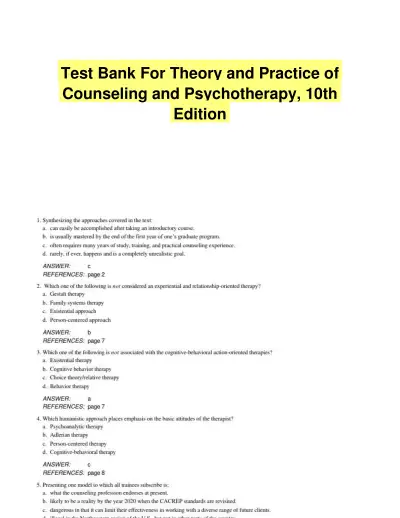 Exam Guides
Test Bank For Theory and Practice of Counseling and Psychotherapy, 10th Edition
Psychology
174 pagesMay 2025 Exam Guides
Test Bank For Theory And Practice Of Counseling And Psychotherapy, 9th Edition
Psychology
399 pagesMay 2025 Exam Guides
Test Bank for Fundamentals of Corporate Finance, 4th Edition
Psychology
917 pages173downloadsFeb 2025 Textbook Guides
Solution Manual for International Economics, 13th Edition
Psychology
242 pages156downloadsFeb 2025 Exam Guides
Test Bank For Fundamentals of Abnormal Psychology, 7th Edition
Psychology
665 pages149downloadsFeb 2025 Class Notes
Lecture Notes for Abnormal Child and Adolescent Psychology, 8th Edition
Psychology
124 pages146downloadsFeb 2025 Class Notes
Lecture Notes For Abnormal Psychology, 18th Edition
Psychology
413 pages146downloadsFeb 2025 Exam Guides
Test Bank For Understanding Dying, Death, and Bereavement, 7th Edition
Psychology
140 pages141downloadsFeb 2025
Study this document with CramX
Once it is in your library, every tool can work from it.