

French I - Reflexive Verbs
- World Languages
- Texas A&M University
- 14 pages
- Shared March 2026
Preview 5 of 14 pages
See the first 5 pages exactly as they appear in the document.
Page 1 Read page 1 as text
Study Guide French I – Reflexive Verbs 1. Idiomatic Reflexive Verbs in French 1. What Are Idiomatic Reflexive Verbs? Idiomatic reflexive verbs are reflexive verbs whose meanings cannot always be translated word - for - word into English . Instead, they have special meanings or expressions that must be learned as a whole. These verbs use a reflexive pronoun (me, te, se, nous, vous, se) along with the verb, but their meaning often goes beyond the literal translation . 2. Common Idiomatic Reflexive Verbs Here are some useful idiomatic reflexive verbs in French: French Expression Meaning in English se brosser les dents to brush one’s teeth se casser la jambe to break one’s leg s’en aller to go away se faire des amis to make friends se mettre en colère to get angry se rendre compte de to realize These expressions are commonly used in everyday conversation. 3. Example Sentences Here are examples showing how these verbs are used:
Page 2 Read page 2 as text
Study Guide • Elle s’en va. She’s going away. • Il se met en colère. He’s getting angry. These examples show how the reflexive pronoun changes according to the subject . 4. Important Tip When learning idiomatic reflexive verbs: • Memorize them as complete expressions . • Do not always translate them word by word . For example: • se rendre compte de literally means “to make oneself account of,” but the correct meaning is “to realize.” Key Takeaway • Idiomatic reflexive verbs are common French expressions that use reflexive pronouns but have special meanings. • Because their meanings are not always literal, it is best to learn them as whole phrases. 2. Reflexive Verbs and Commands in French 1. Reflexive Verbs in Commands When giving commands (imperatives) with reflexive verbs, the position of the reflexive pronoun changes depending on whether the command is negative or affirmative . 2. Negative Commands In a negative command , the reflexive pronoun is placed before the verb , just like in a regular sentence.
Page 3 Read page 3 as text
Study Guide Structure: Ne + reflexive pronoun + verb + pas Example: • Ne te lève pas ! Don’t get up! Here: • te (reflexive pronoun) comes before the verb . 3. Affirmative Commands In an affirmative command , the reflexive pronoun comes after the verb and is connected with a hyphen . Structure: Verb – reflexive pronoun Examples: • Lève - toi ! Get up! (informal) • Levez - vous ! Get up! (formal or plural) 4. Special Rule for te In familiar (tu) commands , the reflexive pronoun te changes to toi when it comes after the verb. Example: • Lève - toi ! (not Lève - te ) This change only happens in affirmative commands .
Page 4 Read page 4 as text
Study Guide 5. Quick Comparison Type of Command Structure Example Meaning Negative Ne + pronoun + verb + pas Ne te lève pas ! Don’t get up! Affirmative Verb – pronoun Lève - toi ! Get up! Formal affirmative Verb – vous Levez - vous ! Get up! Key Takeaway When using reflexive verbs in commands: • Negative commands: the reflexive pronoun comes before the verb . • Affirmative commands: the reflexive pronoun comes after the verb and is joined by a hyphen . • In familiar commands, te changes to toi after the verb. 3. Reflexive Verbs and Compound Tenses 1. Reflexive Verbs in Compound Tenses When reflexive verbs are used in compound tenses (such as the passé composé ), they use être as the auxiliary (helping) verb . The reflexive pronoun stays before the conjugated form of être . Structure: Subject + reflexive pronoun + être (conjugated) + past participle Examples: • Je me suis lavé(e). I washed myself.
Page 5 Read page 5 as text
Study Guide • Tu t'es préparé(e). You got ready. • Il s'est rasé. He shaved. • Elle s'est couchée. She went to bed. • Nous nous sommes peigné(e)s. We combed our hair. • Vous vous êtes coiffé(e)(s). You did your hair. • Ils se sont impatientés. They became impatient. • Elles se sont maquillées. They put on their makeup. 2. Agreement of the Past Participle The past participle with reflexive verbs may or may not agree with the subject depending on the function of the reflexive pronoun . Case 1: Reflexive Pronoun as a Direct Object If the reflexive pronoun acts as the direct object , the past participle agrees with the subject in gender and number . Example: Ils se sont lavés. They washed themselves. Question to ask:
9 more pages in the full document
Unlock it once and it stays in your library, ready to chat with or turn into flashcards.
Unlock the full documentMore World Languages study materials
See all Quick Guides
French I - Nouns
World Languages
16 pagesMar 2026 Quick Guides
French I - Possession
World Languages
8 pagesMar 2026 Quick Guides
French I - Interrogatives Exclamations
World Languages
12 pagesMar 2026 Quick Guides
French I - Prepositions
World Languages
24 pagesMar 2026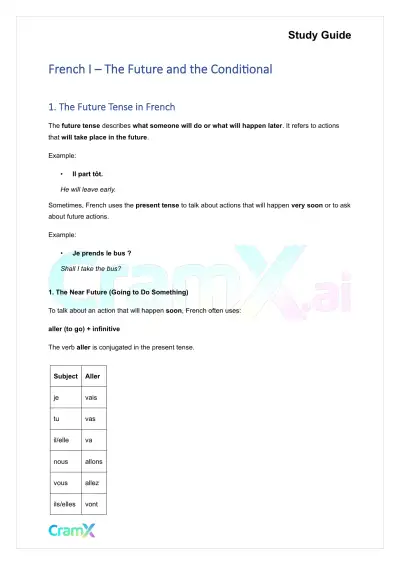 Quick Guides
French I - The Future and the Conditional
World Languages
13 pagesMar 2026 Quick Guides
French I - Present Tense of Verbs
World Languages
25 pagesMar 2026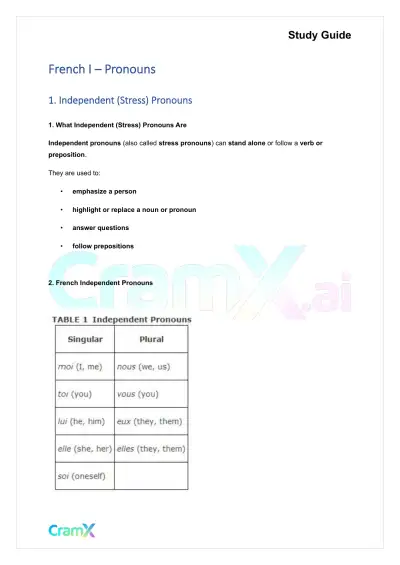 Quick Guides
French I - Pronouns
World Languages
22 pagesMar 2026 Quick Guides
French I - Verb Charts
World Languages
20 pagesMar 2026
Study this document with CramX
Once it is in your library, every tool can work from it.