

French I - The Imperfect
- World Languages
- Texas A&M University
- 19 pages
- Shared March 2026
Preview 6 of 19 pages
See the first 6 pages exactly as they appear in the document.
Page 1 Read page 1 as text
Study Guide French I – The Imperfect 1. Imperfect Tense and Regular Verbs 1. What the Imperfect Tense Is The imperfect tense (l’imparfait) is used to describe past actions that were ongoing, repeated, or habitual . It often corresponds to English expressions such as: • was doing • used to do • would do (in the past) Example: • Je jouais au tennis. I was playing tennis / I used to play tennis.
Page 2 Read page 2 as text
Study Guide 2. How to Form the Imperfect To form the imperfect tense for most verbs , follow these steps: Step 1: Use the nous form of the present tense Example verbs: • jouer → nous jouons • finir → nous finissons • rendre → nous rendons Step 2: Remove - ons This gives the imperfect stem : • jou - • finiss - • rend - Step 3: Add the imperfect endings Subject Ending je - ais tu - ais il / elle / on - ait nous - ions vous - iez ils / elles - aient
Page 3 Read page 3 as text
Study Guide 3. Examples with Regular Verbs jouer (to play) Subject Form je jouais tu jouais il/elle jouait nous jouions vous jouiez ils/elles jouaient finir (to finish) Subject Form je finissais tu finissais il/elle finissait nous finissions vous finissiez ils/elles finissaient
Page 4 Read page 4 as text
Study Guide rendre (to return) Subject Form je rendais tu rendais il/elle rendait nous rendions vous rendiez ils/elles rendaient 4. Important Note About Irregular Verbs Almost all verbs follow the same rule for forming the imperfect. The only completely irregular verb is: être (to be) Imperfect forms: • j’étais • tu étais • il était • nous étions • vous étiez • ils étaient The stem ét - is used instead of the normal rule.
Page 5 Read page 5 as text
Study Guide Key Takeaway To form the imperfect tense : 1. Take the nous form of the present tense . 2. Remove - ons . 3. Add the imperfect endings: • - ais • - ais • - ait • - ions • - iez • - aient The imperfect is commonly used to describe ongoing actions, repeated habits, and background descriptions in the past . 2. Imperfect Verbs with Spelling Changes 1. Why Spelling Changes Occur Some French verbs slightly change their spelling in the imperfect tense to keep the correct pronunciation . These changes happen mainly with verbs ending in: • - cer • - ger The spelling change ensures that the soft sound of the consonant is preserved . 2. Verbs Ending in - cer For verbs ending in - cer , the c becomes ç before the letter a . This keeps the soft “s” sound of the letter c .
Page 6 Read page 6 as text
Study Guide This change occurs only in the “shoe” forms of the verb (je, tu, il/elle/on, ils/elles). Example: avancer (to advance) Subject Imperfect Form je avançais tu avançais il/elle avançait nous avancions vous avanciez ils/elles avançaient Notice: • nous avancions and vous avanciez do not need ç because the i already keeps the soft sound. 3. Verbs Ending in - ger For verbs ending in - ger , add a silent e between g and a . This keeps the soft “zh” sound of g . Again, the change occurs mainly in the “shoe” forms . Example: nager (to swim) Subject Imperfect Form je nageais tu nageais
13 more pages in the full document
Unlock it once and it stays in your library, ready to chat with or turn into flashcards.
Unlock the full documentMore World Languages study materials
See all Quick Guides
French I - Nouns
World Languages
16 pagesMar 2026 Quick Guides
French I - Possession
World Languages
8 pagesMar 2026 Quick Guides
French I - Interrogatives Exclamations
World Languages
12 pagesMar 2026 Quick Guides
French I - Prepositions
World Languages
24 pagesMar 2026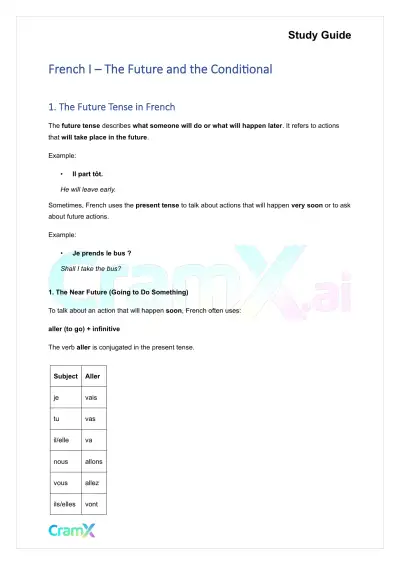 Quick Guides
French I - The Future and the Conditional
World Languages
13 pagesMar 2026 Quick Guides
French I - Present Tense of Verbs
World Languages
25 pagesMar 2026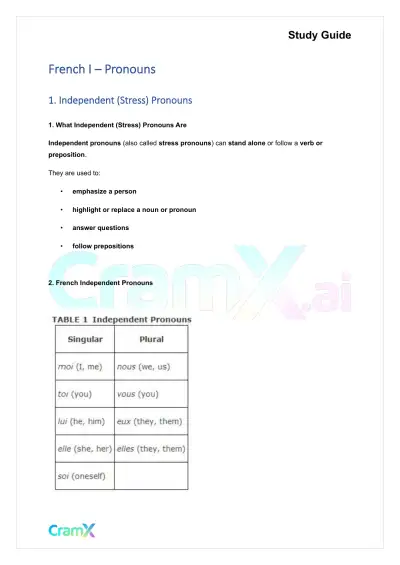 Quick Guides
French I - Pronouns
World Languages
22 pagesMar 2026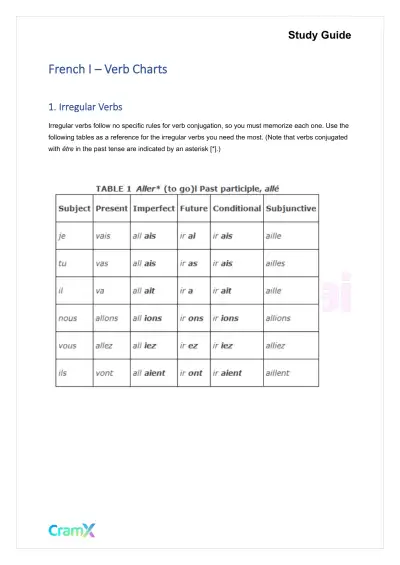 Quick Guides
French I - Verb Charts
World Languages
20 pagesMar 2026
Study this document with CramX
Once it is in your library, every tool can work from it.