

French I - The Passe Compose
- World Languages
- Texas A&M University
- 25 pages
- Shared March 2026
Preview 8 of 25 pages
See the first 8 pages exactly as they appear in the document.
Page 1 Read page 1 as text
Study Guide French I – The Passe Compose 1. Past Participles of Regular Verbs In French, the past participle is an important verb form used in tenses such as the passé composé (a common past tense). For regular verbs , the past participle is formed by removing the infinitive ending and replacing it with a specific ending depending on the verb group. French verbs are usually grouped into three main categories: • – er verbs • – ir verbs • – re verbs Each group follows a simple pattern. 1. Past Participles of – er Verbs For – er verbs , drop – er and add – é . Infinitive Past Participle Meaning parler parlé spoken aimer aimé loved travailler travaillé worked Example • J’ai parlé à Anne. I spoke to Anne.
Page 2 Read page 2 as text
Study Guide 2. Past Participles of – ir Verbs For – ir verbs , drop – ir and add – i . Infinitive Past Participle Meaning finir fini finished choisir choisi chosen réussir réussi succeeded Example • Nous avons fini. We have finished. 3. Past Participles of – re Verbs For – re verbs , drop – re and add – u . Infinitive Past Participle Meaning répondre répondu answered vendre vendu sold attendre attendu waited Example • Ils ont répondu. They answered.
Page 3 Read page 3 as text
Study Guide 4. Past Participles of “Shoe Verbs” Some verbs are called “shoe verbs.” Their present tense forms change spelling inside the “shoe - shaped” part of the conjugation chart. However, their past participles do not change spelling in the stem . They follow the normal pattern. Examples • voyager (to travel) Vous avez voyagé. You traveled. • avancer (to advance) L’auto a avancé. The car advanced. • payer (to pay) Ils ont payé. They paid. • acheter (to buy) J’ai acheté un pantalon. I bought pants. • appeler (to call) A - t - elle appelé ? Did she call? • célébrer (to celebrate) Il a célébré son anniversaire. He celebrated his birthday.
Page 4 Read page 4 as text
Study Guide Key Takeaway To form the past participle of regular French verbs , follow these simple rules: Verb Type Ending Example – er verbs – é parlé – ir verbs – i fini – re verbs – u répondu Important points to remember: • Past participles are used in compound tenses like the passé composé . • Shoe verbs keep their normal stem in the past participle. • The formation rules are simple and consistent for regular verbs. 2. Past Participles of Irregular Verbs Unlike regular verbs, irregular verbs do not follow a single rule when forming their past participles. Because of this, they usually need to be memorized . However, many irregular past participles can be grouped by their common endings , which makes them easier to learn. 1. Past Participles Ending in – u Many irregular verbs form their past participle with – u .
Page 5 Read page 5 as text
Study Guide Example • J’ai vu ce film. I saw this movie.
Page 6 Read page 6 as text
Study Guide 2. Past Participles Ending in – is Some irregular verbs end in – is . Example • Elle a pris le train. She took the train. 3. Past Participles Ending in – it Other irregular verbs form their past participle with – it .
Page 7 Read page 7 as text
Study Guide Example • Il a écrit une lettre. He wrote a letter. 4. Other Irregular Past Participles Some verbs have unique past participles that do not fit into a simple pattern. Example • Nous avons fait nos devoirs. We did our homework. 5. Related Verbs Share the Same Pattern Many French verbs contain another verb inside them , and they usually follow the same past participle pattern. Examples
Page 8 Read page 8 as text
Study Guide Base Verb Past Participle Related Verb Past Participle mettre mis permettre permis ouvrir ouvert couvrir couvert Example sentences: • Il a permis l’entrée. He allowed the entry. • Elle a couvert la table. She covered the table. Key Takeaway Irregular past participles in French often fall into several groups: Ending Example – u vu, su, pu – is mis, pris – it dit, écrit other forms fait, été, ouvert Important points to remember: • Irregular past participles must usually be memorized . • Many verbs follow similar patterns . • Related verbs often share the same past participle structure .
17 more pages in the full document
Unlock it once and it stays in your library, ready to chat with or turn into flashcards.
Unlock the full documentMore World Languages study materials
See all Quick Guides
French I - Nouns
World Languages
16 pagesMar 2026 Quick Guides
French I - Possession
World Languages
8 pagesMar 2026 Quick Guides
French I - Interrogatives Exclamations
World Languages
12 pagesMar 2026 Quick Guides
French I - Prepositions
World Languages
24 pagesMar 2026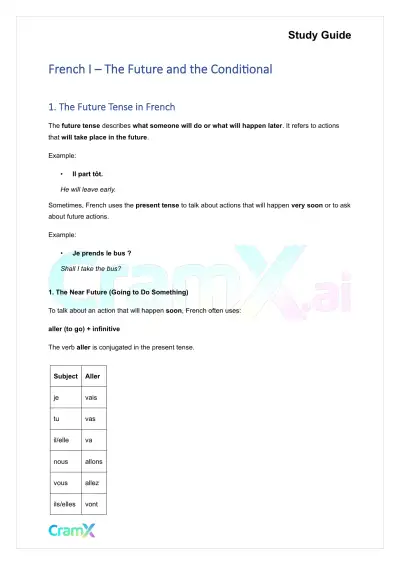 Quick Guides
French I - The Future and the Conditional
World Languages
13 pagesMar 2026 Quick Guides
French I - Present Tense of Verbs
World Languages
25 pagesMar 2026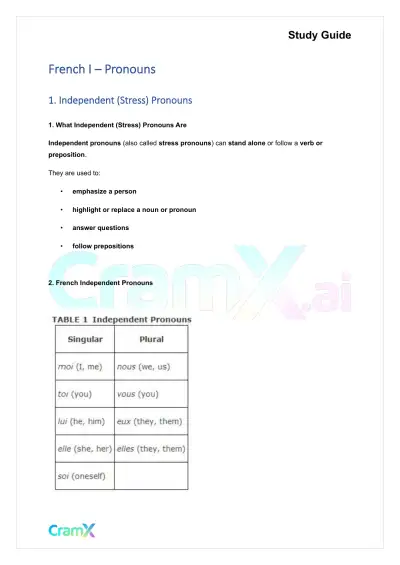 Quick Guides
French I - Pronouns
World Languages
22 pagesMar 2026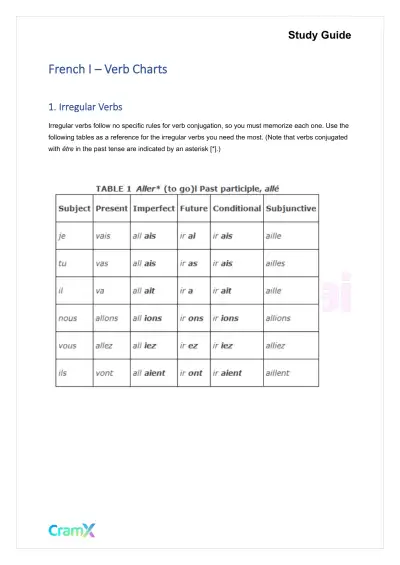 Quick Guides
French I - Verb Charts
World Languages
20 pagesMar 2026
Study this document with CramX
Once it is in your library, every tool can work from it.