

Accounting Principles II – Budgets
- Accounting
- Texas A&M University
- 36 pages
- Shared March 2026
Preview 10 of 36 pages
See the first 10 pages exactly as they appear in the document.
Page 1 Read page 1 as text
Study Guide Accounting Principles II – Budgets 1. Introduction to Budgets What Is a Budget? A budget is an important part of a company’s planning process. It helps management decide how resources will be used in the near future. While companies also make long - range plans that look five to ten years ahead, budgets focus on the short term . Most budgets are prepared for a 12 - month period . This allows businesses to plan their income, expenses, and cash needs for the coming year in a structured way. 1. Rolling Budgets: Planning That Keeps Moving Some companies use a special type of budget called a rolling budget . Instead of staying fixed for the entire year, a rolling budget is updated regularly , usually every quarter. Here’s how it works: • At the end of each quarter, the three months that just ended are removed . • A new three - month period is added to the end of the budget. • This keeps the budget looking 12 months into the future at all times . Because of this system, managers must constantly look ahead and anticipate changes , such as shifts in sales, costs, or economic conditions.
Page 2 Read page 2 as text
Study Guide Purpose of the image: • The image visually shows how a rolling budget works over three different 12 - month budget periods . • Each column represents a full 12 - month budget (Budget 1, Budget 2, Budget 3). • The quarters (Q1, Q2, Q3, Q4) shift forward over time. • This helps students clearly see how old quarters are dropped and new ones are added. This visual support makes the rolling budget concept easier to understand. What Is a Master Budget? The master budget is the complete set of budgets used by a company. It brings together all individual budgets to prepare the company’s budgeted financial statements . Think of the master budget as a big picture plan that combines many smaller plans. 2. Main Components of the Master Budget Different textbooks may organize budgets in slightly different ways, but the key components are generally the same:
Page 3 Read page 3 as text
Study Guide 1. Operating Budgets ○ Focus on revenues and expenses ○ Include budgets such as sales, production, and operating costs 2. Capital Expenditures Budget ○ Plans for long - term investments ○ Includes purchases of equipment, buildings, or other major assets 3. Cash Budget ○ Tracks cash inflows and outflows ○ Helps ensure the company has enough cash to operate smoothly 4. Budgeted Financial Statements ○ Budgeted Income Statement ○ Budgeted Balance Sheet ○ Budgeted Cash Flow Statement These statements show what the company expects its financial position to be if the budget plans are followed. 2. Operating Budgets Operating budgets show how a business plans its day - to - day operations for a future period. These budgets help managers plan sales, production, costs, and expenses in an organized way. The main operating budgets include: • Sales budget • Production budget • Manufacturing cost budgets (materials, labor, and overhead)
Page 4 Read page 4 as text
Study Guide • Selling expenses budget • General and administrative expenses budget Each budget builds on the one before it, so they must be prepared in the correct order. 1. Sales Budget The sales budget is the starting point of the entire budgeting process. Every other budget depends on it. It shows: • How many units the company expects to sell • The selling price per unit Because so many other budgets rely on sales estimates, managers must agree on these numbers first. This can take time because sales forecasts affect production, staffing, and costs. Pickup Trucks Company Example The Pickup Trucks Company makes toy pickup trucks. For the year 20X1, it expects to: • Sell 100,000 units • Charge $15 per unit Sales are planned on a quarterly basis so the company can track performance throughout the year instead of waiting until year - end.
Page 5 Read page 5 as text
Study Guide Note: Many companies also prepare monthly sales budgets to monitor performance more frequently. 2. Manufacturing Costs Before calculating manufacturing costs, the company must first know how many units it needs to produce . This information comes from the production budget . 3. Production Budget The production budget shows the number of units that must be produced to meet sales needs and inventory requirements. To prepare a production budget, the company must know: 1. Expected sales 2. Required ending inventory 3. Beginning inventory For quarterly budgets, this information is needed for each quarter .
Page 6 Read page 6 as text
Study Guide Inventory Policy Used The Pickup Trucks Company requires: • 15% of next quarter’s sales to be available as ending inventory • 2,250 units in beginning inventory at the start of the year • A 10% increase in Quarter 1 sales compared to last year Using these assumptions, the company calculates how many units must be produced each quarter. 4. Direct Materials Budget The direct materials budget shows how much raw material the company must purchase to support production. This budget uses: • Units to be produced (from the production budget) • Required ending raw materials inventory
Page 7 Read page 7 as text
Study Guide • Beginning raw materials inventory • Cost per unit of material Pickup Trucks Company Example Each toy pickup truck requires: • 5 tires (4 wheels + 1 spare) • Cost per tire: $0.50 The company requires 10% of next quarter’s production needs to be kept as ending raw materials inventory. After adjusting for beginning and ending inventory, the company determines: • 501,890 tires must be purchased • Total cost: $250,945
Page 8 Read page 8 as text
Study Guide This same process is repeated for any other raw materials used in production. 5. Direct Labor Budget The direct labor budget shows: • Total labor hours needed • Cost of labor Assumptions • Each pickup truck requires 0.5 labor hours • Labor cost is $14 per hour Using the production total of 100,225 units : • Total labor hours needed = 50,113 hours • Total direct labor cost = $701,575 The labor budget is also broken down by quarter.
Page 9 Read page 9 as text
Study Guide 6. Manufacturing Overhead Budget The manufacturing overhead budget includes all production costs that are not direct materials or direct labor . Costs are separated into: • Variable overhead costs (change with production) • Fixed overhead costs (remain constant) This separation is important because the company uses a predetermined overhead rate . Overhead Cost Assumptions Variable costs per unit: • Indirect materials: $0.50
Page 10 Read page 10 as text
Study Guide • Indirect labor: $1.00 • Maintenance: $0.75 Fixed costs per year: • Depreciation: $12,000 • Supervisory salaries: $24,000 • Property taxes and insurance: $21,000
26 more pages in the full document
Unlock it once and it stays in your library, ready to chat with or turn into flashcards.
Unlock the full documentMore Accounting study materials
See all Quick Guides
Accounting Principles II – Current Liabilities
Accounting
15 pagesMar 2026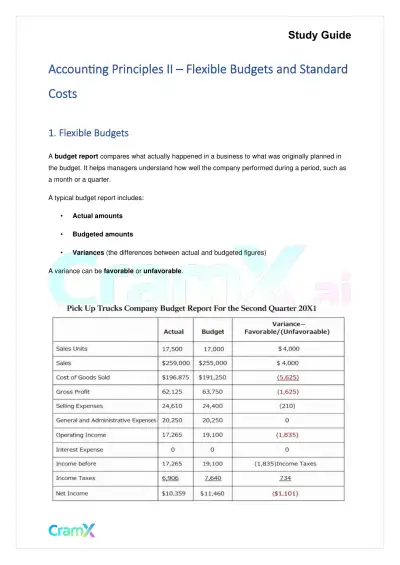 Quick Guides
Accounting Principles II – Flexible Budgets and Standard Costs
Accounting
23 pagesMar 2026 Quick Guides
Accounting Principles II – Activity-Based Costing
Accounting
13 pagesMar 2026 Quick Guides
Accounting Principles II – Cost-Volume-Profit Relationships
Accounting
20 pagesMar 2026 Quick Guides
Accounting Principles II – Traditional Cost Systems
Accounting
31 pagesMar 2026 Quick Guides
Accounting Principles II – Capital Budgeting
Accounting
13 pagesMar 2026 Quick Guides
Accounting Principles II – Managerial and Cost Accounting Concepts
Accounting
20 pagesMar 2026 Quick Guides
Accounting Principles II – Partnerships
Accounting
23 pagesMar 2026
Study this document with CramX
Once it is in your library, every tool can work from it.