

Accounting Principles II – Corporations
- Accounting
- Texas A&M University
- 36 pages
- Shared March 2026
Preview 10 of 36 pages
See the first 10 pages exactly as they appear in the document.
Page 1 Read page 1 as text
Study Guide Accounting Principles II – Corporations 1. Characteristics of a Corporation What Is a Corporation? A corporation is a legal entity , which means it exists separately from its owners. The owners of a corporation are called stockholders (or shareholders in some states). Because a corporation is considered a separate “person” under the law, it: • Has many of the rights and responsibilities of a real person • Can own property, enter contracts, borrow money, and pay taxes • Cannot vote in public elections or hold public office Corporations can be: • For - profit or nonprofit • Publicly held or privately held 1. Public vs. Private Corporations • Public corporations sell stock on a stock exchange. They may have thousands or even millions of stockholders . • Privately held corporations do not trade stock on an exchange and usually have a small number of stockholders . 2. Forming a Corporation To legally become a corporation, a business must: 1. File an application with the state 2. Submit articles of incorporation (also called a charter)
Page 2 Read page 2 as text
Study Guide 3. Pay an incorporation fee 4. Receive approval from the state After approval, the corporation must create its bylaws , which describe how the company will be governed. 3. Organization Costs Costs related to forming a corporation — such as: • Legal fees • Incorporation fees • Underwriters’ fees for issuing stock or bonds are recorded as an intangible asset and amortized over time , for a period not exceeding 40 years . 4. Ownership and Stockholders’ Rights Ownership in a corporation is represented by stock certificates . These certificates show how many shares a stockholder owns. Stockholders have the right to: • Vote for the Board of Directors and other major issues • Receive dividends , if approved by the Board • Exercise pre - emptive rights , allowing them to buy additional shares to maintain their ownership percentage • Share in the corporation’s assets (up to their investment) if the company is liquidated 5. Key Characteristics of a Corporation 1. Unlimited Life A corporation has continuous existence .
Page 3 Read page 3 as text
Study Guide The death of a stockholder, sale of stock, or loss of an employee does not affect the corporation’s ability to continue operating. The corporation’s life may be limited by its charter, but it can continue if the charter is extended. 2. Limited Liability One of the biggest advantages of a corporation is limited liability . • Stockholders are only responsible for debts up to the amount they invested • Their personal assets are protected • Creditors can only claim corporate assets , not stockholders’ personal property 3. Separate Legal Entity Because a corporation is legally separate from its owners, it: • Conducts business in its own name • Can sue or be sued • Pays its own income taxes Stockholders are not agents of the corporation unless they are also employees or officially designated as agents. 4. Ease of Transferring Ownership Ownership in a corporation is easy to transfer, especially for public companies. • Stockholders can sell all or part of their shares at any time • No approval from other stockholders is required • Buyers do not need approval from the corporation After the initial stock sale, the corporation is involved only as a record keeper of share ownership. Privately held corporations may place some restrictions on stock transfers.
Page 4 Read page 4 as text
Study Guide 5. Professional Management Stockholders do not need to manage the business themselves. • Stockholders elect the Board of Directors • The Board hires professional managers • Managers handle daily operations This allows investors to earn returns without being involved in day - to - day decision - making. 6. Ease of Capital Acquisition Corporations can raise large amounts of money by: • Issuing stock • Issuing bonds Limited liability and easy ownership transfer make investing attractive, while the size and reputation of a corporation make borrowing easier. 7. Government Regulations Corporations are subject to more regulation than sole proprietorships and partnerships. • State laws regulate stock issuance and dividend payments • Federal securities laws govern the sale of stock • Public companies must file financial statements and disclosures with the Securities and Exchange Commission (SEC) Some industries — such as banking, financial services, and gaming — are subject to additional regulation from other government agencies. 2. Stock Terminology Before learning how to account for stock, it’s important to understand some basic stock terms. These ideas come up often in accounting, so let’s break them down in a clear and easy way.
Page 5 Read page 5 as text
Study Guide 1. Authorized Stock Authorized stock is the maximum number of shares a corporation is allowed to sell. This number is listed in the company’s articles of incorporation . If the company wants to issue more shares than this amount, it must first get approval from its stockholders. 2. Issued Stock Issued stock refers to the shares that the corporation has already given to stockholders . These shares are exchanged for things like cash, property, or services . 3. Outstanding Stock Outstanding stock is issued stock that is still owned by stockholders . These shares have not been bought back by the corporation. 4. Treasury Stock Treasury stock is stock that was issued before but later repurchased by the corporation. These shares are no longer held by investors. 1. Market Value Market value is the current price of a stock in the marketplace. It is determined by buyers and sellers and applies only to publicly traded companies . 2. Par Value Par value is a small value assigned to each share of stock in the articles of incorporation . This amount appears on the stock certificate .
Page 6 Read page 6 as text
Study Guide In some states, the total par value of all outstanding shares is called legal capital . Legal capital must stay in the business and cannot be paid out as dividends . 3. Contributed Capital (Paid - In Capital) Contributed capital is the value a corporation receives when it issues stock . It includes: • The par value , and • Any amount received above par value This is also known as paid - in capital . 5. No - Par Value Stock No - par value stock does not have a par value listed on it. Instead, the Board of Directors may assign a value to the stock. 6. Stated Value Stated value is the value assigned by the Board of Directors to no - par value stock . It serves a similar purpose to par value. 5. Common Stock Common stock is the most common type of stock issued by corporations. Common stockholders usually have the right to: • Vote on company matters • Receive dividends after preferred stockholders • Receive any remaining investment after creditors and preferred stockholders are paid if the company is liquidated Common stock may have:
Page 7 Read page 7 as text
Study Guide • A par value , or • No par value , with or without a stated value 6. Preferred Stock Preferred stock gives stockholders certain preferences over common stockholders . Preferred stockholders usually: • Receive dividends first • Get their investment back before common stockholders if the company is liquidated Preferred stock typically does not include voting rights . 1. Dividends Dividends are payments made by a corporation to its stockholders . They can be paid in: • Cash • Other assets • Additional shares of stock Stockholders cannot withdraw money whenever they want. Dividends are paid only if the Board of Directors approves them . 2. Stockholders’ Equity On a corporation’s balance sheet, the owners’ equity section is called stockholders’ equity . It includes: • Contributed capital , and • Retained earnings
Page 8 Read page 8 as text
Study Guide 3. Retained Earnings Retained earnings show the total net income earned by a corporation since it began operations, minus dividends paid. Retained earnings: • Increase with net income • Decrease with dividends, net losses, and some treasury stock transactions During the closing process , net income and dividends (if recorded separately) are transferred into retained earnings. 3. Accounting for Stock Transactions This section explains how corporations record stock transactions in their accounting records. We’ll walk through each situation step by step and connect the journal entries to what is happening in real life. 1. Issuing Stock for Cash Corporations often raise money by selling stock for cash. How the transaction is recorded depends on whether the stock has a par value , no par value , or is preferred stock . Issuing Common Stock at Par Value When a company issues common stock at par value , the cash received equals the par value of the shares issued. Example: Big City Dwellers issues 5,000 shares of $1 par value common stock at par. • Cash received = 5,000 × $1 = $5,000 • Cash increases (debit) • Common Stock increases (credit) This entry records exactly what happened: the company received cash and issued ownership shares.
Page 9 Read page 9 as text
Study Guide Issuing Common Stock Above Par Value Sometimes stock sells for more than its par value . When this happens, the extra amount is recorded in Additional Paid - in Capital . Example: Big City Dwellers sells 5,000 shares of $1 par value stock for $5 per share . • Cash received = 5,000 × $5 = $25,000 • Par value portion = 5,000 × $1 = $5,000 • Extra amount = $20,000 How it’s recorded: • Debit Cash for $25,000 • Credit Common Stock for $5,000 • Credit Additional Paid - in Capital for $20,000
Page 10 Read page 10 as text
Study Guide The company separates the legal par value from the extra amount investors were willing to pay. Issuing No - Par Value Stock Some stock does not have a par value. • If the Board of Directors assigns a stated value , that value is treated like par value. • If no stated value is assigned , the entire amount received is credited to the Common Stock account. If a company issues both par value and no - par value stock, it must keep separate Common Stock accounts . Issuing Preferred Stock Preferred stock follows the same accounting rules as common stock, but it uses separate accounts . Preferred stockholders usually: • Receive dividends first • Get paid before common stockholders if the company liquidates
26 more pages in the full document
Unlock it once and it stays in your library, ready to chat with or turn into flashcards.
Unlock the full documentMore Accounting study materials
See all Quick Guides
Accounting Principles II – Current Liabilities
Accounting
15 pagesMar 2026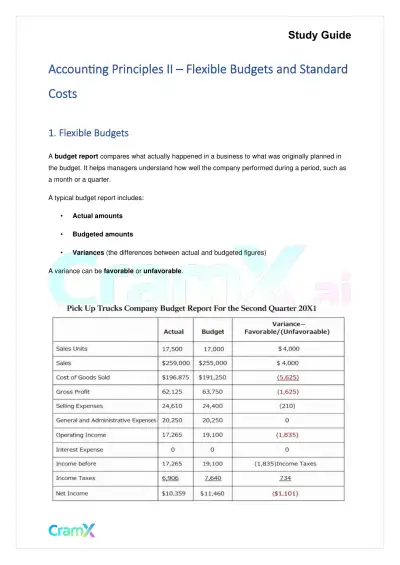 Quick Guides
Accounting Principles II – Flexible Budgets and Standard Costs
Accounting
23 pagesMar 2026 Quick Guides
Accounting Principles II – Activity-Based Costing
Accounting
13 pagesMar 2026 Quick Guides
Accounting Principles II – Cost-Volume-Profit Relationships
Accounting
20 pagesMar 2026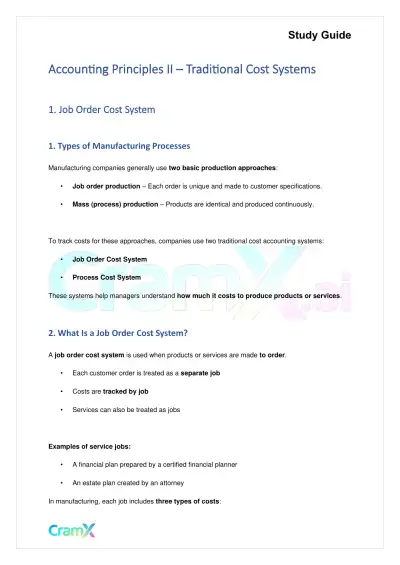 Quick Guides
Accounting Principles II – Traditional Cost Systems
Accounting
31 pagesMar 2026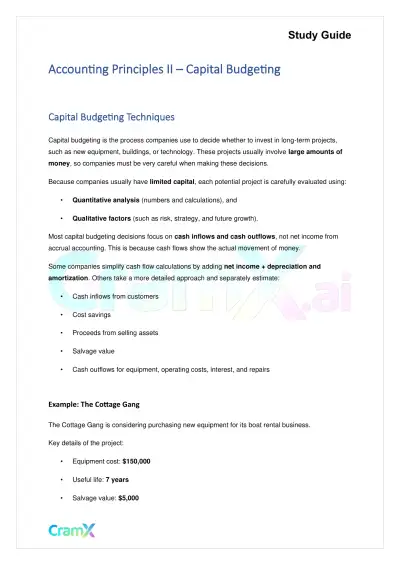 Quick Guides
Accounting Principles II – Capital Budgeting
Accounting
13 pagesMar 2026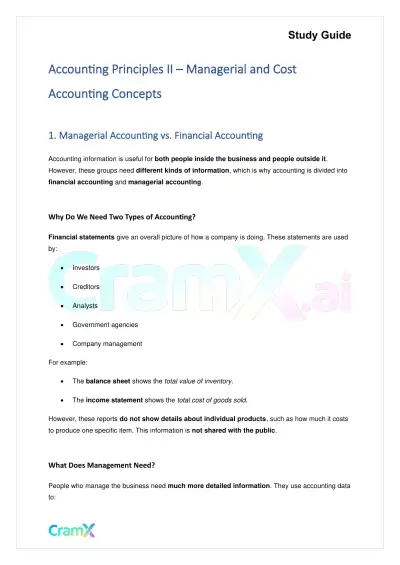 Quick Guides
Accounting Principles II – Managerial and Cost Accounting Concepts
Accounting
20 pagesMar 2026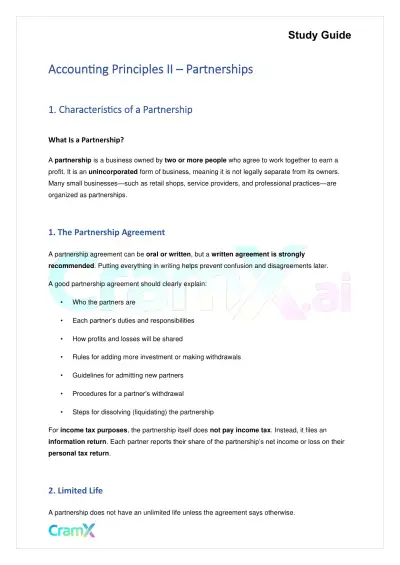 Quick Guides
Accounting Principles II – Partnerships
Accounting
23 pagesMar 2026
Study this document with CramX
Once it is in your library, every tool can work from it.