

Introduction to Financial Accounting, 11th Edition Class Notes
- Accounting
- 162 pages
- Shared February 2025
- 42 downloads
Master key topics with Introduction to Financial Accounting, 11th Edition Class Notes, your perfect class companion.
Preview 31 of 162 pages
See the first 31 pages exactly as they appear in the document.
Page 1 Read page 1 as text
1 - 1 CHAPTER 1 Accounting : The Language of Business LEARNING OBJECTIVES After studying this chapter you should be able to: 1. Explain how accounting information assists in making decisions. 2. Describe the components of the balance sheet. 3. Analyze business transactions and relate them to changes in the balance sheet . 4. Prepare a balance sheet from transactions data. 5 . Compare the features of sole proprietorships, partnerships, and corporations. 6 . Identify how the owners’ equity section in a corporate balance sheet differs from that in a sole proprietorship or a partnership. 7 . Explain the regulation of financial reporting, including differences between U.S. GAAP and IFRS. 8 . Describe auditing and how it enhances the value of financial information. 9 . Evaluate the role of ethics in the accounting process. 10. Recognize career opportunities in accounting, and understand that accounting is important to both for - profit and nonprofit organizations. Chapter 1 provides a glimpse of the entire field of accounting. It describes the nature of accounting and its role in providing useful information for a wide variety of decisions. In addition, the balance sheet equation is introduced: Assets = Liabilities + Owners’ e quity. An introduction to the basic terms accountants use — the accounting vocabulary — is an overall theme of the chapter. Transaction analysis is introduced as well as the effect of a transaction on the balance sheet equation. The chapter also looks at types of business organizations. The chapter concludes with a discussion of the accounting profession , regulation, the auditing function , and professional ethics.
Page 2 Page 3 Read page 3 as text
1 - 2 Accounting is the language of business and is the process of identifying, recording , and summarizing e conomic information to decision makers. An organization’s accounting system is the series of steps it uses to record financial data and convert them into informative financial statements. L earning Objective 1. Explain how accounting information assists in making decisions. Accounting information is useful to anyone making decisions that have economic consequences. Financial accounting serves external decision maker s (stockholders, suppliers, banks and government agencies)while management accounting serves internal decision makers (top executives, department heads, college deans , and hospital administrators) . A common source of financial information used by investors and others outside the company is t he annual report . It is prepared by management to inform current and potential investors about the company ’ s past performance and future prospects. It contains financial statements and other information about the corporation , such as a letter from corporate management, a discussion and analysis by management of recent economic events, footnotes to the financial statements, auditor’s report, and statements by management and the authors on the company’s internal controls . Financial statements also appear in Form 10 - K , filed annually with the Securities and Exchange Commission (SEC) , the government agency responsible for regulating capital markets in theUnited States. U.S. c ompanies with publicly traded stock ( companies that sell shares in their ownership to the public) must file Form 10 - K and other forms with the SEC. DO MULTIPLE CHOICE 1 , 2 and 3 . Learning Objective 2. Describe the components of the balance sheet. The balance sheet (also called the statement of financial position ) shows the financial status of a n organization at a particular instant in time. The balance sheet has two counterbalancing sections . One section lists the resources of the firm and the other the claims against the resources. The two sections form the balance sheet equation: Assets = Liabilities + Owners’ equity. A ssets are economic resources that the company expects to generate future cash inflows or reduce or prevent future cash outflows . Examples are cash, inventory, and equipment. Liabilities are economic obligations of the organization to o utsiders, or claims against its assets by outsiders such as a debt to the bank . Notes payable describe the existence of promissory notes that are signed when a company takes out a bank loan. Owners ’ equity is the owners’ claims on the organization’s assets and is equal to total assets less total liabilities. The term net assets also refers to assets less liabilities. DO MULTIPLE CHOICE 4 and 5 . DO EXERCISES 1 and 2.
Page 4 Read page 4 as text
1 - 3 Learning Objective 3. Analyze business transactions and relate them to changes in the balance sheet (S ee EXHIBIT 1 - 2 ) . An entity is an organization or a section of an organization that stand s apart from other organizations and individuals as a separate economic unit. A transaction is any event that affects the financial position of an entity and can be reliably recorded in monetary terms. Every transaction affects the balance sheet . When accountants record transactions they always make at least two entries (i.e., double - entry accounting system) so that the total assets always equal the total liabilities and owners ’ equity. The balance sheet equation always must remain in balance. Accountants record transactions in an organization ’ s accounts . An account is a summary record of the changes in a particular asset, liability , or owners ’ equity category, and the account balance is the total of all entries to the account up to a particular date. Transaction analysis determines which spe cific accounts are affected, whether the account balances are increased or decreased, andthe amount of the change in each account balance. For example, if the company borrows money from the bank, an asset (cash) increases, and a liability (notes payable) increases. Inventory refers to goods held by the company for the purpose of sale to customers. An account payable is a liability that results from a purchase of goods or services on open account (i.e., on credit). When inventory is purchased on account, both assets and liabilities are increased (if purchased for cash , one asset will increase and another asset will decrease) . A compound entry affects more than two balance sheet accounts. A creditor is one to whom the company owes money. DO MULTIPLE CHOICE 6 and 7. L earning Objective 4. Prepare a balance sheet from transactions data (See EXHIBIT 1 - 3 ) Transactions data can be used to compute a cumulative total for each account at any date. Note that a balance sheet represents the financial impact of all transactions up to a specific point in time. The account titles are listed with their respective balances on the specific date noted in the header of the balance sheet. Each account is listed under the category that it belongs to — assets, liabilities, or owner’s equity. Examples of actual corporate balance sheets can be found in EXHIBIT 1 - 5 . Although a new balance sheet could be prepared after each transaction, companies usually produce balance sheets only when needed by managers and at the end of each quarter for reporting to the public. L earning Objective 5 . Compare the features of sole proprietorships, partnerships, and corporations. A sole proprietorship is a business with a single owner. Sole proprietorships tend to be small businesses such as local stores or restaurants.
Page 5 Read page 5 as text
1 - 4 A partnership is aform of organization that joins two or more individuals together as co - owners. Each partnership is an individual entity that is separate from the personal activities of each partner. Corporations are organizations created under state law in the United States with a n unlimited number of owners. Owners of a corporation have limited liability (i.e., corporation creditors ordinarily have claims against the corporate assets only, not against the personal assets of the owners) . A publicly owned corporation is one in which shares of ownershipare sold to the public. Purchasers or shares are identified as shareholders or stockholders. A privately owned (closely held, unlisted) corporation is owned by a family , a small group of shareholders, or a single individual . Advantages of the corporate form of ownership include e ase of transfer of ownership (the corporation issues stock certificates as formal evidence of ownership), e ase of raising ownership capital , and c ontinuity of existence . Tax laws may favor a sole proprietorship, a partnership, or a corporation, depending on the personal tax situations of the owners. L earning Objective 6 . Identify how the owners’ equity section in a corporate balance sheet differs from that in a sole proprietorship or a partnership . All business entities account for assets and liabilities similarly ( See E XHIBIT 1 - 8 ) . a. Owners ’ equities for proprietorship s and partnership s are identified as capital. b. Owners ’ equities for the corporation are called stockholders ’ equity or shareholders ’ equity. In a corporation, capital investment by the owners , known as paid - in capital , is recorded in two parts : common stock at par value and paid - in capital in excess of par value. Par value or stated value is the dollar amount printed on the stock certificates, and p aid - in capital in excess of par value or additional paid - in capital is the difference between the total amount received for the stock and the par value. Common stock represents the par value purchased by the common stockholders of the corporation. ( See EXHIBIT 1 - 9 ) . Common stockholders have a “residual” ownership in the corporation. DO MULTIPLE CHOICE 8 and 9 . In corporations, the ultimate responsibility for management is deleg ated by the stockholders to the boardof directors . One of the duties of the board of directors is to appoint and monitor managers. The chief executive officer (CEO) is the top manager in an organization and sometimes serves as the chairman of the board.
Page 6 Read page 6 as text
1 - 5 L earning Objective 7. Explain the regulation of financial reporting, including differences between U.S. GAAP and IFRS. Generally accepted accounting principles (GAAP) consist of all the broad concepts and detailed practices to be followed in preparing and distributing financial statements. Companies reporting in more than 100 countries use International Financial Reporting Standards (IFRS) while U . S . companies use Financial Accounting Standards . The Financial Accounting Standards Board is responsible for establishing U.S. GAAP. In 2009 it compiled all standards and other elements of U.S. GAAP into the FASB Accounting Standards Codification. The U. S. Congress has charged the Securities and Exchange Commission (SEC) with the ultimate responsibility for authorizing GAAP for companies whose stock is held by the general investing public. However, the SEC has informally delegated much rule - making power to the FASB. Congress can, however, overrule both the SEC and the FASB. The International Accounting Standards Board(IASB) was established to “ develop, in the public interest, a single set of high quality, understandable , and enforceable global accounting standards. ” The IASB sets International Financial Reporting Standards (IFRS). The IASB has 16 members who represent a diversity of geographic and professional backgrounds. DO MULTIPLE CHOICE 10. L earning Objective 8 . Describe auditing and how it enhances the value of financial information. The credibility of financial statements is the ultimate responsibility of the managers who are entrusted with the resources of the entity under their command. Third - party assurance about the credibility of financial statements gave rise to the CPA profession. An auditor examines the information that managers use to prepare the financial statements and provides assurances about the credibility of those statements. The desire for third - party assurance about the credibility of financial statements created the profession of public accountants – accountants who offer services to the general public on a fee basis. A certified public accountant (CPA) in the U.S. earns this designation by meeting standards of knowledge and integrity set by a State Board of Accountancy. To assess management’s financial disclosures, CPAs conduct an audit , an examination of a company’s transactions and the resulting financial statements . The audit is conducted by an independent CPA to lend credibility to management ’ s financial statements and is described in the auditor ’ s opinion (see E XHIBIT 1 - 10 ). An auditor’s opinion (also called an independent opinion ) describes the scope and results of the audit, and companies include the opinion with the financial statements in their annual reports and 10K filings . DO MULTIPLE CHOICE 11. Accountants who do not offer services to the general public are known as private accountants . They work for businesses, governmental agencies, and other nonprofit organizations.
Page 7 Read page 7 as text
1 - 6 The American Institute of Certified Public Accountants (AICPA) is the princi pal professional association of CPAs. The International Auditing and Assurance Standards Board (IAASB) , established by the International Federation of Accountants, is working to standardize audit regulation around the globe, but regulation of auditing continues to differ significantly across countries. In 2002, the U.S. Congress passed the Sarbanes - Oxley Act , which gave the government a larger role in regulating the audit profession. Among its regulations were : a. the establishment of the Public Company Accounting Oversight Board (PCAOB) with powers to regulate many aspects of public accounting and to set standards for audit procedures, b. prohibit ing public accounting firms from providing to audit clients certain nonaudit services, and c. requir ing rotation every five years of the lead audit or coordinating partner and the reviewing partner on an audit . All accounting firms that audit companies with publicly traded stock in the U.S. must register with the PCAOB , and they are referred to as registered public accounting firm s . Additionally, the PCAOB issues Generally AcceptedAuditing Standards (GAAS) that prescribe the minimum steps that an auditor must take in examining the transactions and financial statements and issuing an auditor’s opinion.
Page 8 Read page 8 as text
1 - 7 L earning Objective 9 . Evaluate the role of ethics in the accounting process. Members of the AICPA, as well as members of the Institute of Manage ment Accountants and the Association of Government Accountants , must abide by code s of professional conduct, which are especially concerned with integrity and independence. Professional accounting organizations have procedures for reviewing behavior alleged as not being consistent with the codes of professional conduct (see E XHIBIT 1 - 1 1 ) . DO MULTIPLE CHOICE 1 2 and 13 . Learning Objective 10. Recognize career opportunities in accounting, and understand that accounting is important to both for - profit and nonprofit organizations. Accounting is provides an excellent background for almost any manager and is especially important for finance professionals. Additionally, anyone who wants to move up in the management structure of a company needs to know accounting. Companies often rely on accountants to safeguard the ethics of a company. Therefore, accountants have a special responsibility to ensure that managers act with integrity and that information provided by the company is accurate. Although this textbook focuses on profit - seeking organizations, accounting principles also apply to nonprofit organizations such as hospitals, universities, and government agencies. Chapter 1 Quiz Multiple C hoice 1. Financial accounting focuses on the specific needs of decision makers external to the organization. Which of the following would not be an external user? a. Stockholders b. Internal Revenue Service c. Vice President — Marketing d. Banks 2. The correct version of the accounting equation is
Page 9 Read page 9 as text
1 - 8 a. assets = liabilities – owners’ equity b. assets = liabilities + owners’ equity c. liabilities = assets + owners’ equity d. owners’ equity = assets + liabilities 3. The annual report does not include a. a report from the independent auditors. b. footnotes. c. statements on the company’s internal controls . d. a letter from the board of directors. 4 . Another term for owners’ equity is a. assets . b. liabilities . c. net assets . d. net liabilities . 5 . The balance sheet shows the financial status of a company a. at a particular point in time. b. for a period of a month, quarter, or year. c. from the beginning of a period to the end of the period. d. only at the end of the year. 6. A loan from the bank a. increases assets and owner ’ s equity. b. increases assets and liabilities. c. increases liabilities and owner ’ s equity. d. has no effect on total assets . 7. The purchase of inventory by paying cash causes a. an increase in one asset and a decrease in another. b. an increase in owner ’ s equity and a decrease in an asset. c. an increase in an asset and an increase in a liability. d. none of the above 8 . If the owners ’ (stockholders ’ ) equity section of the balance sheet includes “ Additional Paid - in - Capital, ” the type of organization is a a. nonprofit. b. partnership. c. corporation. d. governmental entity . 9 . Which of the following is a disadvantage of the corporate form of ownership?
Page 10 Read page 10 as text
1 - 9 a. Separation of ownership and management b. Continuity of existence c. Unlimited liability d. Ease of raising capital e. Both c and d f. None of the above 1 0 . Which organization has the responsibility to establish U.S. GAAP ? a. T he FASB b. T he IASB c. T he SEC d. M anagement 1 1 . An audit opinion a. is provided by the audited company ’ s president. b. is provided by private accountants . c. is provided by an independent CPA . d. a ll of the above 1 2 . A certified public accountant (CPA) in the U.S. earns certification through a. being an accounting major in college. b. having sufficient experience. c. meeting Board of Accountancy standards of knowledge and integrity . d. all of the above 1 3 . The overall concern of the AI CPA ’ s Code of Professional Conduct is which of the following? a. Whether the CPA is an officer in the corporation being audited b. Whether the CPA owns stock in the corporation being audited c. Whether the CPA is independent and acts with integrity and objectivity d. Whether the CPA ’ s father is the controller o f the corporation being audited Exercises 1. If total assets are $85,000 and total liabilities are $45,000, what is total owner ’ s equity? 2. If a company purchases $50,000 of equipment on credit, how much did total owners ’ equity increase?
Page 11 Read page 11 as text
1 - 10 Chapter 1 Quiz Solutions Multiple C hoice 1. c 6. b 11. c 2. b 7. a 12. f 3. d 8. c 13. c 4. c 9. f 5. a 10. a Exercises 1. The balance sheet equation holds that Total Assets equal Total Liabilities plus Total Owner ’ s Equity. This means that $85,000 = $45,000 + x and x = $40,000 , the Total Owner ’ s Equity balance. 2. “ 0 ” : Assets increase and liabilities increase.
Page 12 Read page 12 as text
2 - 1 CHAPTER 2 Measuring Income to Assess Performance LEARNING OBJECTIVES After studying this chapter you should be able to: 1. Explain how accountants measure income. 2. Determine when a company should record revenue from a sale. 3. Use the concept of matching to record the expenses for a period . 4 . Prepare an income statement and show how it is related to a balance sheet. 5. Account for cash dividends and prepare a statement of stockholders’ equity . 6. Compute and explain earnings per share, price - earnings ratio, dividend - yield ratio, and dividend - payout ratio. 7 . Explain how the conceptual framework guides the standard setting process and how accounting regulators trade off relevance and faithful representation in setting accounting standards. 8 . Explain how the following concepts affect financial statements: entity, going concern, materiality, stable monetary unit, periodicity, and reliability . Chapter 2 presents the rudiments of measuring income, including a discussion of revenues and expenses. It introduces accrual accounting and what it means to recognize revenues when they are earned and realized . The matching concept is then explained as to how expenses are assigned to a period in which the pertinent goods and services are either used or appear to have no future benefit. O ther basic financial sta tements — the income statement and the statement of stockholders’ equity — are introduced in more detail. The chapter discusses four financial ratios that decision makers use to analyze the performance and prospects of a business entity. The chapter concludes with discussion of important concepts and conventions and their effect on financial statements.
Page 13 Read page 13 as text
2 - 2 Learning Objective 1. Explain how accountants measure income . The accounting measurement of income is the major means for evaluating a business entity ’ s performance. Generally Accepted Accounting Principles (GAAP) specify rules that govern income measurement so that investors can compare one company to another. The operating cycle ( cash cycle ) is the time elapsing between the acquisition of goods and services, in exchange for cash, and the subsequent sale of products to customers who in turn pay for their purchases in cash. Accounting time periods are imposed on a business to enable periodic reports of performance. a. The calendar year is the most popular time period for measuring i ncome or profits, although a business may adopt a fiscal year that differs from the calendar year. b. Interim periods are the time spans established for accounting purposes that are less than a year. Revenues ( sales , sales revenue ) are increases in net assets resulting from selling products or services to customers. Expenses are decreases in net assets as a result of consuming or giving up resources in the process of providing products or services to a customer. Income ( profit s , earnings ) is the excess of revenues over expenses. DO MULTIPLE CHOICE 1 and 2 . Retained earnings ( retained income ) is total cumulative owners ’ equity that is generated by income or profits (see EXHIBIT 2 - 3 ). Accounts receivable ( trade receivables , receivables ) are amounts owed to a company by customers as a result of the company’s delivering goods or services and extending credit in the ordinary course of business. Cost of goods sold expense ( cost of sales , cost of revenue ) is the original acquisition cost of the inventory that a company sells to customers during the reporting period. The accrual basis records revenue when the company earns it and expenses when the company incurs them . U nder the cash basis , revenues and expenses are recorded only w hen cash is received or pai d.
Page 14 Read page 14 as text
2 - 3 Learning Objective 2. Determine when a company should record revenue from a sale. To measure income on an accrual basis, a ccountants use a set of revenue r ecognition criteria to determine whether revenues should be recorded in the financial statements of a given period. Both U.S. GAAP and IFRS use revenue recognition criteria, although the criteria differ slightly . To be recognized under U.S. GAAP , revenues must meet two criteria: a. They must be earned . Goods or services are fully rendered, usually delivered to the customer. b. They must be realized or realizable . Revenues are realized when c ash or claims to cash are received in the exchange of goods or services . Revenues are realizable when the company receives assets that are easily converted into cash or claims to cash. (If cash is not received directly, the eventual collectability of cash must be reasonably assured.) DO MULTIPLE CHOICE 3 . Learning Objective 3. Use the concept of matching to record the expenses for a period. There are two types of expenses in every accounting period : a. T hose directly linked to the generation of revenues earned that period — product costs ( costs that are linked with revenues and charged as expenses when the related revenue is recognized). b. T hose linked to the time period itself — period costs ( costs supporting a company’s operations for a given period that are charged to expense in the time period in which the costs are incurred ). Matching is the concept of recording expenses in the same time period as the related revenues are recognized. DO MULTIPLE CHOICE 4 . S ome purchases of goods or services are initially recorded as assets in order to match the costs with revenues of future periods. For example, a firm might pay rent in advance for the entire year and record the payment in the asset account P repaid R ent. Each month the firm reduces the prepaid rent account and increases rent expense. The same matching concept applies to recognition of d epreciation , the systematic allocation of the acquisition cost of long - lived or fixed assets to the expense accounts of particular accounting periods that benefit from the use of the assets . In both case s (prepaid rent and depreciation ) , the business purchased an asset that gradually wore out or was used.
Page 15 Read page 15 as text
2 - 4 Learning Objective 4 . Prepare an income statement and show how it is related to a balance sheet . An income statement ( statement of earnings , statement of operati ons ) is a report of all revenues and expenses pertaining to a specific time period. Net income ( net earnings ) is the remainder after all expenses have been deducted from revenue. If expenses exceed revenue s, a company has a net loss . The income statement shows how an entity’s operations for the period have increased net assets through revenues and decreased net assets through expenses. The income statement is the major link between two balance sheets and shows the activities of an entity between the two balance sheet dates . DO EXERCISES 1 and 2 . Learning Objective 5. Account for cash dividends and prepare a statement of stockholders’ equity . Retained earnings increase by the amount of net income reported during the period (or decrease by the amount of net loss). DO MULTIPLE CHOICE 5 and 6 . Cash dividends are distributions of cash to shareholders that reduce retained earnings . Cash dividends are not expenses , and, therefore, not deducted from revenues on the income statement . C ash dividends are declared by the board of directors of a company on the declaration date, are payable to those stockholders on record as owning stock on a second date (record date), and are paid on a third date (payment date) . Retained earnings and cash are two separate accounts. Cash is needed to pay the declared dividend. The statement of stockholders’ equity ( statement of shareholders’ equity ) shows all changes during the year in each stockholders’ equity account . ( See EXHIBIT 2 - 8 . ) Changes in stockholders ’ equity arise from three main sources: a. A period’s net income (or net loss) increase s (decreases) the balance in the retained earn in gs portion of stockholders’ equity. b. Transactions with shareholders such as the payment of dividends and purchase or sale of shares of stock. c. Other comprehensive income ( OCI ) - specific changes in stockholders’ equity that do not result from net income or transactions with shareholders. Companies accumulate these items in a stockholders’ equity account entitle d Accumulated other comprehensive income ( AOCI ) .
Page 16 Read page 16 as text
2 - 5 Negative Retained Earnings is known as Accumulated Deficit . DO MULTIPLE CHOICE 7 and 8 . Learning Objective 6. Compute and explain earnings per share, price - earnings ratio, dividend - yield ratio, and dividend - payout ratio. 1. Basic e arnings per share (EPS) is net income divided by the weighted - average number of common s hares outstanding during the period over which the net income is measured . Net income Earnings per share = Weighted-Average Number of Common Shares Outstanding 2. Price - Earning (P - E) Ratio ( earnings multiple ): measures how much the investing public is willing to pay for a chance to share in a company’s potential earnings. Market Price per Share of Common Stock P – E Earnings per Share of Common Stock 3. Dividend - Yield Ratio: common dividends per share divided by market price per share Dividend – Yield = Common Dividends per share Market Price per Share 4. Dividend - Payout Ratio : common dividends per share divided by earnings per share Common Dividends per Share Dividend – Payout Earnings per Share DO MULTIPLE CHOICE 9 , 1 0 , and 1 1 . Learning Objective 7 . Explain how the conceptual framework guides the standard setting process and how accounting regulators trade off relevance and faithful representation in setting accounting standards. When the FASB and the IASB are setting standards, they begin with the Objective of Financial Reporting - t o provide information that is useful to present and potential investors and creditors and others in making investment, credit, and similar resource allocation decisions Relevance and faithful representation are the two main qualities that make accounting information useful for decision making (see EXHIBIT 2 - 9 ). Relevance is the capability of the information to make a difference to the decision maker and is characterized by the following: a. Predictive value helps users form their expectations about the future. b. Confirmatory value helps confirm or contradict existing expectations. Faithful Representation means that the information truly captures the economic substance of the transactions, events , or circumstances it describes. It requires information to be :
Page 17 Read page 17 as text
2 - 6 a. C omplete b. N eutral c. F ree from material errors Relevance and faithful representation are both enhanced by the following characteristics: a. Comparability means that companies use similar concepts and measurements and use them consistently from period to period . b. Verifiability means that information can be checked to make sure it is correct. c. Timeliness means that information reaches decision makers while it can still influence their decisions. d. Understandability requires information to be presented clearly and concisely. The cost - effectiveness constraint is a requirement that stand ard setting bodies choose rules whose decision - making benefits exceed the cost of the information. Learning Objective 8 . Explain how the following concepts affect financial statements: entity, going concern, materiality, and stable monetary unit , periodicity , and reliability . There are a number of concepts and conventions that are implicit in all financial statements . The entity concept – an accounting entity stands apart from other organizations and individuals as a separate economic unit. The going concern (continuity) convention asserts that the entity will persist indefinitely . The materiality convention states that an item should be included in a financial statement, if its omission or misstatement would tend to mislead the reader of the financial statement under consideration . The stable monetary unit is a monetary unit that is not expected to change significantly over time. The periodicity convention requires that a company break up its economic activity into a rtificial time periods that will provide timely information to users. The reliability concept assures decision makers that the information presented captures the conditions or events it purports to represent.
Page 18 Read page 18 as text
2 - 7 Chapter 2 Quiz Multiple Choice 1. A fiscal year a. ends on December 31. b. always ends at the end of the month. c. end s on June 30. d. is any 12 consecutive months. 2. The key components in measuring income are a. revenue and assets. b. assets and liabilities. c. revenue and expenses. d. retained earnings and expenses. e. revenue and liabilities. f. expenses and assets. 3. Which of the following help(s) determine when a sale should be included in the income statement? a. Recognition principle b. Cost recovery principle c. Matching principle d. Both a and c 4. The recording of expenses in the same time period as the related revenues is called a. matching. b. recognition. c. allocation. d. accuracy. 5 . Given the following information at the end of the year, what was the balance in retained earnings at the beginning of the year? Total Assets = $190,000 Total Liabilities = 110,000 Contributed Capital = 30,000 Revenues = 85,000 Expenses = 70,000 a. $25,000 b. $35,000 c. $45,000 d. $80,000
Page 19 Read page 19 as text
2 - 8 6 . Which of the following accounts is not an expense? a. depreciation b. salaries c. dividends d. delivery expense 7 . Given the following information at the end of the year, how much was net income for the year? Beginning retained earnings = $54,000 Dividends = $20,000 Ending retained earnings = $69,000 a. $(5,000) b. $15,000 c. $35,000 d. $40,000 8 . Declaration of dividends to stockholders a. increase s paid - in capital. b. decrease s paid - in capital. c. increase s retained earnings . d. decrease s retained earnings . e. increase s assets. f. increase s liabilities. 9 . The ratio that is sometimes referred to as the earnings multiple is the a. e arnings - per - share ratio. b. d ividend - yield ratio. c. p rice - earnings ratio. d. d ividend - payment ratio. 1 0 . The only financial ratio required to be a part of the financial statements is a. price - earnings. b. earnings per share. c. dividend - yield. d. dividend - payout. 1 1 . Which of the following formulas is used to calculate dividen d - yield ratio? a. Net income / average number of shares outstanding b. Common dividends per share / market price per share c. Market price per share / gross profit per share d. Revenue / average number of shares outstanding
Page 20 Read page 20 as text
2 - 9 Exercises 1. Calculate net income using the following data: Interest expense $ 3,100 Revenue $ 110,000 Rent expense 3,000 Wages expense 80,000 Supplies e xpense 4,000 Interest i ncome 7,100 2. The income statements for four different firms are shown next . Some of the account balances and totals have been omitted and a letter substituted. Determine the omitted amounts. Revenue from Operations $ 3,600 c e 3,000 Operating Expenses Rent Expense 400 650 200 400 Wages Expense 700 330 200 265 Advertising Expense 600 d f 300 Total Expenses a 1,200 580 g Net Income (Loss) b (210) 1,000 h
Page 21 Read page 21 as text
2 - 10 Chapter 2 Quiz Solutions Multiple Choice 1. d 6. c 11. b 2. c 7. c 3. a 8. d 4. a 9. c 5. b 10. b
Page 22 Read page 22 as text
2 - 11 Exercises 1. Sales Revenue $ 110,000 Interest Income 7,100 Expenses: Interest 3,100 Rent 3,000 Supplies 4,000 Wages 80,000 90,100 Net Income $ 27,000 2. a = $1,700 b = $1,900 c = $990 d = $220 e = $1,580 f = $180 g = $965 h =$2,035
Page 23 Read page 23 as text
3 - 1 CHAPTER 3 Recording Transactions LEARNING OBJECTIVES After studying this chapter you should be able to: 1. Use double - entry accounting. 2. Describe the five steps in the recording process. 3. Analyze and journalize transactions and p ost journal entries to the ledgers. 4. Prepare and use a trial balance. 5. Close revenue and expense accounts and update retained earnings. 6. Correct erroneous journal entries and describe how errors affect accounts. 7. Explain how computers have transformed the processing of accounting data. Chapter 3 introduces the accounting recording process , concentrating on the general journal and general ledger. The terms debit and credit are introduced and explained. Journal entries are illustrated. Recording transactions in the general journal and general ledger is explained. Analysis of transactions is discussed. Included in the discussion are the effects of errors in the records and the methods for creating entries from incomplete files and data sources. Trial balances are introduced and their purpose is discussed. Closing revenue and expense accounts to retained earnings is demonstrated. Lastly, t he importance of computers in data processing is discussed.
Page 24 Read page 24 as text
3 - 2 Learning Objective 1. Use double - entry accounting. In the double - entry system , at least two accounts are a ffected by every transaction. After a transaction is recorded, the balance sheet equation Assets = Liabilities + Stockholders ’ Equity must remain in balance. The general journal is a complete chronological record of an organization’s transactions , including how each transaction affects the balances of the organization’s accounts. The general ledger is a collection of all ledger accounts that support the major financial statements . A ledger account is a listing of all increases and decreases in a particular account . DO MULTIPLE CHOICE 1 . a. Accounts are used to appropriately categorize transactions. b. T - accounts are used to portray the individual accounts in the general ledger and resemble the letter T. For example, Cash Left side Right side I nc rease s D ec rease s A balance is the net result of all activity that has been recorded in an account a s of a particular point in time . In a T - account the balance is the difference between the total left - side and total right - side amounts in the T - account. The balance in a general ledger account at the end of an accounting period is computed as the beginning balance in the account, plus the amount of the increases in the account during the period, minus the amount of the decreases. Assets and expenses usually have left - side balances, while liabilities, equity, and revenues have right - side balances. The word d ebit means an entry or balance on the left side of any account . The word c redit means an entry or balance on the right side of any account . The word “ charge ” is sometimes used instead of debit. DO MULTIPLE CHOICE 2 and 3 .
Page 25 Read page 25 as text
3 - 3 Learning Objective 2. Describe the five steps in the recording process . Recording transactions consists of the following steps: Transaction Documentation Journal Ledger Trial Balance Financial Statements Step 1: The recording process begins with s ource documents , which are the original records supporting any transaction. Step 2: An analysis of the transaction, based on the course documents , is recorded in the general journal (also known as t he book of original entry ). Step 3: Enter transactions into the ledger accounts. Step 4: Prepare the trial balance - a list of all of the accounts in the general ledger with their balances. Step 5: Closing the books and preparing the financial statements. DO MULTIPLE CHOICE 4 and 5. Learning Objective 3. Analyze and journalize transactions and post journal entries to the ledgers. Journalizing is the process of entering transactions into the general journal . A journal entry is a n analysis of the effects of a transaction on the various accounts — ( see EXHIBIT 3 - 1 ) and is recorded as follows : a. The title of account(s) to be debited is placed left , b. the title of account(s) to be credited is indented , c. a brief explanation of the transaction is usually included , and d. the account number column refers to the number of the account in the ledger. Account ant s use account numbers as a shorthand way to identify the accounts. The ledger account number is found in the chart of accounts ( a numbered or coded list of all account titles) .
Page 26 Read page 26 as text
3 - 4 DO MULTIPLE CHOICE 6. “ Posting ” is the transferring of amounts from the general journal to the appropriate accounts in the general ledger (see EXHIBIT S 3 - 1 and 3 - 2 for examples ). The process of using numbering, dating, and/or some other form of identification to relate each ledger posting to the appropriate journal entry is known as cross - referencing. Analyzing a transaction for the journal and ledger requires a. the accounts a ffected by the transaction to be identified , b. deciding if the accounts should be decreased or increased , and c. deciding if the accounts should be debited or credited. Simple entries are for transactions that affect only two accounts. Compound entries are for transactions that affect more than two accounts. a. Assets and expenses normally have left - side (debit) balances. They are increased by entries on the left side and decreased by the entries on the right side. b. Liabilities and owners ’ equity (including revenue) accounts have right - side (credit) balances. They are increased by entries on the right side and decreased by the entries on the left side ( see EXHIBIT 3 - 3 ) . Revenue and expenses are summarized as net income (net loss) on the income statement. With regard to the balance sheet, revenues serve to increase retained earnings and expenses serve to decrease retained earnings. When recording depreciation expense on an asset, accumulated depreciation is credited. Accumulated depreciation is a contra a ccount (a separate but related account that is an offset or a deduction from a companion account ) . It is the cumulative sum of all depreciation recognized since the date of acquisition of a long - term asset. Accumulated depreciation is a contra asset because its companion account is an asset. A contra account always has a companion account and i t has a balance on the opposite side from the companion account. The book value ( net book value, carrying amount, or carrying value ) is the balance of an account shown on the books, net of any associated contra accounts. EXHIBIT S 3 - 4 and 3 - 5 illustrate the general journal and general ledger for Biwheels Company .
Page 27 Read page 27 as text
3 - 5 Learning Objective 4. Prepare and use a trial balance. The trial balance (see EXHIBIT 3 - 6 ) is a list of all accounts with their balances. Its purpose is to a. help check on the accuracy of posting by proving whether the total debits equal the total credits in the general ledger , and b. establish a convenient summary of balances in all accounts for the preparation of formal financial statements. DO MULTIPLE CHOICE 7 and 8 . DO EXERCISE 1 . Financial statements are derived from the trial balance (see EXHIBIT 3 - 7 ). In the trial balance, all balance sheet accounts except Retained Earnings show their balances as of the date of the trial balance. Retained Earnings show the balance at the beginning of the period because any changes to Retained Earnings during the period are reflected in the balances of the Revenue and Expense accounts. Learning Objective 5. Close revenue and expense accounts and update retained earnings . The last step in the process is to close the books . The closing process transfer s the balances in all revenue and expense accounts to Retained Earnings . Closing entries perform this transfer. There are two procedures that may be used to close the books. 1. Alternative #1 is a two - step process. a. Transfer the amounts in each revenue and expense account to a “temporary” Income Summary account. The Income Summary account is used only for the closing process and is credited to close a company ’ s revenues, and is debited to close a company ’ s expenses. b. Transfer the balance in the Income Summary account to Retained Earnings. 2. Alternative #2 is a single - step process, which transfers the amounts in the revenue and expense accounts directly into the Retained Earnings account, bypassing the need for the Income Summary account. Either way, t he revenue and expense account balances are “ reset ” to zero and the net income (net loss) generated during the period incre ases (decreases) retained earnings (see EXHIBIT 3 - 8 ) . DO MULTIPLE CHOICE 9 and 1 0 .
Page 28 Read page 28 as text
3 - 6 Learning Objective 6. Correct erroneous journal entries and describe how errors affect accounts. When a journal entry contains an error, the entry can be erased or crossed out and corrected — if the error is discovered immediately. If the error is detected later, typically after posting to ledger accounts, then the accountant makes a correcting entry (one that cancels an erroneous journal entry and adds the correct amounts to the correct accounts) , as distinguished from a regular entry. Some errors in recording revenues and expenses are temporary in nature and are counterbalanced by offsetting errors in the ordinary bookkeeping process in the next period. Such errors misstate net income in both periods; they also affect the balance sheet of the first period but not the second. DO MULTIPLE CHOICE 1 1 and 1 2 . Other errors may not be counterbalanced in the ordinary bookkeeping process. Until specific correcting entries are made, all subsequent balance sheets will be in error. Accountants must sometimes construct financial statements from incomplete data (for example, documents can be stolen, destroyed, or lost). T - accounts help organize an accountant ’ s thinking and aid the discovery of unknown amounts. a. Enter all known items into the key T - account. b. Find the unknown. Simple arithmetic will often suffice. Learning Objective 7. Explain how computers have transformed the processing of accounting data. Data processing and computers are used by almost all organizations to process transactions efficiently. An accounting information system is a data processing system , which records, analyzes, stores, and reports on an entity ’ s business transactions. eX tensible B usiness R eporting L anguage ( XBRL) is a computer language that can be used for financial reporting and allows for easy comparisons across companies.
Page 29 Read page 29 as text
3 - 7 Chapter 3 Quiz Multiple C hoice 1. The general ledger a. should always have a credit balance. b. is a collection of accounts that support the financial statements . c. is the book of original entry. d. compiles all source documents. 2. Which of the following is a group of accounts that all normally have a debit balance? a. Cash, Mortgage P ayable, and Inventory b. Land, Cost of G oods S old, and Paid - in C apital c. Accounts R eceivable, Salaries E xpense, and Inventory d. Prepaid R ent, Building, and Notes P ayable 3. The term credit means a. to increase. b. to decrease. c. the left side of an account. d. the right side of an account. 4. Source documents are a. supporting original records of financial transactions. b. journal entries. c. ledger accounts. d. increases on the left side of an account. 5. What is the correct order of the accounting process? a. Ledger , journal, trial balance, balance sheet, income statement b. Journal , trial balance, ledger, balance sheet, income statement c. Trial balance, j ournal , ledger, income statement, balance sheet d. Journal , ledger, trial balance, income statement, balance sheet 6 . To find an explanation of a transaction, one would look at the a. journal. b. ledger. c. chart of accounts. d. trial balance.
Page 30 Read page 30 as text
3 - 8 7 . The trial balance is a. the listing of all accounts. b. a listing of all accounts with their balances. c. a place where a running balance of an account is kept. d. the book of original entry. 8 . The trial balance makes sure that a. the proper accounts are a ffected . b. each account has the appropriate dollar amount balance. c. the debits equal the credits in the journal. d. the debits equal the credits in the ledger. e. None of the above 9. When the financial statements are completed, the Income Summary account is found on which financial statement? a. Balance sheet b. Income statement c. Statement of cash flows d. None of the above 10. If the company ends the year with a net income, the balance in the Income Summary account immediately preceding its closing will have a a. debit balance. b. credit balance (usually) . c. b oth a and b d. credit balance (always) . 11 . If the bookkeeper (in 20X2 ) expenses the entire cost of a truck that normally would be used for three years, then a. net income will be understated for 20 X 2 and overstated for the years 20 X 3 and 20 X 4. b. total assets will not equal liabilities plus owners ’ equity. c. net income will be overstated for 20X2 and understated for the years 20X3 and 20X4 . d. assets will be overstated for 20X2 . 12 . If the bookkeeper fails to make a revenue entry for 20X2 , a. both 20X2 ’ s and 20X3 ’ s net income will be overstated. b. only 20X2 ’ s net income will be overstated. c. net income for 20X2 would be understated. d. assets will be overstated for 20X2 and 20X3 .
Page 31 Read page 31 as text
3 - 9 Exercise 1. Date Description Debit Credit March 2 Cash 3,000.00 Paid - in Capital 3,000.00 Issued 100 shares of $30 par value March 31 Salary Expense 500.00 Salary P ayable 500.00 Accrued wages owed to employees April 1 Supplies 900.00 Cash 900.00 Paid cash for supplies Required: a. Classify each account and indicate its normal balance. b. Show how these transactions would be posted to the Cash account using a T - account format. Assume the Cash account had a $10,000 balance on March 1. c. What balance would appear in the Cash account following these transactions?
131 more pages in the full document
Unlock it once and it stays in your library, ready to chat with or turn into flashcards.
Unlock the full documentMore Accounting study materials
See all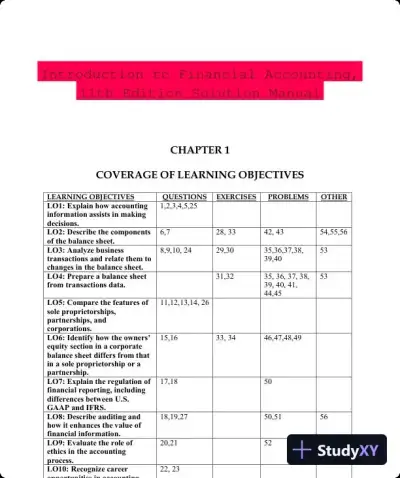 Textbook Guides
Introduction to Financial Accounting, 11th Edition Solution Manual
Accounting
524 pages173downloadsFeb 2025 Textbook Guides
Solution Manual For International Accounting, 4th Edition
Accounting
309 pages161downloadsFeb 2025 Textbook Guides
Solution Manual For Managerial Accounting, 7th Edition
Accounting
361 pages159downloadsFeb 2025 Class Notes
Class Notes For Advanced Accounting, 4th Edition
Accounting
149 pages159downloadsFeb 2025 Textbook Guides
Financial Accounting 6th Canadian Edition Solution Manual
Accounting
867 pages156downloadsFeb 2025 Textbook Guides
Accounting Theory, 7th Edition Solution Manual
Accounting
325 pages153downloadsFeb 2025 Textbook Guides
Financial Accounting, 9th Edition Solution Manual
Accounting
1024 pages134downloadsFeb 2025 Textbook Guides
Solution Manual For Fundamental Accounting Principles with Best Buy Annual Report, 19th Edition
Accounting
1391 pages132downloadsFeb 2025
Study this document with CramX
Once it is in your library, every tool can work from it.